Recommended Cameras
Fast Picks: For most people with general needs, I suggest the Canon EOS R10 and the RF 18-150mm IS STM lens as an ultralight system that takes the same great pictures as my far more expensive pro cameras. The R10 is so light it feels like a toy, has a built-in flash and takes superb pictures, the best of all worlds.
The EOS R50 is less expensive and takes exactly the same pictures, but has a dimmer finder and lacks many convenience features. Get the R50 if you need to save money and don't mind some minor inconveniences; see Canon R7, R10, R50 & R100 Compared for a complete guide to picking the best for you from among several similar cameras.
I recommend this line of APS-C (smaller sensor) Canon cameras to all my friends and family. I've shot just about every camera ever made, and as of 2025 this line of cameras is my very favorite for anyone looking for a "good" camera.
No, you don't need a Full Frame camera to take great pictures. 20 years ago digital cameras were in their infancy and it made a difference, while today the only real difference in pictures from the APS-C cameras above and Full-Frame is that there is more in focus with the APS-C cameras because the shorter focal lengths needed for the same angle-of-view for any given picture will have a greater depth-of-field. The only real reason for Full-Frame cameras today is to show off that you have a fancy camera and don't mind carrying a lot more weight just to get less in focus (shallower depth-of-field). See also Crop Factor.
Introduction Brands iPhone The Best Camera
Telephoto Lens More Great Cameras
Serious DSLR Camera People Camera Pocket Camera Underwater
Nikon Lenses Canon Lenses Flash Tripods Bags
Costlier Cameras 35mm Cameras Flashlight Gifts
Filters Straps Flashlights Labs
Carry Less Assembling a System
Where to get your camera. Never buy at retail!
This all-content, junk-free website's biggest source of support is when you use any of these links to approved sources when you get anything, regardless of the country in which you live.
When you click on links to various merchants on this site and make a purchase, this can result in this site earning a commission. Affiliate programs and affiliations include, but are not limited to, the eBay Partner Network. Thanks for helping me help you! Ken.
Best Cameras for Landscapes, for Sports, for People & etc. This page covers the best cameras overall for general use. Best Cameras suggests the best cameras by specific kinds of shooting.
January 2025 Better Pictures Canon Sony Nikon Fuji LEICA Zeiss Hasselblad All Reviews


|


Introduction top
I own and shoot just about every kind and brand of camera.
I've been shooting for over 50 years, ever since I was a very little kid, so I've seen and shot it all. Not to brag, but I really do shoot every day and you can see my images in my gallery. Beware random people handing out camera information as the people doing the most talking usually do the least shooting, and thus have the least experience and are the worst people from whom to take advice.
Before taking camera advice from anyone look at their portfolio to see if they actually know how to use a camera, or if they just like to spew facts. This is important because talkers lack the perspective from which to know what really matters in a camera, which is how the pictures look in real-world shooting and how easy a camera's ergonomics make it to get those pictures.
Ask any genuine full-time career pro shooter and he'll tell you that a camera's only job is to get out of the way between him seeing the picture and taking it. The only hard thing in photography is seeing the picture in the first place; the camera's job is to snap it and move on. Technical specsand features have nothing to do with picture quality — but hobbyists, retail stores, camera makers and everyone with an interest in selling you (or bragging about their) expensive camera will tell you otherwise. If you have a question, ask me directly; obviously I love to help.
Brands top
Cameras are always evolving. I started shooting Nikon back in 1983 when they had already ruled the world of news and sports for 20 years. Nikon was king from the dawn of practical DSLRs in 1999 until serious mirrorless came along in 2018, at which point Canon surpassed them.
Sony was popular at the dawn of mirrorless ten years ago when the Sony A7 was all we had in full-frame mirrorless, but I don't recommend Sony today because of their awful ergonomics and horrible menu systems. I also don't like Sony's real-world color rendition as much as I love the great results I get from my Nikons and Canons, so while Sony is popular I don't recommend them.
Nikons take photos as great as do Canons, but I prefer Canon's ease-of-use. Canon has been the best-selling camera brand since about 1992 for good reason: they make the most great cameras and just as importantly they're a better, bigger company with much better customer support. If you ever get stuck, just phone (800) OK-CANON and someone genuinely smart and knowledgable will help you out.
I'd pass on Fuji altogether. While I love my X100F, Fuji cameras have become more of a cult for people pretending that they're in the dark ages shooting film as if it was cool or some sort of religion. Like old film, I dislike the dull color rendition I get from my Fujis. Fuji's menu system is even worse than Sony (see also All Menu Systems Compared). I hate shooting with my Fujis; their dull color rendition is only good for people pictures and while they shoot well once you have them set up, it's maddeningly difficult to set them up in the first place.
LEICAs have always been expensive. 100 years ago they were great little picture takers on 35mm film, but ever since rangefinder cameras went obsolete in the 1960s (superceded by Nikon's 35mm SLR system), LEICAs are simply jewelry for men. They are well-made and expensive trinkets mostly for people passionate about nice cameras rather than those who care about making great pictures. Real LEICAs, which are only the LEICA M system, are clumsy to handle, don't have any zoom lenses, don't have any lenses longer than about 135mm, you usually can't actually see through the lens to see your precise composition or framing and they can't focus more closely than about 2.5 feet (0.7 meters). This is why they went obsolete in the 1960s.
As of 2024 Canon just happens to make the best cameras there are if you're reading this page for my sage advice, which is why I recommend them so strongly below. No camera makers pay me anything, which is why I'm always so embarrassingly honest as you've just seen here.
Canon is unique today in being the only major maker who still makes most of their cameras and lenses domestically in Japan. Nikon, Fuji and Sony dump most of their production overseas — but don't sell their cameras for any less with the money they save themselves by offshoring jobs. While it may look like I'm a shill for Canon below, they won't even lend me a camera or send me a Christmas card. I recommend so many of their products because as of 2024 they just happen to make the most brilliant cameras and lenses, and stand behind them as they should.
Click any of the links below for very detailed reviews of every camera and lens I mention.
If you find this helpful, what does pay the bills around here so I can keep handing out objective, seasoned and free information is when you use any of these links to approved sources when you get anything. Thanks!!!
iPhone top

iPhone 17 Pro Max Camera Array.
Of course we all love our iPhones, and I love my iPhone 17 Pro Max probably more than any other camera ever for its universal ability to shoot anything, anywhere, anytime. No camera wakes up and gets the first shot faster and better for breaking news, action, family and other photos. No other camera so universally can sort, edit and send photos right from the camera as an iPhone.
iPhone is always my first choice for any kind of video because it has the best autofocus of any video camera, is able to tame difficult real-world lighting with Apple's magic that uses HDR and all sorts of secret science to make videos simply look fantastic without needing any supplemental lighting. The cameras below might make better video if you're in Hollywood and have six trucks of lighting and three guys to keep the actors on their marks and pull focus according to the script (focus in Hollywood and network TV has always done manually to this day), while iPhone can do it automatically. The larger cameras below have inferior video autofocus because they're not as able to figure out where to focus, and also the physics of the larger sensor and lens formats below make it impossible for the larger cameras to pull focus as quickly as the tiny optics of the iPhone can.
Of course for many things the dedicated cameras below are still better, which is why pros still use them. If you need to shoot birds from a hundred feet away or need precise picture control or more than ten frames per second or specialized lenses, of course the regular cameras below are a great addition to your phone.
The Best Camera for Most People top
What camera do I suggest for my friends and family? What's the best camera for every kind of photo situation, but still super lightweight and inexpensive?
If you have to ask, the inexpensive and lightweight Canon EOS R50 is the best camera for normal people who want great pictures rather than hobbyists who are more interested in owning a fancy camera for its own sake:
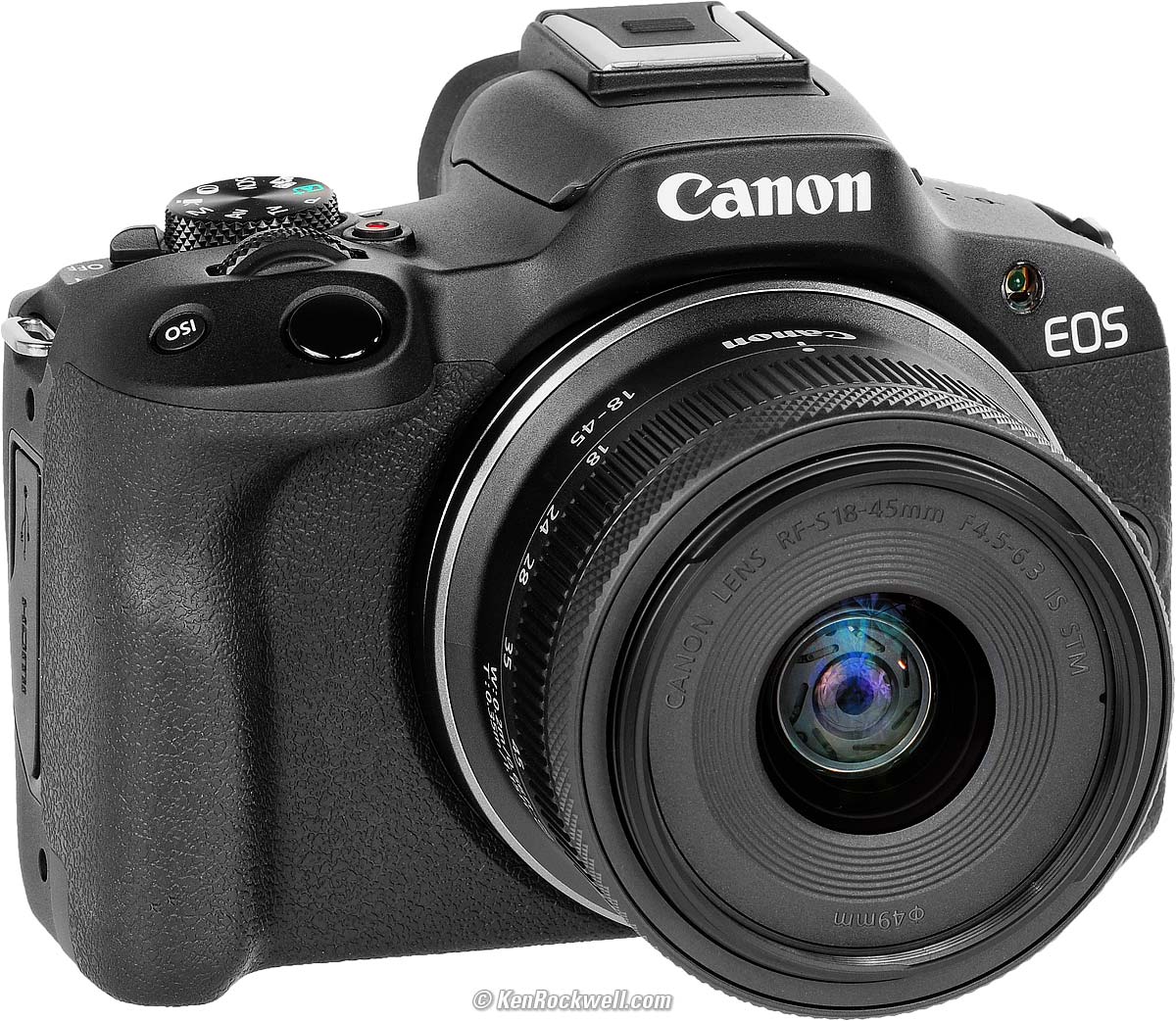
Canon EOS R50 (24 MP APS-C @ 15 FPS, 13.2 oz./375g with battery and SD card) and RF-s 18-45mm IS STM. bigger.
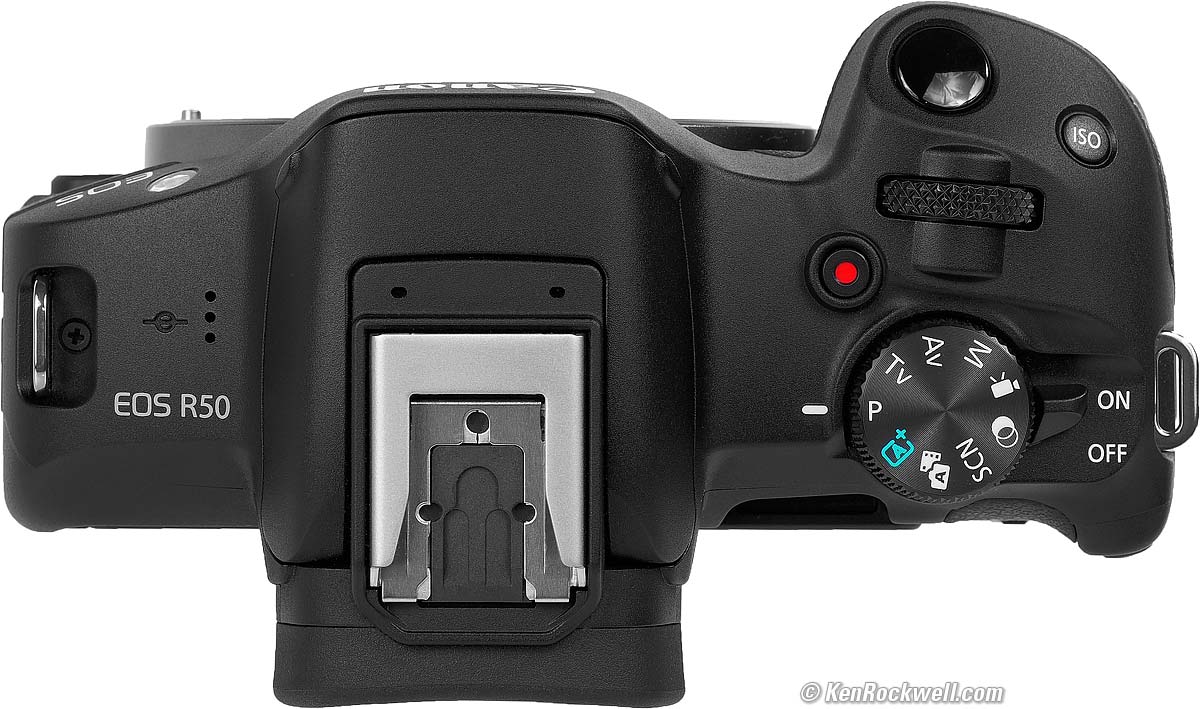
Multipin digital shoe. Use the AD-E1 Adapter to use traditional flash. bigger.
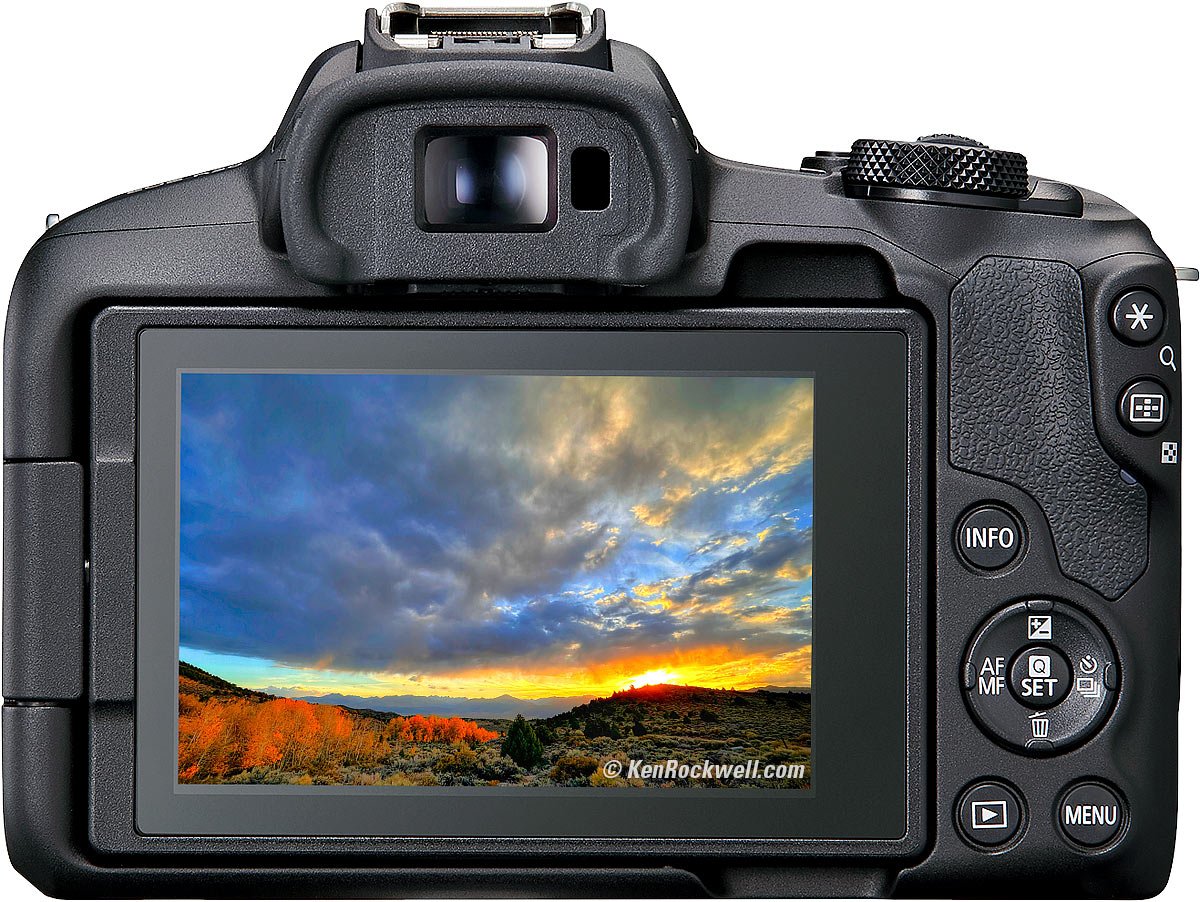
The Canon EOS R50 is so light it feels like a toy, while it gives me the same quality images as my much heavier pro cameras. It doesn't feel like the photo powerhouse it is, but look at the images I get from it. Its picture quality and ease of use astound me; every one of my shots is sharp and well-exposed, better than my hit rate with a much heavier and more expensive camera like the $4,000 Nikon Z8. Of course you still need to know how to take great pictures, while assuming you do, the R50 never disappoints.
You can pay a lot more, but no camera does anything significantly better than the R50 for most people's photography. Especially if you have kids in sports, a camera like the R50 is a huge step up from an iPhone because it can zoom-in (especially with a telephoto lens) and focus fast enough to track all the action, as well as shoot at 15 frames-per-second (FPS) to catch fast action.
You can pay more for fancier cameras I use for my more serious work, but the pictures are the same. You're paying more for more dedicated controls to make advanced settings easier for experts who use the more advanced settings, paying for tougher build quality for people who abuse their cameras all day, every day for a living and for extra features most people don't understand and are only useful in special situations. Expensive cameras make it easier for experts to adjust advanced settings and may offer some odd features few people understand, but the results ultimately are the same. The extra cost and size, weight and expense are to make it more fun for people who shoot all day, not for picture quality.
No camera takes better pictures than an R50. If you know what you're doing you'll get fantastic photos with an R50, and if you don't you'll get crummy pictures with any camera.
The reason guys like me pay more for fancier cameras isn't for better pictures; it's for more controls and options that let us few who actually know how to use all these controls to get to them faster. The R50 has the same adjustments, just that you'll more often have to use a menu to set them instead of a dedicated knob or button. If you shoot all day every day as I do, it's worth it, otherwise, there's no reason to pay more since most people have no idea what these other settings do.
Sure, you can buy fancier cameras, but you don't need to unless you want to. The R50 is the most basic camera sold today, and it works wonders. Sure, feel free to pay more as I'll expand below (and many people do), but you're only buying more durability or convenience, not better pictures. Better pictures come from knowing how to take better pictures, not from a better camera.
Better cameras simply make it easier for people like me who are virtuosos to make our pictures, while for normal people who have no idea what all the settings do, the R50 is plenty of camera.
R50 Body: I'd get it at B&H, at Adorama, at Amazon and at Crutchfield, or get it used if you know How to Win at eBay.
R50 with RF-S 18-45mm IS STM: I'd get it at B&H or $799 at Adorama, at Amazon and at Crutchfield, or get it used if you know How to Win at eBay.
R50 with RF-S 18-45mm IS STM, DM-E100 mic & HG-100TBR grip-release-pod: I'd get it at Amazon or at B&H, at Adorama or at Crutchfield.
R50 with RF-S 18-45mm IS STM and RF-S 55-210mm IS STM: I'd get it at B&H, at Adorama, at Amazon or at Crutchfield.
WHITE R50 Body: $679 at B&H, at Adorama and at Amazon.
WHITE R50 with white RF-S 18-45mm IS STM: $749 at B&H or $799 at Adorama and at Amazon.
When you click on links to various merchants on this site and make a purchase, this can result in this site earning a commission. Affiliate programs and affiliations include, but are not limited to, the eBay Partner Network.
Personally I prefer getting the R50 body-only and the RF-s 18-150mm lens separately because the 18-150mm replaces both the RF-s 18-45mm IS STM and RF-s 55-210mm IS STM and eliminates the need to carry and swap between them; with the 18-150mm a flick of the wrist gets you whatever setting you need without missing photos while changing lenses.
The R50 body-only and the RF-s 18-150mm lens is really all I'd need for just about anything. Don't let people talk you into buying more if you don't understand exactly why you need it. Don't shop at retail; they do their best to sell you more cameras and lenses than you need. You also don't need any sort of service or repair plans; cameras don't break unless you break them and Canon has great customer service and repair support if you ever need it at (800) OK-CANON.
Super Telephoto Lens top
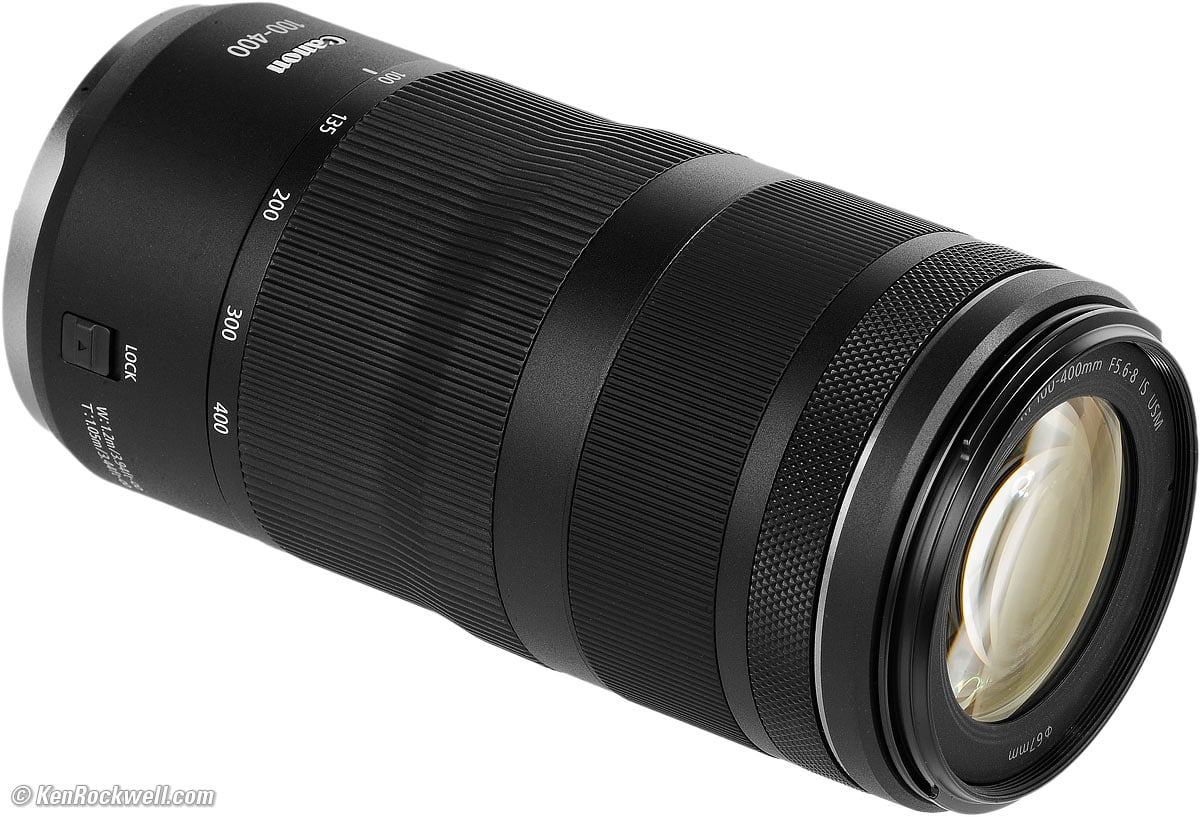
Canon RF 100~400mm IS USM (67mm filters, 22.4 oz./635g, 2.9~4'/0.88~1.2m close focus, 0.41× macro ratio).
Need an extra-long lens for sports or birds and wildlife and airshows beyond what the RF-s 18-150mm lens gets? We're in luck because Canon also uniquely makes an extraordinary ultratelephoto zoom for the R50 that's pocket-sized, sharp, ultralight and nearly free.
Get the RF 100-400mm IS STM. I got mine at B&H, and I'd also get mine at Adorama, at Amazon or at Crutchfield, or used at eBay if you know How to Win at eBay.
If you want to pay a lot more the RF 100~500mm IS USM (77mm filters, 48.3 oz./1,370g) is a much larger lens that works better in lower light or if super-telephoto and landscape shots are a very serious thing for you, but the RF 100~500mm IS USM is so big you might not want to carry it with you all the time. Having the RF 100-400mm IS STM with you takes much better pictures than an RF 100~500mm IS USM left back in the car.
Even Better Inexpensive Cameras top
The EOS R10 is an even better version of the R50 and uses the same lenses, if you need or want its extra features. It may be more convenient for a more skilled user, while the pictures come out the same.
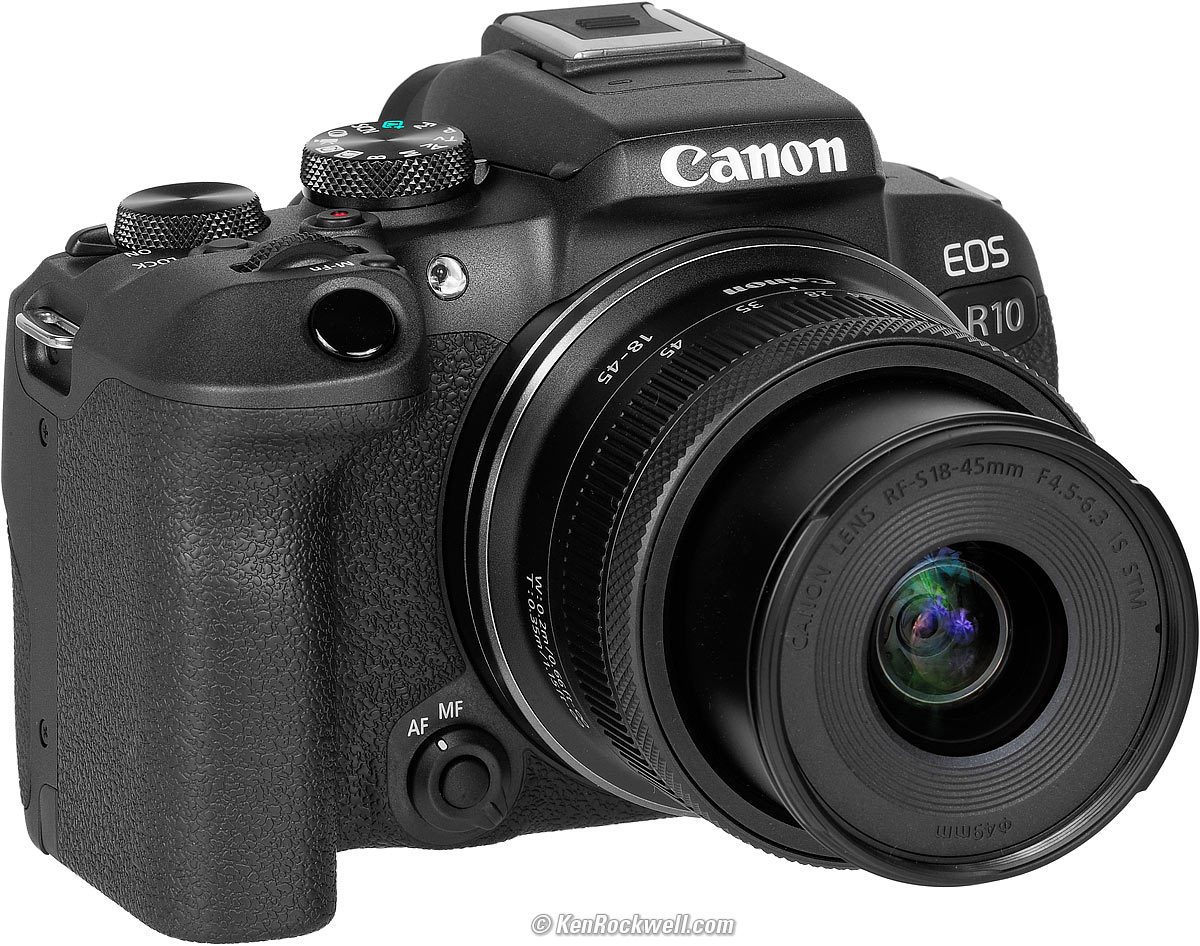
Canon EOS R10 (24 MP @ 23 FPS, one SD card slot, 15.0 oz./424g with battery and SD card) and Canon RF-s 18-45mm IS STM.
The EOS R10 adds a rear control dial, a dedicated AF/MF lever and faster frame rates for action.
My favorite addition in the R10 compared to the less expensive R50 are the C1 and C2 preset camera-state memory recalls on the top mode dial:
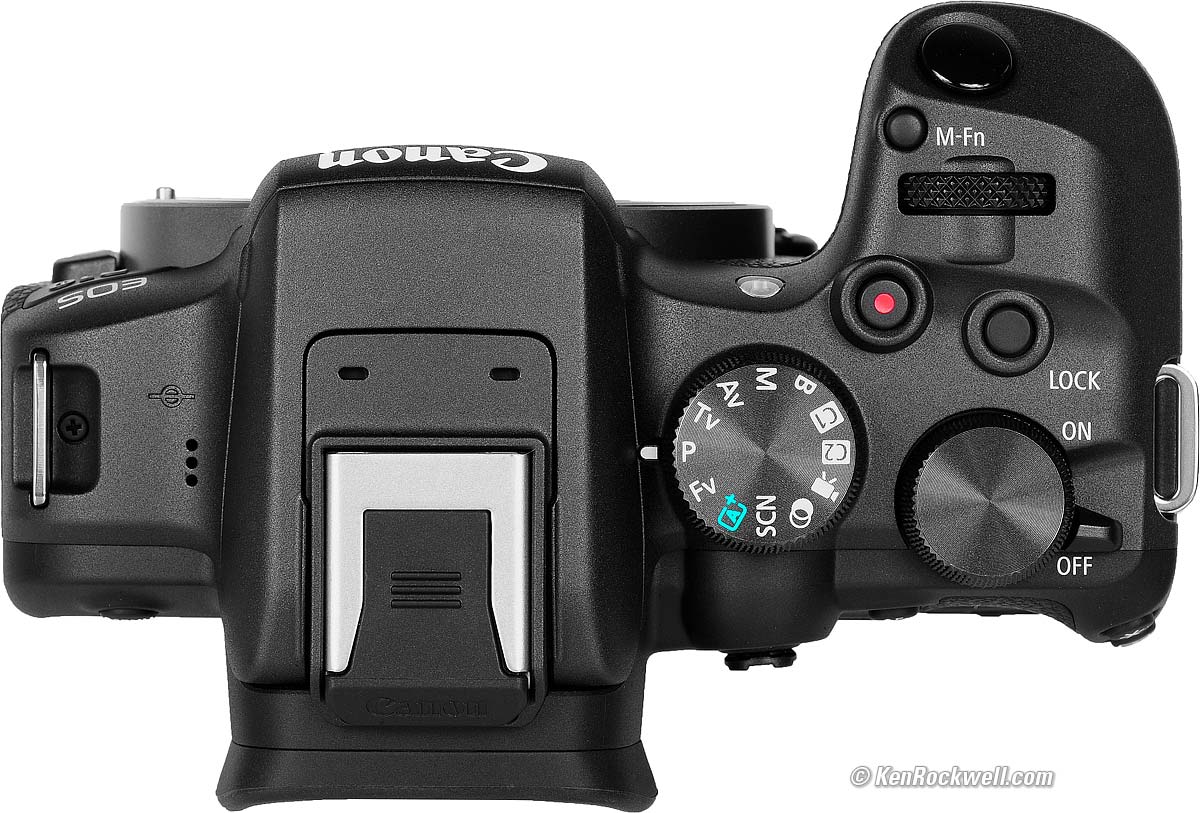
Top, Canon EOS R10. bigger.
The C1 and C2 settings let me save everything about my camera into each of them, and recall all these settings with one click. I use C1 for landscapes and C2 for sports, each with different ISO and autofocus and picture control and screen brightness settings and more.
With C1 and C2 on that dial I can be ready to shoot each sort of situation exactly as I've set before, saving me loads of time fiddling with all the settings as I have to in the R50 — but if you don't know or use all these settings, the C1 and C2 positions don't do anything for you.
Picture quality and light sensitivity of the R10 is identical to the R50. As far as I know they have exactly the same image sensor.
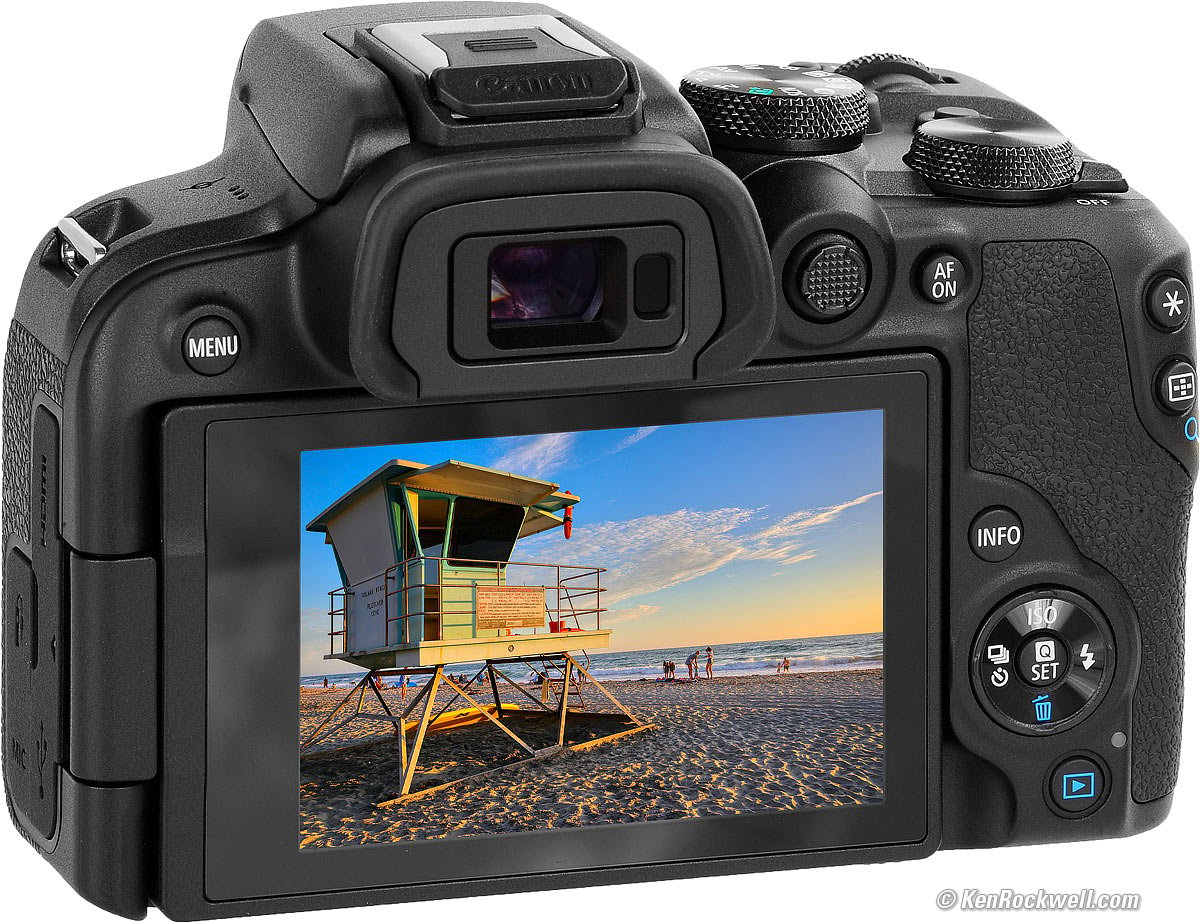
Back, Canon EOS R10. bigger.
R10 body-only: I got mine at B&H, or I'd get it at Adorama, at Amazon and at Crutchfield. They're also at eBay if you know How to Win at eBay.
R10 & 18-45mm IS kit as shown: I got mine at B&H, or I'd get it at Adorama, at Amazon or at Crutchfield.
R10 & 18-150mm IS kit as recommended: I got mine at B&H, or I'd get it at Adorama, at Amazon or at Crutchfield.
Canon EOS R7 top
The EOS R7 is Canon's state-of-the-art APS-C camera. It adds a second card slot, a third C3 memory position on the mode dial, slightly more resolution, a faster 30 FPS frame rate, a self-stabilized sensor and, as of this writing in summer 2023, it's the world's only camera with an astonishing self-leveling sensor! Its amazing sensor actually rotates to keep pictures level with no resolution-robbing resampling needed!
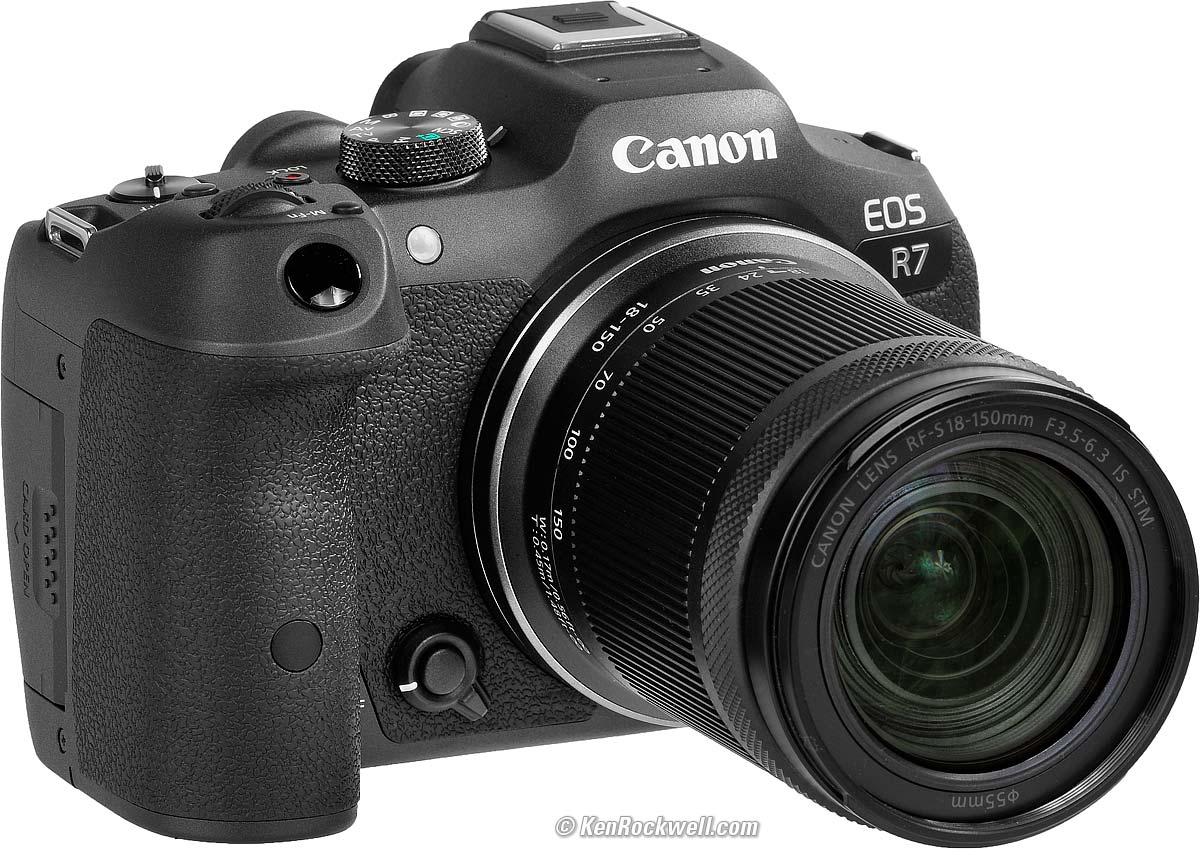
Canon EOS R7 (Auto-Leveling self-stabilized 32 MP sensor, 30 FPS, two SD card slots, 21.6 oz./611g with battery and one SD card) and Canon RF-s 18-150mm IS STM.
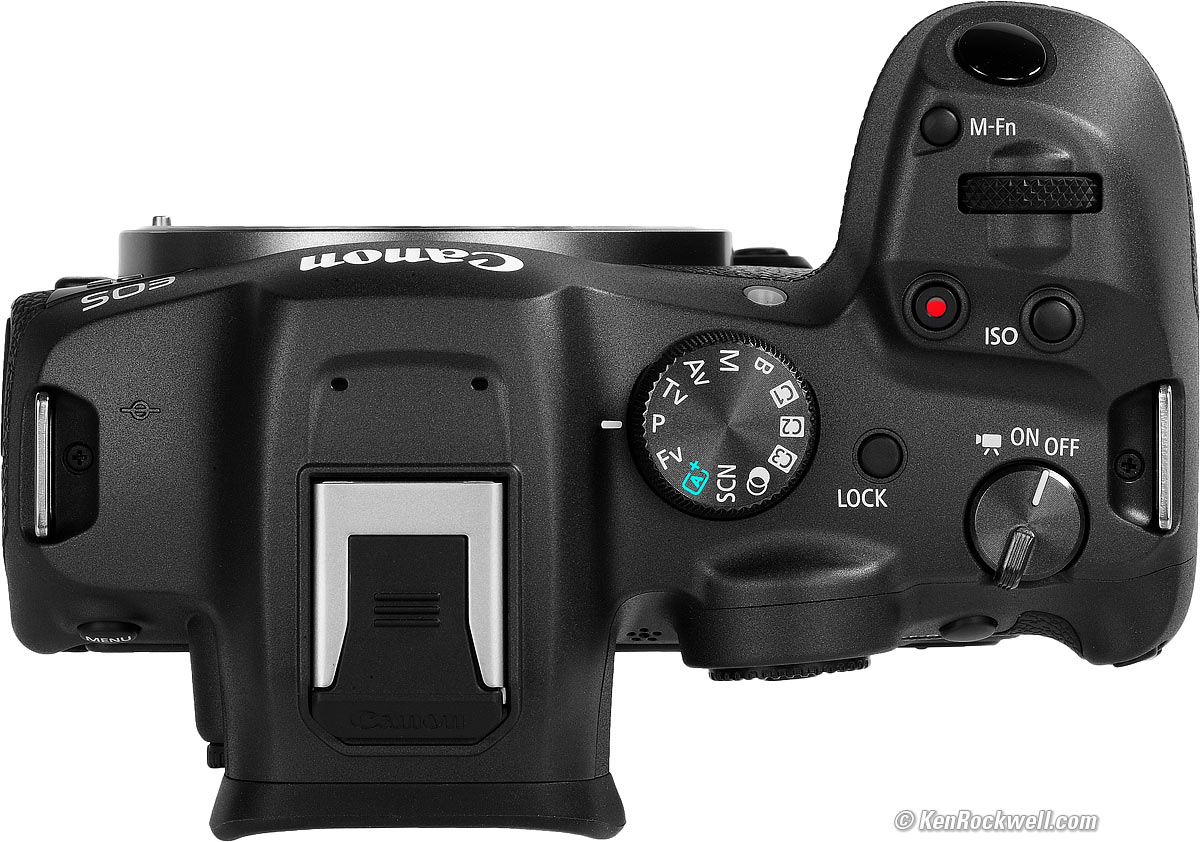
Top, Canon EOS R7. bigger.
At 30 FPS the R7 is twice as fast for action as the R50, and its self-leveling sensor means I no longer have to correct my crooked photos before publishing them. These features are all wonderful and I greatly appreciate them, but ultimately you'll get mostly the same images from the R50. The R7 has only slightly better low-light performance than the R50, for instance. The extra features are for the pleasure of the owner; they don't make much of a difference in the pictures, especially if you use it with lenses that are already stabilized, as are all of Canon's APS-C RF lenses.
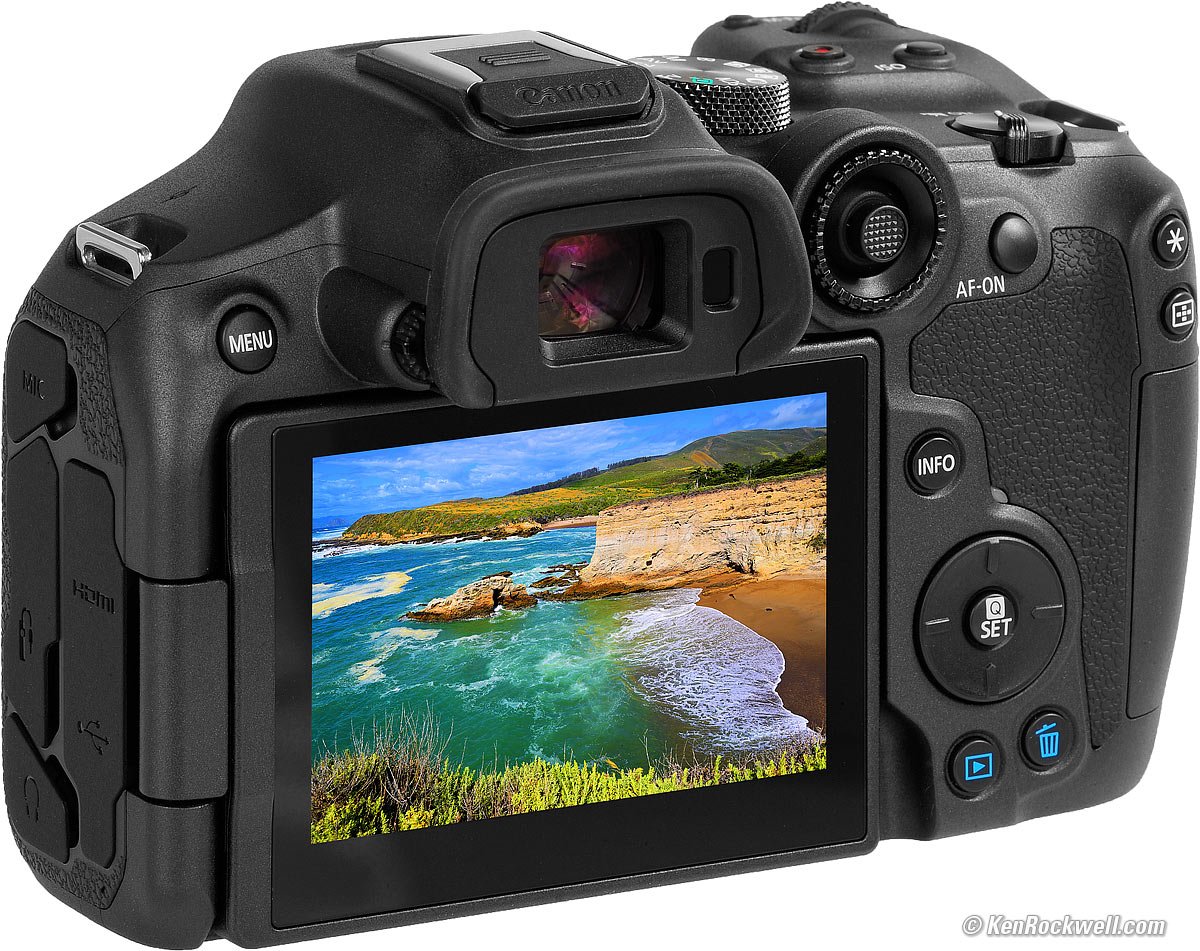
Back, Canon EOS R7. bigger.
R7 body-only: I got mine at B&H. I'd also get it at Adorama, at Crutchfield or at Amazon.
R7 & 18-150mm IS as shown and suggested: I got mine at B&H. I'd also get it at Adorama, at Crutchfield and at Amazon.
The Rest of My Recommendations Below top
I start with normal camera recommendations for normal people who just want great pictures, then get to suggestions for dedicated photographers, and end with great gift suggestions.
Click the links (or photos) for detailed individual reviews.
If you find this page helpful, you can help me keep helping you by using these links to approved sources when you get anything, regardless of the country in which you live. Most of these places ship internationally, and if you are outside the USA, B&H Photo Video even has a calculator which shows the final, total cost to-your-door including taxes, shipping and duties before you complete the order.
I've been buying my own gear from Adorama and B&H Photo Video since the mid-1970s and have had nothing but great service and the lowest prices, which is why I recommend them so highly. Using these links costs you nothing (and probably saves you money), gets you the same great service I've enjoyed myself, and most importantly, is what helps me keep adding to this website for everyone's benefit.
Cameras have nothing to do with taking great pictures. To take great pictures, you have to know How to Take Great Pictures. If you know what you're doing, all a better camera does is make it easier, faster and more convenient to take great pictures.
The pictures you take depend on you, not on your camera. Just as your signature is uniquely your own no matter what sort of pen you use, it's the same with pictures and cameras. If you want to take better pictures, your efforts are better spent learning how to take better pictures, not in buying new cameras.
Best More-Serious Cameras top
I need to rewrite all this. As of 2026 the Canon R7, R10, R50 or R100 are all any intelligent person needs for any sort of photo The old "full frame" cameras I consider obsolete today because the smaller APS-C cameras now take the same pictures much more easily — but people who want to sell you more expensive cameras will draw on old-wives tales from the days of film and DSLRs where the larger format mattered.
Today with mirrorless, the only thing full frame does better is if you love soft backgrounds. APS-C cameras retain more in focus, and are smaller, lighter and less expensive; and their lenses are also much smaller and lighter and less expensive - and take the sale pictures!
Flash more flash suggestions
While you're saving all this money over more expensive cameras, I suggest getting the Nikon SB-400 miniature external flash ($175 used). The D3500 and D7200 have built-in flashes, but this tiny external flash gives a lot more range, and most importantly, saves the camera's batteries and lets you shoot a lot faster because it recharges almost instantly after each shot. In-camera flashes drain the camera's battery and can take a long time to recycle after each shot.
Lenses more lens suggestions
For most things, the 18-55mm DX AFP VR included with the D3500 is all you'll ever need.
The best telephoto lens for sports, head-shot portraits and distant subjects is the new 70-300mm AFP VR DX. It's ultra sharp and focuses almost instantly. A less expensive choice would be a used Nikon 55-200mm VR.
If you want a do-everything lens that replaces both the 18-55mm DX AFP VR and the 70-300mm AFP VR DX, the 18-300mm is fantastic. The advantage of the 18-300mm is that you never have to change lenses, however the 18-55mm DX AFP VR and the 70-300mm AFP VR DX autofocus faster. I've shot billboards for McDonald's with an older version of the 18-300mm, and they put it on a billboard, so no worries about optics on any of these. All can take awesome pictures if you know what you're doing.
For low-light, no-flash shooting, I use the Nikon 35mm f1.8 lens (about $197) instead. It's what I use most of the time. I zoom with my feet, and prefer its low-light abilities compared to a zoom.
For action and indoor sports, full-time pros use the exotic huge 70-200mm f/2.8 VR FL mostly because it can take more of a beating, and it lets them shoot in dimmer light than the other lenses.
If you need wider than the excellent 18-55mm VR lens lens, the Nikon 10-20mm is a fantastic performer at a bargain price, but you have to know How to Use Ultrawide Lenses.
Best for People, Family & Travel top
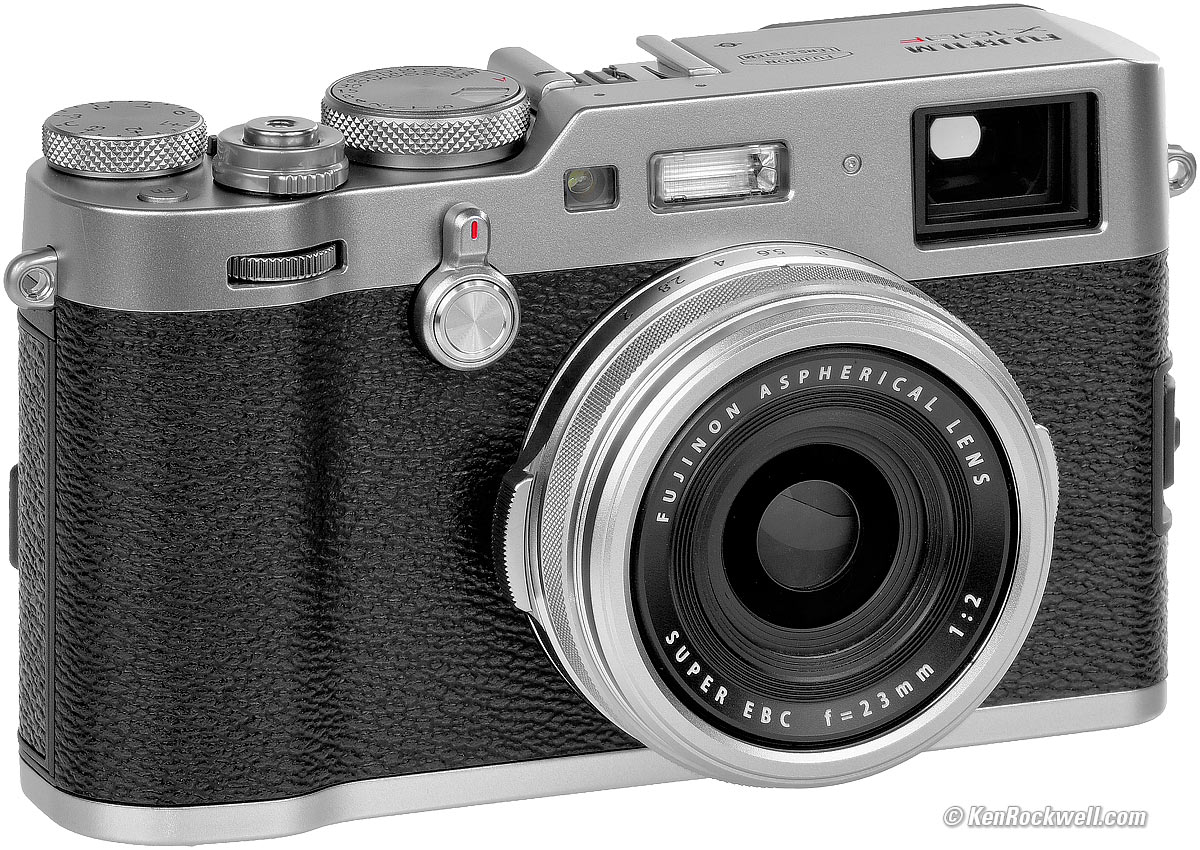
Fujifilm X100F. (16.6 oz./470g with lens, battery and card, about $1,200). enlarge.
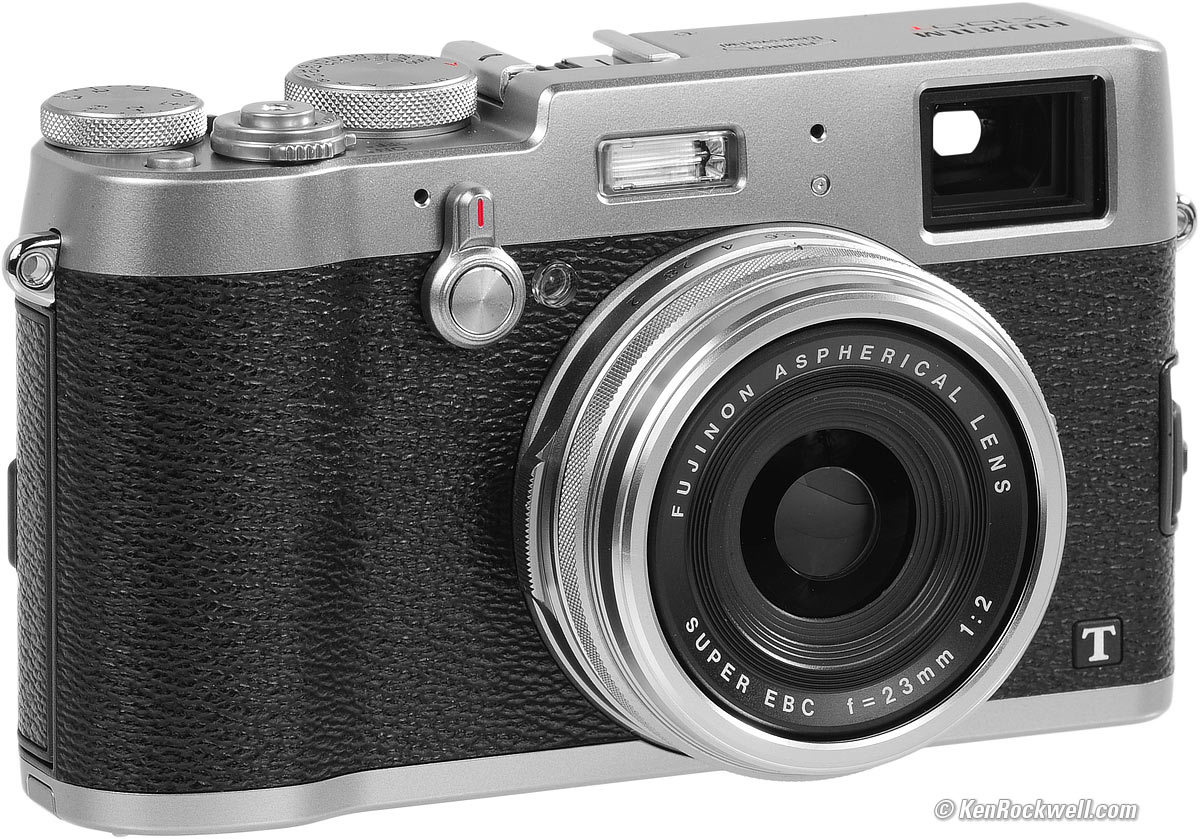
For carrying everywhere, for photographing people under any and every available lighting condition, for silent shooting and for macro, there is no camera that compares with the Fuji X100F. It's what I carry everywhere with my family. It's not as good as the Nikon D3500 for sports (no zoom) and not as good for landscapes (colors optimized for people, not landscapes), but for people photos in any light, the tiny X100F is extraordinary.
The X100F is also the very best camera available for new families, travel and vacation photography. It's best for families and people because of its unique ability to get great skin tones in any light, and great for travel because it's a full-featured camera in a very small package.
The X100F is the smallest and lightest serious camera available (half the weight of a LEICA and a fraction of the size and weight of a pro DSLR), and also gives the best results for people pictures under every sort of crazy light you'll find people being people. Its low-light, auto fill-flash, auto ISO, auto WB and color rendition under difficult conditions is far better than any of my Canons, Sonys, Nikons or LEICAs. Yes, I can get the same results after fiddling with my Nikon or Canon or LEICA for half an hour, but the Fuji X100F always nails the first shot in difficult light all by itself without fiddling, when means the Fuji gets my shot while I'd still be fiddling with one of the other cameras.
No camera captures life like the Fuji X100F, and it's so easy to carry everywhere around your neck since it's even smaller and lighter than the Nikon D3500.
All the pros I've talked to prefer their X100F to the LEICAs they used to shoot for reportage photography. The Fuji X100F is over 60 years ahead of the LEICA M10. The LEICA is great for nature and landscapes as I suggest below, but for the people shots that LEICA used to do best, today it's Fuji.
Last year's Fuji X100T is the same, minus a few pixels and with no nifty digital zoom feature. The older Fuji X100S lacks the very helpful facial recognition feature and has no silent electronic shutter. The oldest Fuji X100 is 80% as good as the X100S, just slower. If money matters, get a leftover or used older model; they all make the same great pictures, but may take longer doing it.
World's Best Pocket Camera top
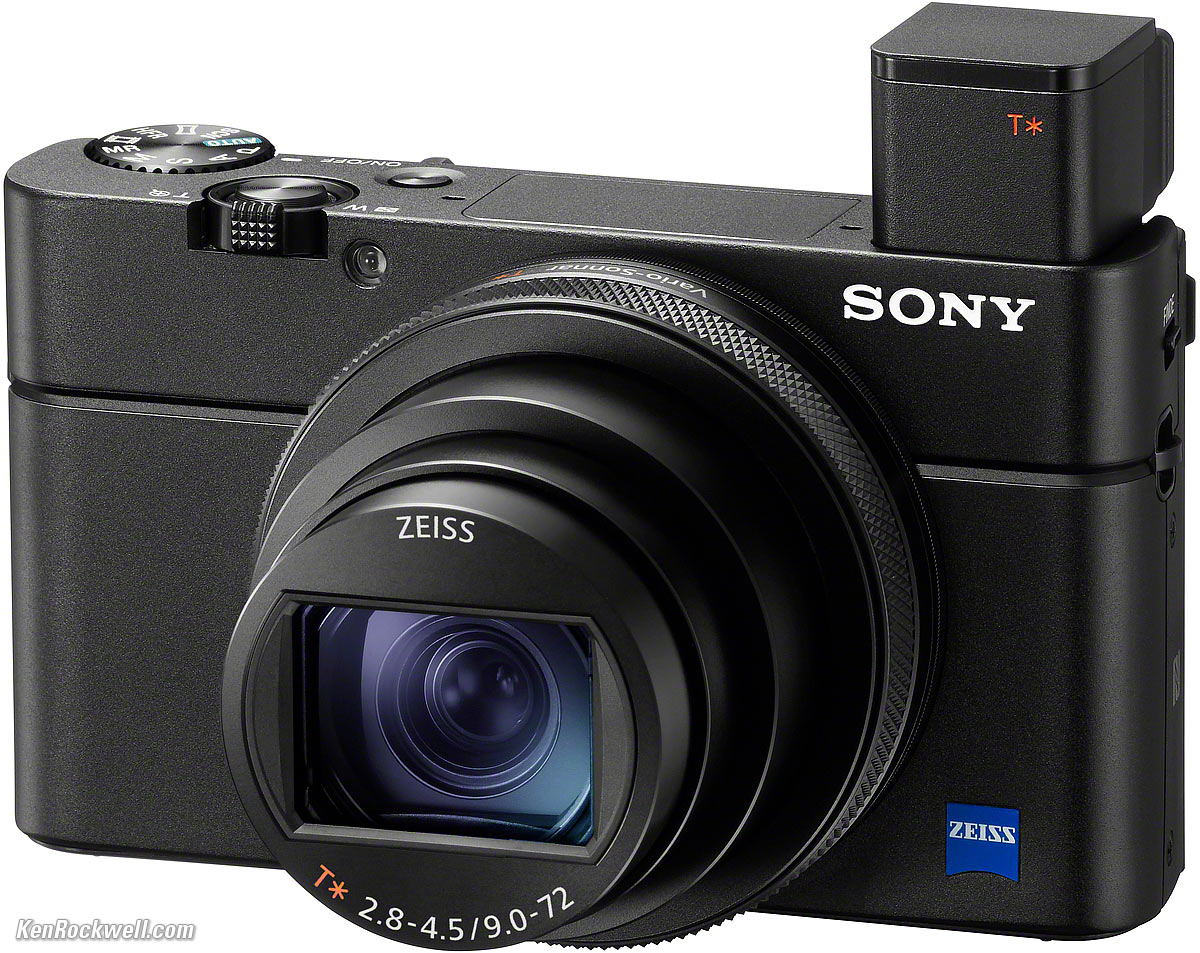
Sony RX100 Mark VII with its finder popped-up. bigger.
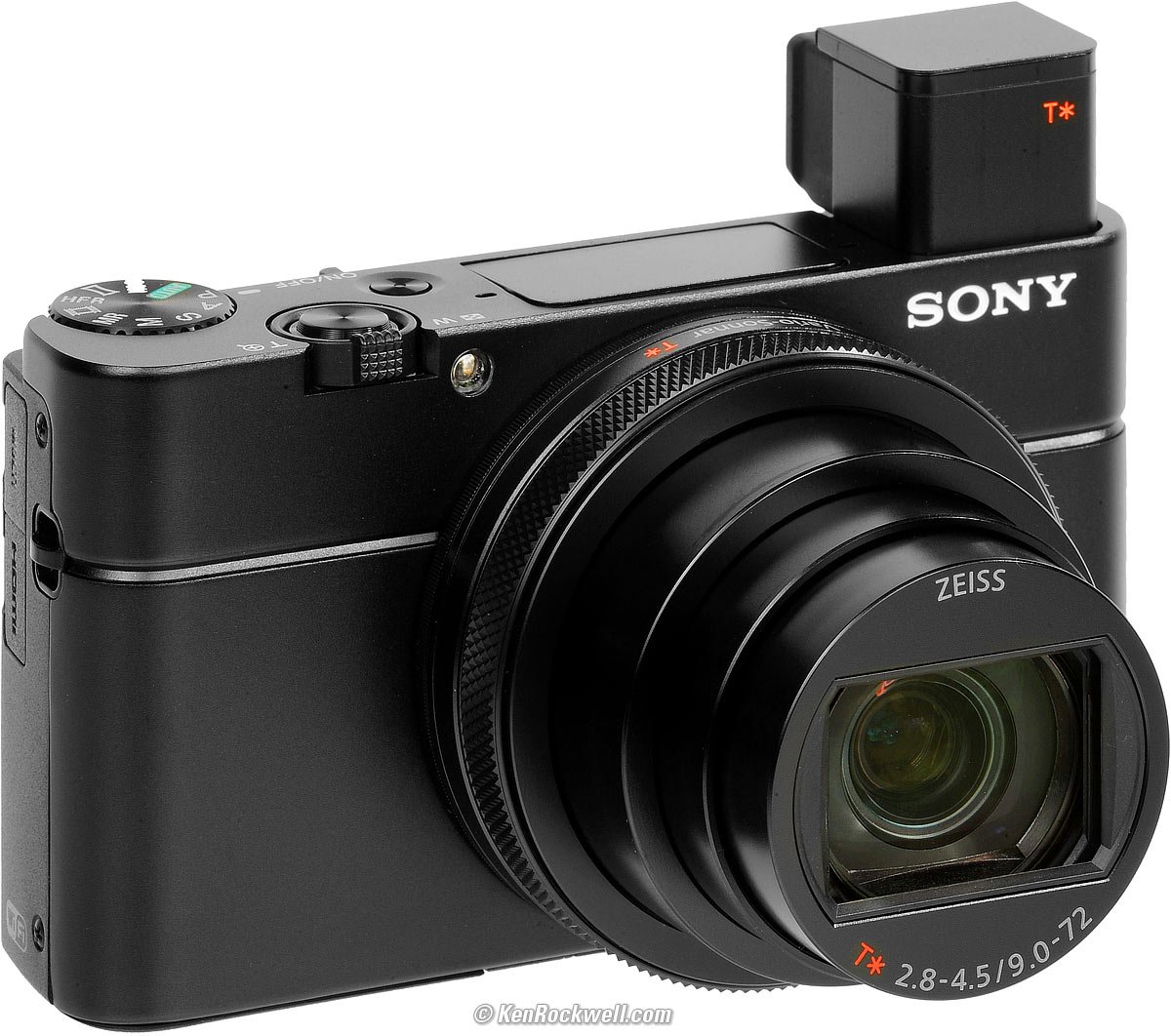
New as of 2018, the RX100 Mark VII is head and shoulders above other pocket cameras because it works essentially instantly, it has a zoom lens with a huge range and its pictures look fantastic.
See its review; it's extraordinary.
This Sony has a much smaller sensor than most of the other cameras on this page and therefore it's picture quality isn't quite as good if you need to make 3-foot-wide prints or shoot in darkness, but otherwise for every other use its pictures look fantastic, especially for photos of places and things — and it's smaller than every other camera here.
The Nikon and Canon cameras look great for everything, while the Fujifilm X100F is optimized for people photos. The Fujifilm X100F is a somewhat bigger camera with a bigger sensor that goes around your neck and has a faster lens than this Sony (fixed f/2 versus a variable zoom that's usually about f/4), while this little Sony excels for fast autofocus and brilliant colors for photos of places and things.
Take the Fuji for better results in low light, or take the Sony if you need a zoom lens and are shooting in better light.
The earlier RX100 Mark VI, RX100 Mark V, Sony RX 100 Mk IV and RX 100 Mk III are also excellent, with a lens better for use in no light but doesn't zoom anywhere near as close. See my reviews at those links and All Sony Cameras Compared for the specifics.
Best Underwater Camera top
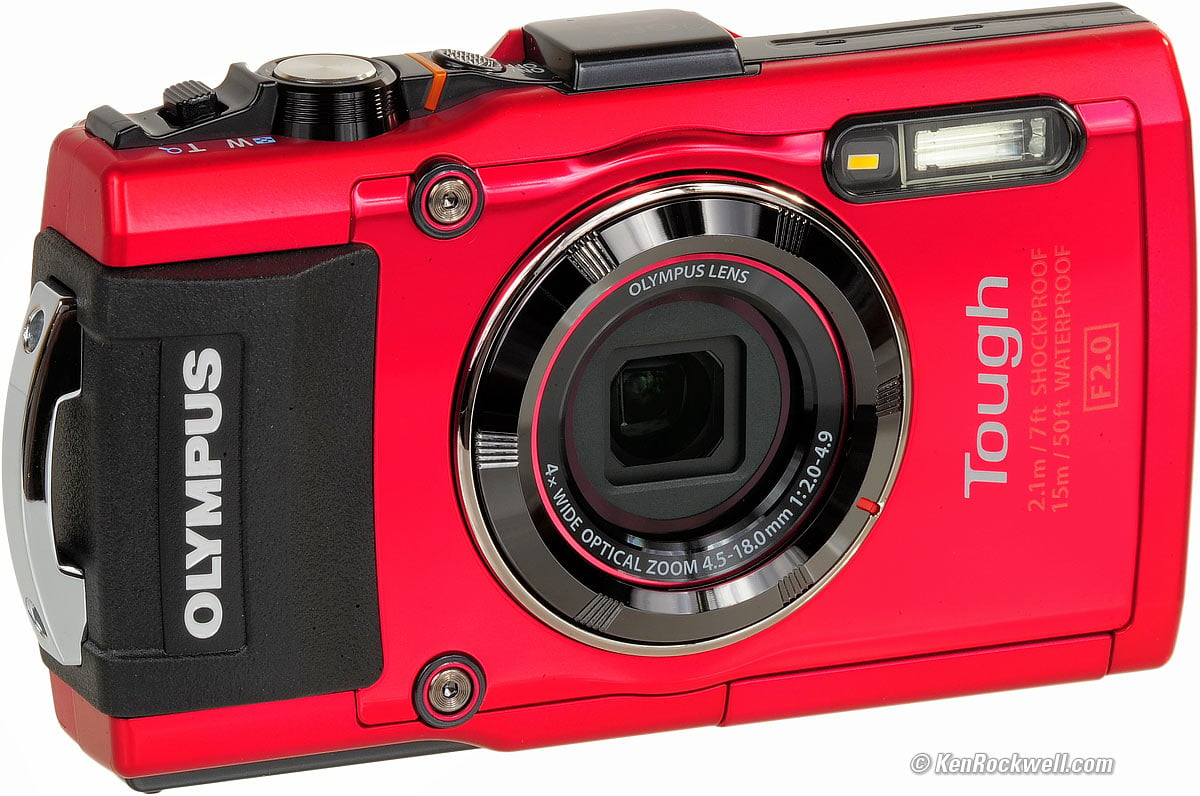
Olympus TG-4 (rated waterproof to 50'/15m, 25~100mm eq. f/2~4.9 zoom, 8.6 oz./243 g. with battery and card, about $349).
The TG-4 is a great little camera for stills and video in or out of the water. It takes abuse like a champ. The newest model is the TG-7.
Flash top
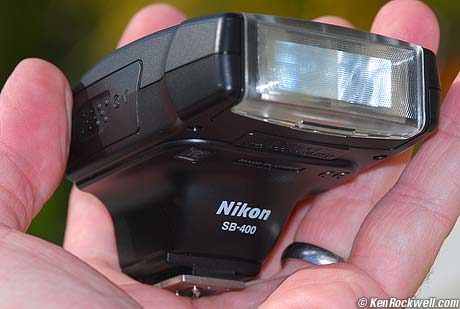
Nikon SB-400, about $175.
Nikon
Built-in flashes are excellent, but can't be pointed to bounce off the ceiling to improve your indoor photos. I own more expensive flashes, but I almost always use my SB-400 instead.
Even if you don't bounce it, the SB-400 lets you shoot faster since it recharges much faster than the built-in flash. I use my SB-400 even on my more expensive Nikons. It's that good.
If you want a larger flash to get more range or to bounce sideways, the Nikon SB-700 is my favorite. It's still reasonably sized.
The huge SB-5000 is too big unless you really need all that power as a full-time journalist or or sports shooter.
Canon
For Canon, my favorite daily-use flash is the small 320EX, or the older Canon 220EX.
If you want a larger flash to get more range, the Canon 430EX II is my favorite. It's smaller and easier-to-use than bigger flashes and just works great.
The huge Canon 600EX RT is intended for full-time journalist or wedding shooters who use several of them in multiple portable flash setups.
Straps top
I never use the strap that comes with the camera.
See Straps for strap suggestions.
Tripods top
Complete Tripod & Head Sets
With a digital camera with Image Stabilization or VR, there's no need for a tripod. I only use a tripod for very long time exposures made at low ISOs.
My recommendation on tripods is not to bother with one, or if you must, get something so small and light that you won't mind carrying it. Even if it seems wiggly, it's still good enough to hold your camera so long as you're not trying to wiggle it while you're taking the picture. So long as it's strong enough to hold up your camera, it's strong enough. A tripod left behind because you don't want to carry it is just getting in the way.
When I do use a tripod, I use the lightest one I can find, a $55 Dolica GX600B200 which I always carry in my trunk. It's all-metal, and lighter than any of the far more expensive brands that advertise like crazy, only 2.5 pounds total for head and legs. Companies that spend money on advertising and sponsoring big-name photographers aren't spending that money on making me a better tripod, so I'll stick with Dolica where we get a much better tripod for less money. (When looking at more expensive tripods, remember that the dollar and weight specifications are usually only for a head or for the legs sold separately.)
The Dolica GX600B200 has padded, adjustable-angle legs with rubber feet and or spikes, and includes a ball-head with a quick-release, a compass, a level, a center column with hook, and a nice padded shoulder-strap case in its low price!
The Dolica GX600B200 is a complete system, complete with loads of nice extras (like the case) usually sold separately with more heavily-advertised brands.
My Dolica GX600B200 is all I usually carry with me, and I use it with its included head. No, it's not the sturdiest if I'm going to bang on it during exposure, but I don't jiggle the camera while shooting and this way I need not lug a heavier tripod. Done.
The key is to have a tripod light enough and in a convenient case so that we'll actually take it out and use it. Heavy brand-name tripods left back in your trunk, home or hotel are useless. It's easy to throw the padded Dolica case over my shoulder when the light fades so I have the tripod with me.
You don't need to spend more on a tripod, but go ahead if you prefer. Unlike digital cameras, tripods last a lifetime. The first cheap tripod my dad bought me when I was 11 years old still works great, and my exotic French-made Gitzo G1227 carbon fibre I bought in 1995 for $500 for just the legs also continues to work flawlessly every day. Don't skimp on a tripod; just don't think that paying more takes better pictures. Get what you want and it will serve you a long time.
Tripod Heads
The Dolica GX600B200 comes with a head. When you buy fancy tripods they usually come as just legs, and you have to buy a head to go with them separately.
Tripod heads and legs all interchange between brands. They all use ⅜″ × 16 TPI threads regardless of how big or small.
Not a bargain, but I love my Novoflex Mini MagicBall Head. Quick releases are a pain; I prefer the instant access and simplicity of my MagicBall and its thumbscrew. I use it for traveling light.
I use a huge Bogen Manfrotto 3275 410 Geared Head on my big Gitzo G1227 in the studio and with huge telephoto lenses for its ability to point and level precisely, and to get exact framing. I use a geared head for all my serious photography.
Mini Tripods
I don't bring tripods on vacation because I'm trying to relax and have fun. I shoot every day, so on vacation I take as little as possible, and as I said above, I rarely need a tripod.
I do however always throw a tiny tripod in my bag just in case:

Tropical Storm, Bahamas. bigger.
If I hadn't brought along a mini tripod on vacation, I'd have missed this shot which graces my home page as one of my greatest works of all time. This is one of many one-second exposures made to catch a random thunderbolt and be long enough to expose the sky and foreground properly.
If all I'm bringing is a Pocket Camera I'll bring my tiny Adorama travel tripod that weighs about an ounce. It lives in my suitcase all year and I forget it's there until it saves the day (or night).
If I'm taking a big camera on vacation, I'll bring my amazing little Oben CTT-1000 that weighs less than a pound and does everything. I leave my Oben CTT-1000 in my camera bag all the time just in case.
Filters top
I prefer to leave a Hoya UV filter on every lens to protect it from damage.
I rarely carry a graduated neutral-density filter, which I use only for shooting into adverse light like a sunrise or sunset where I'm trying to hold detail in both the bright sky and dark foreground.
I rarely use a polarizer, and when I do, it's to cut through long-distance haze. The best polarizers on Earth are the Hoya Polarizers, which come in many different versions.
I prefer the Tiffen HT graduated filters. They are also expensive, but I'm still using the Tiffen grads I bought back in the 1990s as well.
Filters last forever; don't be cheap.
More at Filters.
Advanced Lenses top
Low-Light Far-Away Wide-Angles Do-It-All
You can stop here. You don't need any more lenses. The lens that came with your camera is all you really need.
The Nikon D3500, its kit lens, and maybe a separate flash, are all anyone really needs for anything. If you want to go whole-hog, I see no reason ever to need to buy anything other than the DX Dream Team lenses.
I go on vacations for a week at a time with my D7200, one lens and an SB-400 flash, and never miss anything. In fact, I love not having to carry more gear!
If you have special needs, or need a lens for a camera which sells without a lens, keep reading.
Long term, it's always better to spend money on lenses instead of digital cameras. Any of these lenses will work great on any fancier camera. Cameras drop in price and go obsolete every year, while lenses can stay current for decades, and their prices usually go up.
Low-Light without Flash top
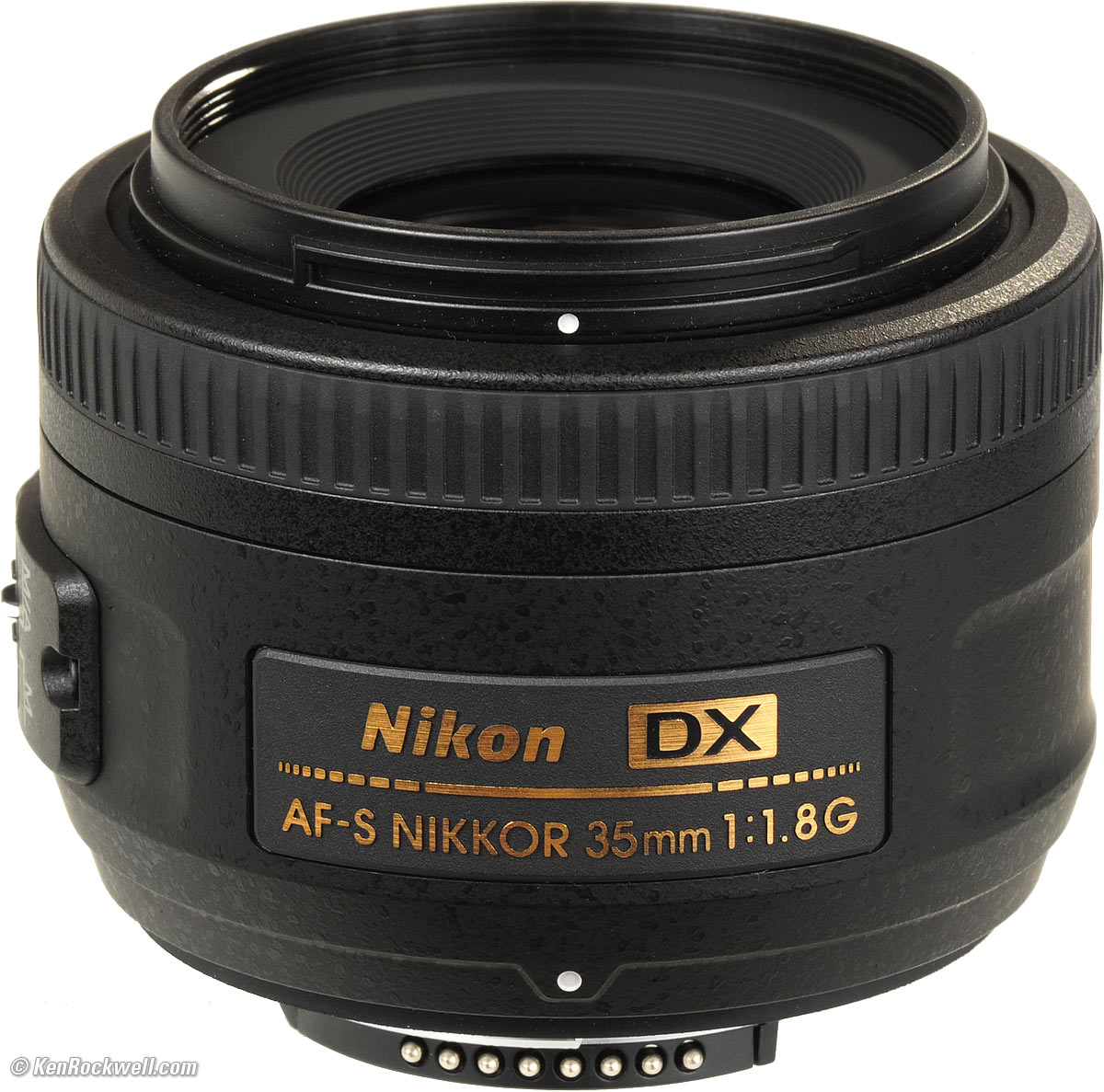
Nikon 35mm f/1.8 AF-S (52mm filters, 6.95 oz./197.0g, about $197).
The fast f/1.8 aperture of this $197 lens lets it capture three times as much light as any $1,800 f/2.8 zoom, and five to ten times as much light as any other more reasonable zoom lens. Not bad for $197!
I usually use just this lens all day instead of a zoom because it lets me shoot indoors without flash, without a problem! If I need to shoot closer or father away, I simply move forward or back.
Because it gathers so much more light than zoom lenses, my cameras don't have to shoot at such a high ISO or slow shutter speed, so I can take great photos in bad light.
I'd suggest everyone who shoots indoors or in dim light get one of these lenses, since its a wonderful lens with a wonderful price. It works on all DX cameras.
Far-Away Things top
An 18-55mm VR II and imagination is all anyone needs to make great portraits. Imagination is the important part, with which any lens will do, and without imagination, any lens will make awful portraits.
The only reason for longer lenses is if you can't get close enough, like to kids on stage or playing sports on the field.
The new Nikon 70-300mm VR DX AFP is the state-of-the art, and reasonably priced. This 70-300mm lens is ultrasharp and focuses super fast. You can't beat it:
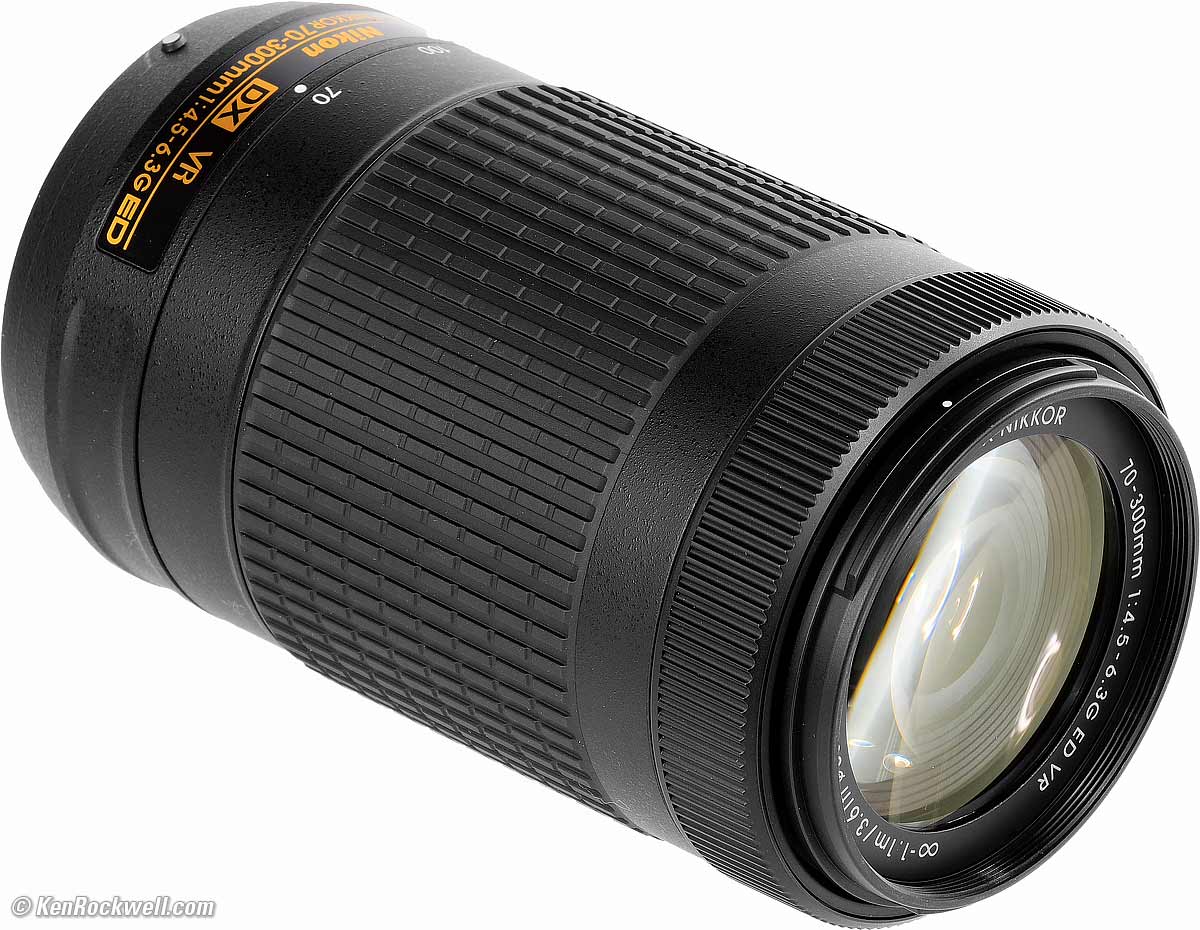
Nikon 70-300mm VR DX AFP (58mm filters, 14.5 oz./412g, 3.7'/1.1m close-focus, check price.)
If you really want to get serious for indoor sports and theater, the world's standard professional telephoto zoom is the Nikon 70-200mm f/2.8 FL. It works in much lower light than the 70-300mm VR above. It works flawlessly on less expensive cameras.
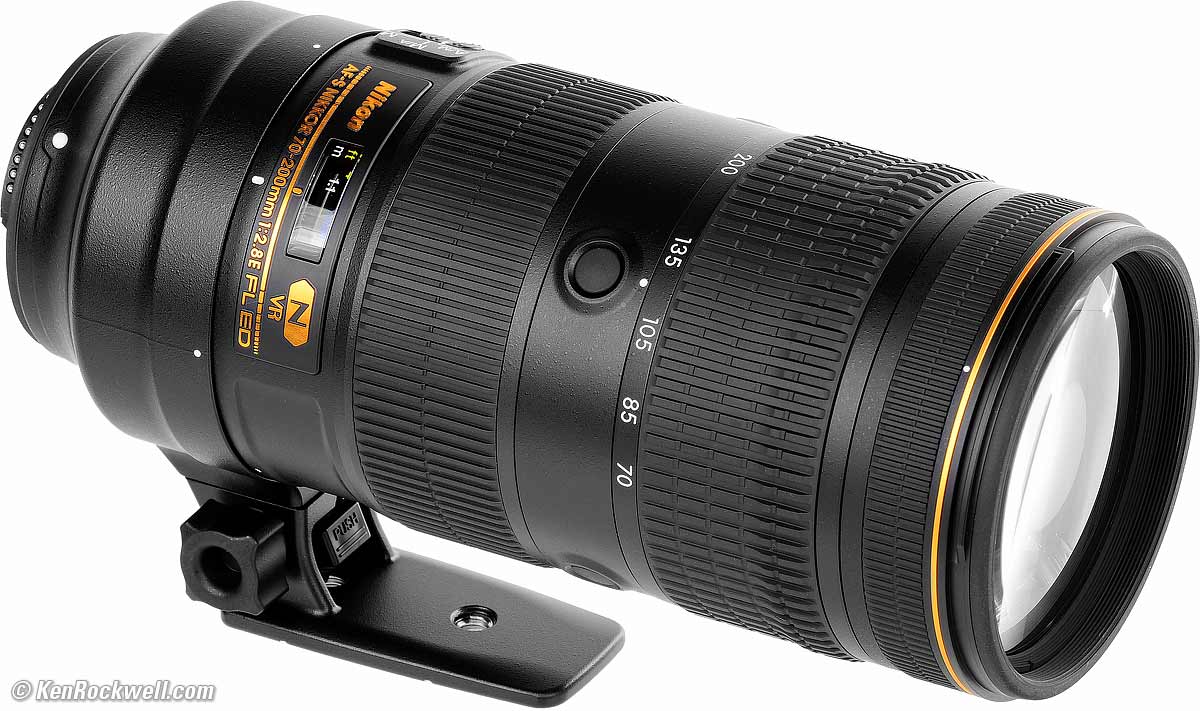
Nikon 70-200mm f/2.8 FL (metal 77mm filter thread, 50.3 oz./1,425g with tripod collar, 3.6'/1.1m close-focus, check price.)
You're paying much more because this fully professional lens because it's built like a tank, and also because it is much more sensitive to light for indoor shooting. For use outdoors the Nikon 70-300mm VR DX AFP takes the same pictures for a fraction of the price so long as you don't abuse it.
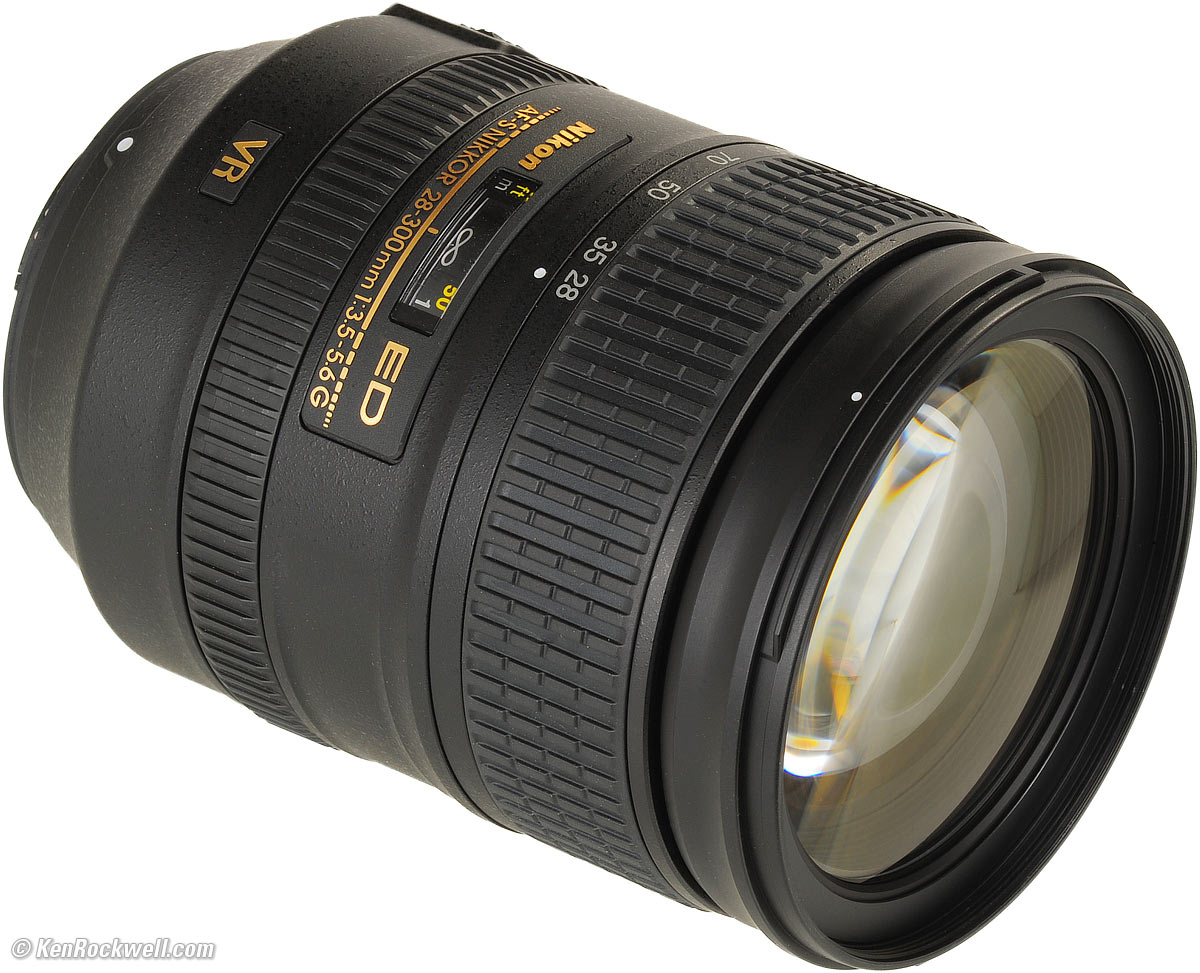
Nikon 28-300mm VR.
For FX digital and 35mm film, my 28-300mm VR replaces all the other lenses I used to use.
Wide Angles: Getting Closer top
I'm a sucker for ultra-wide lenses, but they take a lot of skill to use properly.
Ultra-wide lenses are not for "getting it all in." They are for letting you get closer and thus creating stronger images.
For FX and 35mm cameras, the Nikon 16-35mm is the world standard for ultrawide performance.
If an 18-55mm lens isn't wide enough, my favorite for all Nikon DX camera is Nikon's 10-20mm DX. It's inexpensive and a great performer
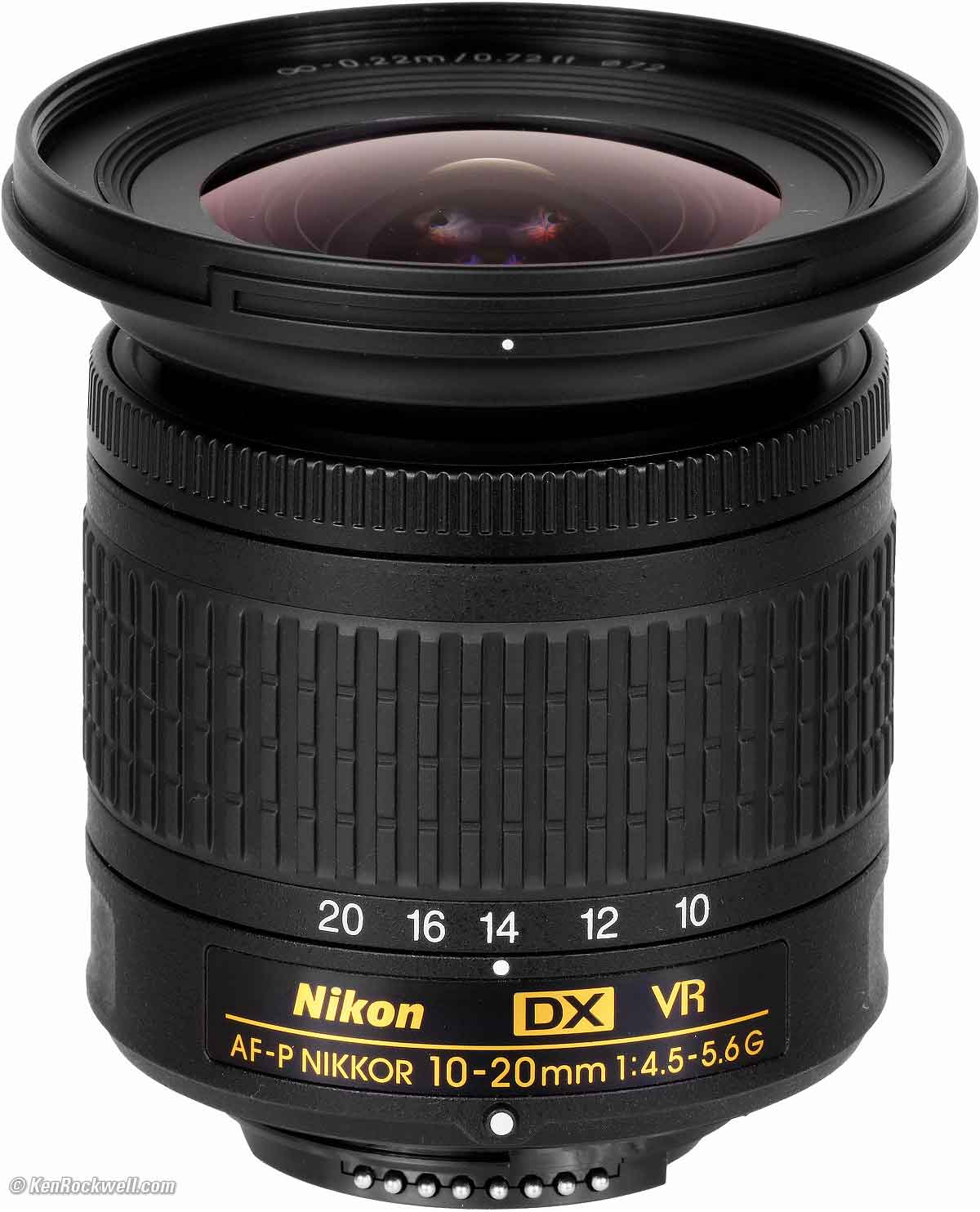
Nikon 10-20mm DX (72mm filters, 8.0 oz./227g, 0.7'/0.22m close focus. check price).
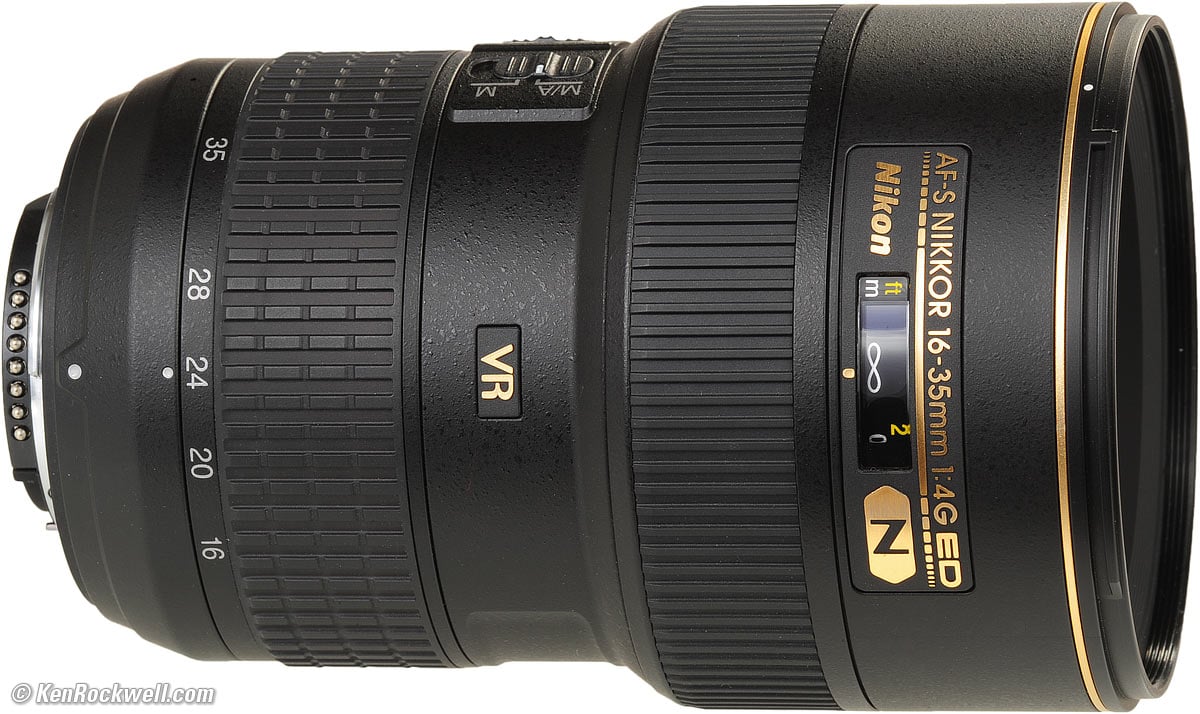
Nikon 16-35mm FX (77mm filters, 23.9 oz./678g. check price).
Do-Everything Lenses top
For day-to-day use, I prefer the 50mm f/1.8 for my 35mm and FX cameras, and either that or the 35mm f/1.8 DX lens for my DX cameras. I move a few steps to frame my photo, and Voilà, perfect pictures. I carry these small lenses when I'm spending more time carrying my camera than using it.
Most people want one lens to do everything, and Nikon makes the best of these:
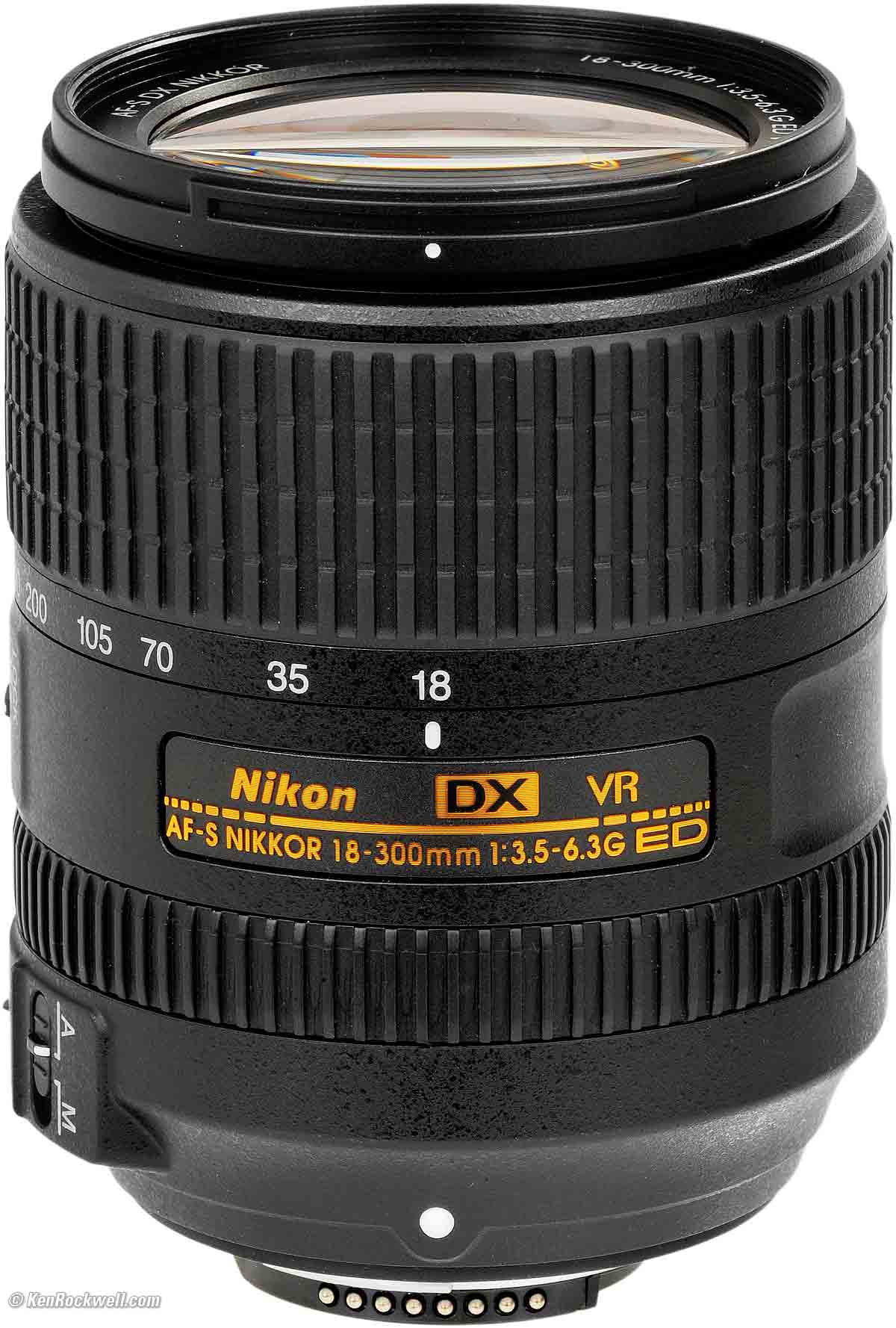
Nikon 18-300mm VR DX (67mm filters, 19.4 oz./550g, 1.6'/0.5m close focus. check price)
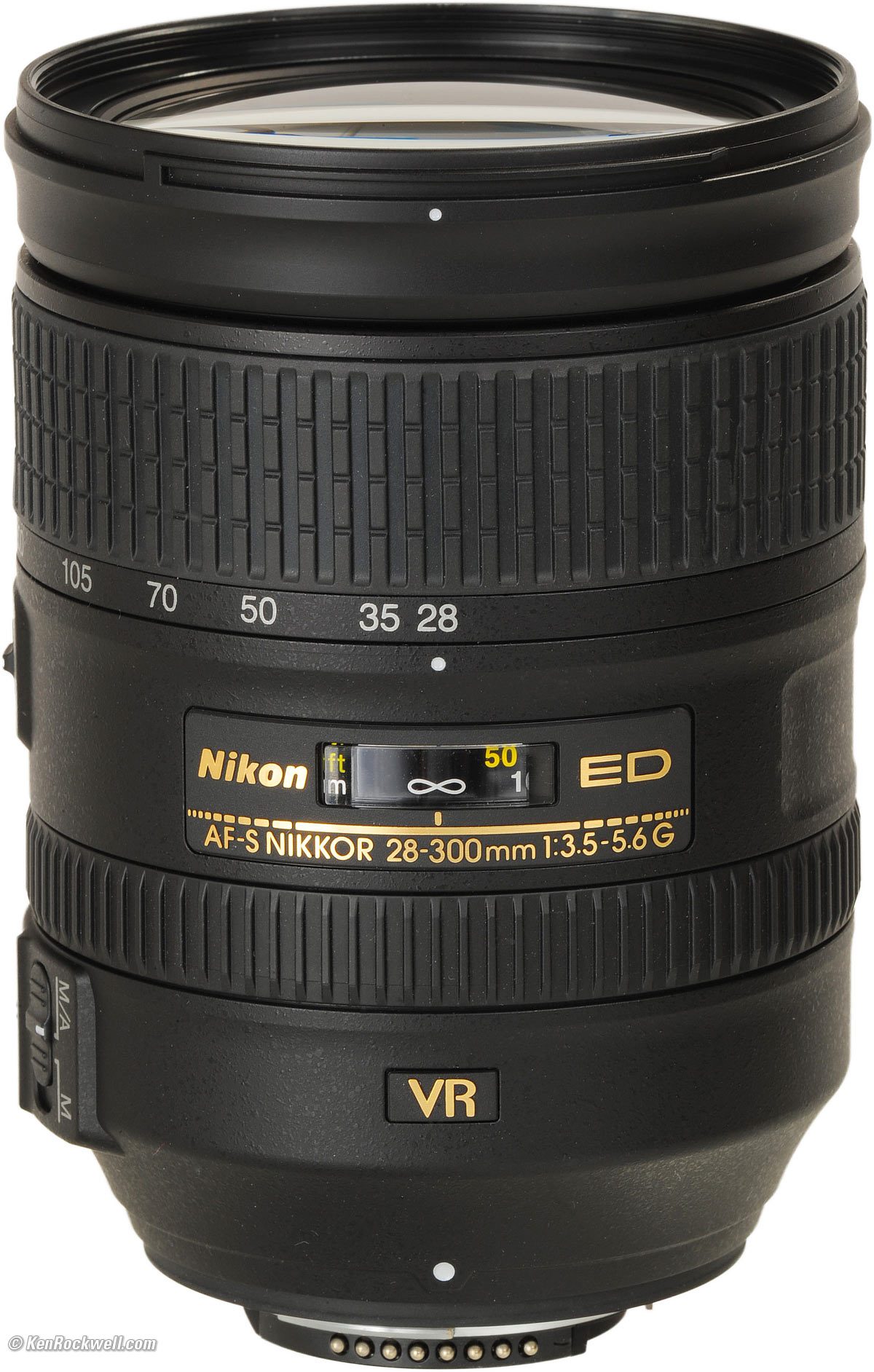
Nikon 28-300mm FX VR (77mm filters, 28.1 oz./796g. check price).
For FX and 35mm cameras, Nikon's 28-300mm VR does everything except for action in low-light or crazy-wide angles. The 28-300 also covers every reasonable focal length, has vibration-reduction so you can forget the tripod, and you can get instant manual-focus override just by flipping the focus ring.
With the 28-300mm VR, I can dump all my other lenses into the lake; the 28-300 is perfect for 99% of what I do on serious photo outings on full-frame. The tiny 50mm f/1.8 is what I prefer to carry day-to-day, and the 28-300 is the ticket for serious all-day shooting.
More Nikon Lenses top
I have pages and pages devoted to Nikon lens reviews and suggestions.
For FX and film, Nikon has made fantastic lenses ever since the 1950s, many of which are available for almost free, used.
See Recommended Nikon FX lenses, the Nikon FX Dream Team, Nikon D3 Lens Suggestions, and Nikon FX Cheapskate Lenses for suggestions.
Canon Lenses top
Canon makes a zillion lenses, but I only use a couple for my full-frame Canon cameras. (I prefer the Nikons for small-format (DX) digital.)
When photographing my family, I use a 50mm f/1.8 STM (or 50mm f/1.2 L), and that's it: just one lens, period.
If out on a dedicated photo trip, instead I bring one wide lens and one tele zoom, and that's it!
My favorite wide lens for Canon full-frame is the 16-35mm f/4 IS L, which is ideal for nature, interiors and landscapes. I use the 16-35mm f/2.8L III in the rare cases I shoot low-light sports or action.
Lower-cost options for Canon full frame are the 17-40mm f/4 L (for light weight and bargain price) or the Canon EF 20mm f/2.8 USM for smallest size and low price.
My favorite reasonably priced Canon tele is the new 70-300mm IS USM II. It is extremely sharp and focuses instantly. It's a superior lens at a very reasonable price.
I do this for a living every day so lens price doesn't matter to me. If you want the very best regardless of price or weight, then I love my Canon 100-400mm L IS II. It's ultra sharp, extremely well made, and has great image stabilization for hand-held shots in the dark. It's the world's best professional tele zoom.
I don't use 70-200 f/2.8 tele zooms; they have a very limited long range and I don't need f/2.8 since I'm shooting digital. f/2.8 was for 35mm film or very low light; the higher ISO speeds of digital make carrying all that weight for one extra stop foolish. I get even more defocus at 400mm and f/5.6 than 200mm at f/2.8; focal length is more important than f/stop for shallow depth of field.
The 70-300mm IS USM II is just as sharp and weighs and costs much less than the 100-400mm; I bought my 100-400mm before the 70-300 came out. The biggest difference is that the 70-300mm is mostly plastic doesn't focus as close as the larger and mostly metal 100-400mm. The 100-400mm focuses so close it replaces a macro lens.
That's it. I put the camera around my neck and the second lens in my pocket. See also Carry Less.
See also Assembling a System.
Costlier options top
No one, not even me who uses his cameras all day long, needs anything better than a D3500.
I own fancier cameras because they make it even easier to do fringe-element things, like burn away at 10 frames per second for sports or photograph birds a half-mile away under moonlight. No one needs this, but if you have the cash or use cameras so much that even little improvements are appreciated, go for it. See also Is It Worth It.
Canon 5D Mk IV & 5DS R top
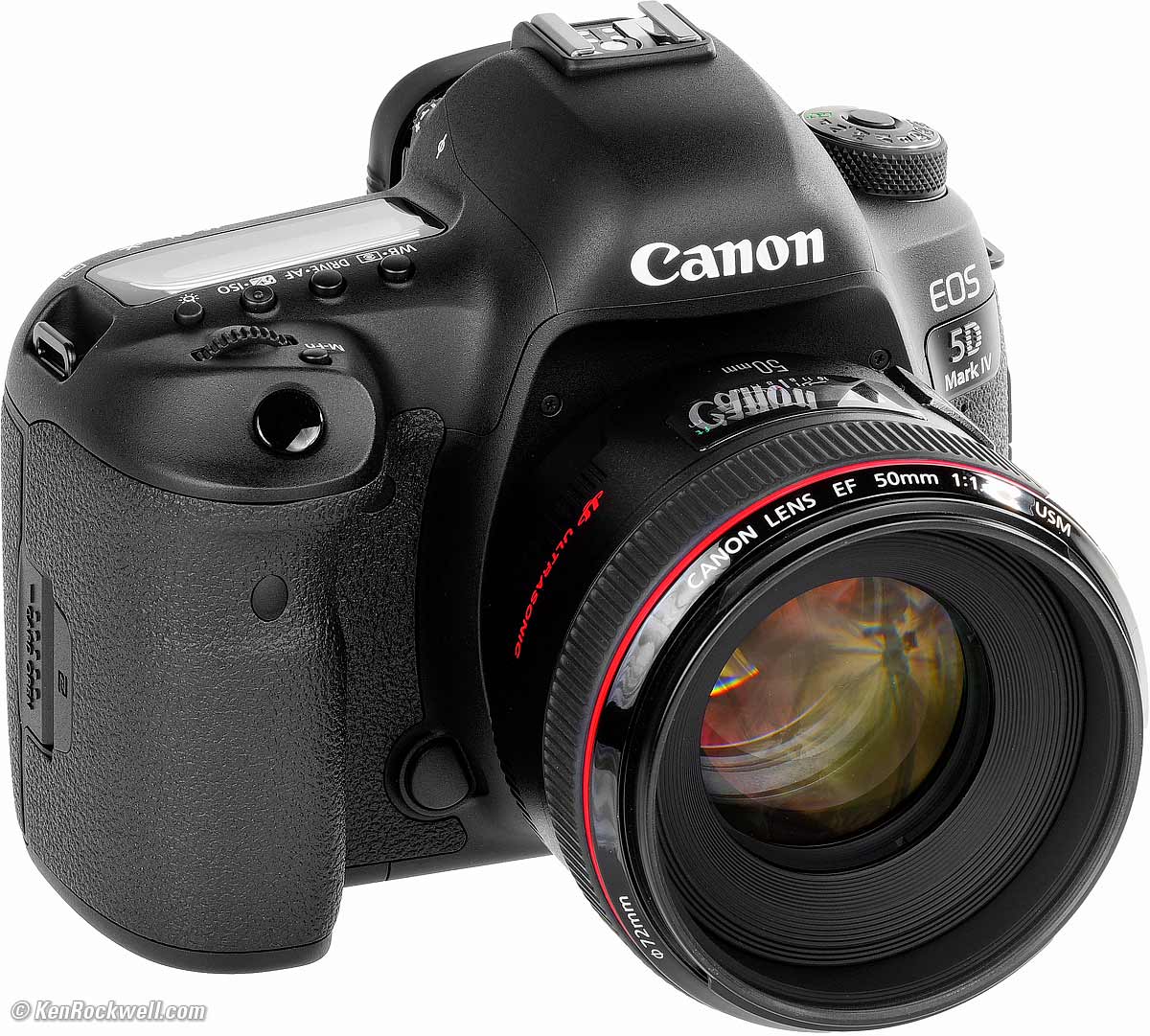
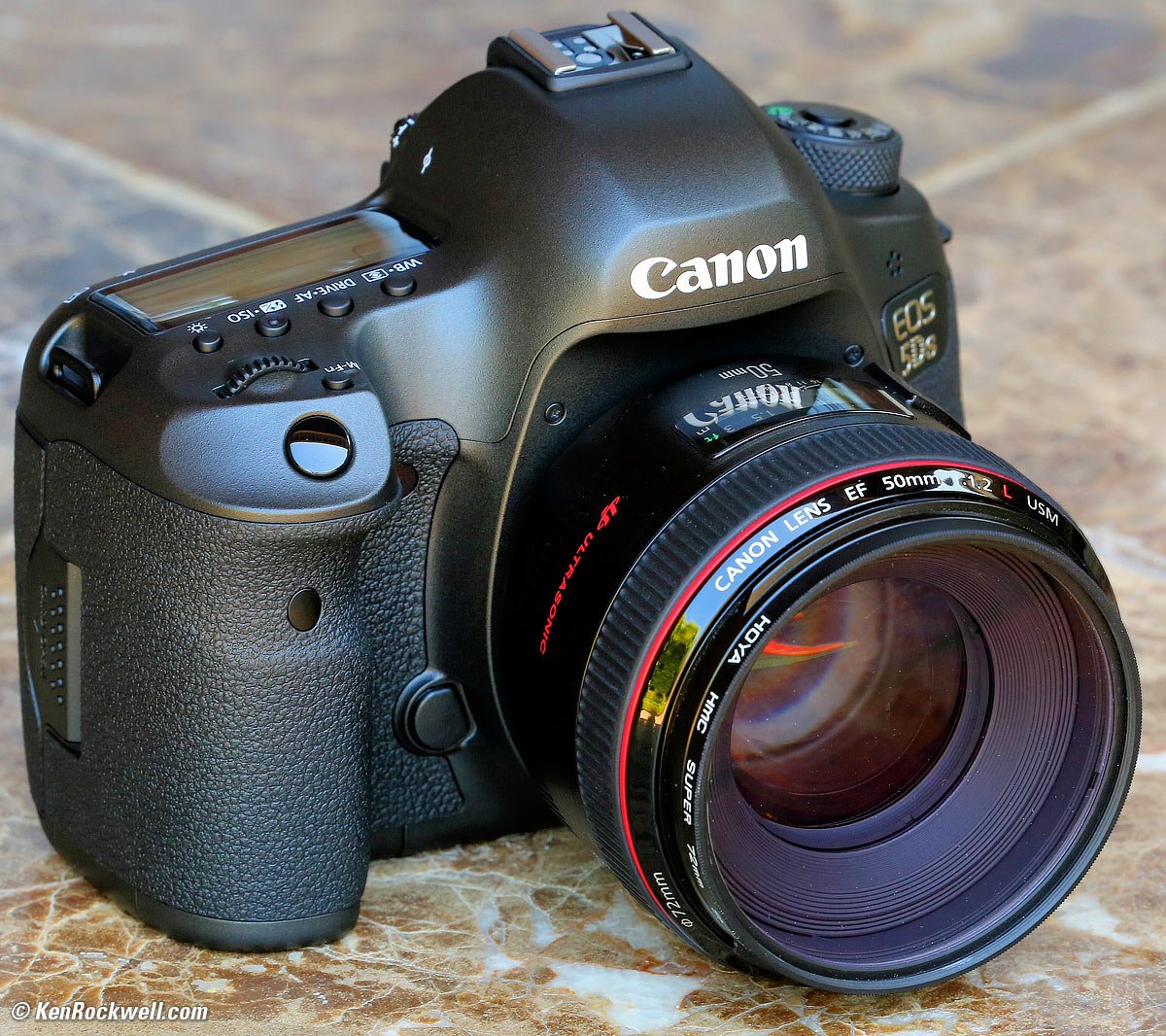
The Canon 5D Mark IV and 5DS/R are the world's best DSLRs. I report on every camera, and when I actually need great photos, I grab my 5DS/R. The 5DS/R excels for high resolution, while the 5D Mark IV runs faster and still has more than enough resolution for anything.
I love my 5DS/R over all my Nikons and LEICAs because it handles and feels so much better. My images always look great, and the 5DS/R always feels fantastic in my hands. Not only does the 5DS/R feel better, it always takes fewer clicks to set what I want, it shoots more quietly, and while its LCD seems the same on paper, in reality it's actually much bigger than on my Nikons — and the Auto Brightness control of my 5DS/R works great in every light.
The 5DS/R replaces the 5D Mark III which replaced the 5D Mark II which replaced the original 5D which was introduced in 2005. The original 5D was the king of landscape and nature photography, and to be honest, if you can find a deal on an old 5D, it's a bigger pain to use with a dreadful LCD, but also gives spectacular results.
If money matters, many people prefer the Canon 6D II, which removes some features but costs much less.
Nikon D750 top
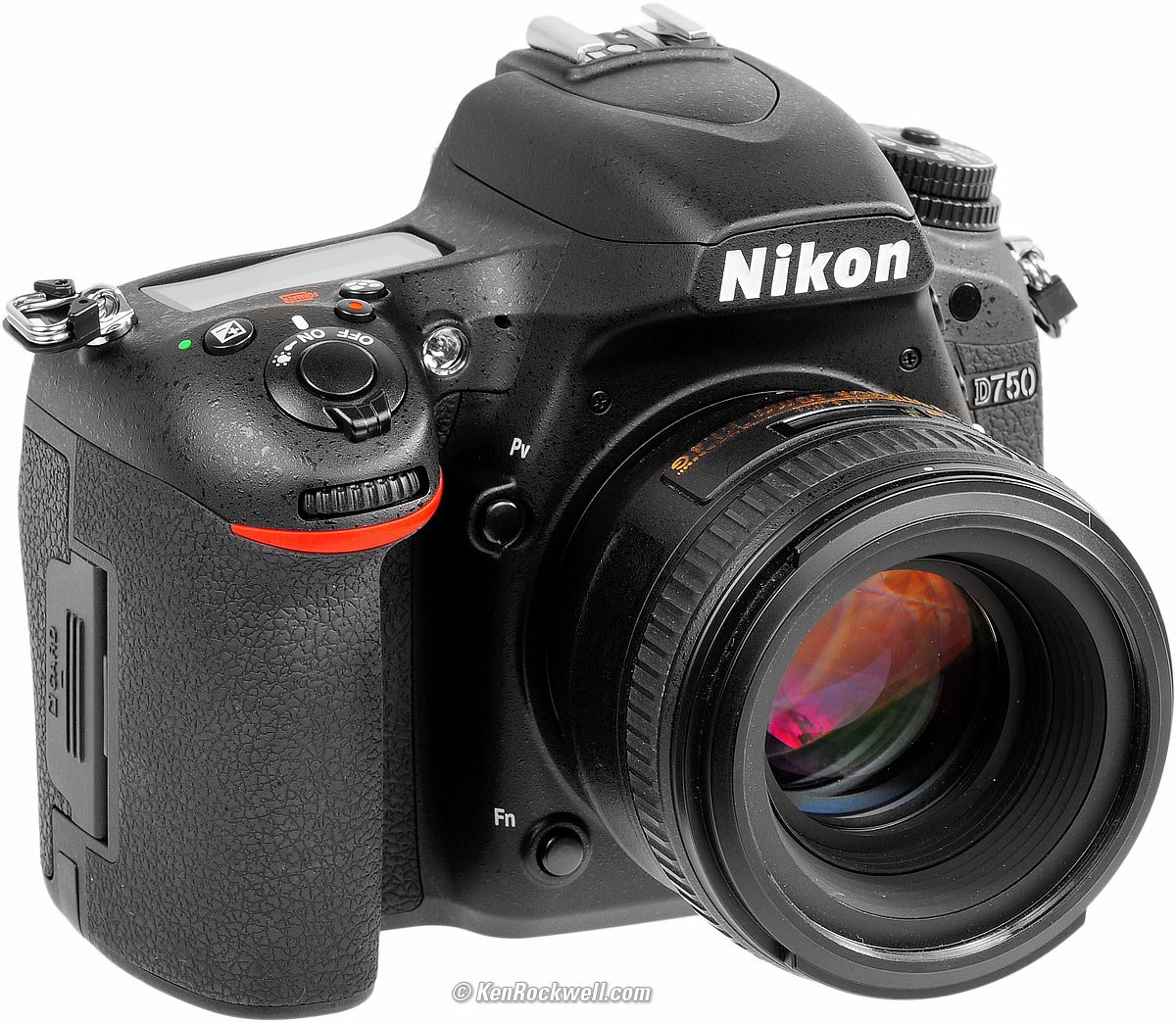
The Nikon D750 is a super bargain today. It's a full-frame version of the D7200. It's a bargain because it's been out a while, so it's discounted. Don't wait for a new version, because the only difference a new version is likely to have is to add Bluetooth, remove compatibility with older lenses, lower flash power and raise the price.
The D750 is the better model of the D610, and oddly the D750 sells for less today. Don't wonder, just get a D750 while they're so inexpensive.
Honestly, the biggest difference between full-frame (FX) and the smaller APS-C (DX) sensors is that full-frame cameras have bigger viewfinders and less depth-of-field The pictures are as good; the difference being that you get more depth-of-field with DX, or more subject isolation (narrower depth of field) with full frame.
35mm & Larger Film Cameras top
How to Get Digital Files from Film
Most people think of 35mm cameras for shooting film, and they are fun and easy, however for ultrasharp, grain-free images (like digital), look to medium format cameras like HASSELBLAD for use on a tripod or the Mamiya 6 or 7 for use handheld.
35mm was mostly for sports and action where you shot at high frame rates on an SLR, however today we shoot film more carefully so you ought to investigate a rangefinder 35mm camera like the LEICA or Olympus 35SP for their superior lenses, and ideally medium format for superior image quality. Large Format is for the truly afflicted; even Ansel Adams shot everything from about 1950-on on his HASSELBLAD, not his large-format camera with which he was so famously pictured in his earliest days.
Today all 35mm SLR brands cost about the same used because people have forgotten what huge differences there were between them.
Nikon's 35mm cameras were the pro's overwhelming choice from the 1960s through the 1990s and what everyone wanted, but was so expensive that normal people settled for Canon or lesser brands like Pentax, Minolta and Olympus. If you're serious, stick with Nikon. Nikon's manual focus cameras were the best they've ever made and the cameras on whose reputation Nikon still rests today.
You may as well get the very best that we all wanted but couldn't afford back when they were new. That means go NIKON for 35mm.
Canon was never a leader in the pro market until autofocus became popular with pros in the 1990s, and Canon has always been hugely popular with consumers and amateurs, especially before Nikon started making consumer cameras in the late 1970s. Canons are also great cameras. I'd completely forget about Pentax, Minolta and Olympus unless you're just collecting them for goofs; people bought those new because they cost less, not because they're what anyone really wanted.
For manual exposure and manual focus, look for a Nikon FM or FM2 or FM3a. All of them are sturdy professional level cameras always praised by pros for their simplicity and durability. Back when they were new, pros would carry an FM as a backup because regardless of extreme temperatures, physical abuse or anything, the FM always got the shot. I have a 40+ year-old FM on my desk that a friend gave to me after she found it dumped in a paper bag sitting in the street. It still works fine. Feel free to get an F2, but the photos are the same while it weighs much more.
For manual focus with aperture-preferred auto exposure and center-weighted metering look at the FE, FE2 or FM3a. For full program auto exposure and matrix metering get the FA, with which all you have to do is point, focus, and shoot!
The best autofocus 35mm SLR today is the Nikon F6. The autofocus Canon EOS 1V was the best 35mm SLR ever made for sports and action, but are you shooting sports on film today? Probably not, but a huge advantage of the Canon 35mm EOS system is that all its EF lenses work great on all their DSLRs and even all their newest mirrorless cameras today with a simple EF to RF adapter for complete compatibility. Nikons lack this compatibility; its cameras and lenses more than about ten years apart usually aren't completely compatible — but every EF lens from Canon since 1987 is 100% compatible with all their EF cameras made even today, so any Canon EF lenses lenses you get as a goof for film can serve you well on modern digital, which is not the case with Nikon.
If getting a Nikon manual-focus camera, the best part of the system are its manual-focus AI and AI-s lenses. It's true bliss shooting Nikon's AI and AI-s manual lenses. Nikon lenses have been mostly crappy plastic ever since they went to autofocus in 1987, while its manual-focus lenses are all-metal mechanical works of art.
The best things Nikon ever made were their manual focus cameras and manual focus AI-s lenses. Do not put a non-camera brand lens on any of these cameras; the magic comes from the extreme quality with which their original manual focus lenses were made.
I get all these from eBay.
Ever since DSLRs got to 24 MP around 2014 I have shot very little 35mm film. Unless I'm projecting film slides with a film projector or doing optical darkroom printing I don't use 35mm anymore. If I'm doing any part of the process in the digital domain I lose so much in scanning that I'm better off shooting in digital in the first place, so my 35mm suggestions are for the truly affected who insist on shooting 35mm just because that's what they like.
If you want real quality, step up to medium or large film formats. Today I love my HASSELBLAD system above all others.
Here are some of my favorites. Prices are without lenses form 2016, when they sold for less than today in 2023. These are best available used at eBay as most are no longer available new.
Nikon F6 top
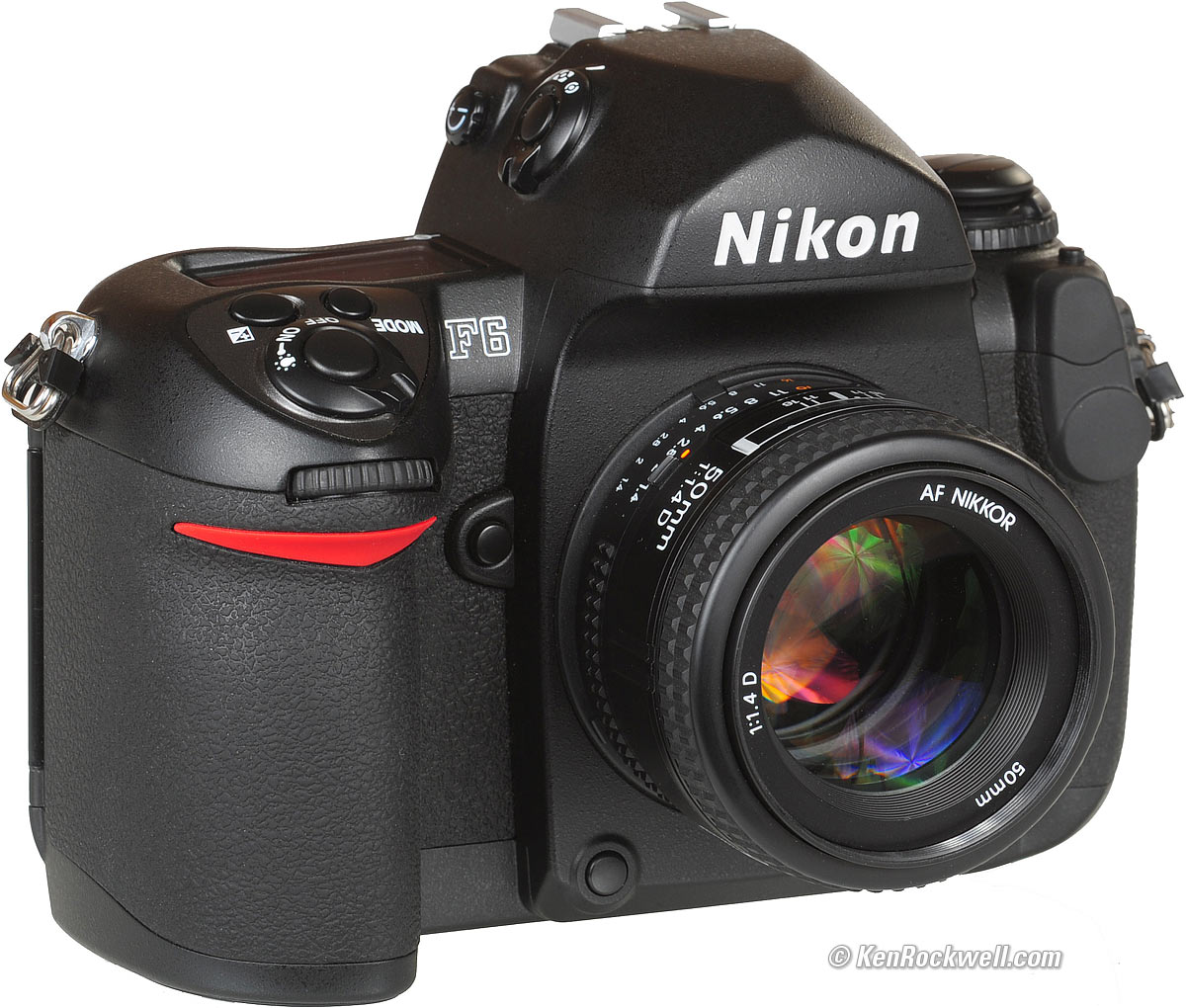
Nikon F6 (2004-today) with Nikon 50mm f/1.4 AF-D. check price.
The F6 weighs and costs much less than a D5.
Other favorite Nikon 35mm cameras available used are the Nikon FA, the indomitable Nikon F4 and Nikon F5. The Nikon N75 is a fly-weight, high performance AF camera.
LEICA M3 top
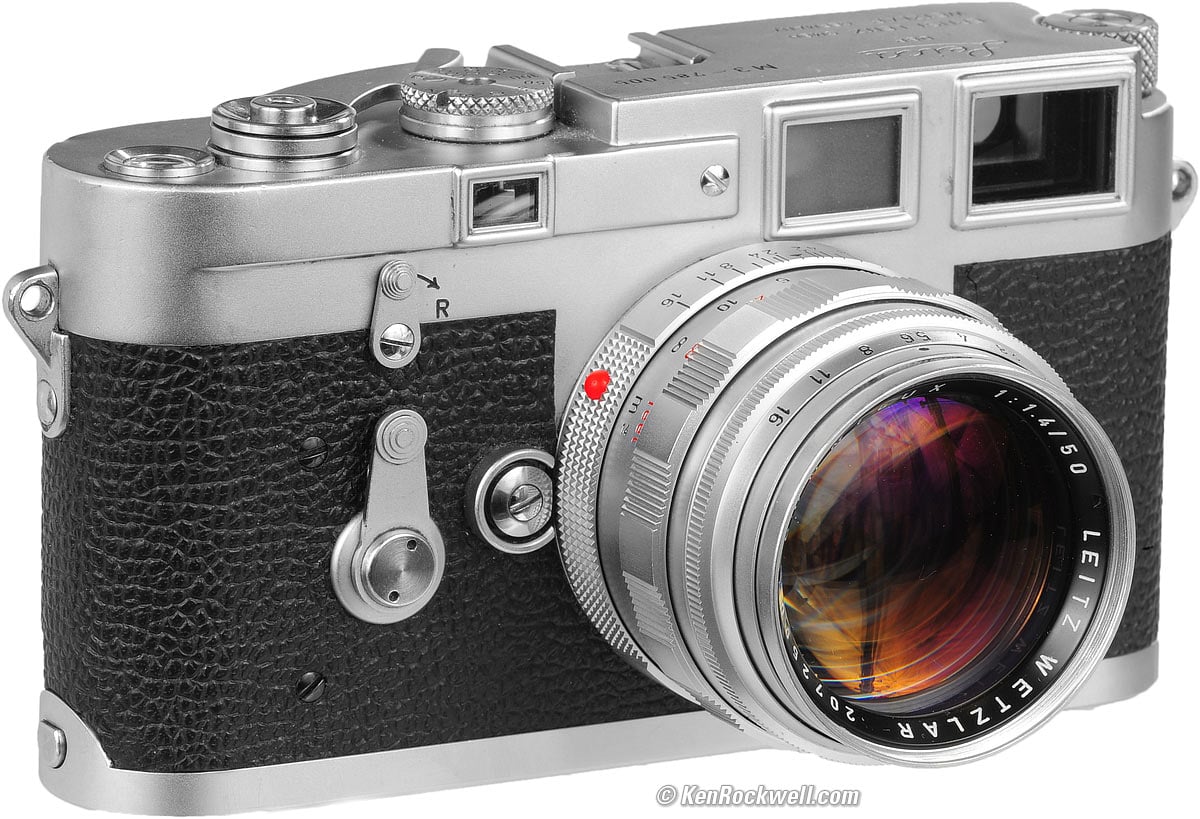
LEICA M3 (1954-1967) with LEICA SUMMILUX 50mm f/1.4.
The 1950s LEICA M3 is still the world's best 35mm camera. I use mine with the LEICAMETER, Fuji ACROS 100, a few filters (yellow, orange, red and green) and I'm good!
Hasselblad 503 CX top
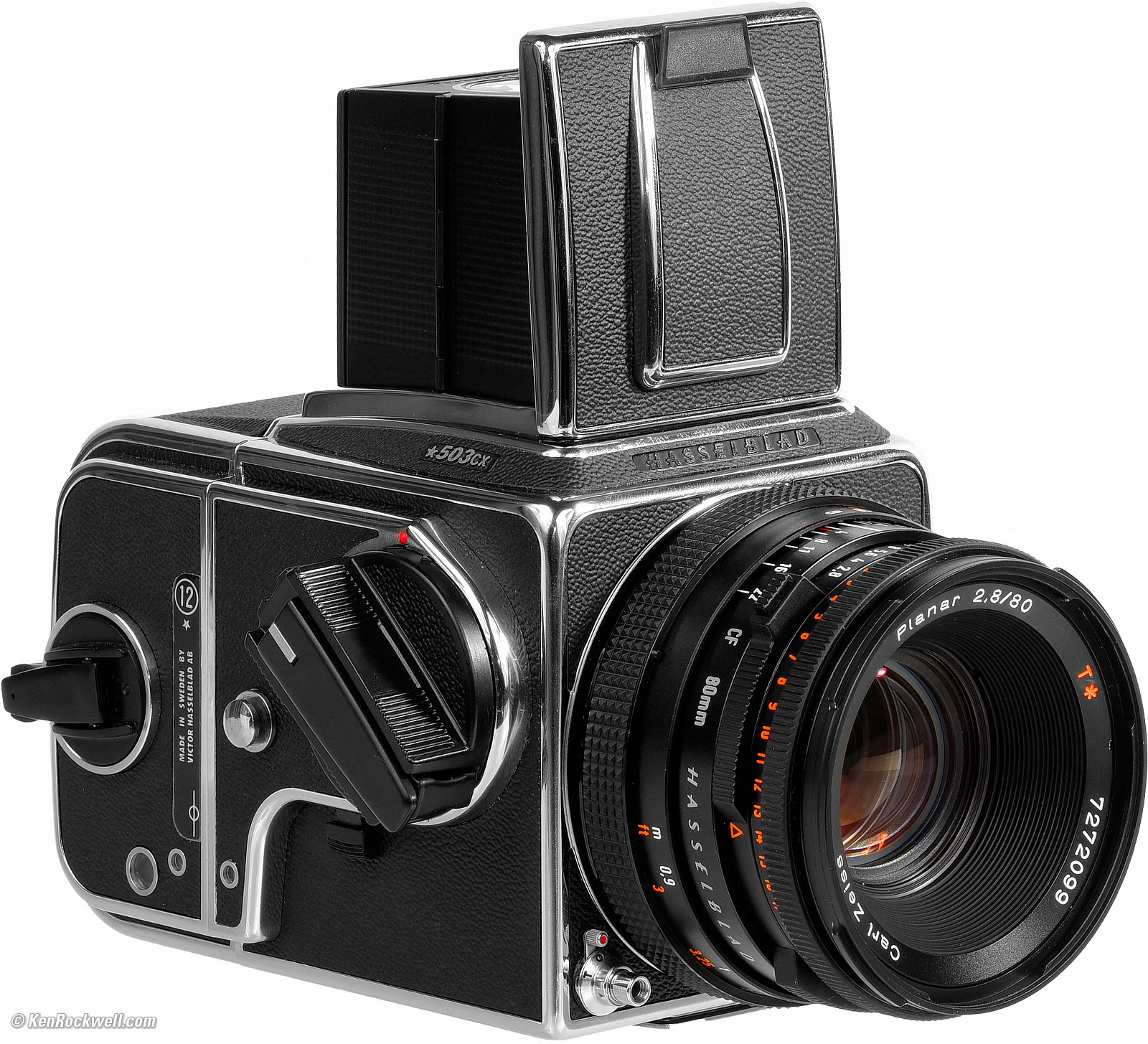
Hasselblad 503 CX (1988-1992). About $500 used (cubical body only), or about $1,300 used as shown with 80mm f/2.8 CF lens, A12 back and waist-level finder. As shown without lens: about $800.
Hasselblad has been the top professional camera since the 1960s. Even today in 2016 pros wished they could afford a new Hasselblad, the same as they've wished for over 50 years.
All Hasselblad SLRs are superb. I love my 503 CX because it's the least expensive Hasselblad new enough to have the super-bright Acute-Matte screen. It's new enough that any you buy will probably work perfectly without needing service, and old enough to be inexpensive.
All Hasselblads are pretty much the same; the older 500 C/M is just about the same thing, but with a much darker screen. By the time you replace the dark screen of the 500 C/M so you can see what you're doing, you may as well just get a 503 CX.
I'd also suggest a PME metered prism finder, which lets you see the image as you expect in an SLR. As shown above with a waist-level finder, you have to look down to see a reversed image, exactly as on a TLR. Get the PME and you'll love it.
Nikon FM3A
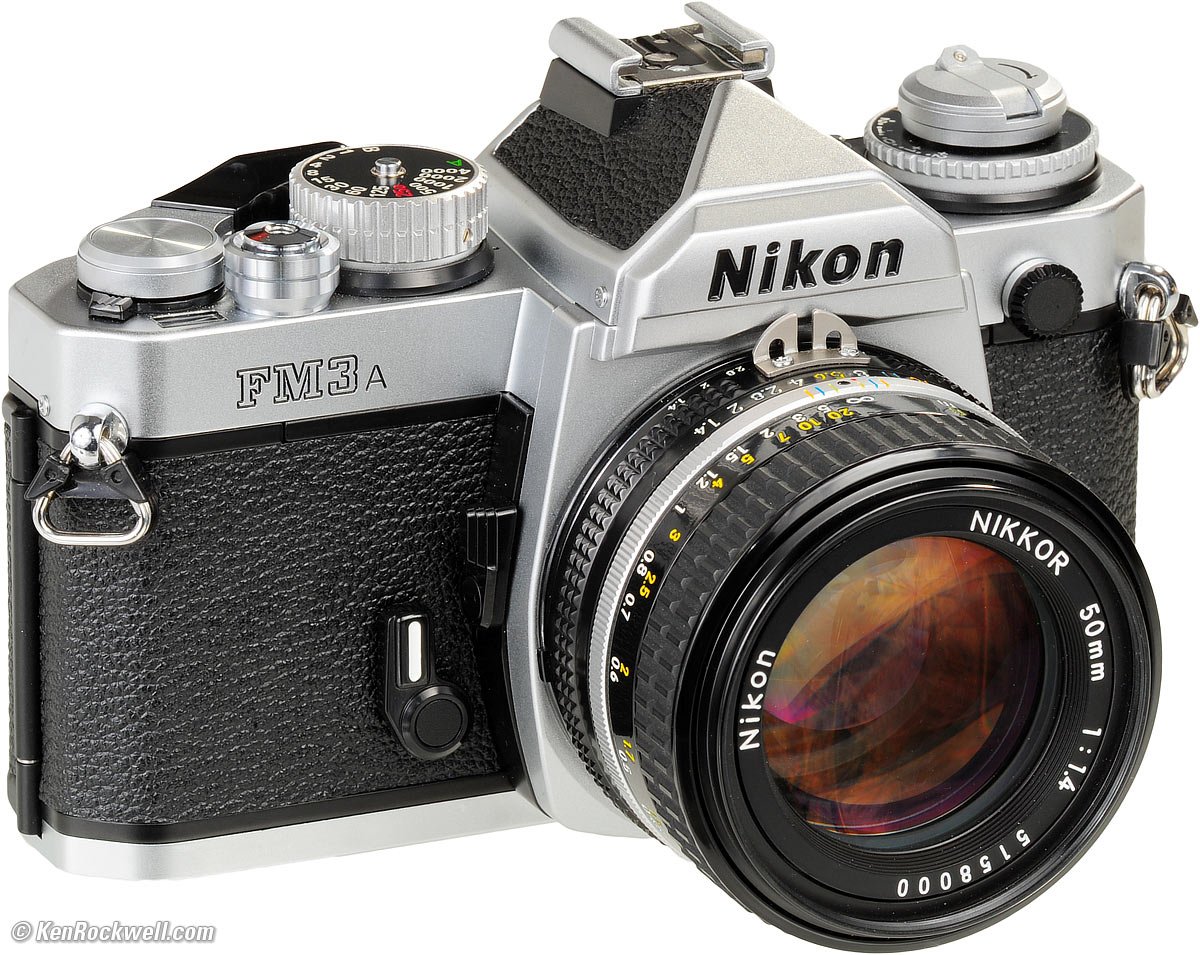
Nikon FM3A (2001-2006) with Nikon 50mm f/1.4 AI-s. check price.
Nikon's FM3A is an absolutely brilliant camera.
It just shoots, with no backtalk.
Nikon FE top
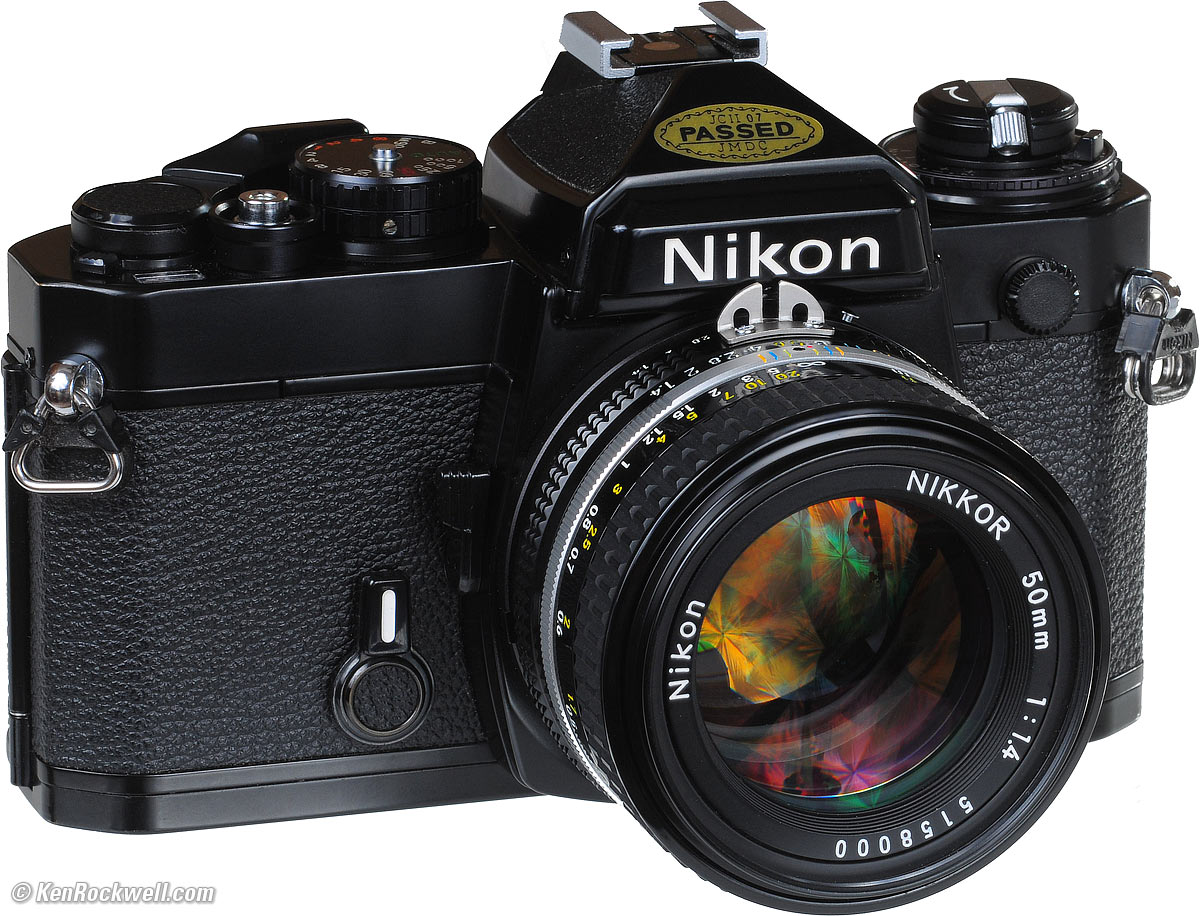
Nikon FE (1978-1983) with Nikon 50mm f/1.4 AI-s. check price.
The Nikon FE is 99% the same as the FM3a, for a lot less money.
Canon AE-1 Program: $50 w/Lens top

Canon AE-1 Program (1981-) and Canon FD 50mm f/1.8.
The Canon AE-1 Program is one of my very favorite manual-focus Canon FD cameras, and it sells used for next to nothing. Everything on it just works, as opposed to more expensive Canons, like the New F-1, that cost a lot more and do a lot less.
LEICA M7: $5,000 top
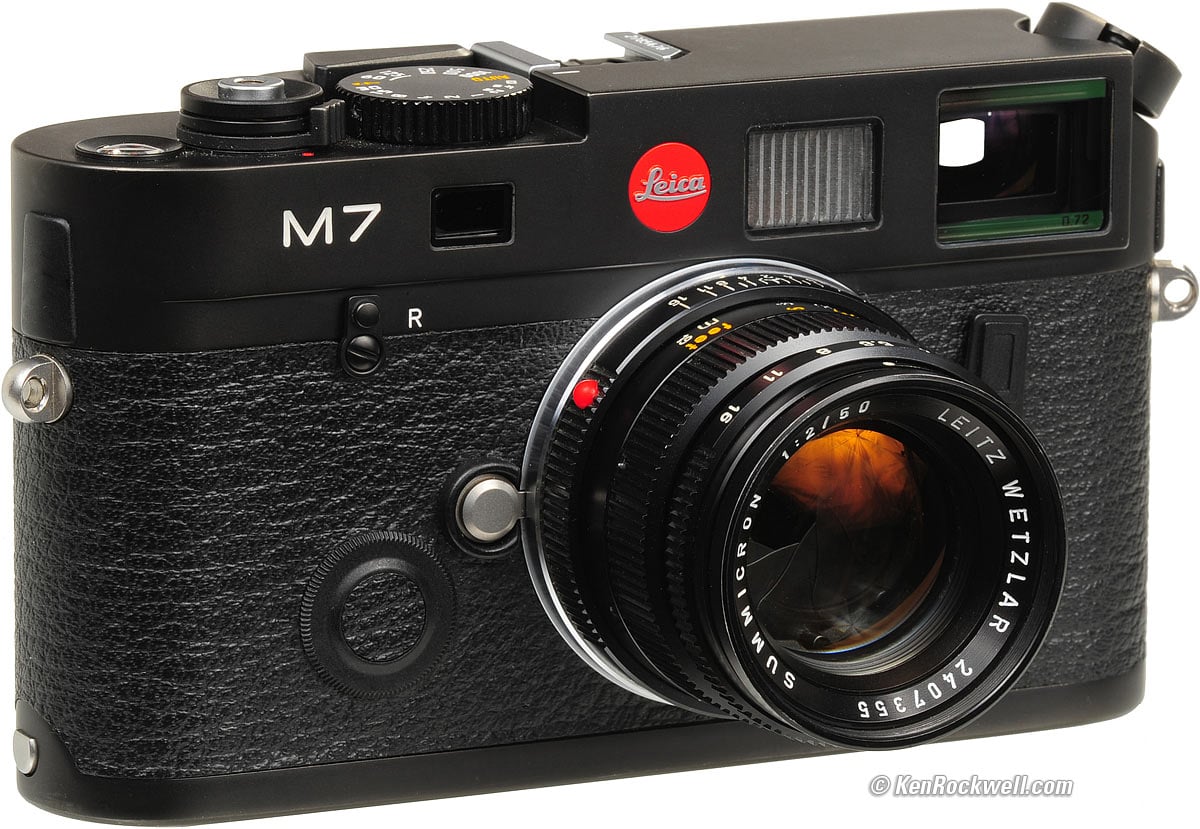
LEICA M7 ($5,000 new or about $1,700 used if you know how to win at eBay) with 50mm f/2 SUMMICRON.
The LEICA M7 (2002-today) is a rangefinder version of the Nikon FE that uses Leica's superior lenses. These superior LEICA lenses let it make sharper images than from SLR cameras.
Another reason to use the LEICA is that it and its lenses are much smaller and lighter than SLRs. For instance, most Leica lenses take tiny 39mm filters!
Mamiya 7: $3,900 top
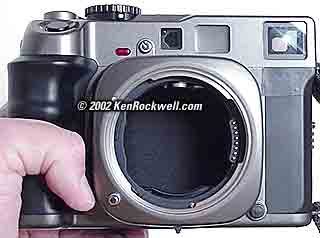
Mamiya 7 body (shot with an FD-88)
The Mamiya 7, along with its sister the Mamiya 6, is the world's best camera, period.
It is super-easy to hold, shoot, and carry the complete system in the field.
It also offers the world's highest hand-holdable technical image quality. Shooting 6x7cm medium-format film, this lightweight interchangeable-lens rangefinder camera is the same or smaller in size and weight than 35mm SLRs and DSLRs, while offering far superior image quality and more convenient size and weight.
Its 70 x 56mm images are over double the area of the largest medium-format digital sensors.
The Mamiya 7's lenses are spectacular and beyond comparison. They are as good as LEICA, but for a format with over four times the image area of full-frame 35mm.
All this, and easy to carry and shoot hand-held = the world's best camera.
Tachihara 4x5:" $700 top
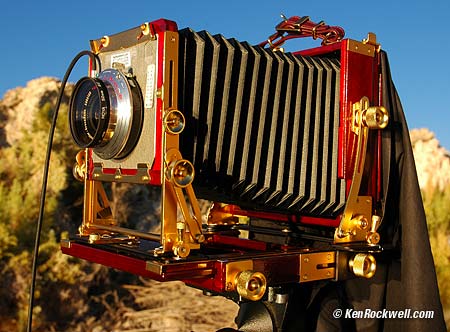
The Tachihara is a lightweight wooden 4x5" camera.
It has been one of the most popular cameras for decades for serious landscape and outdoor photography because of its ultra light weight, ability to fold up about as big as a book, its ample set of movements, and great screen.
It has recently been discontinued; I need to test some newer cameras to give personal recommendations, however I suspect that the $990 Toyo Field 45CF is also excellent, and built a lot tougher out of metal. The Tachihara usually doesn't survive falling off a tripod in the wind.
Of course you can go whole-hog and buy the classic of classics, the timeless Linhof Master Technika, for $10,000. I also use a 1956 Linhof Technika IV which is the same thing, but I grew tired of carrying the weight. Even though the light Tachihara feels flimsy, its results are what get published every month in your landscape calendars and seen on gallery walls.
Best Gifts for Photographers top
© Ken Rockwell. All rights reserved. Tous droits réservés. Alle Rechte vorbehalten. Alla rättigheter förbehållna. Toate drepturile rezervate. Omnia jura reservata. Ken Rockwell® is a registered trademark.
Help Me Help You top
I support my growing family through this website, as crazy as it might seem.
The biggest help is when you use any of these links when you get anything. It costs you nothing, and is this site's, and thus my family's, biggest source of support. These places always have the best prices and service, which is why I've used them since before this website existed. I recommend them all personally.
If you find this page as helpful as a book you might have had to buy or a workshop you may have had to take, feel free to help me continue helping everyone.
If you've gotten your gear through one of my links or helped otherwise, you're family. It's great people like you who allow me to keep adding to this site full-time. Thanks!
If you haven't helped yet, please do, and consider helping me with a gift of $5.00.
As this page is copyrighted and formally registered, it is unlawful to make copies, especially in the form of printouts for personal use. If you wish to make a printout for personal use, you are granted one-time permission only if you PayPal me $5.00 per printout or part thereof. Thank you!
Thanks for reading!
Ken.