LEICA Lens Reviews
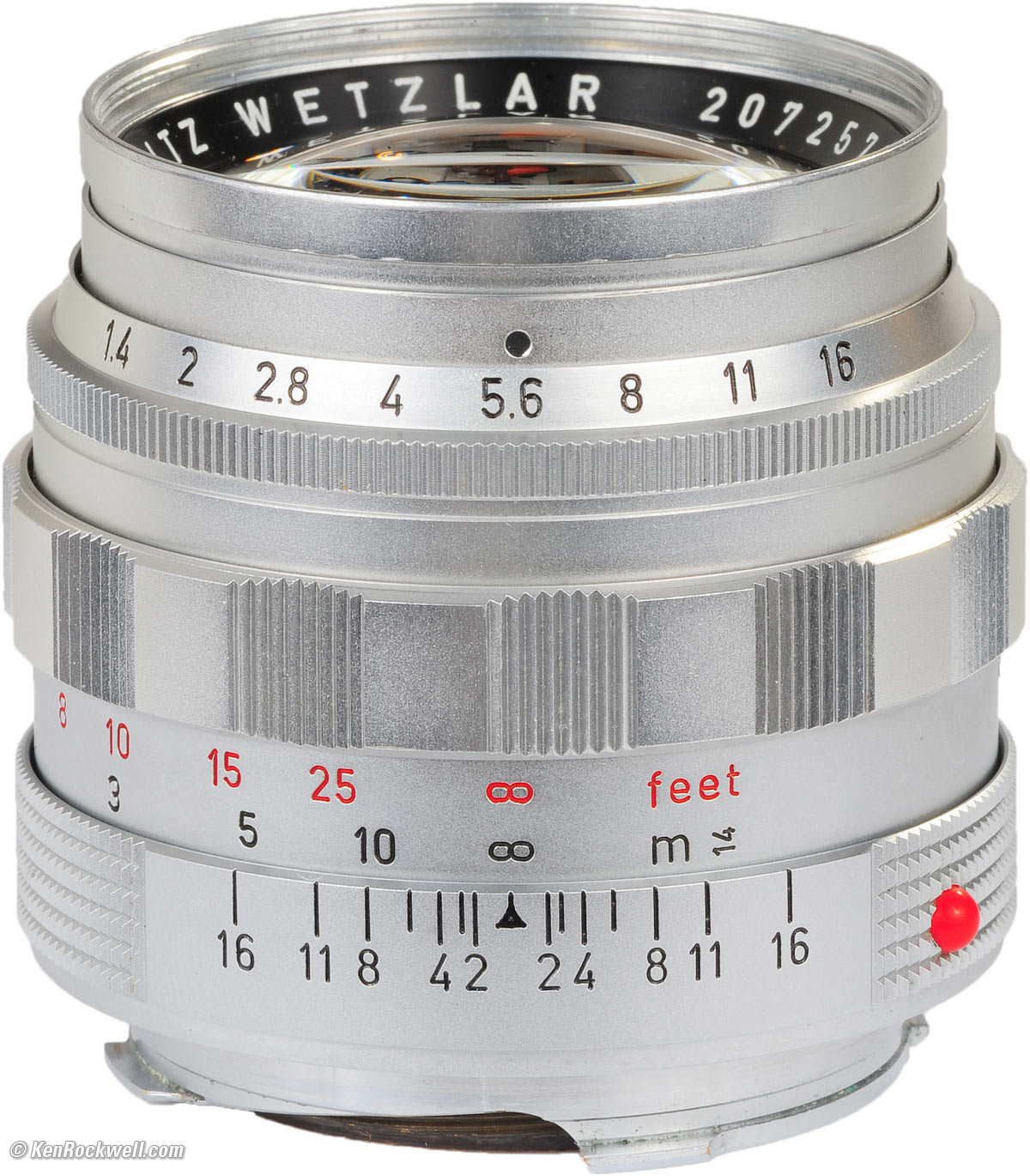
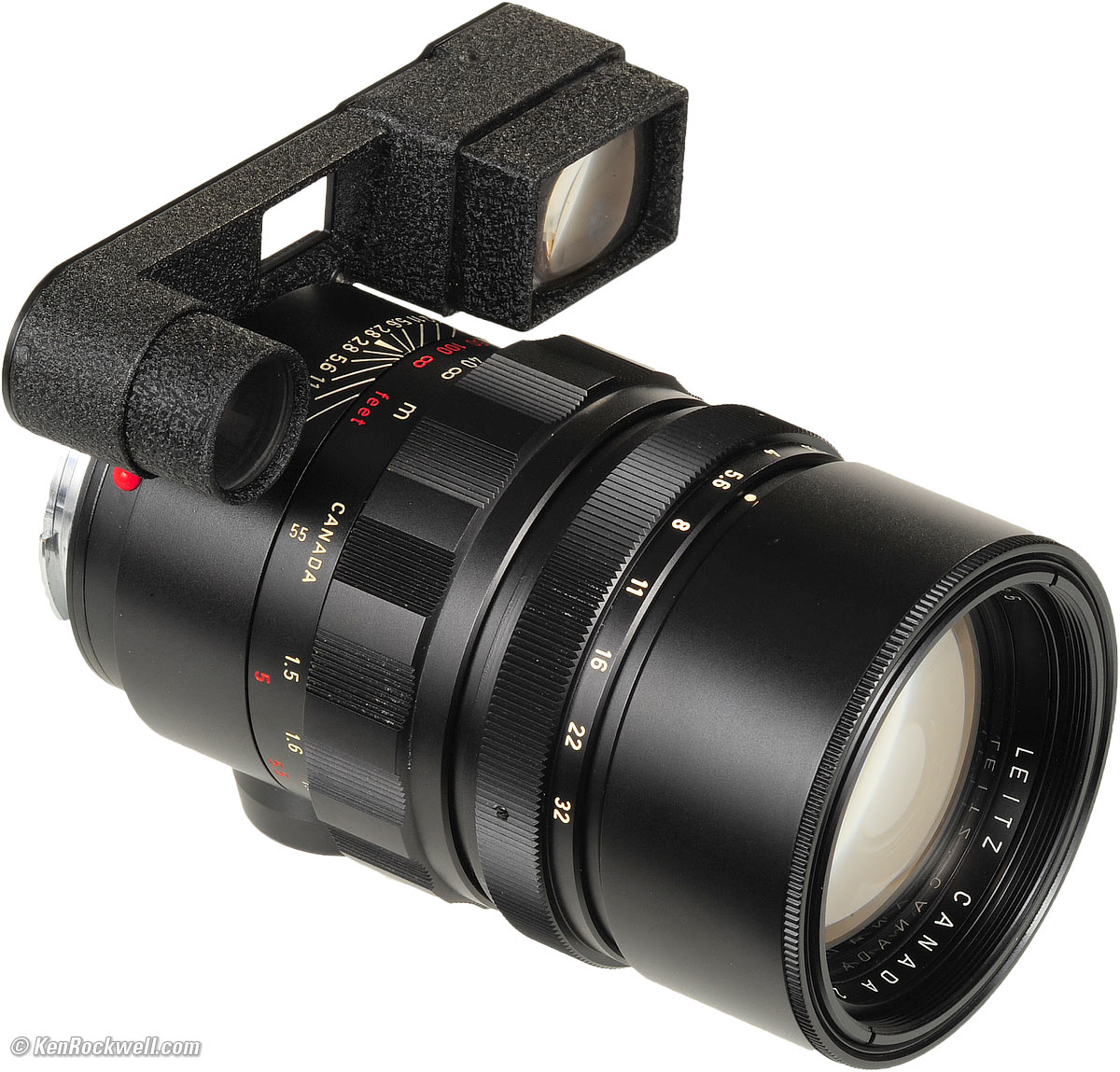
LEICA SUMMILUX 50mm f/1.4 (1961~2004).

My junk-free, all-content website's biggest source of support is when you use any of these links to the places I use myself when you get anything, and it costs nothing more. I've bought from these places for over 100 combined years because they have the best service, the best selection, the best prices, and usually 100% cash-back returns for at least 30 days if you don't love your new goodies. As an Amazon Associate and eBay Partner Network Affiliate, I earn from qualifying purchases. Thanks for helping me help you! Ken.
January 2026 LEICA Cameras Voigtländer lenses Zeiss
12mm 15mm 18mm 21mm
24mm 28mm 35mm 40mm
50mm 75mm 90mm 135mm
Why Fixed Lenses Take Better Pictures
LEICA SUMMICRON 35mm Sharpness Comparison 14 January 2011
LEICA Lens Serial Numbers 04 November 2009
Specific Lens Recommendations for the LEICA 17 September 2009
LEICA M9 Lens Compatibility 01 October 2009
Click any image below to go to its review or more information.
12mm (requires external finder) top
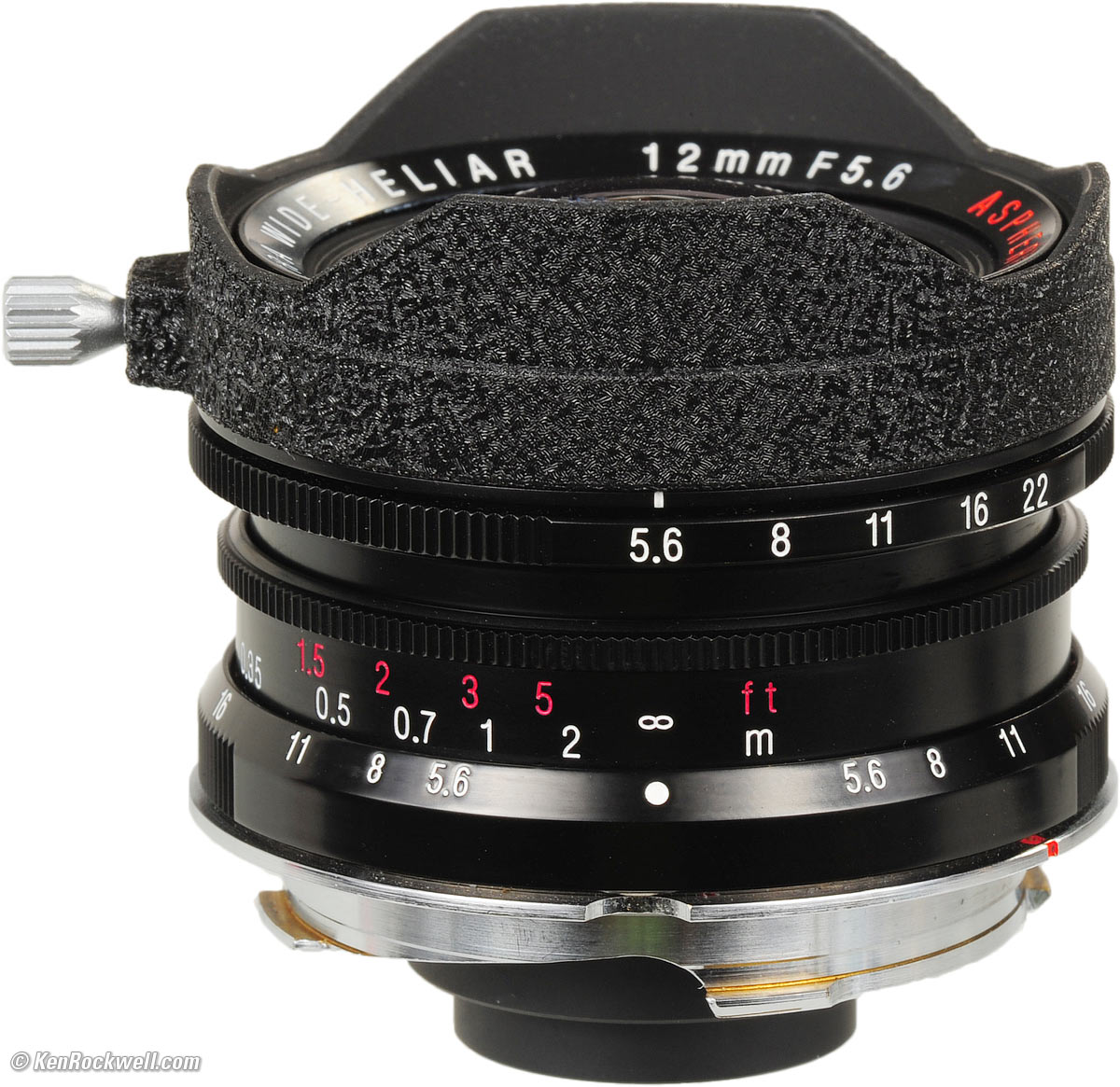
Leica makes no 12mm lenses. Be sure to read How to Use Ultrawideangle Lenses. If you get a 12mm, you're crazy. Don't bother with a 15mm or 18mm as well; they are too similar to bother carrying them and their finders at the same time.
LEICA |
The old screw-mount 173g year-2000 model needed a filter adapter to use 77mm filters. It came with a dedicated 12mm finder. Use a screw-mount adapter for M cameras. It came in black as shown or silver. It's sharp, and has plenty of falloff (darker corners) as expected. I'm a wide-angle junkie, and 12mm is too wide, even for me. It is not rangefinder coupled as all Leica brand lenses. No big deal, just guess. Its depth-of-field is just about unlimited. TTL metering works great on all M cameras. Achtung: Although wonderful on film, this lens sucks on the M9 because its rear nodal point is too close for the sensor. The left and right sides take on weird color shifts. For the M9, get the 16-18-21mm zoom instead. |
15mm (requires external finder) top
Leica makes no 15mm lenses. These Voigtländers are excellent, and very useful for ultrawide effects. Be sure to read How to Use Ultrawideangle Lenses. If you get a 15mm, don't bother with an 18mm or 21mm lens; they are too similar to bother carrying them and their finders as well.
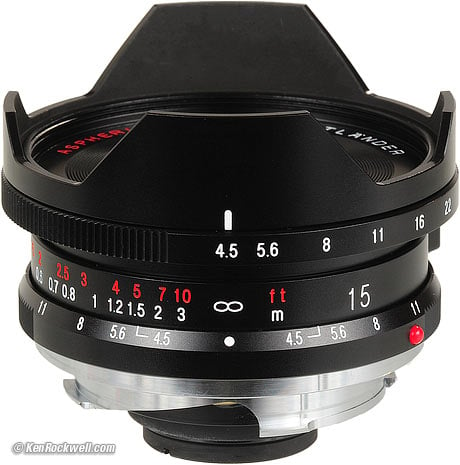 |
Voigtländer 15mm f/4.5 M II ASPH 2009-today, 52mm filters, 155g. An excellent lens in every way. TTL metering works great on all M cameras. Achtung: Although wonderful on film, this lens sucks on the M9 because its rear nodal point is too close for the sensor. The left and right sides take on weird color shifts. For the M9, get the 16-18-21mm zoom instead. |
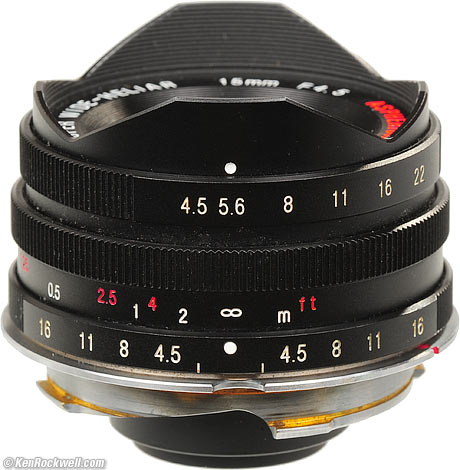 |
1999-today, no filters, 115g. Same as the lens above, except that it's screw-thread, and has no rangefinder coupling or filter thread. Use a screw-mount adapter for M cameras. TTL metering works great on all M cameras. Achtung: Although wonderful on film, this lens sucks on the M9 because its rear nodal point is too close for the sensor. The left and right sides take on weird color shifts. For the M9, get the 16-18-21mm zoom instead. |
18mm (requires external finder) top
Both these 18mm lenses are excellent, and very useful for ultrawide effects. Be sure to read How to Use Ultrawideangle Lenses. If you get one, don't bother getting any 15mm, 21mm or 24mm lens: they are too close to bother carrying all of them and their finders at the same time.
 |
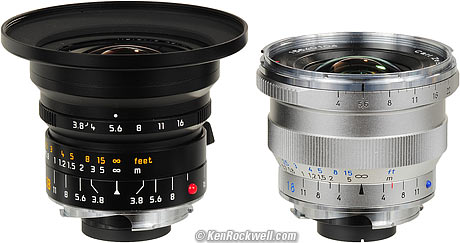
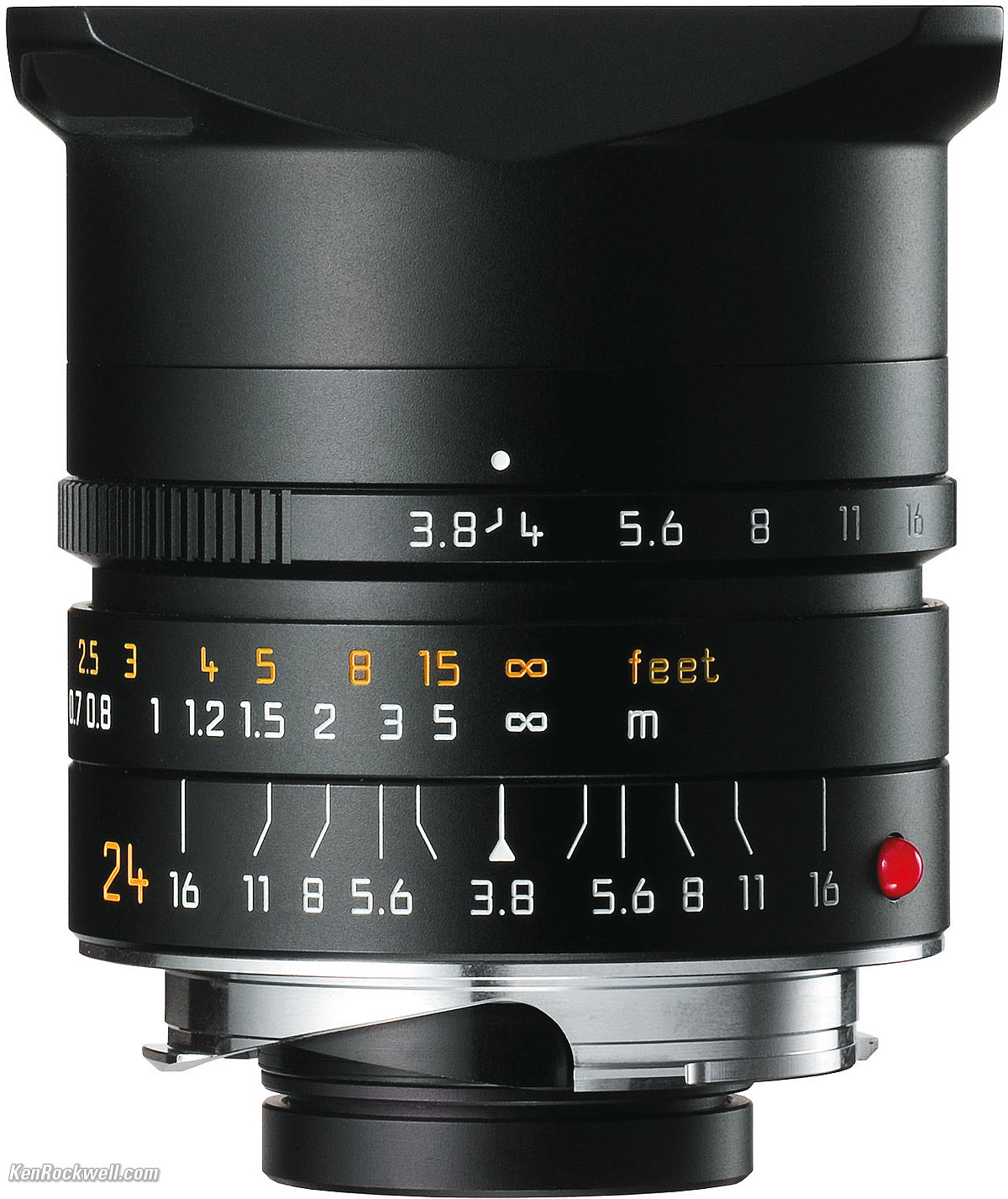
LEICA SUPER-ELMAR-M 18mm f/3.8 ASPH 2009-??, 77mm filters, 310g. 11 649. Fantastic performance at a low price. Needs adapter as shown to use most filters. Full review or check price. I'd get it at eBay or at Amazon.
|
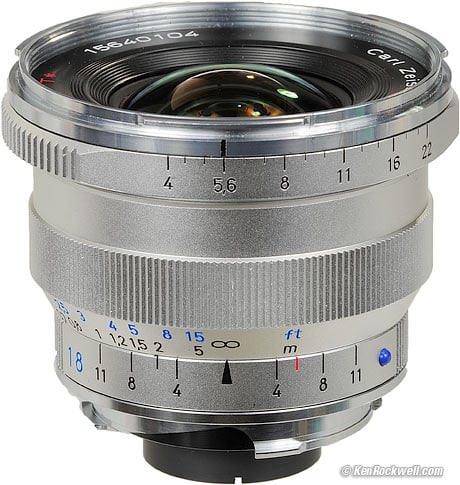 |
2007-today, 58mm filters. 323g. As good as the LEICA, for a lot less money. |
 |
21mm (requires external finder) top
21mm has been the standard ultrawide angle for the LEICA since 1958. Everyone should have one of these. Don't bother carrying any of the 15mm, 18mm, 24mm or 28mm lenses at the same time.
 |
Guide to all LEICA 21mm lenses, 1958 - today Comparison of all 21mm Rangefinder Lenses |
|
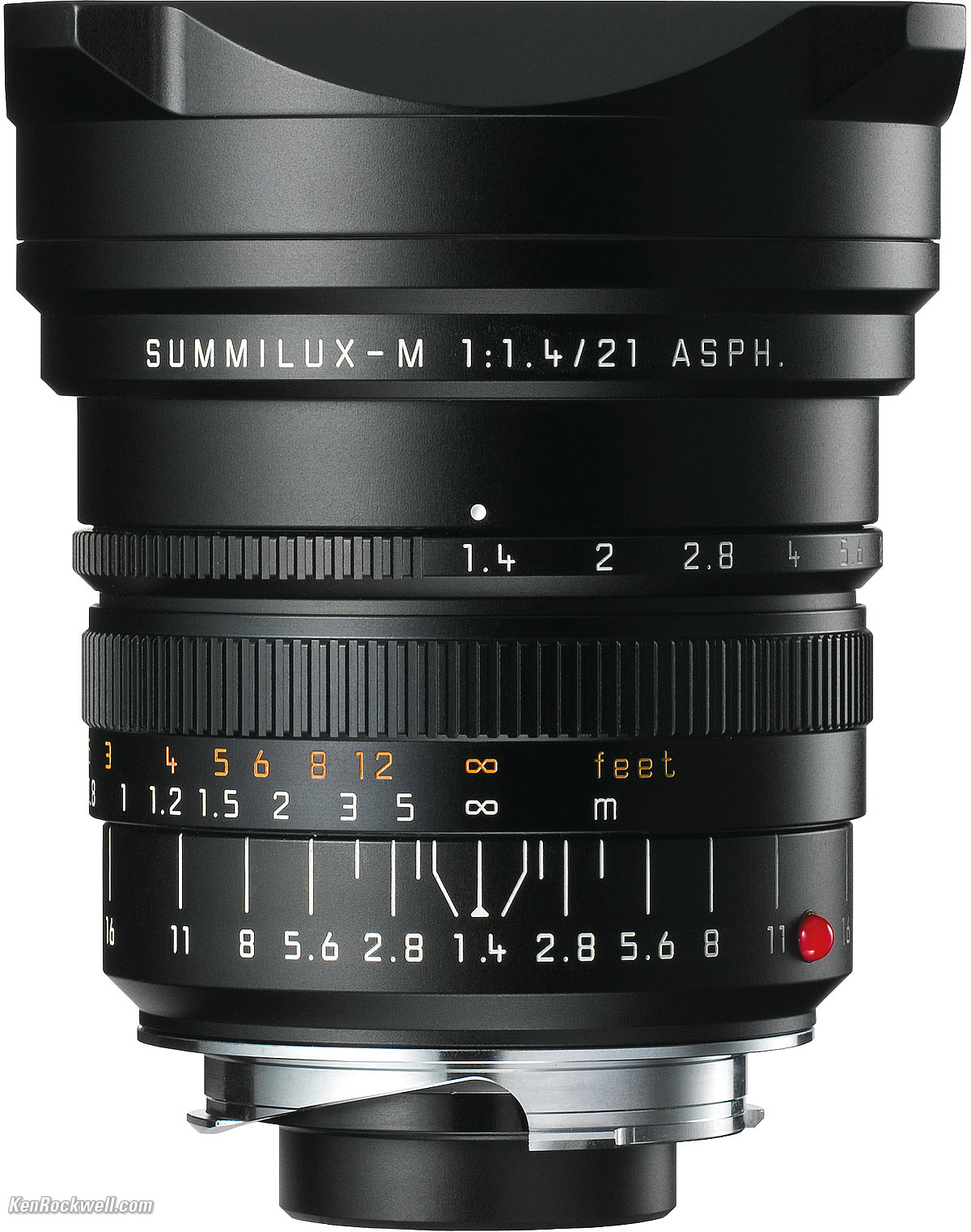
LEICA SUMMILUX-M 21mm f/1.4 ASPH 2008-today, Series VIII filters, 580g. 11 647. $6,500. The world's fastest ultrawide lens. It probably blocks your finder a great deal. Also can take 82mm filters with 14 481 adapter. enlarge image or more information (no review yet) . |

|
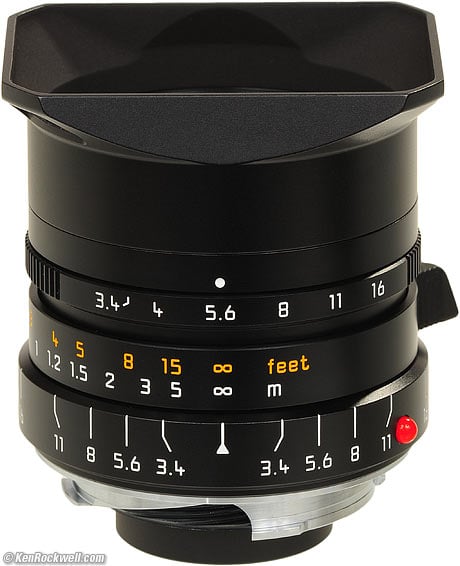
LEICA SUPER-ELMAR-M 21mm f/3.4 ASPH 2011-today, 46mm filters, 263g with hood. 11 145. $2,995 and LEICA's best 21mm lens ever — even better than the $6,500 SUMMILUX above. |
|
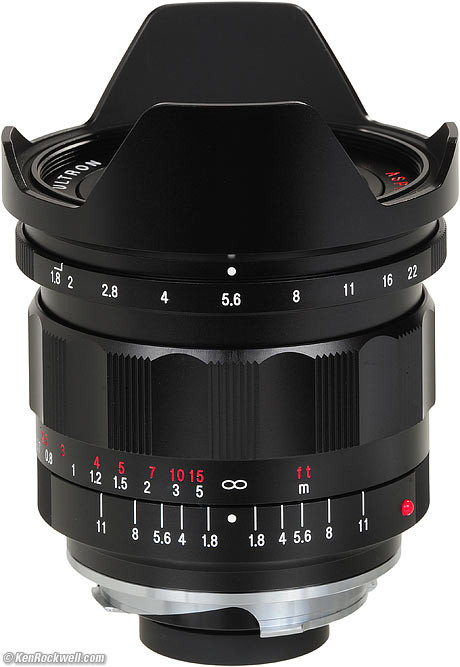
2012-??, 58mm filters, 412g. Optically pretty good, and works great on M9. |
|
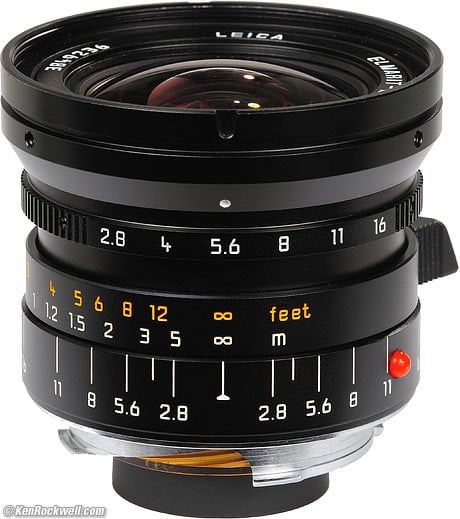
LEICA ELMARIT-M 21mm f/2.8 ASPH 1997-2011, 55mm filters, 317g. 11 135. Leica's standard ultra-wide lens. Sample image (12MB JPG). |
|
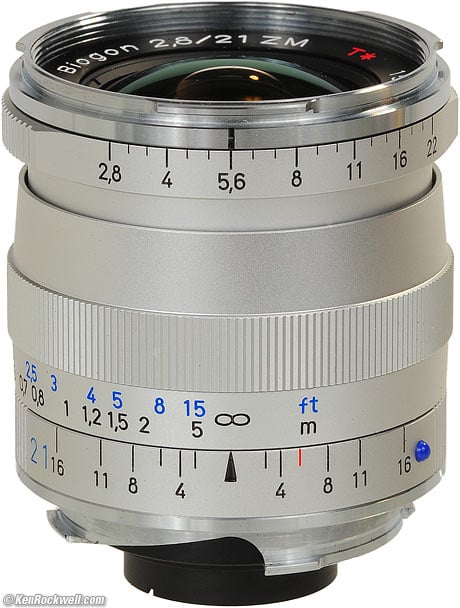
2004-today, 46mm filters, 258g. A superb lens, just as good as the LEICA ELMARIT-M 21mm f/2.8 ASPH. |
|
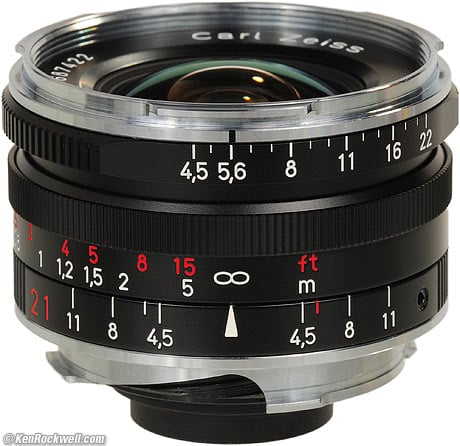
2004-today, 46mm filters, 195g. Even sharper than the LEICA ELMARIT-M 21mm f/2.8 ASPH, but Nicht für die M9. For the M9, get the LEICA 21mm f/2.8 ASPH or Zeiss ZM 21mm f/2.8 instead. |
|
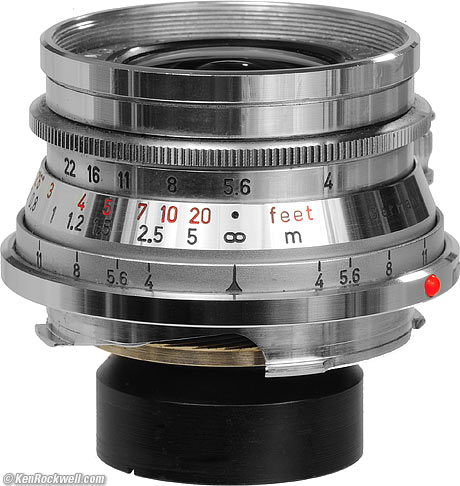
1958-1963, 39mm filters, 251g. 11 102. (screw-mount: 11 002.) A sharp, tiny, distortion-free lens; Leica's only 21mm that takes standard E39 filters and A42 accessories. Achtung: Nicht für die M9. For the M9, get the LEICA 21mm f/2.8 ASPH instead. Sample image (12MB JPG). |
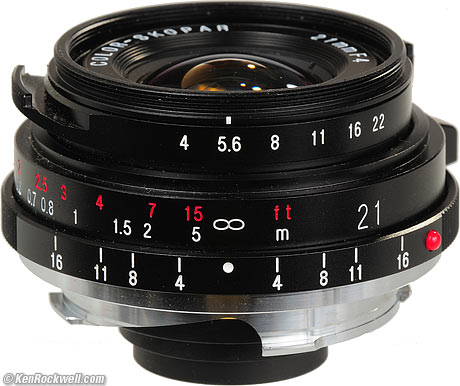 |
2009-today, 39mm filters, 132g. The tiniest ultrawide ever for LEICA. A great performer that fulfills Oskar Barnack's vision even better than Leica's own lenses today. Achtung: Although wonderful on film, this lens is not for the M9 because its rear nodal point is too close for the sensor. The left and right sides take on weird color shifts. For the M9, get the LEICA 21mm f/2.8 ASPH instead. |
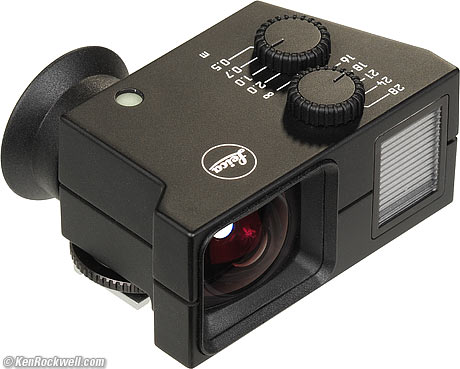 |
Guide to all LEICA 21mm Finders, 1958 - 2009 |
24mm top
I'm not a fan of 24mm lenses on LEICAs because they require an inconvenient external viewfinder. The widest lens supported with the camera's own finder on full-frame LEICAs is 28mm. Since you need to use an external finder, I prefer to use a 28mm lens instead with the camera's own finder, or go all the way to 21mm if I have to use an external finder. Never attempt to swap finders at the same time you swap lenses: you will drop things and go insane. If you must use more than one wide lens with an external finder, use the Universal Wide Finder or the 21-24-28mm zoom finder.
|
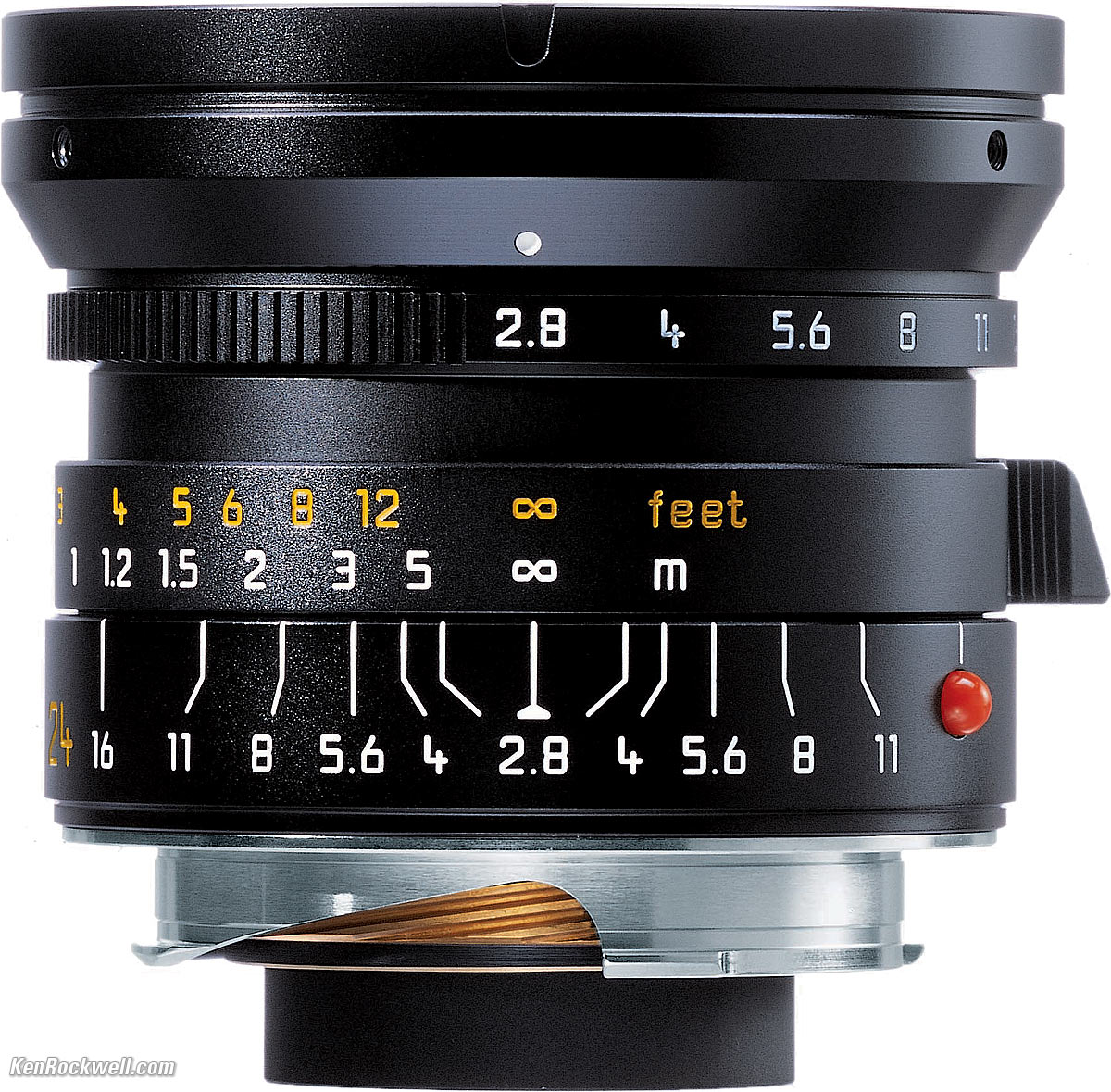
LEICA SUMMILUX-M 24mm f/1.4 ASPH 2008-??, Series VII filters, 468g. 11 601. Leica's fastest 24mm lens. Also takes 72mm filters with 14 479 adapter. Full review or check price (was $6,500 new in 2008). |
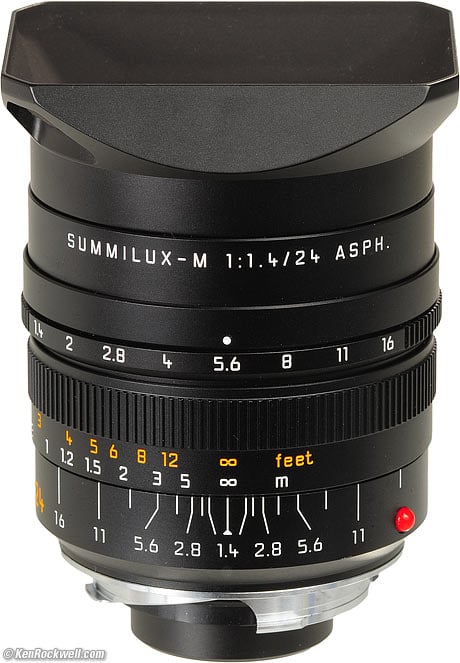
|
LEICA ELMARIT-M 24mm f/2.8 ASPH 1996-at least 2010, 55mm filters, 290g (388g in silver). 11 878. This was Leica's most popular 24mm lens, at a moderate $4,000. It is very similar in size and appearance to its cousin, the 21mm f/2.8 ASPH. |

|
2008-today, 46mm filters, 260g. 11 648. This is Leica's smallest 24mm lens, and also Leica's most insanely sharp and least distorting 24mm lens. It is offered at a very reasonable $2,400. Per Leica's specs, it is super sharp even wide open in the farthest corners. I have no reason to doubt this, although I have yet to try it. |

28mm top
23 Oktober 2023
NEU: LEICA SUMMICRON-M 28mm f/2 ASPH Edition 2023.
46mm filters, 9.7 oz./275 g,1.3'/0.4m close-focus.
January 2016:
LEICA SUMMICRON-M 28MM f/2 ASPH, also at B&H.
LEICA ELMARIT-M 28mm f/2.8 ASPH, also at B&H.
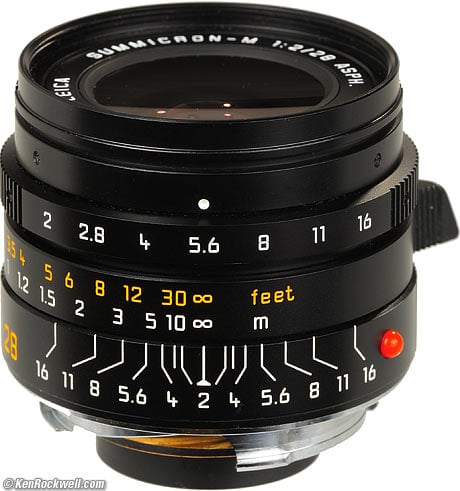 |
LEICA SUMMICRON-M 28mm f/2 ASPH 2000-at least 2010, 46mm filters, 256g. 11 604. (11 661 in silver aluminum, 270g.) The world's sharpest wide-angle lens. It is the only 28mm f/2 lens ever made by Leica. It is fantastic on the M9. |
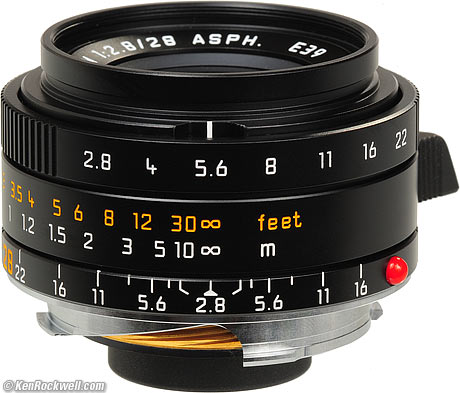 |
LEICA ELMARIT-M 28mm f/2.8 ASPH 2006-today, 39mm filters 173g. 11 606. Leica's tiniest current lens, and a stellar performer as well. If you can get only one wide lens, this is a great choice. Especially with the M9, there is no need for the f/2 ASPH unless you just have to have it. This f/2.8 is fantastic on the M9. |
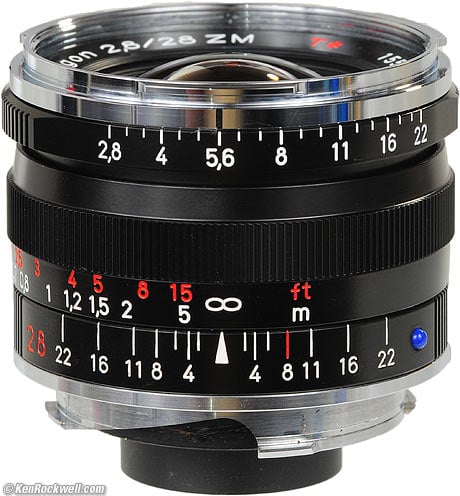 |
2000s-today, 46mm filters, 210g. Optically a bit better than the LEICA 28mm f/2.8 ASPH and it can use two stacked 46mm filters without vignetting in full-frame, but it's bigger, heavier and blocks the finder. |
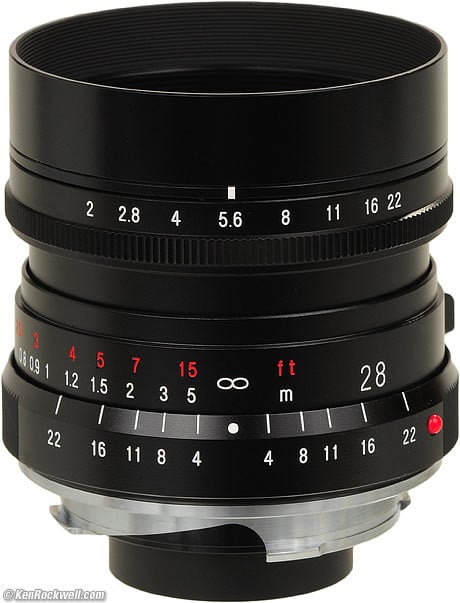 |
2008-today, 46mm filters, 243g. Inferior to the current LEICA lenses, but at one-sixth the price of the current LEICA SUMMICRON, a great lens for lesser cameras. |
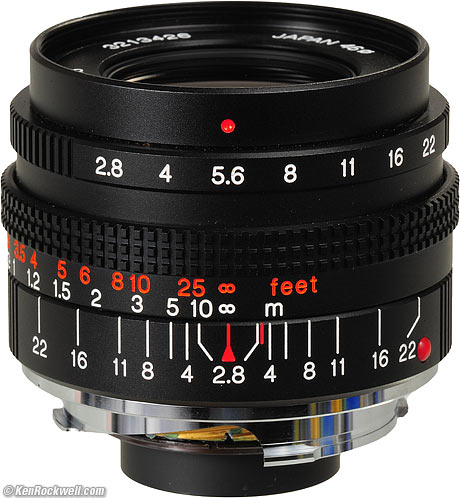 |
1990s, 46mm filters, 226g. Optically and mechanically inferior to the LEICA 28mm f/2.8 ASPH and Zeiss 28mm f/2.8 ZM, oddly it sells for almost as much used. |
 |
Older LEICA 28mm f/2.8 lenses 1936-2008. I would forget any older LEICA 28mm lens. Today's 28mm f/2.8 ASPH is the highest-performance f/2.8 they've ever made, and it doesn't cost much more brand new than older 28mm lenses cost used! Today's f/2.8 is also the smallest 28mm f/2.8 ever made by Leica and it takes the standard 39mm filter, so it's a no-brainer. |
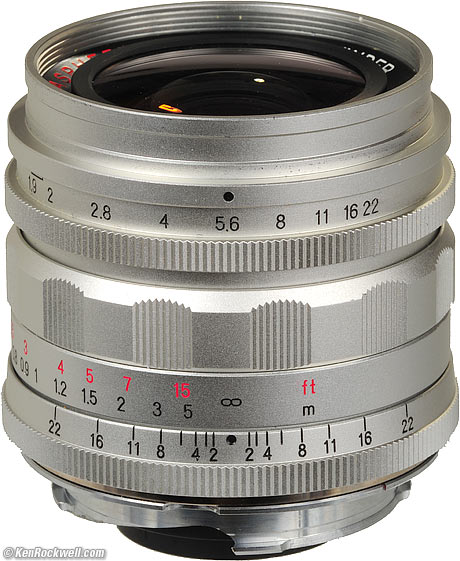 |
2000-2008, 46mm filters, 261g. Inferior to LEICA in every way, but far less expensive and good enough for most people. |
35mm top
NOCTILUX-M f/1.2 SUMMILUX: f/1.4 SUMMICRON: f/2
SUMMARON: f/2.8 und f/3.5 SUMMARIT-M: f/2.5
LEICA SUMMICRON 35mm Sharpness Comparison 14 January 2011
35mm NOCTILUX-M: Hyper-Speed f/1.4 35mm top
|
NEU: LEICA NOCTILUX-M 35mm f/1.2 ASPH.Typ 11 635, 49mm filters, 14.7 oz./416g, 1.6'/0.5m close-focus, 0.09× macro ratio, 10 elements in 5 groups (3 are glass-molded asperical elements), 11-blade diaphragm, ø2.54 × 1.98" (ø64.6 × 50.2mm). Check price at B&H and at Adorama, or get it used at eBay if you know How to Win at eBay, or get it used at KEH. 30 January 2026 |

35mm SUMMILUX: Ultra-Speed f/1.4 35mm top
NEW |
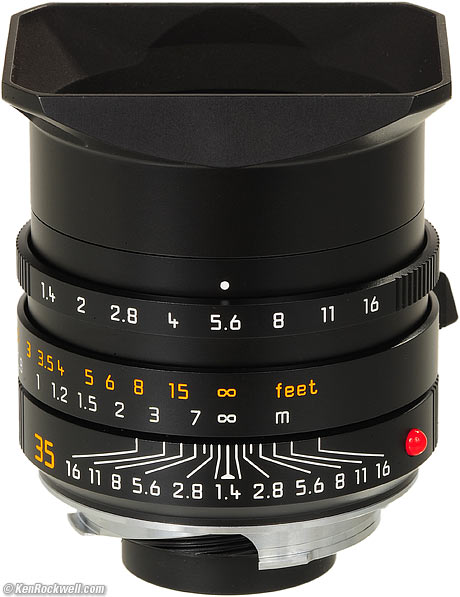
NEU: LEICA SUMMILUX-M 35mm f/1.4 ASPH «SAFARI» 11 734.Announced 04 December 2025, 46mm filters, 1.3' (0.4m) close-focus, 0.11× macro ratio, 338g. It's a new green variant of the 11 726 Schwarz und 11 727 Silber versions announced 19 September 2022. All add a built-in hood and Doppelnockensystem (double cam system) to compensate the optics to focus as closely as 0.4m (1.3') — very useful on the newest M EV1 where you can see the focus that close. They also have 11 blade diaphragms, up from 9 in the otherwise optically identical 2010-2022 SUMMILUX-M 35mm f/1.4 ASPH (floating element). These and the optically identical 2010-2022 ASPH versions are the world's highest-performance fast wide-angle lenses. I have a full review of the 2010-2022 ASPH version. |
|
LEICA SUMMILUX-M 35mm f/1.4 ASPH (floating element) 2010-2022, 46mm filters, 312g. 11 663. The world's highest-performance fast wide-angle lens. Full review. Sample image (13MB JPG). |
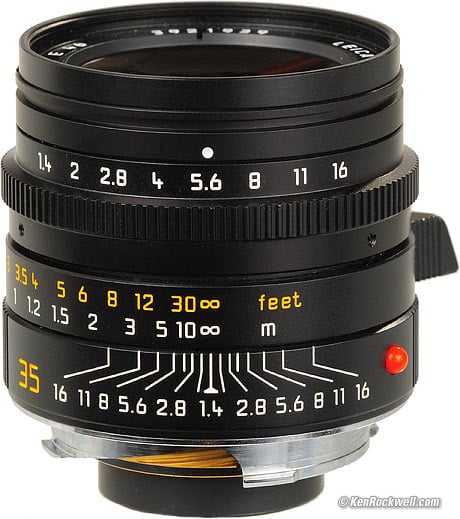 |
LEICA SUMMILUX-M 35mm f/1.4 ASPH 1994-2010, 46mm filters, 307g. 11 874. The world's second-highest-performance fast wide-angle lens. Full review. Sample image (5MB JPG). |
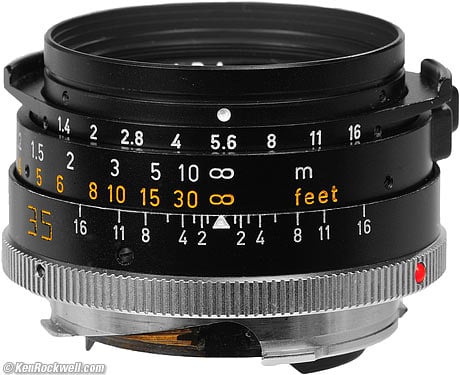 |
1960-1995, 41mm or Serie VII filters (details), 184g. 11 870. (Für M3: 11 871, 325g.) The world's smallest professional f/1.4 lens. It's fantastic stopped down, but today's LEICA SUMMILUX-M 35mm f/1.4 ASPH is far superior at f/1.4. |
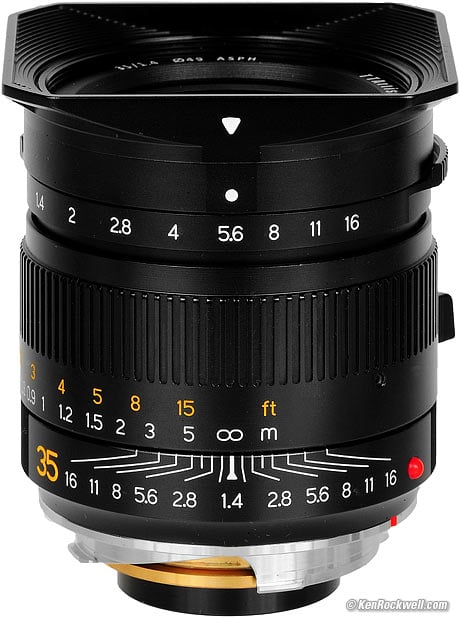
NEW: TTArtisan 35mm f/1.4 ASPHAlso comes in sliver. Metal 49mm filter thread, 13.9 oz./395 g, 2¼'/0.7m close focus. 25 August 2021 |
35mm SUMMICRON: Ultra-Performance f/2 35mm top
LEICA SUMMICRON 35mm Sharpness Comparison 14 January 2011
NEUE 04 März, 2021:
LEICA APO-SUMMICRON-M 35MM f/2 ASPH BLACK 11 699, also at B&H.
NEUE Januar 2016:
LEICA SUMMICRON-M 35MM f/2 ASPH BLACK 11 673, also at B&H and at Crutchfield.
LEICA SUMMICRON-M 35MM f/2 ASPH SILVER 11 674, also at B&H.
|
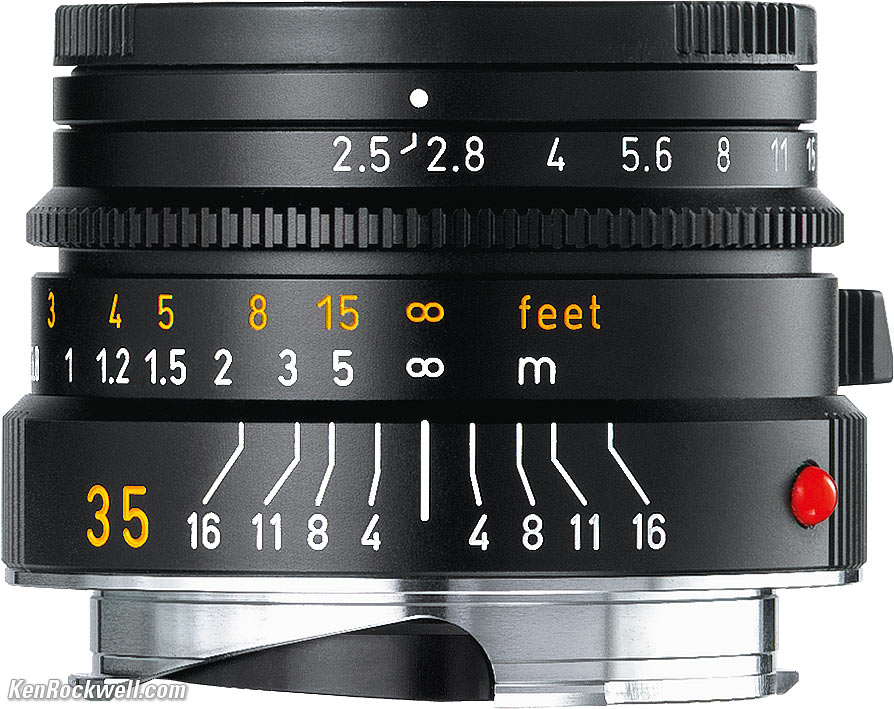
LEICA SUMMICRON-M 35mm f/2 ASPH 1996-2016, 39mm filters. Black (11 879): 254g. Chrome (11 882): 340g. 1999: Leica made a small run of these mit Schraubgewinde M 39 (screw mount) for Leica's original 1932-1960 cameras like the LEICA IIIf. Shipped with a traditional 12 504 hood instead of the current plastic thing and focusing only to 1 meter, these are otherwise the same as the standard model. Hewn from solid brass, these chrome beauties weigh 324.9g (11.460 oz.), Verk. Nr. 11 608. Leica's most practical wide-angle today. It comes in black aluminum (11 879) and chromed brass (11 882). Distortion: -0.8 at infinity, -1.5 at 3 meters, -1.0 at 1 meter. |
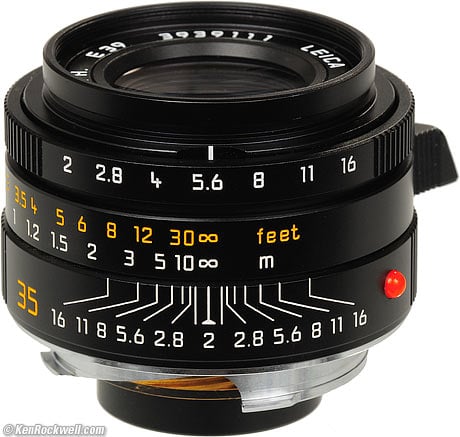
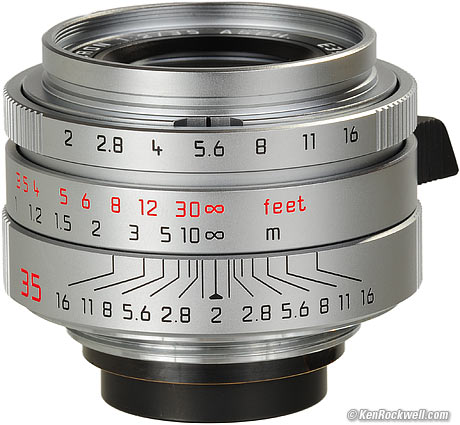
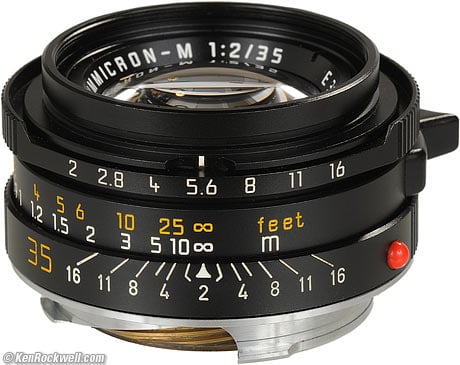 |
1979-1996, 39mm filters, 156g, 7 elements, 10 blades. Black (11 310); also silver (11 311) from 1993. 12 524 plastic hood. Plastic 14 268 front cap. Laymen call all of these "version 4" or the "King of Bokeh," even though its bokeh is pretty poor as with most LEICA 35mm lenses. Distortion: 0.0 at infinity, -0.5 at 3 meters, +0.3 at 1 meter. |
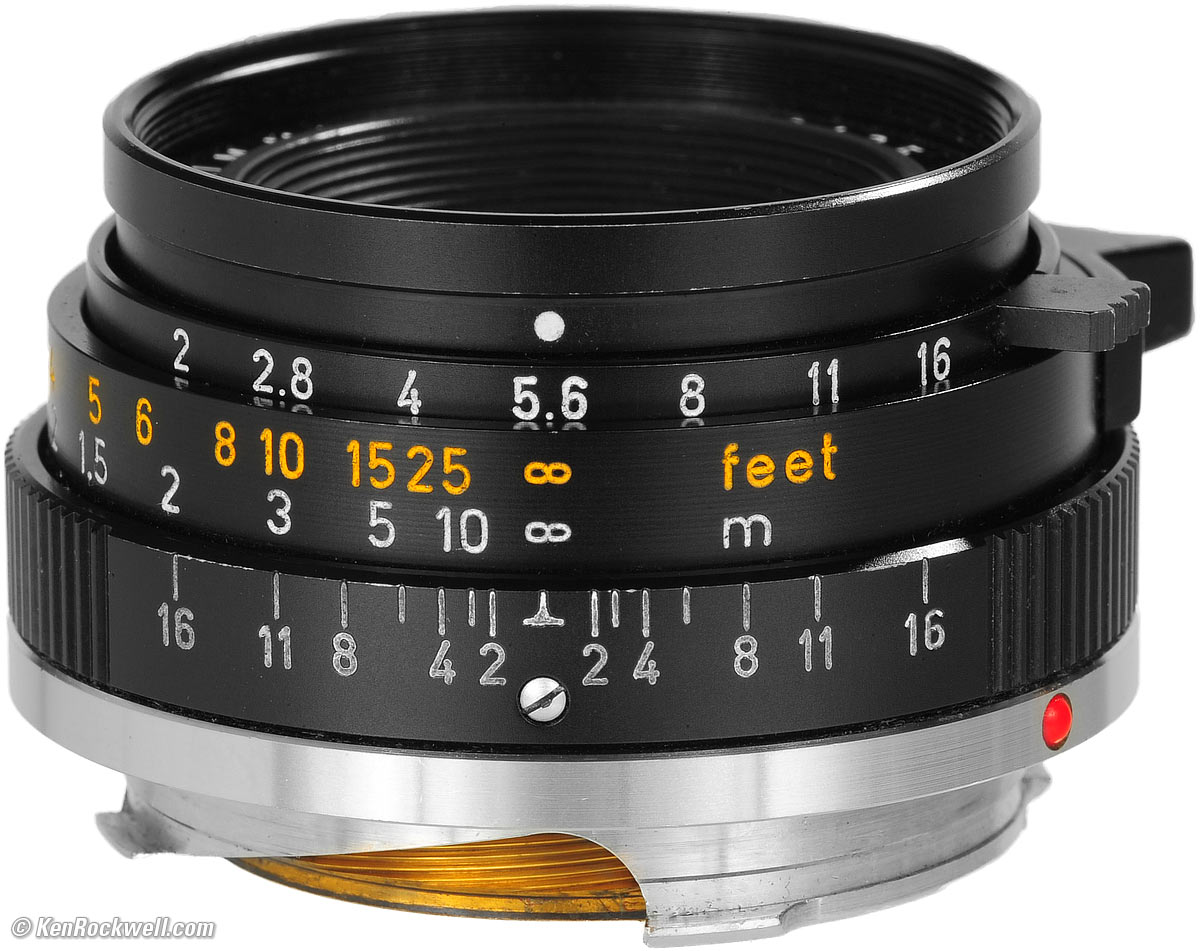 |
LEICA SUMMICRON 35mm f/2 1969-1979, 39mm filters, 6.040 oz./171.2g, 11 309, 6 elements, 10 blades. 1969-1971: Made in Germany. Laymen call this "version 2." 1971-1979: Made in Canada. Laymen call this "version 3." Contrastier in the center at f/2, but never as sharp in the corners as the 1958-1979 (8-element) version. The 35mm f/2 ASPH outdoes them all. Distortion: +0.8 at infinity, +0.5 at 3 meters, +0.9 at 1 meter. Spherochromatism is very minor. enlarge image (review coming). |
|
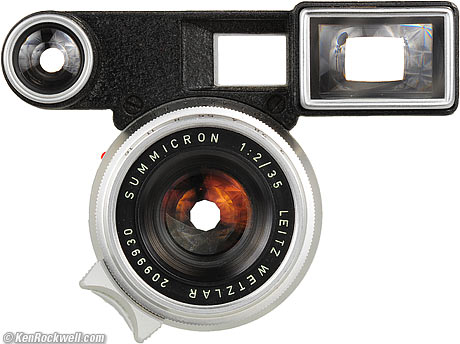
1958-1974, 39mm filters, 238g, 8-elements, 10 blades. 11 108 as shown (11 104 in black). 11 308 without M3 auxiliary finder optics (11 307 Z in black). 11 008 in screw mount. A stellar performer even today, and priced to match. Even with the auxiliary finder optics shown, weighs less than today's ASPH version and performs as well, with even less distoerion. Laymen call this "version 1." Distortion: +0.6 at infinity, 0.0 at 3 meters, +0.5 at 1 meter. |
|
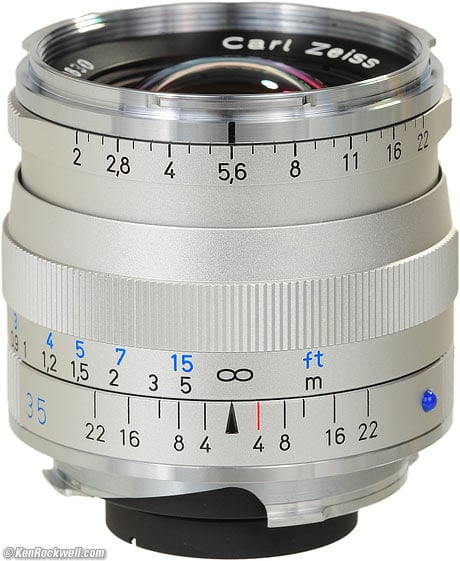
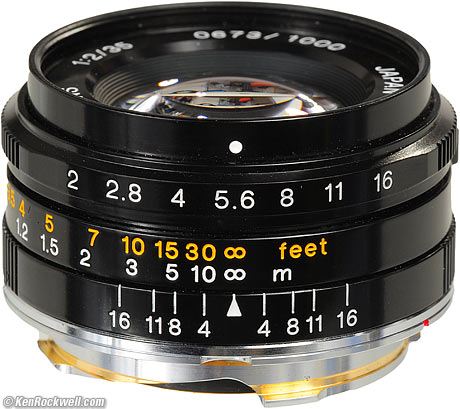
2004-, 43mm filters, 224g, 9 elements, 10 blades. Optics and mechanics about as good as the LEICA SUMMICRON-M 35mm f/2 ASPH for one-third the price, but with a screwy filter size and more finder blockage. |
 |
1990s, 43mm filters, 132g. The lightest 35mm lens for LEICA, but optically inferior to the LEICA SUMMICRON-M 35mm f/2 ASPH. |
35mm SUMMARON: Classic Performance 35mm top
 |
LEICA SUMMARON 35mm f/2.81958-1974, 39mm filters, 239g. SIMWO/11 106; SIMOO/11 006 without M3 auxiliary finder optics. A bargain today, and a great performer. |
1948-1956: A36 filters.
1957-1960: E39 filters.
|
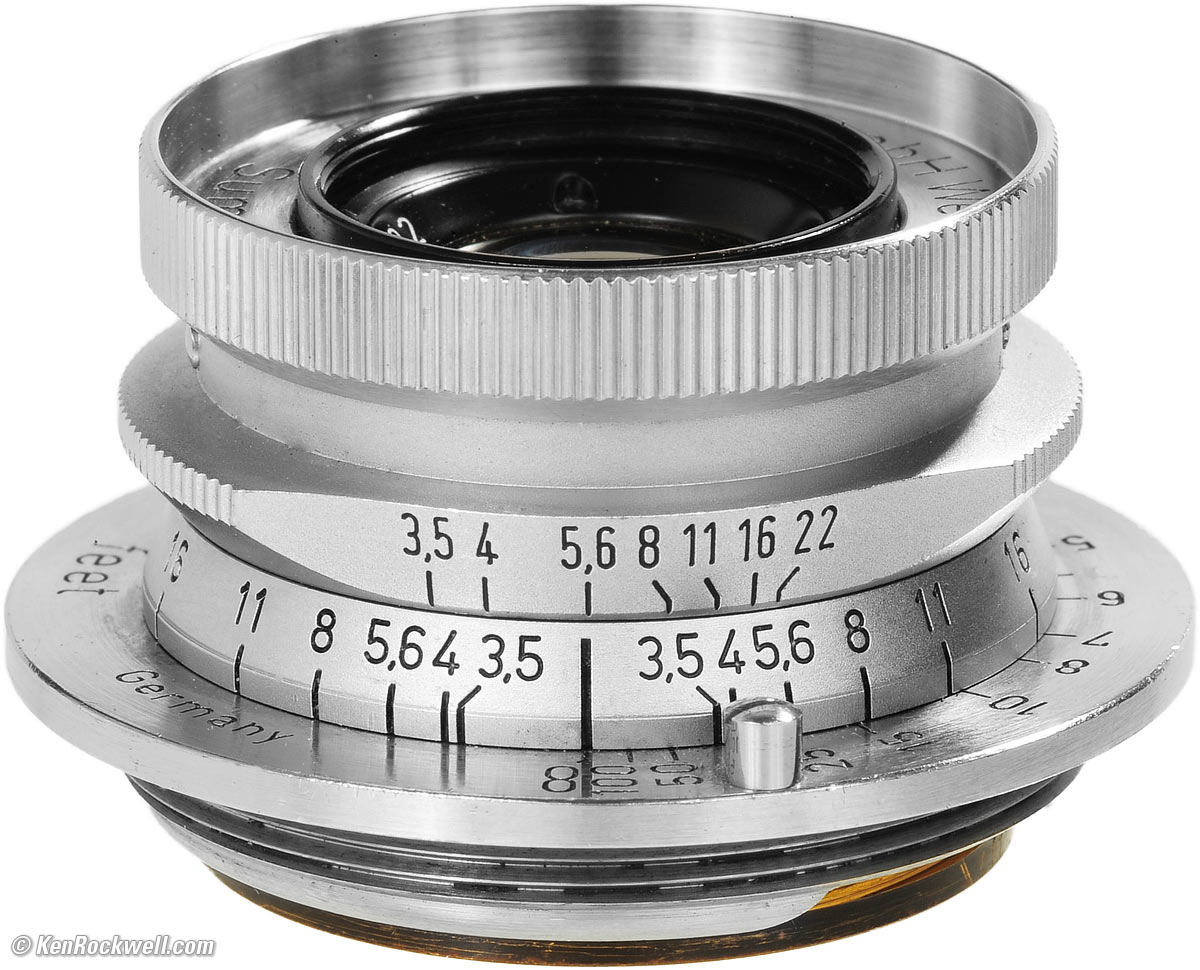
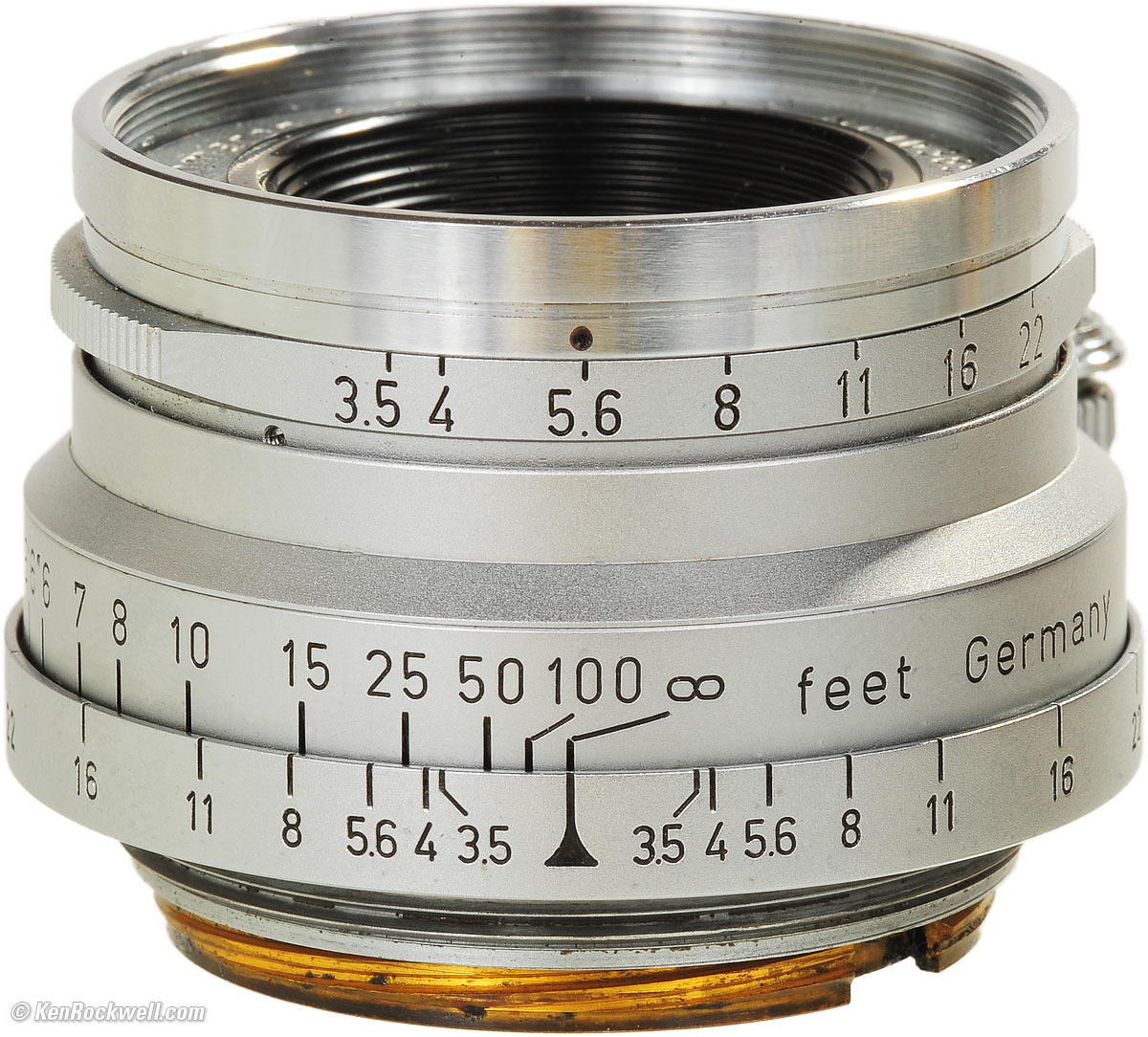
LEICA SUMMARON 35mm f/3.51948-1960, A36, later 39mm filters, 6 elements, 10 blades, screw and bayonet mounts. 1948-1956: SOONC, M39 screw-mount, A36 filters, 145.4g (5.130 oz.), 1m close focus. 1954-1960: SOONC-M, bayonet mount, 39mm filters, 1m close focus. No auxiliary finder optics for the LEICA M3, needs an external finder. 1956-1960: SOONC-MW then SOMWO, Bayonet mount, 39mm filters, 0.65m close focus. Includes auxiliary finder optics for the LEICA M3. 1957-1960: SOONC, M39 screw-mount, 39mm filters, 172.4g (6.080 oz.), 1m close focus. With the introduction of the larger M-mount version, this later screw-mount version was updated to use the same parts. A36: enlarge image (review coming). E39: enlarge image (review coming). This is a super sharp lens. Its classic and authentic look can't be matched by anything non-LEICA. It makes great photos, but since isn’t worshipped by collectors it sells for much less than other lenses — and takes the same great pictures. If you want great photos and money matters, get one, but if you want to show off what an exotic camera you have as do most LEICAMEN, instead stretch for the SUMMICRON or SUMMILUX. |
|
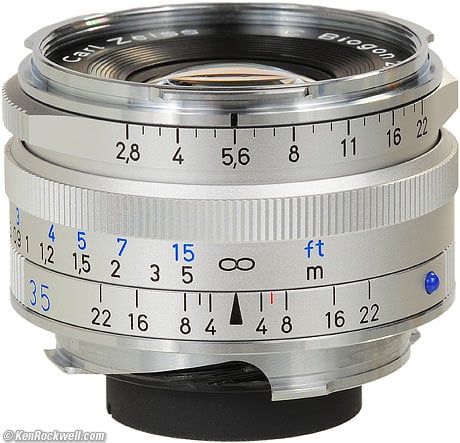
2008-, 43mm filters, 178g, 7 elements, 10 blades. Optics and mechanics as good as the LEICA SUMMICRON-M 35mm f/2 ASPH for less than one-third the price, but with a screwy filter size. |
35mm SUMMARIT-M: Discount f/2.5 35mm top
 |
LEICA SUMMARIT-M 35mm f/2.5 (low-price lens für Voigtländer ünd Zeiss kameras) 2007-today, 39mm filters, 220g. 11 643. I haven't used this new lens, but the other Summarit-M lens I used had superb optical quality with sub-par mechanical quality. I wouldn't buy one of these. For less money you can get a used 35mm SUMMICRON lens of whatever vintage you like, including the current ASPH, or get a 1960's SUMMARON f/2.8 which ought to do about the same thing for a whole lot less. enlarge image or more information (no review yet). |
40mm top
40mm lenses are designed for the LEICA CL and CLE, both of which have 40mm frame lines. It's a bit silly to use this lens on other cameras, on which it selects the 50mm frame lines
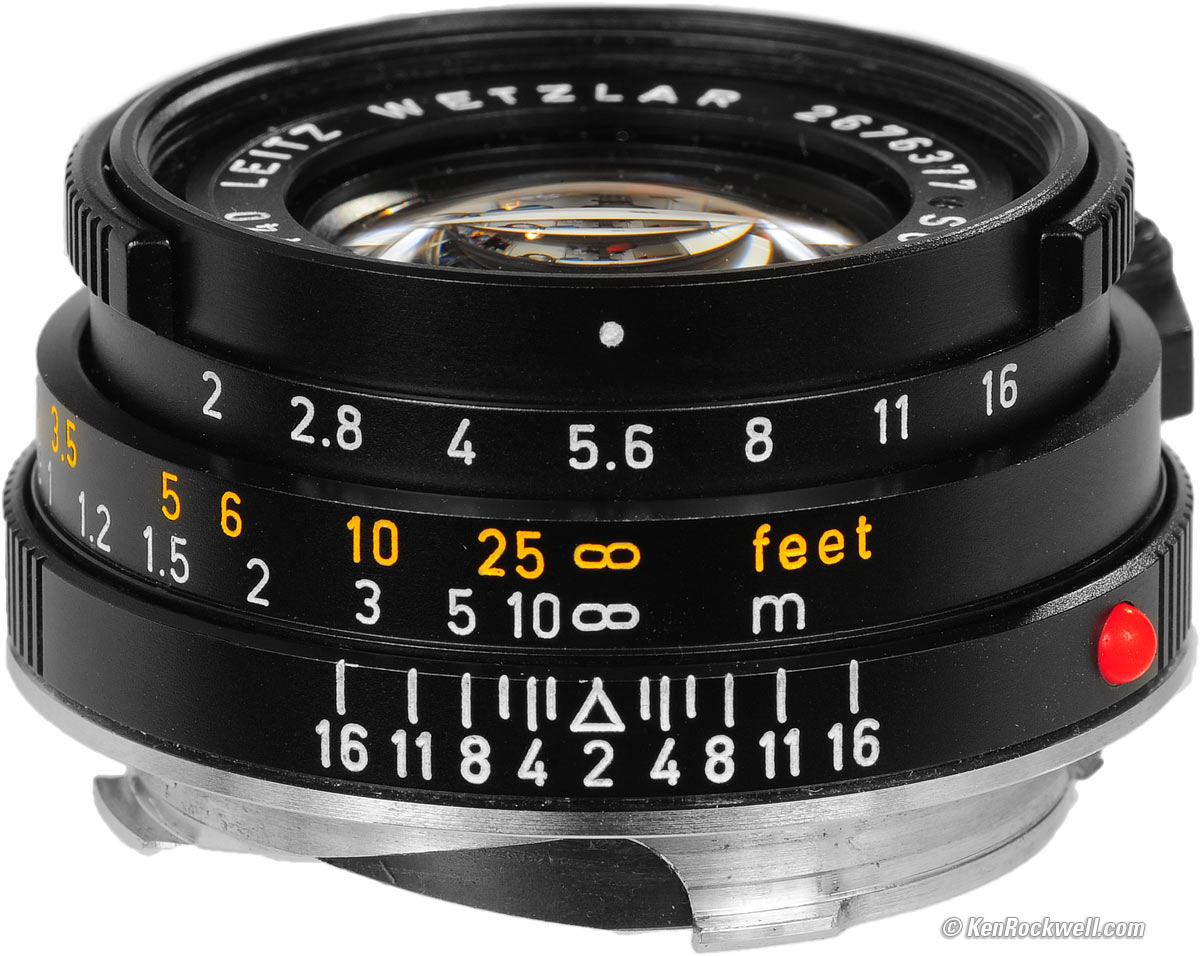 |
LEICA SUMMICRON-C 40mm f/2 1973-1977, 39 x 0.75mm filters, 126g. 11 542. This may be the smallest and lightest M lens ever made by LEICA. It focuses perfectly on my LEICA M9, CLE and other LEICAs. It works very well and is super-sharp, albeit a little less contrasty in the corners at f/2. Background bokeh is bad (foreground bokeh is great, but that doesn't count). Watch the filter thread: it's not a standard 39mm thread. Leica intends for this to be used with nonexistent series 5.5 filters held in place by the dedicated threaded rubber/metal hood 12 518. The lens' threads are the same diameter, but too coarse to receive standard filters. I use regular 39mm filters, but I only screw them in to where they first stop. Force them and you destroy everything. enlarge image and example photos (review coming). |
50mm top
NOCTILUX f/1 SUMMILUX f/1.4 SUMMICRON f/2 ELMAR SUMMARIT
All LEICA 50mm lenses are superb. Even the uncoated f/3.5 ELMAR from 1934 gives me bright, contrasty, sharp and vividly colorful images.
50mm NOCTILUX: Ultra Speed 50mm top
|
Neu von LEICA in schwarz glänzend (glossy black)Neu: LEICA NOCTILUX 50mm f/1.2 ASPH, schwarz glänzend (glossy black). Neu: LEICA M11, schwarz glänzend (glossy black). 21 November 2024, Thursday
|
 |
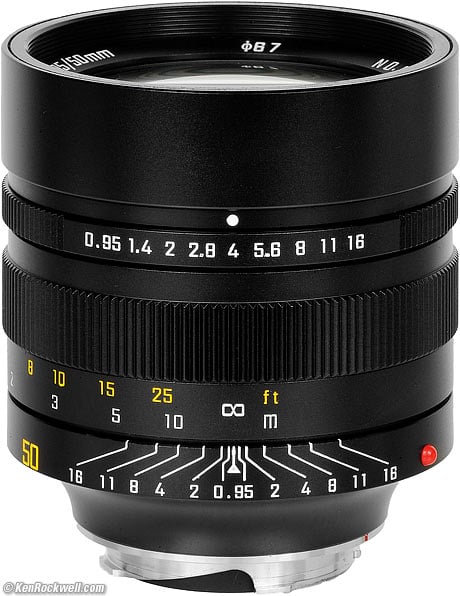
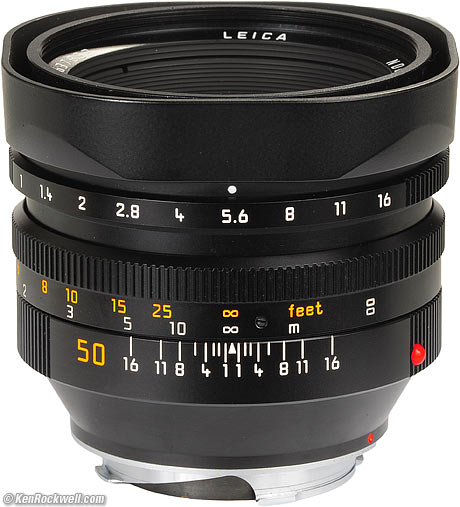
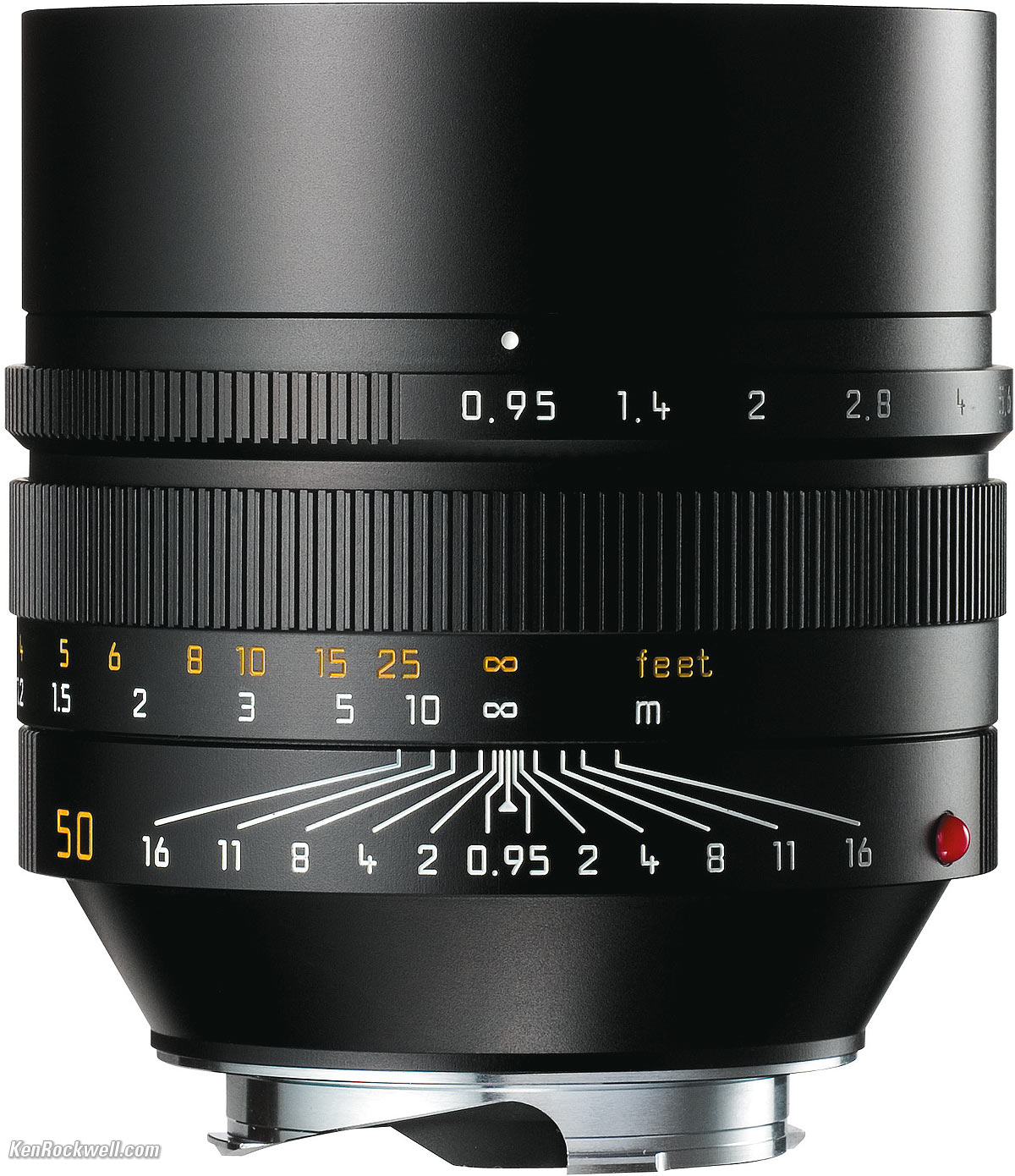
LEICA NOCTILUX-M 50mm f/0.95 ASPH 2008-today, 60mm filters, 700g. 11 602. The 60mm C-Polarizer is 13 406. Leica's show-off lens, this huge thing weighs a ton. It sells for a for a mere $10,500. It has very little distortion, and is a huge improvement over the older f/1 spherical lens. enlarge image or more information (no review yet). |
|
NEU: Mitakon 50mm f/0.95 für LEICA M und all mirrorless camerasMetal 67mm filter thread, 23.7 oz./673 g, 3.3'/1.0m close focus, also comes in silver. 09 January 2021 |
 |
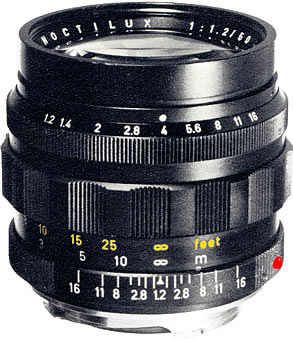
1976-2008, 60mm filters, 584g, made in Canada. 11 821. (Earliest version used 58mm filters, a bayonet metal hood and weighed 580g.) The 60mm C-Polarizer was 13 376, now 13 406. These sell for about $5,000 used. They use conventional spherical optics. They were only recently discontinued, and since many people buy them to try once, they are easy to find used. |
 |
LEICA NOCTILUX 50mm f/1.2 1966-1975, Series VIII filters, 470-515g. 11 820. Spare hood: 12 503. 8 elements (1-ASPH), 5 groups, 73mm ∅by 75.1mm long, 1:17 macro, 1 meter close-focus. These sold for about $5,000 used in 2009, and as of 2013 they sell for about $10,000 used. They are the world's first mass-produced aspherical lens, with two hand-ground aspherical surfaces. enlarge image (no review yet). |
 |
Edition 2021~, 49mm filters, 405g, 1m close-focus. enlarge image (no review yet). |
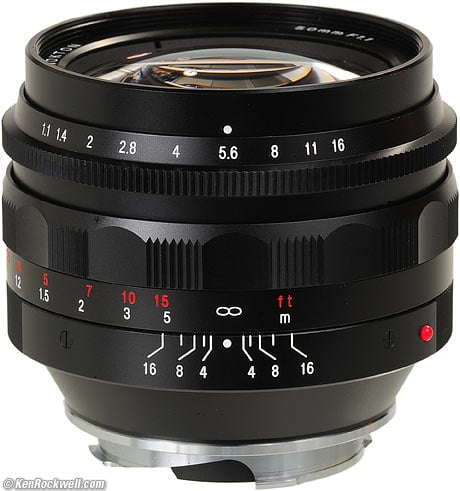 |
2010-, 58mm filters, 434g, about $1,000. A poor performer, introduced as a gimmick for the less critical. |
50mm SUMMILUX: Ultra Speed f/1.4 50mm top
|
NEU: LEICA SUMMILUX-M 50mm f/1.4 ASPH Glänzend Schwarz (glossy black) 11 713 und «SAFARI» 11 736.This Glänzend Schwarz (glossy black) 11 713 und «SAFARI» 11 736 are new-color veriations of 2023's Schwarz (black) 11 728 und Silber (silver) 11 729. 8 elements in 5 groups, 11 blades, 46mm filters, 0.45m/1.5' close focus, 337g. 04 December 2025 |
|
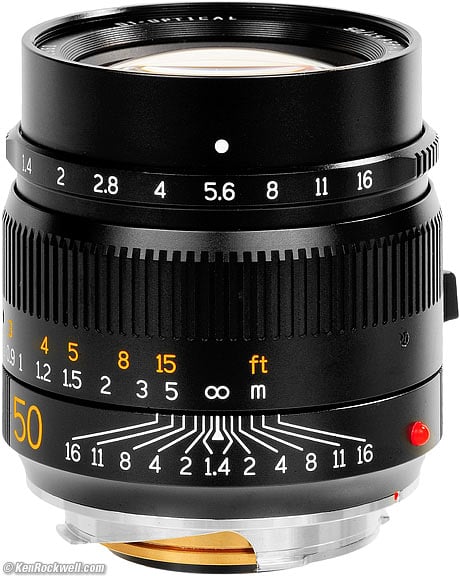
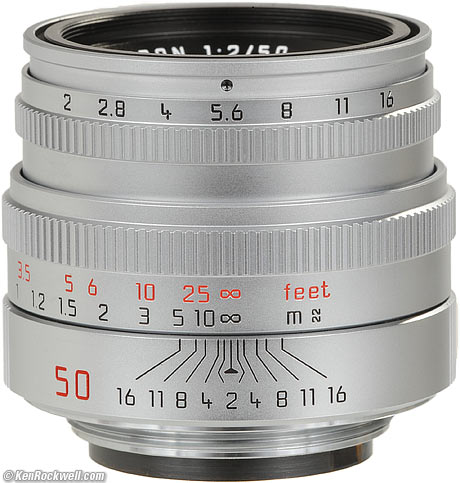
NEU: LEICA SUMMILUX 50mm f/1.4 (Edition 2025, Typ. 11 714).This is a modern recreation of the original 1961 LEICA SUMMILUX 50mm f/1.4. Its optics have been slightly updated. Chrome-plated brass, 7 spherical elements in 5 groups, 46mm filters, heavy brass 14.7 oz./417g, 0.7m close-focus, 12 diaphragm blades. Hood included. 20 Feb 2025. |
|
NEU: LEICA SUMMMILUX-M 50mm f/1.4 ASPH (Edition 2023) 11 728, also in silver 11 729.8 elements in 5 groups, built-in hood, 46mm filters, 11 blades, 0.45m/1.5' close focus, 0.16× macro ratio, 337g. This is only LEICA's third 50/1.4 optical design since 1961. Hopefully this one is sharp; the SUMMICRON have always been superior to the SUMMILUX "speed" lenses in 50mm. I know this lens came out in 2023 and it's already 2026, but in LEICA years, this is still NEU. They only update optical designs every 20 years or so. The original 50/1.4 (1961~2004) was a "speed" lens that sacrificed ultimate sharpness in the quest for speed. The previous ASPH (2004-today) had far superior bokeh (the best of any LEICA lens I've seen), but paradoxically also sacrificed sharpness for it. Let's hope they get it right this time. |
Premium 50mm lenses compared September 2014
|
LEICA SUMMILUX-M 50mm f/1.4 ASPH 2004-today, 46mm filters, built-in locking hood. 335g in black aluminum 11 891; 460g in chromed brass, 11 892. 2015: black aluminum 335g version taking 43mm filters to look like the 1961-1991 version below: 11 688, All have 0.7m (2.3') close focus. This is the only 50mm f/1.4 on the planet that uses aspherical optics and floating elements. Every other 50mm f/1.4 lens, even Nikon's newest 50mm f/1.4 AF-S of 2008, makes due with conventional spherical optics and fixed elements. In 2003, a special LHSA version was struck: 11 628 in chrome, styled as the 1960s 50mm SUMMILUX (E43 0.5mm filter), but mit 0.7m close-focus and much faster focus pitch. It also came in black paint. 375 of each color were sold with the MP3 LHSA, and 125 of each color sold alone, 1000 total.
|

New: TTArtisan 50mm f/1.4 ASPH Review.Metal 49mm filter thread, 14.0 oz./398g, 2¼'/0.7m close focus. 24 December 2020 |
1964 version. |
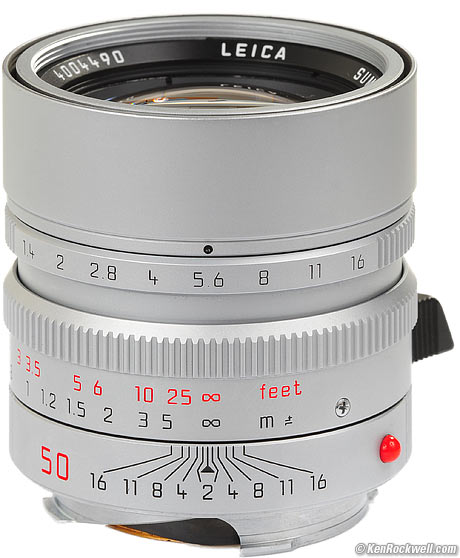
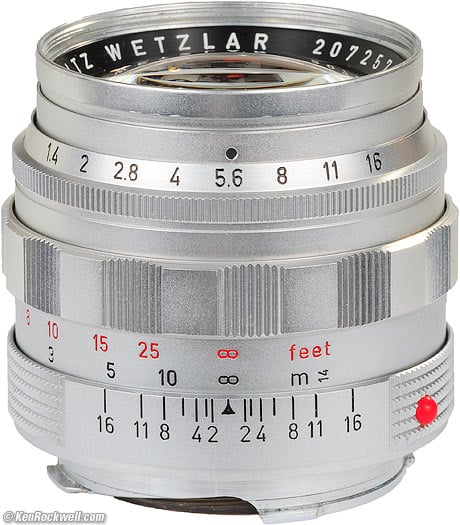
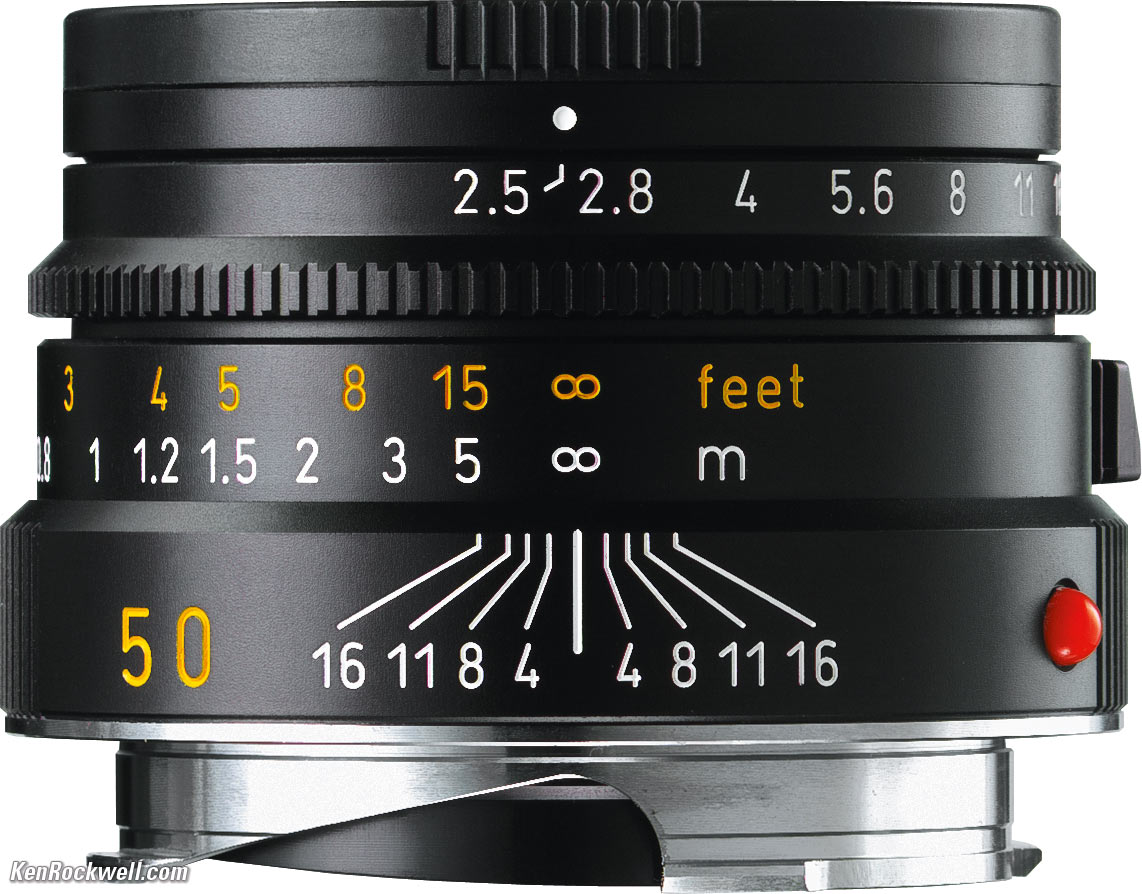
1961-2004, all with identical optics and coatings. 1961-1991: 43mm filters, 300g. 11 114. 1992-2004: 46mm filters, 360g, and adds built-in hood. 11 868. 1999: Special screw-mount version sold only in Japan. This was the world's highest performance 50mm f/1.4 lens for 43 years. Its performance is exceeded only by the newer LEICA SUMMILUX-M 50mm f/1.4 ASPH, introduced in 2004, and still exceeds the performance of Nikon and Canon 50mm f/1.4 lenses. Not bad for a lens designed in 1960! |
|
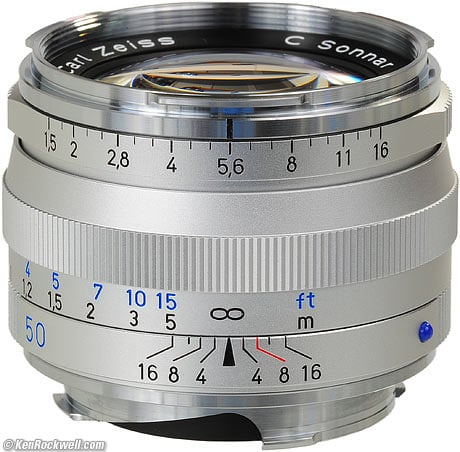
2004-today, 46mm filters, 232g. A very compact, high-speed lens with outstanding bokeh. It's a remake of Zeiss' Sonnar of the 1930s. |
50mm SUMMICRON: Ultimate Performance f/2 50mm top
See also my LEICA SUMMICRON 50mm Guide.
LEICA APO-SUMMICRON-M 50mm f/2 ASPH (Black)
LEICA APO-SUMMICRON-M 50mm f/2 ASPH (Silver)
1994-today
1979-1994
|
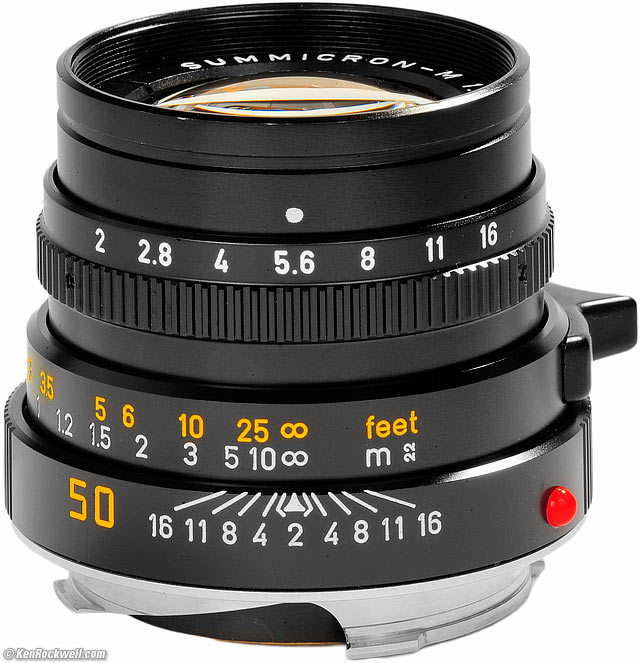
1979-today, 39mm filters, 8-blade diaphragm. Made in Canada 1979-1985, then Germany 1985-today. These all use the same optics, differing only in their outward mechanics: 1994-today: built-in hood, ring focus. Most often seen in black anodized aluminum: 240g, 11 826. Also seen in chromed brass: 335g, 11 816; and in "titan coated brass:" 11 624. 1979-1994: round clip-on plastic hood, tab focus, 197.6g. 11 819 (schwarz), 11 825 (silber chrom). Special Editions: 2002 (Verk. Nr. 11 615): Leica made a small run of these modern optics in the same style as the rigid 1956 SUMMICRON, but with the modern squared font, to commemorate the 50th anniversary of the 1952 SUMMICRON. Leica didn't bother to copy the mechanics of the more appropriate collapsible 1952 SUMMICRON because it cost too much to duplicate, and instead settled on copying the later, cheapest rigid design. Leica also goofed in making this commemorative in M-mount, which did not exist in 1952, but would have allowed universal compatibility with all LEICAs, as the M39 version below does. 1999 (Verk. Nr. 11 619): Leica made a small run of these in traditional M39 screw mount for Leica's original 1932-1960 cameras like the LEICA IIIf. They are otherwise the same as the current model, with 39mm filters, a built-in hood and ring focus. Hewn from solid brass, these screw-mount chrome beauties weigh 324.65g (11.450 oz.). This is the fourth optical iteration of the 50mm SUMMICRON on which Leica has built its reputation since 1953. All versions are wonderful, and today's optical iteration is the world's standard for 50mm performance. Street names for these two mount types are "type 4" for the 1979-1994 version and "type 5" for the 1994-current version. You could not go wrong with any 50mm SUMMICRON as your only LEICA lens. |

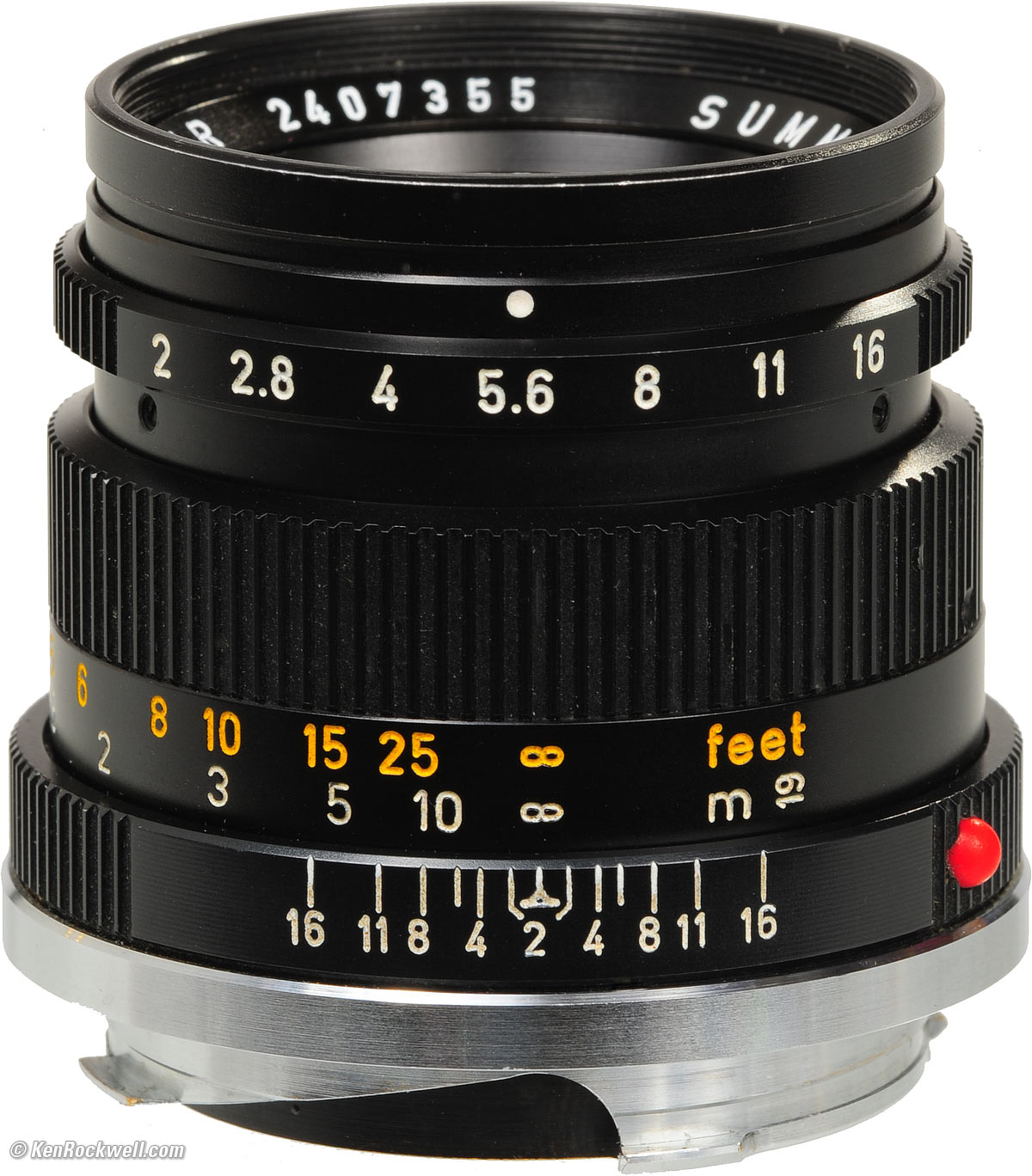 |
LEICA SUMMICRON 50mm f/2 1969-1979, 39mm filters, 200g. 11 817. This is the third optical iteration of Leica's 50mm f/2 SUMMICRON, with six elements. It is one optical version before today's SUMMICRON-M optical design. Its street name is "type 3." You could not go wrong with this lens as your only LEICA lens, for only about $400 used. Its performance is similar to the previous 1957-1968 SUMMICRON, with more contrast in exchange for a little less resolution. Dollar for dollar, Leica's best 50mm f/2 lens, but Leica has never been about price. enlarge image. Example photos from Death Valley and Route 66. (review coming). |
Rigid.
With near-focusing range (shown without viewfinder attachment) |
1956-1968, 39mm filters, 7 elements, 10 blades. This SUMMICRON has similar, but superior, optics to the first version from 1952. All these versions share the same optics (Laymen call these "type 2"): 1956- : Rigid screw mount, meters: SOSTA or 11 518. 1960-1963: Rigid screw mount, feet: 11 018 (rare). 1956-1968: Rigid bayonet mount, 251g, SOSIC or 11 818. 1956-1968: Rigid bayonet mount with near-focusing range (to 478mm), 339g + 52g finder attachment, SOMNI or 11 918. These are superior lenses, and are usually in good shape when found used. |
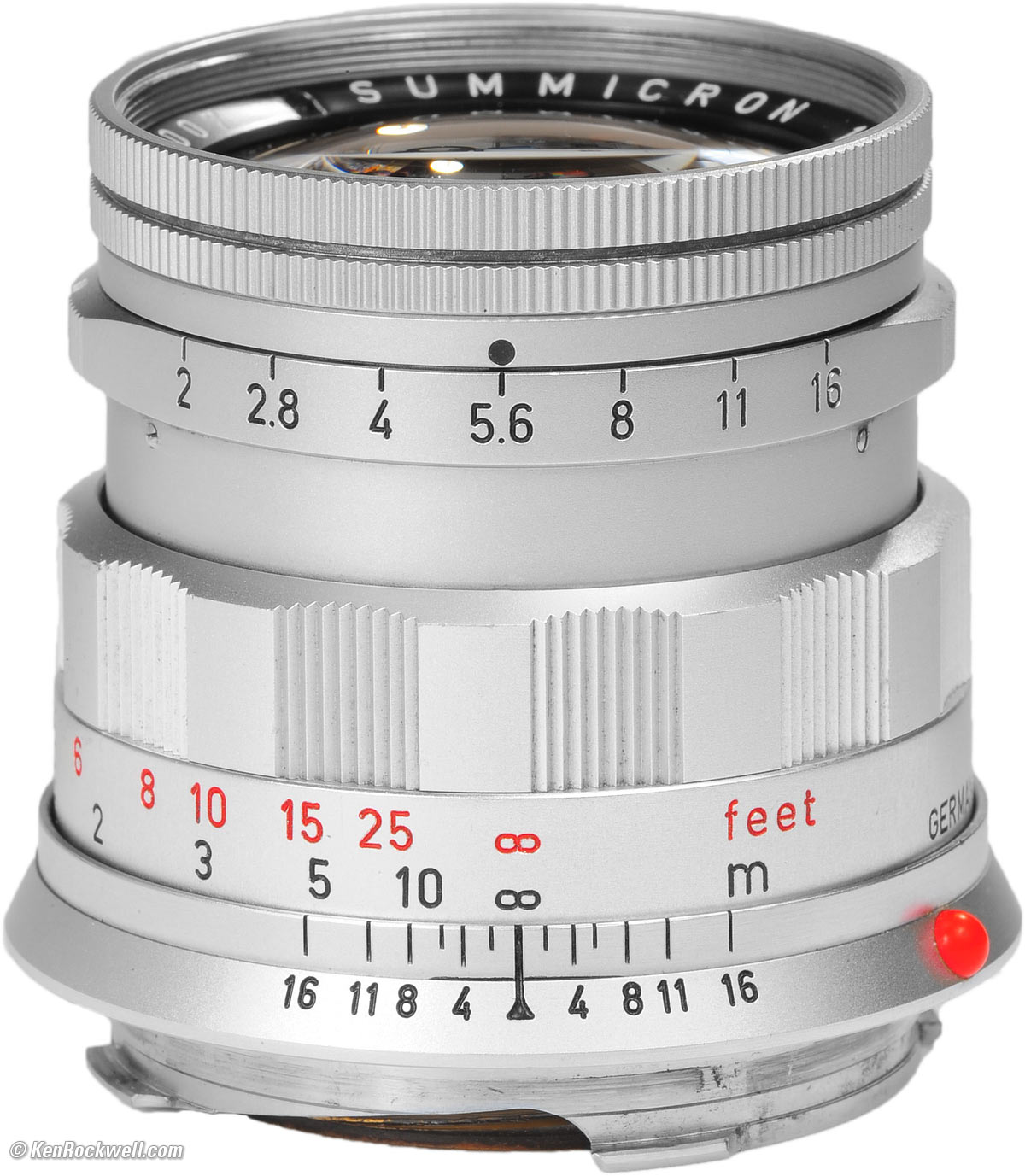
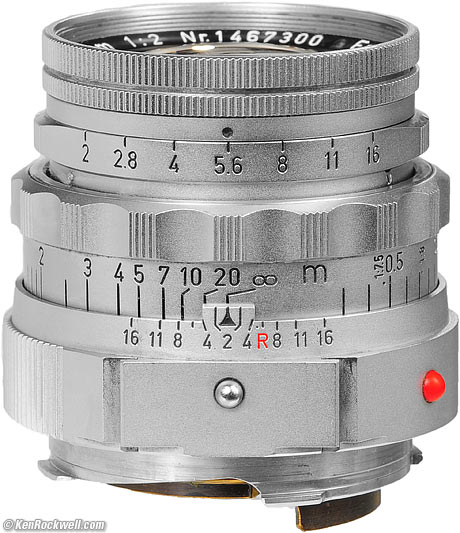
Screw mount.
Bayonet mount. |
LEICA SUMMICRON 5cm f/2 1952-1960, 39mm filters. This is Leica's first 50mm SUMMICRON, with seven elements and 10 blades. It replaces the SUMMITAR (1939-1953), which replaced the SUMMAR (1933-1939, 6 blades). The two versions differ only mechanically from each other: 1952-1960: collapsible screw mount, 216.2g, 7.625 oz., SOOIC. (228.7g, 8.065 oz. mit M-adapter.) 1954-1957: collapsible M mount, 233.8g, 8.245 oz., SOOIC-M. The street name for this SUMMICRON is "type 1," although specifying the year is more correct. A prototype with a leaf shutter was made in 1956 for use at high flash sync speeds up to 1/200, but was never sold. These are great lenses, but be careful: it's front element is made of glass as soft as chalk. It is highly unlikely that you will find one in usable condition. This lens design is described in US Patent 2,622 478. click either to enlarge (reviews coming). |
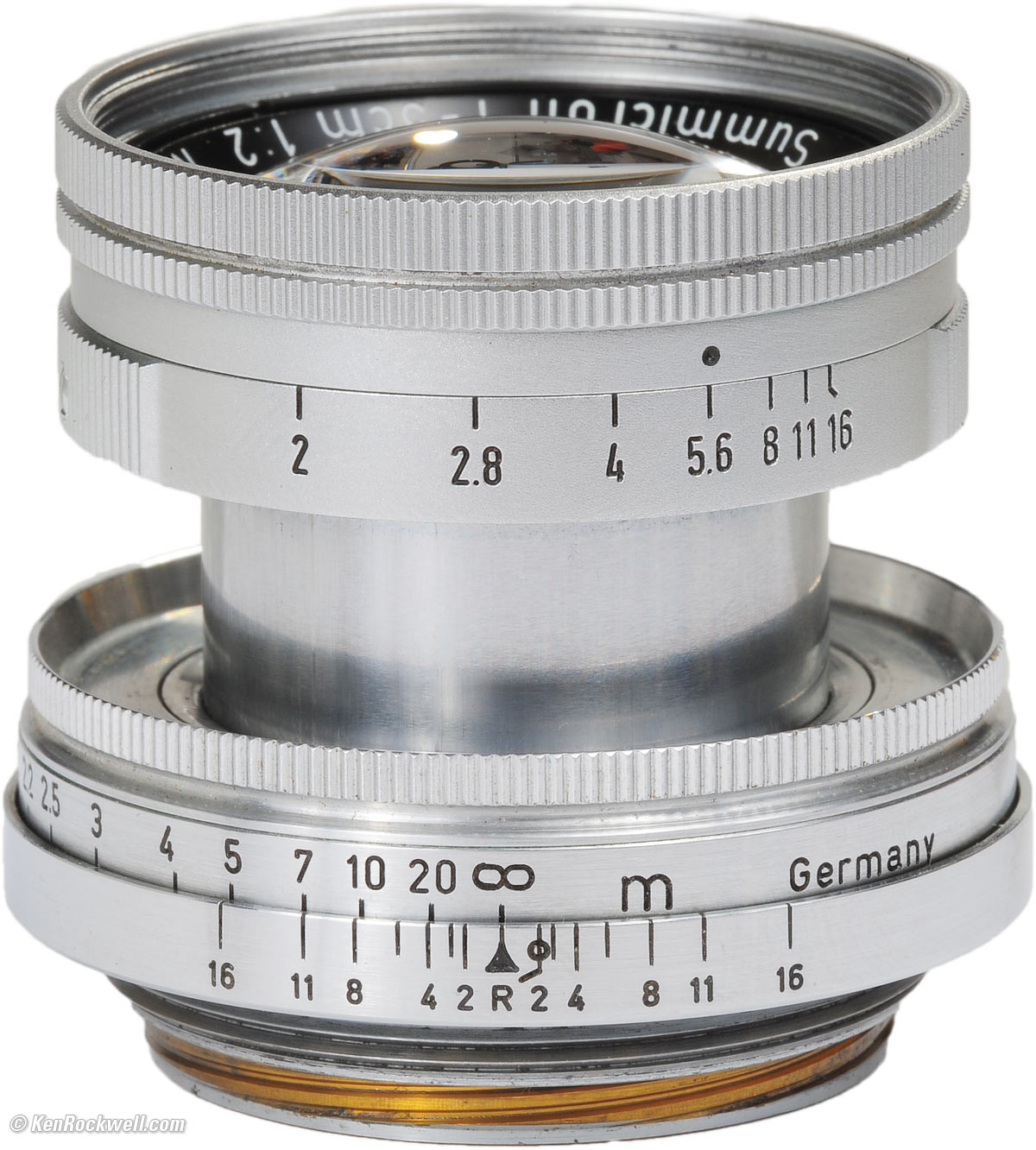
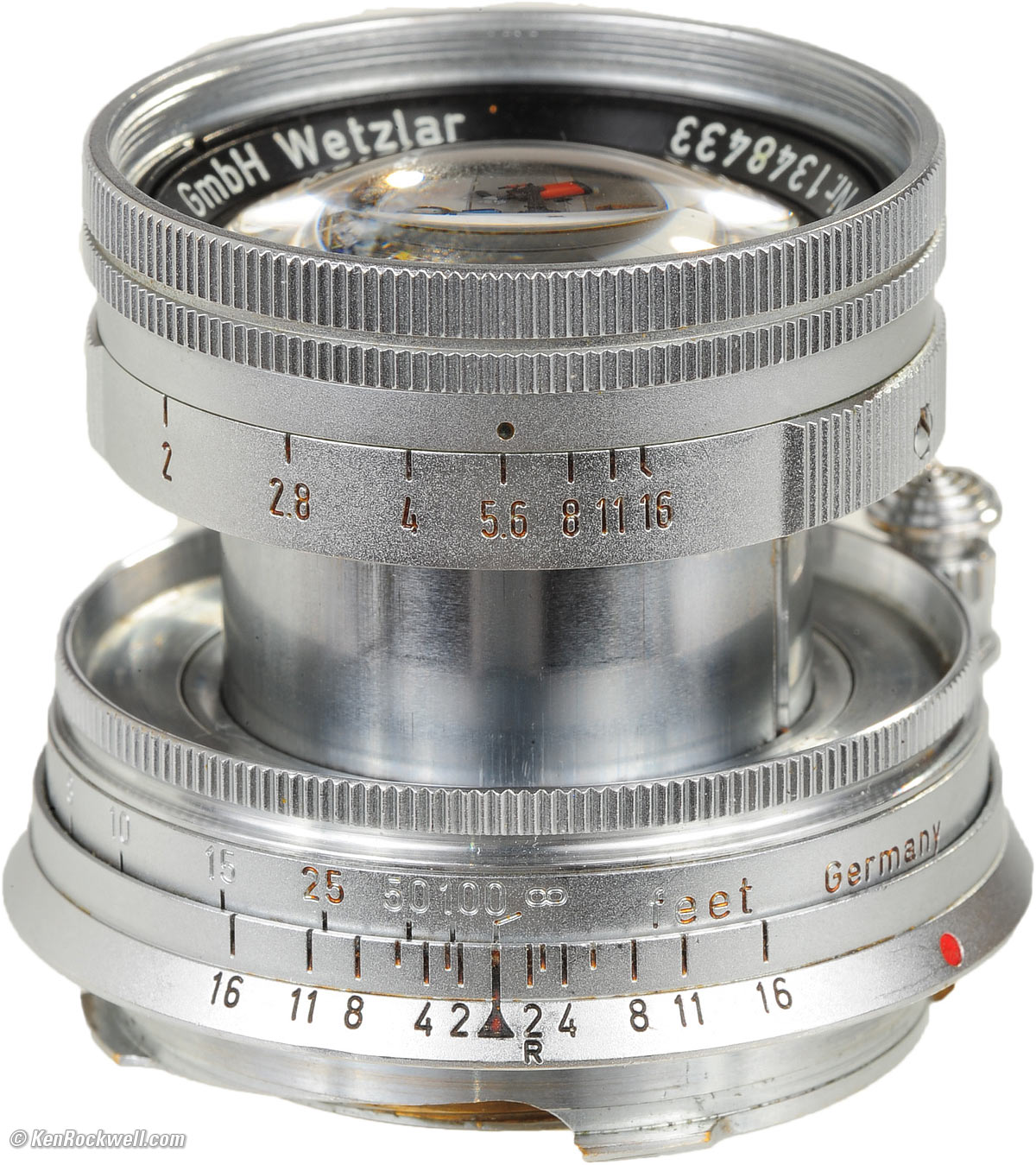
Screw mount only. |
1939-1953, screw-mount collapsible only, Type L filters, 206g, SOORE. 1939-1950: 10 blades, then 6 blades, 1950-1953. 1946-1953: coated. This SUMMITAR replaced the SUMMAR (1933-1939, 6 elements, 6 blades), improving corner falloff by using a larger front optical component. This front optical component was updated to two cemented elements, instead of the single front element of the SUMMAR. |
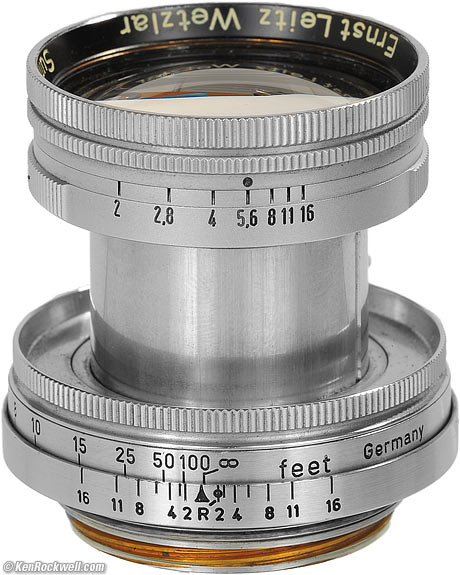
|
Screw mount only. |
1932-1939, screw-mount collapsible only, A36 filters, (use SOOGZ adapter for 39mm filters), 6.240 oz./176.8g, 6 elements, 6 blades, uncoated. The SUMMAR was the first speed lens for the LEICA, with a blinding f/2 speed for photography under any conditions, even for color work. The SUMMAR was such a landmark that LEICA couldn't meet demand for a couple of years after its introduction! |
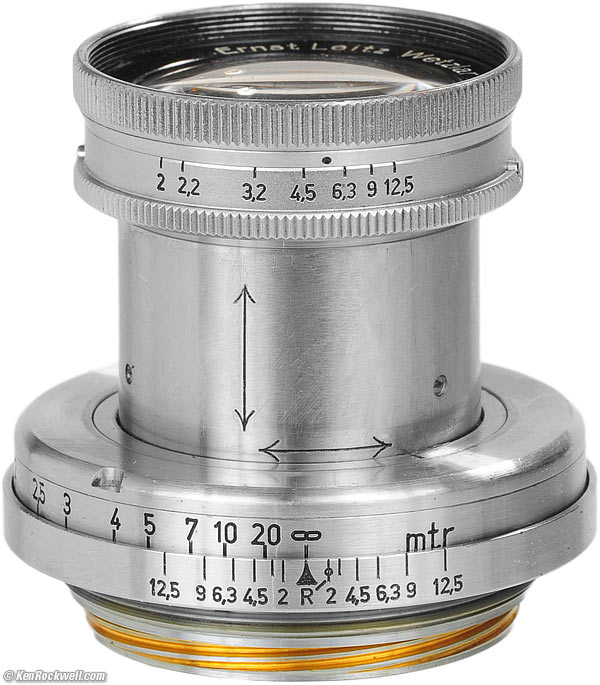
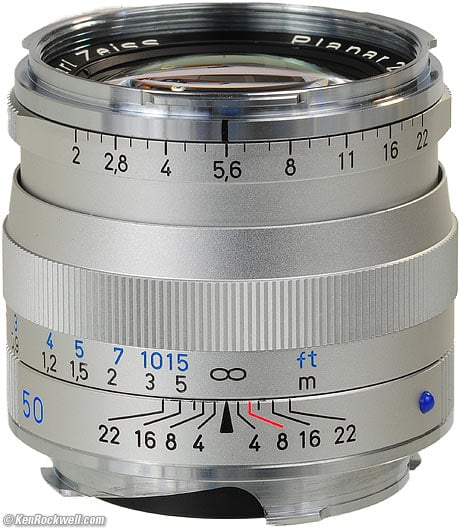 |
2004-today, 43mm filters, 211g. Almost as good optically as the current SUMMICRON-M, but with a bizarre filter size and more distortion. |
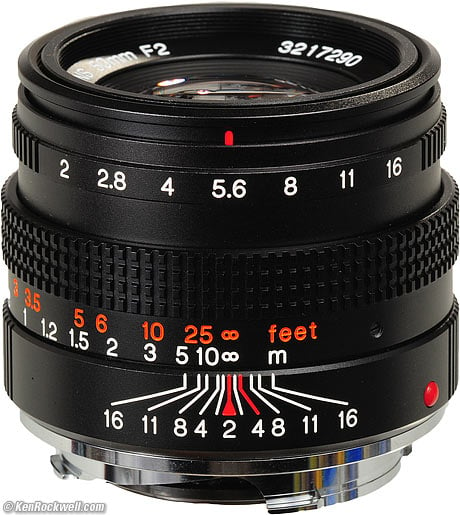 |
1990s: 40.5mm filters, 255g. An optically and mechanically inferior attempt at copying the LEICA SUMMICRON-M 50mm f/2. |
50mm ELMAR: Collapsible Classic 50mm top
LEICA ELMAR 50mm lenses compared
|
1994-2007, 39mm filters, 167g, 13 131, 13 132. Better than the original ELMAR f/2.8, but not that much better, and nowhere near as good, by LEICA standards, as the current SUMMICRON-M. |
|
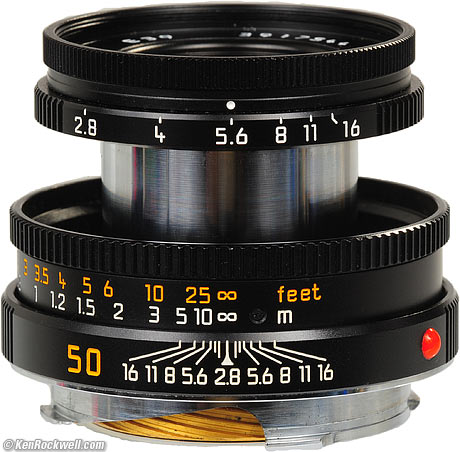
1957-1974, 39mm filters. Bayonet mount: 207g. 11 112 (11 612 meters). Screw mount: 192g. 11 512 (204.0g/7.195 oz. mit M-adapter.) This is a perfectly good and inexpensive lens. It's not up to current standards when shot at f/2.8, but at normal apertures, this lens is as good as current lenses. |
|
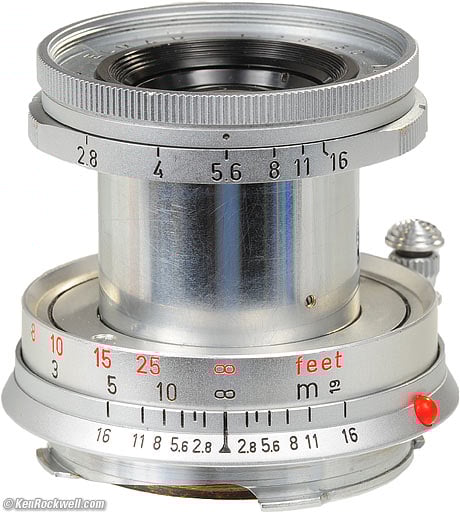
1925-1961, collapsible, 10-blade diaphragm. 1925-1930: Permanently fixed to the LEICA. 1930-1959: Screw mount, A36 filters, 111.2g/3.920 oz. 1954-1961: Bayonet mount, E39 filters, 210g/7.4 oz. This is the lens that started 35mm photography. It still performs well today, and weighs half what other 50mm lenses do.
|
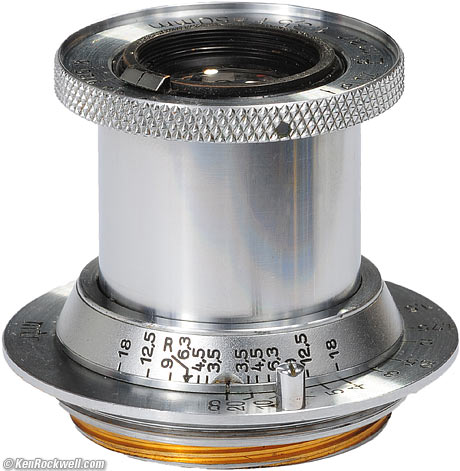
|
? - 1990 - today?, 40.5mm filters, 130g., screw-mount. This lens sells for about $20. It's sort of as sharp as the 1920s f/3.5 ELMAR above, but with much more distortion, larger size and somewhat more weight. It does not collapse. |
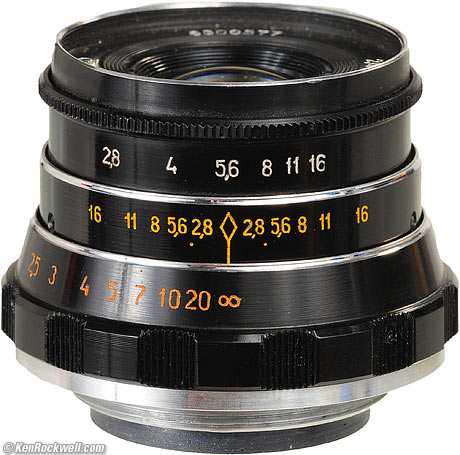
50mm SUMMARIT-M: cheap 50mm top
 |
LEICA SUMMARIT-M 50mm f/2.5 (low-price, unremarkable lens für Voigtländer und Zeiss kameras) 2007-today, 39mm filters, 230g. 11 644. I haven't used this new lens, but the other Summarit-M lens I used had superb optical quality with sub-par mechanical quality. I wouldn't buy one of these. For less money you can get a used 50mm SUMMICRON lens of whatever vintage you like for one-quarter the price. enlarge image or more information (no review yet). |
75mm top
75mm is an odd focal length for LEICA, as is 24mm. With LEICAs made since 1980 the 75mm frame lines are merely vestigial tits inside the 50mm frame, and on older cameras, there are no 75mm framelines at all.
 |
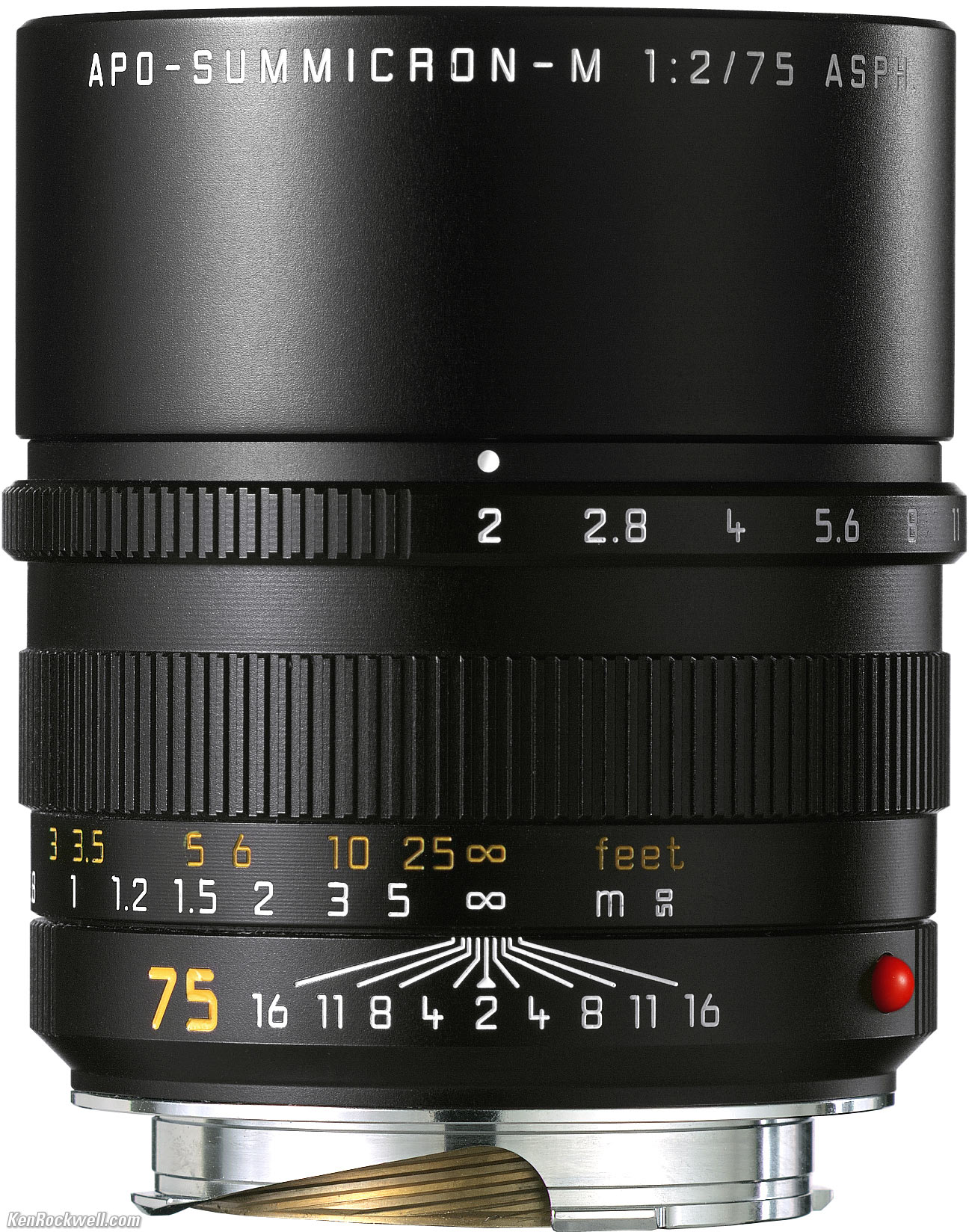
LEICA APO-SUMMICRON-M 75mm f/2 ASPH 2005-today, 49mm filters, 430g. 11 637. I'd rather a 90mm lens, but as 75mm lenses go, this is the best ever made. Distortion is +1% maximum. and it's smaller than its big brother the 90mm f/2 APO ASPH. enlarge image or more information (no review yet). |
 |
LEICA 75mm f/2.5 SUMMARIT-M (low-price lens für Voigtländer und Zeiss kameras) 2007-today, 46mm filters, 345g. 11 645. I haven't used this new lens, but the other Summarit-M lens I used had superb optical quality with sub-par mechanical quality. I wouldn't buy one of these. For less money you can get a used 90mm lens for a fraction of the price. enlarge image or more information (no review yet). |
1983-2005
1980-1982 |
LEICA SUMMILUX-M 75mm f/1.4 1980-2005: All share the same optics, differing only mechanically: 1982-2005: 60mm filters, 625g, built-in hood. 11 815. 1980-1982 (to serial 3 223 300): 60mm filters, 490g, bayonet hood. 11 814 I've not tried this one. It's a big fat lens that weighs as much as a camera. The optics are all the same; the barrel was merely redesigned to include a hood in 1983. Its performance lags behind the state-of-the-art LEICA 75mm f/2 APO-SUMMICRON-M ASPH. (no review yet). |

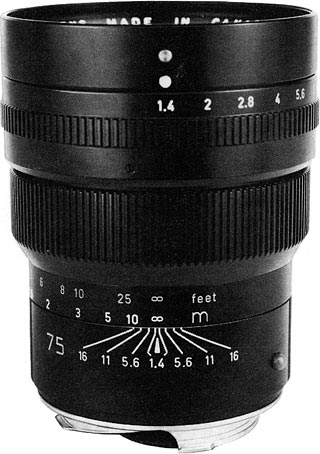
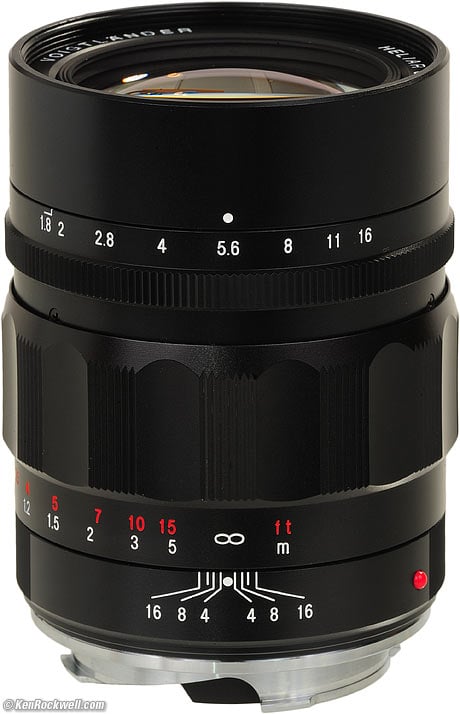 |
2010-, 52mm filters, 423g, about $715. A swell lens, but why would you want any 75mm lens for LEICA M? |
90mm top
f/2 SUMMICRON f/2.8 ELMARIT f/4 ELMAR f/2.5 SUMMARIT-M
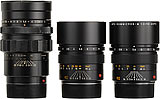 |
90mm SUMMICRON: Ultimate Performance f/2 (1958-today)
 |
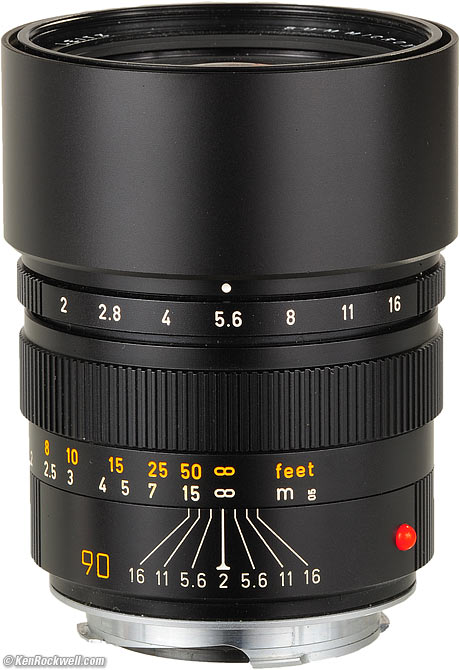
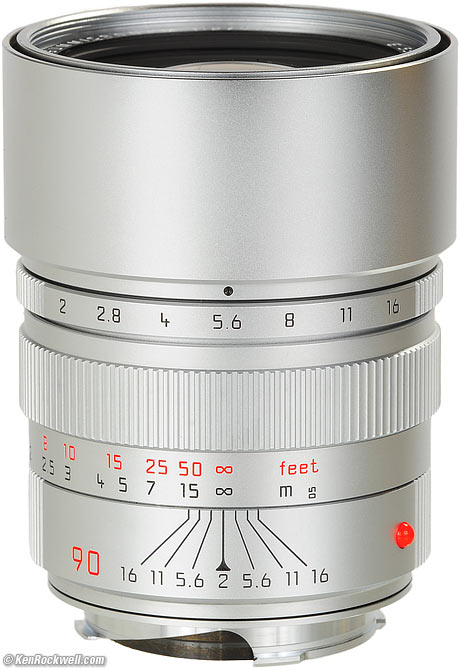
LEICA APO-SUMMICRON-M 90mm f/2 ASPH 1998-today, 55mm filters, 473g, built-in hood. 11 884 (11 636 in black paint with red footage markings, 11 632 titanisiert: titanium-colored paint). The world's highest-performance photographic lens, period. |
|
1980-1998, all versions share the same optics, 11-blade diaphragm and 11 136 order number (in black), and differ only mechanically: 1981-1998: 55mm filters. 485g in black aluminum. Silver-chromed solid-brass version weighs 684.15g, order number 11 137. 1980-1981: 49mm filters, rated 410g. This fat 90mm f/2 replaced the first 90mm f/2 made from 1958-1980. This lens is made in Canada, eh, home of Santa Claus and the North Pole. It looks almost exactly the same as today's 90mm f/2 APO ASPH, but shares none of today's lens' technology. The only reason to get this lens is to save money versus the state-of-the-art 90mm f/2 APO ASPH. |
|
1959-1980, 48mm filters, numerous cosmetic variations, heavy 605-635g. 11 123. This lens is an excellent performer, but too darn big for most of us. If you don't mind the size and are on a budget, its performance is 95% the same as today's 90mm SUMMICRON APO ASPH on the M9. This lens can be a bargain. Perfectly good beaters often sell for under $250! |

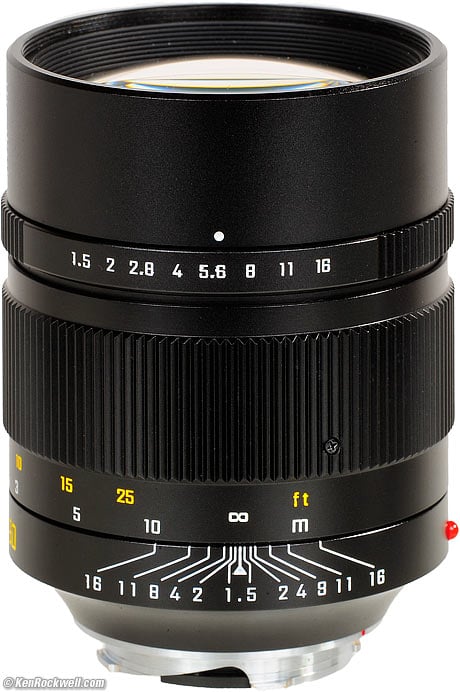
New: Mitakon 90mm f/1.5Crappy lens, great price. Metal 67mm filter thread, 27.2 oz. (772g), 3.6'/1.1m close focus). It comes in mounts für LEICA M in black und für LEICA M in silver (which can be adapted to every mirrorless camera), or in dedicated mounts for Canon RF, for Nikon Z and for Sony E. You also can get it at eBay if you know How to Win at eBay. 11 December 2021 |
90mm ELMARIT: Fast, Compact Performance 90mm top
 |
1990-2008, 46mm filters, 395g, built-in hood. 11 807. Leica's best 90mm f/2.8 lens ever; as good as the 90mm f/2 ASPH, and therefore a screaming bargain used for less than an f/2.5 Summarit-M new. It also came in heavy chromed brass (11 808, 560g), titanium-painted aluminum (11 899), and maybe even more colors. |
 |
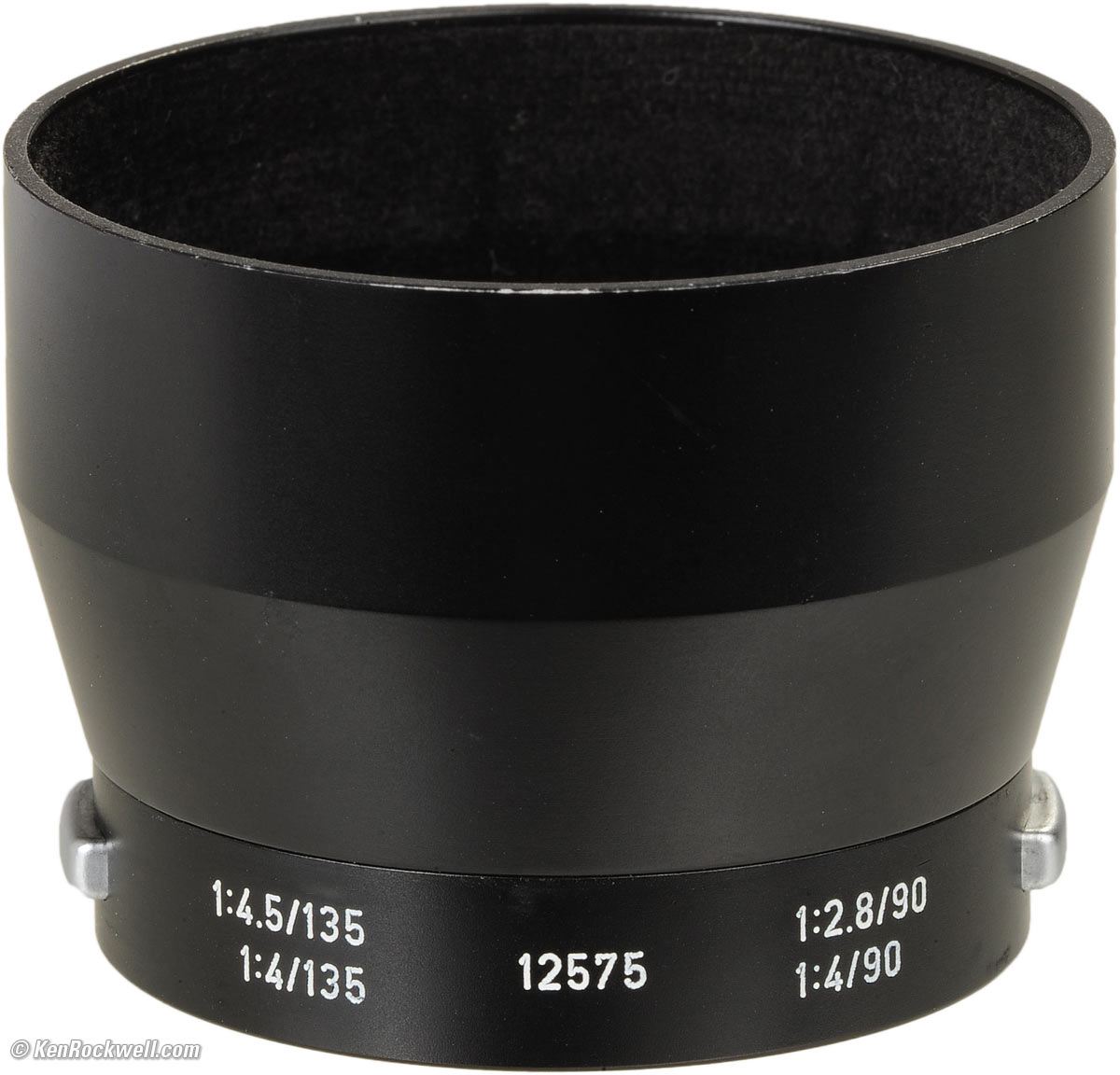
LEICA TELE-ELMARIT-M 90mm f/2.8 1974-1990, 39mm filters, 226g. 11 800. Hood: 12 575. Leica's lightest 90mm ever and a swell performer; my favorite tele travel lens. Its small size and great performance allowed it to replace both the earlier TELE-ELMARIT and ELMARIT below. It's only limitation is that it's softer in the corners at f/2.8 than newer lenses, but so what: at f/2.8 in the corners with a tele, nothing usually is in focus anyway. |
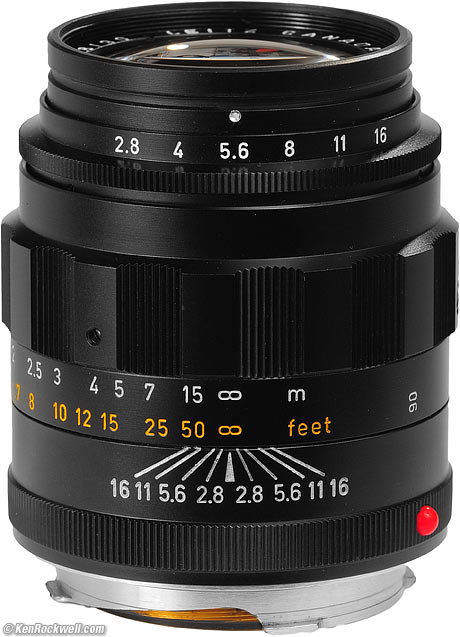 |
1964-1974, 39mm filters, 340g. 11 800. Hood: 12 575. This was a smaller, lighter alternative to the premium ELMARIT below. Oddly, it outperforms this 1958-1974 ELMARIT, and although smaller, weighs more. It was replaced by the TELE-ELMARIT-M above. A streetname for this TELE-ELMARIT is the "fat" Tele-ELMARIT. |
|
1958-1974, 39mm filters, 333g, ELRIM/11 129. Hood: 12 575. Leica's first 90mm f/2.8. It has a flare problem, and is as sharp as its contemporary SUMMICRON. Today, the newest LEICA ELMARIT-M 90mm f/2.8 is far superior, and sells for not much more used. |

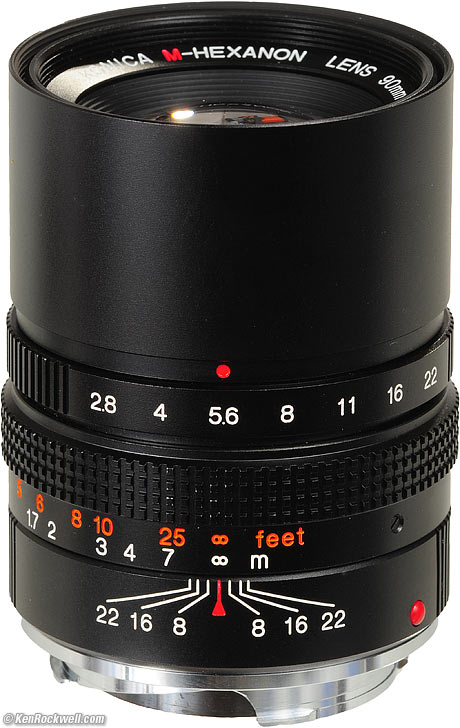 |
46mm filters, 307g. An optically and mechanically inferior attempt at copying the LEICA ELMARIT-M 90mm f/2.8. |
90mm ELMAR: Compact Performance (1933-today) 90mm top
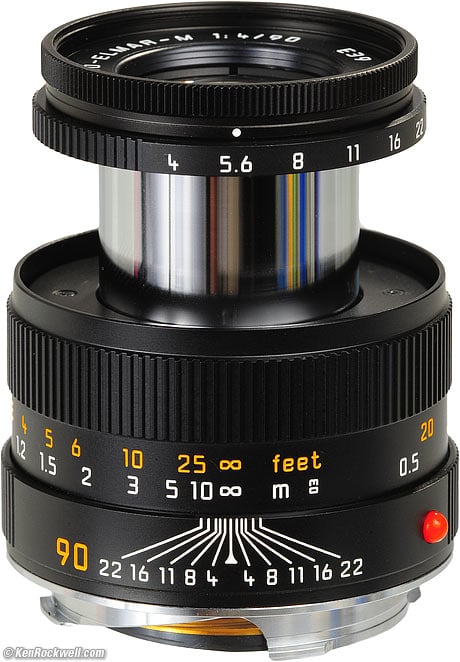 |
2003-today, 39mm filters, 223g (black aluminum 11 629), 320g (chromed brass 11 634). Hood: 12 575. This is LEICA's secret: This MACRO-ELMAR-M has optics as good as LEICA's best APO-SUMMICRON-M ASPH, but in a tiny package that collapses for carrying, and focuses much closer (0.78m) with no need of adapters! This is LEICA's best 90mm lens for travel and light weight. Add an optional 14 409 close-focus adapter, and you can get macro to 1:3 at 0.5 meters. |
|
LEICA ELMAR-C 90mm f/4 1973-1978, 39 x 0.75mm filters, 246g. 11 540; includes 12 517 hood and 14 543 pouch. This compact 90mm lens came out for use with the LEICA CL. It works fine on other LEICAs, especially the M7 and M9 with which I've used it. Focus is just fine. Watch the filter thread: it's not a standard 39x 0.5mm thread. Leica intends for this to be used with nonexistent series 5.5 filters held in place by the dedicated threaded hood. The lens' threads are the same diameter, but too coarse to receive standard filters. I use regular 39mm filters, but I only screw them in to where they first stop. Force them and you destroy everything. This lens sells used for only about $100. Performance is swell, but watch for some obvious falloff (darkening) in the corners at f/4, gone by f/8. Bokeh is neutral to good. I prefer the 90mm f/2.8 TELE-ELMARIT-M since it weighs slightly less with similar size and a stop extra speed, but if you're short on brains and cash, this is a great lens. (the crack about being short on brains means that you should never cheap-out on lenses, since they are a far better investment than cameras.) enlarge image (review coming). |
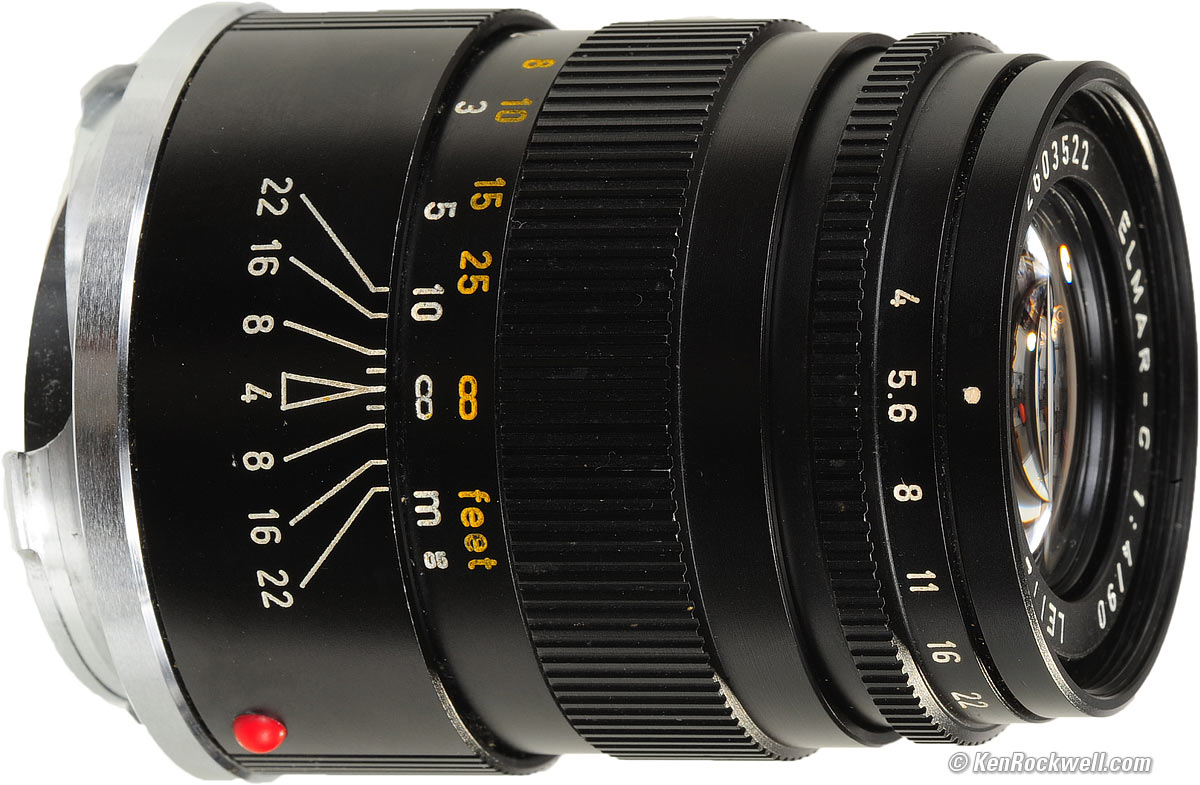
Collapsible M mount.
Screw Mount. |
1933-1964, Screw mount A36, later E39mm filters, 194.05g (6.845oz.). Later also in M-mount. 1954-1964, Collapsible M-mount, 39mm filters, 337g. 11 131 (feet), ILNOO or 11 631 (meters). THe E39/A42 versions use the 12 575 hood. This is Leica's first 90mm lens, designed in 1933 with four elements. It was sold in many different mounts, including the collapsible M mount seen here from 1955. More common is the rigid screw mount, which takes a slip-on A36 filter. It's always contrasty, but it's softer in the corners at the largest apertures. f/11 and f/16 are optimum. This version is solid chrome-plated brass. Its collapsible mount is a work of genius: Leica has it locked-out so you can't focus, and therefore accidentally shoot, unless you have it fully extended. It works great on everything including the M7, but look out: Leica specifically cautions not to try to mount this lens on the M9. I tried it on the M9, and it works fine. I even collapsed it a bit, and my M9's still kicking. Don't do this. It has been coated since 1946. Another three-element design popped up from 1964-1969. enlarge image, M-mount (review coming). enlarge image, screw mount (review coming). |
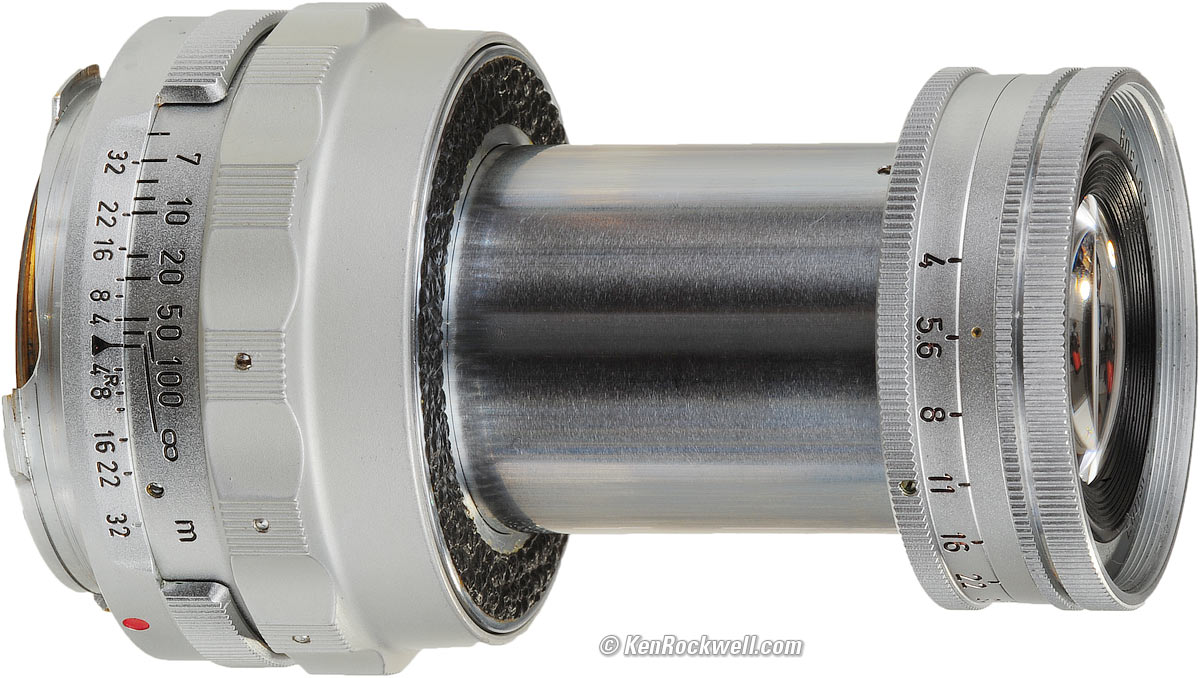

90mm SUMMARIT-M: Cheap Lens für Voigtländer Kamera 90mm top
 |
LEICA SUMMARIT-M 90mm f/2.5 (low-price lens für Voigtländer und Zeiss kameras) 2008-today, 46mm filters, 344g. 11 646. Spectacular optics with mediocre mechanics, a bad investment today. |
135mm top
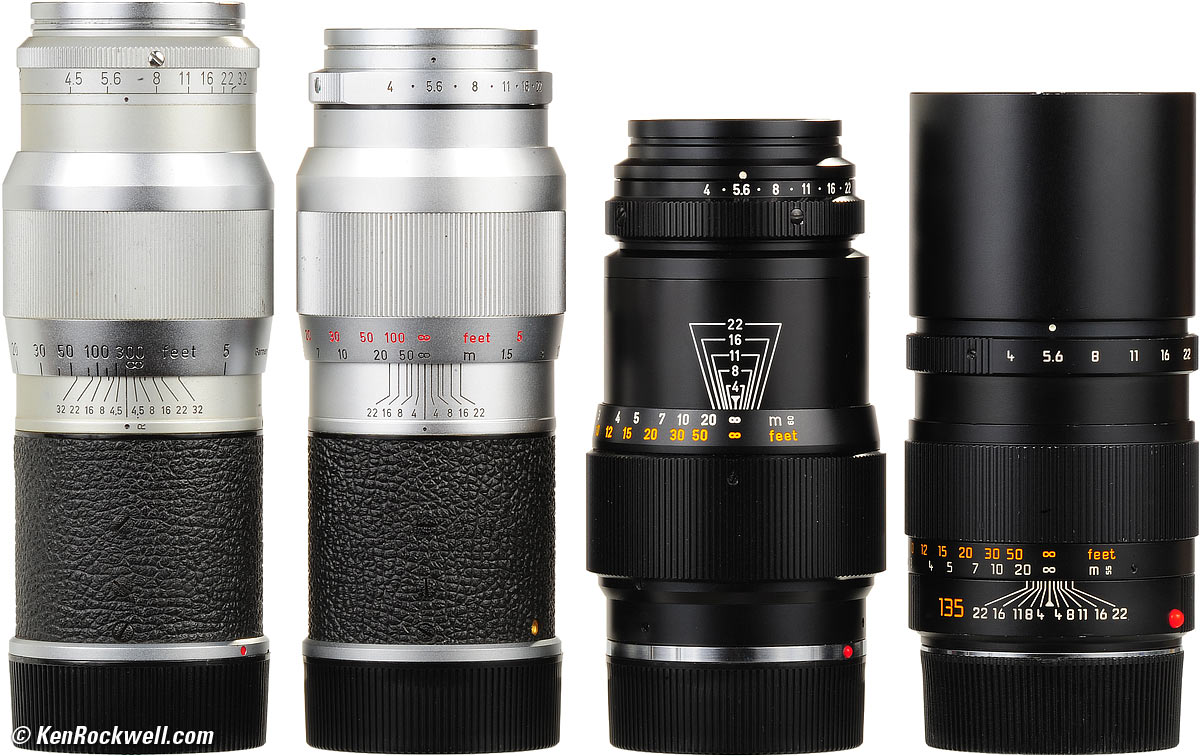 |
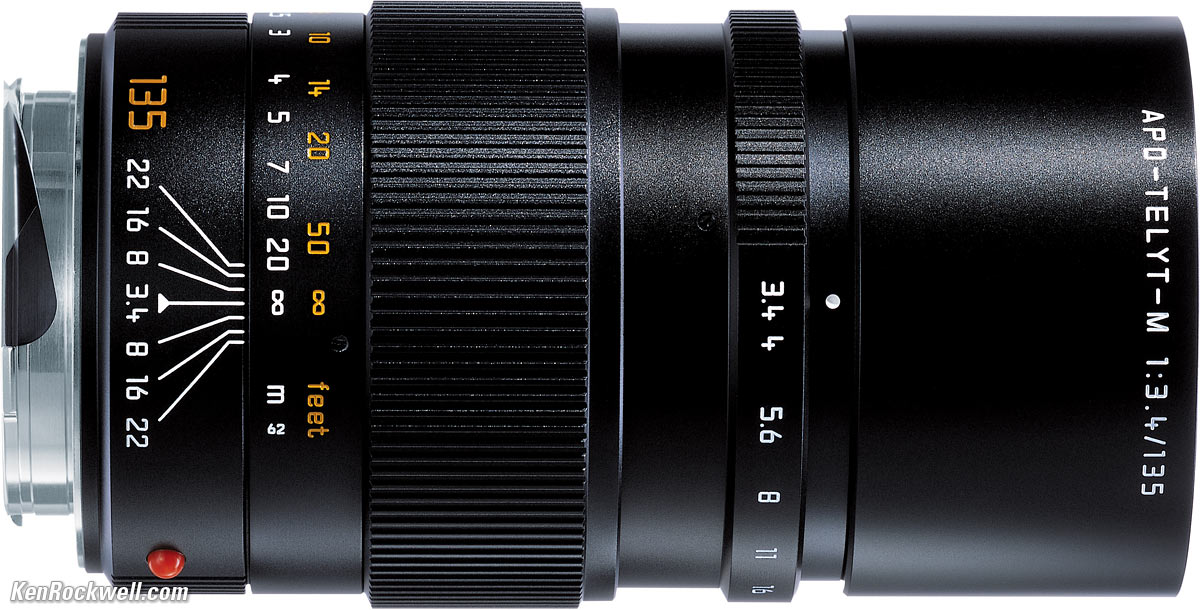
LEICA 135mm Lenses Compared left to right: 1933-1960: HEKTOR f/4.5: HE FAM (bayonet). Not in picture: 1998 - : APO-TELYT f/3.4: 11 889. |
 |
1998-today, 49mm filters, 453g, built-in hood. 11 889. Today's 135mm f/3.4 replaces both earlier f/4 and f/2.8 lenses, for at least eight times the price. It should offer spectacular performance. The adjustment of your camera's rangefinder will be your biggest limitation in sharpness. enlarge image or more information (no review yet). |
|
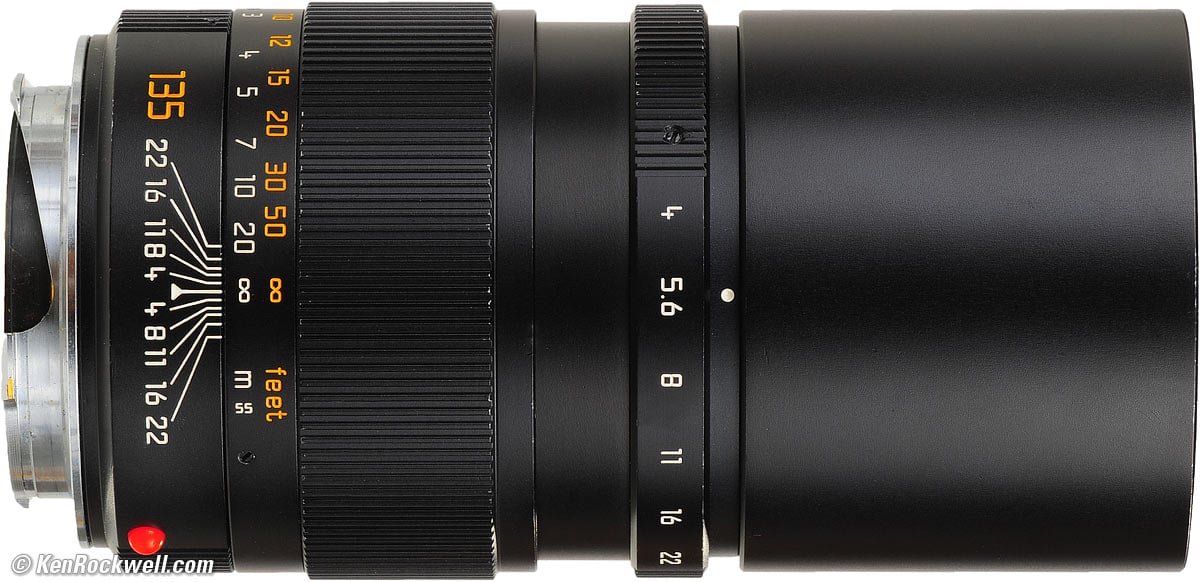
LEICA TELE-ELMAR-M 135mm f/4 1990-1998, 46mm filters, 550g, built-in hood. 11 861. This TELE-ELMAR-M offers fantastic performance, for about 1/8 the price of the 135mm f/3.4 APO. It has the same optics as the superb 1965 lens below. The biggest limitation to sharpness, as with all 135mm rangefinder lenses, is whether or not your camera's rangefinder and lenses are accurately adjusted to one another. enlarge image (review coming). |
|
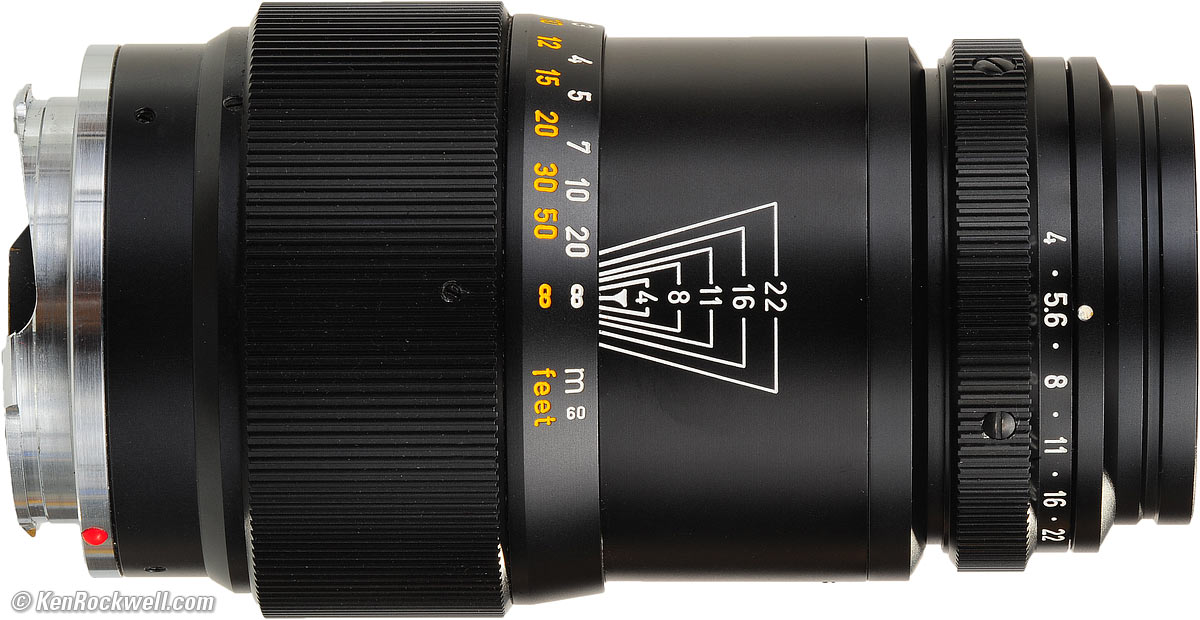
LEICA TELE-ELMAR 135mm f/4 1965-1990, 39mm filters, 505g. 11 851. Hood: 12 575. This lens has the same optics as the TELE-ELMAR-M above, but in a smaller, lighter package. Leica updated the styling to improve sales, therefore, this older lens is a top pick for fabulous optics in a smaller, lighter package for less money. enlarge image (review coming). |
|
LEICA 135mm f/2.8 ELMARIT1963-1977, Series VII filters, 730g. 11 829. 1977-1998, 55mm filters, 735g. 11 829. (11 829 for both versions, -M version from serial number 2 788 927) This is a big, fat lens. it was never popular because it is too big to make sense. It uses 1.5x magnifiers for the finder which key-in the 90mm frame lines and gives a life-size or bigger finder image, but don't do anything to alleviate the mechanical calibration errors which often give incorrect focus. Performance is fine, limited by your particular camera's calibration to focus with this lens. enlarge image (review coming). |
|
1960-1965, 39mm filters, 405g ,bayonet: 11 850, screw-mount: 11 750. A superb performer, even today, and a bargain second-hand. It's a traditional non-tele design and therefore not marked TELE. It's a little longer than the newer TELE-ELMARs which replace it. It is the lightest 135mm ever sold by Leica, and seeing how inexpensive it is, along with high performance, this is the cheapskate's top pick. |







 |
1933-1960, 39mm filters, 436g. HE FAM. Named after Barnack's dog with performance to match, this is a mechanically well-made lens. It's not bad for 1933, but my last choice for a sharp LEICA lens. |
Zooms (requires external finder) top
Zoom lenses don't really work on Leica because the finder of the Leica can't zoom. Thus Leica has only made two zooms, only one of which is made today. Because the finders have to be manually adjusted to the lens (unlike the Contax G whose finder does zoom), Leica's zoom lenses only adjust in three click-stops. Leica attempts to hide the fact that these are zooms, and limited to only three settings, by marketing these under the clever trade name "TRI-ELMAR."
 |
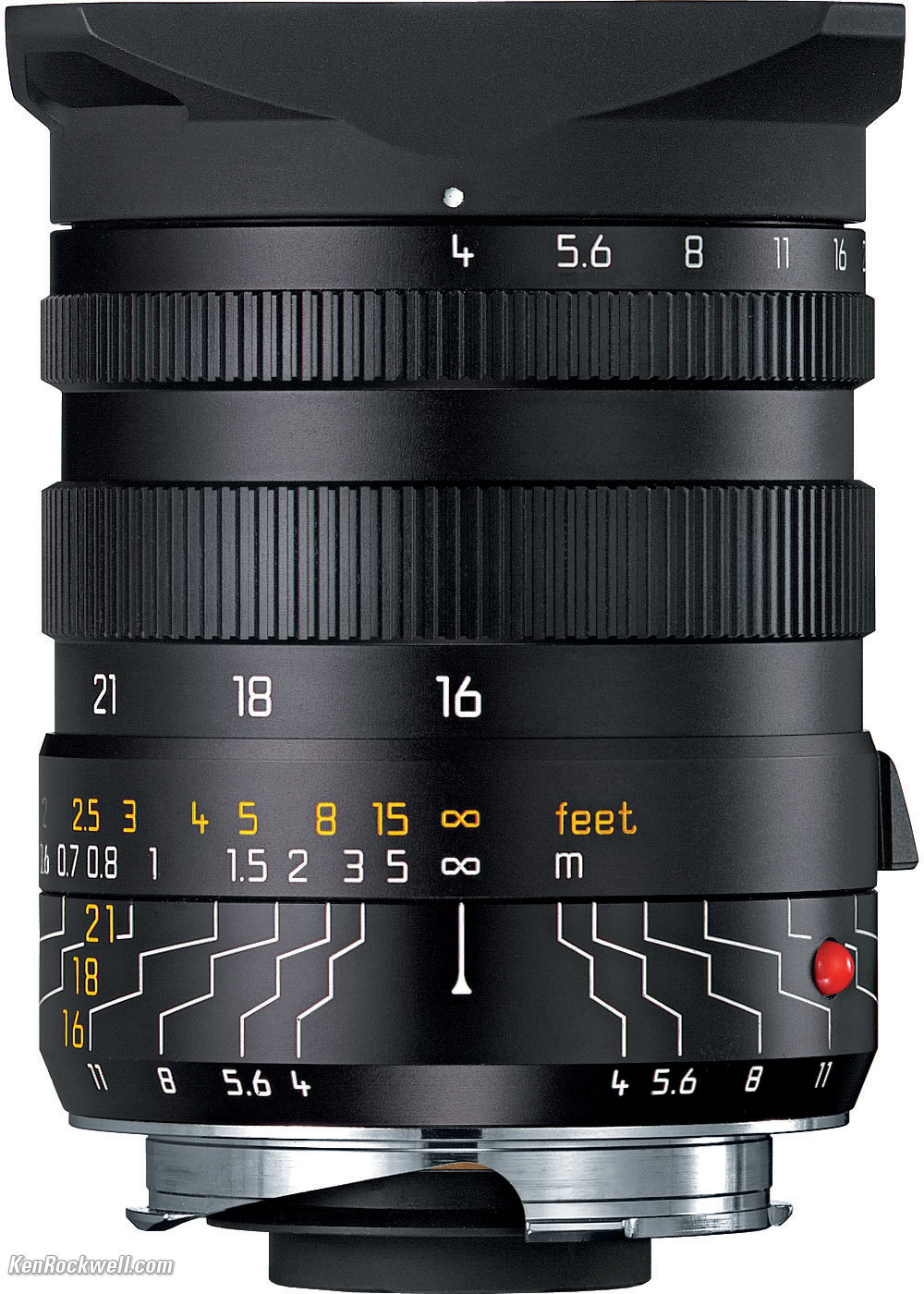
LEICA TRI-ELMAR-M 16-18-21mm f/4 ASPH 2006-today, 67mm filters, 335g. 11 642. Use the LEICA Universal Wide Finder. You can buy this finder with the lens as a kit if you like. Unlike the earlier 28-50mm zoom below, this newer lens does not couple its focal length to the camera via 6-bit code as you zoom it. I've played with this lens, but not extensively. I prefer a fixed ultrawide. enlarge image or more information. (no review yet). |
|
LEICA TRI-ELMAR-M 28-35-50mm f/4 ASPH 1998 - ?, 55mm, later 49mm filters. First black aluminum version (11 890) weighed 340g; first chromed brass version (11 894) weighed 460g. Latter version is 11 625. Unlike the newer 16-21mm zoom, this older zoom was very handy because it automatically selected the correct finder frame as you zoomed. (no review yet). |
More Information top
LEICA Lens Names 24 January 2009
LEICA Summarit-M Lenses (2007 introduction)
Cosina, Voigtländer and other lenses for LEICA 15 January 2009
Contax G Lenses for LEICA M 26 February 2009
M Lenses (from LEICA)
M Lens Technology and History (from LEICA)
List of Current Lenses for 6-Spot Updates (from LEICA)
Discontinued Voigtländer lenses
© Ken Rockwell. All rights reserved. Alle Rechte vorbehalten.
Help me help you top
I support my growing family through this website, as crazy as it might seem.
If you find this as helpful as a book you might have had to buy or a workshop you may have had to take, feel free to help me continue helping everyone.
If you've gotten your gear through one of my links or helped otherwise, you're family. It's great people like you who allow me to keep adding to this site full-time. Thanks!
If you haven't helped yet, please do, and consider helping me with a gift of $5.00.
The biggest help is to use these links to Adorama, Amazon, Calumet, Ritz and J&R when you get your goodies. It costs you nothing and is a huge help. These places have the best prices and service, which is why I've used them since before this website existed. I recommend them all personally.
Thanks for reading!
Ken
Home Donate New Search Gallery How-To Books Links Workshops About Contact