Home Donate New Search Gallery Reviews How-To Books Links Workshops About Contact
Canon 220EX
Speedlite
(1996-2009)
Intro Specs Performance Compared Recommendations
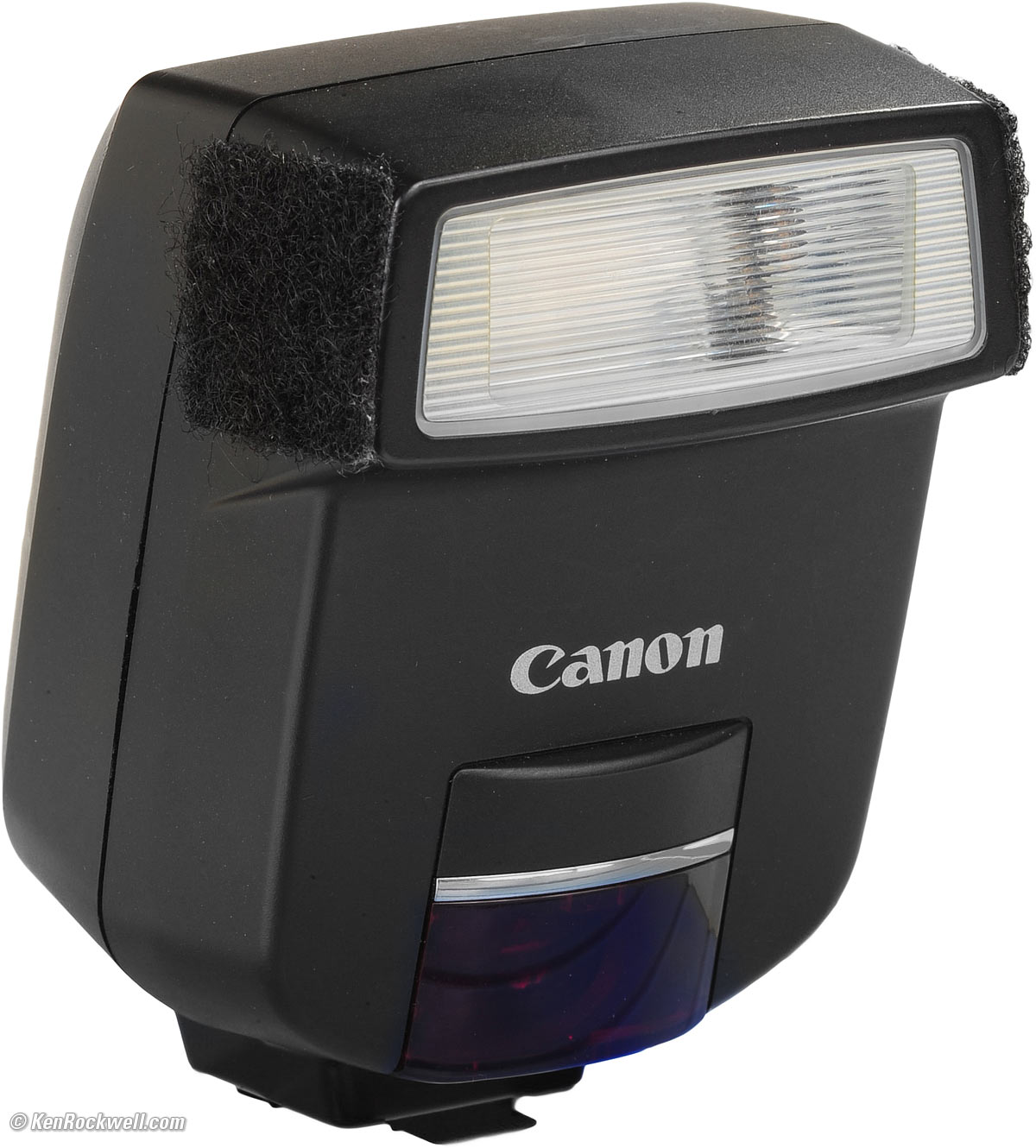
Canon 220EX flash (4-AA cells, 8.9 oz/253g with batteries, 2.3 second measured recycle time, measured ISO 100 guide number 19 meters/63 feet, about $70 used if you know How to Win at eBay). enlarge. My biggest source of support is when you use those or any of these links, especially this link directly to them at eBay or at Amazon, when you get anything, regardless of the country in which you live. Thanks! Ken.

April 2018 Canon Reviews Canon Lenses Canon Flash All Reviews
NEW: Canon 320EX Flash Review. Even better than this 220EX, but a little bigger.
Compared to Canon's and Nikon's other small flashes
Introduction top
Intro Specs Performance Compared Recommendations

I buy only from these approved sources. I can't vouch for ads below. |



The Canon 220EX is a wonderful little flash. I carry it everywhere on my 5D Mark III for use as a fill-flash.
It is even better than its new replacement, the Canon 270EX, and 270EX II, because this 220EX recycles much faster and has a real AF illuminator. With the 220EX, it's always ready to belt out flashes whenever I need them without me ever having to wait for it to catch up, and always lets my 5D Mark III focus in any light without blinding or disturbing anyone.
The current Canon 320EX is more powerful and bounces, but lacks the IR AF illuminator. Either are magnificent flashes.
The 220EX works perfectly on all Canon EOS cameras and DSLRs, from Canon's first EOS650 of 1987 through today's newest 1D X and 5D Mark III. It's also supposed to work perfectly on Canon's IX APS cameras and many G-series point-and-shoots. It works in all TTL, E-TTL and E-TTL II modes. It certainly works great on my 5D Mark III, and is even rated to work on one FD-mount manual-focus camera, the Canon T90.
On the 5D Mark III it offers both trick FP high-speed sync (the H-bolt button), and rear sync, set in the 5D Mark III's menus: MENU > CAMERA • > External Speedlite control > SET > Flash Function Settings > SET > Shutter Sync. If this is too much to juggle in the field, set this on one of the 5D Mark III's Total Recall C1, C2 or C3 positions.
In the 5D Mark II, set this at MENU > WRENCH ••• > External Speedlite control > SET > Flash Function Settings > Shutter Sync, and these are also recalled in the 5D Mark II's Total Recall C1, C2 or C3 positions.

Rear, Canon 220EX Speedlite. enlarge.
Specifications top
Intro Specs Performance Compared Recommendations
See also my Small Flash Comparison Table for more data and features.
Name
Canon calls this the CANON Speedlite 220EX.
Flash Control Systems
TTL, E-TTL.
E-TTL II is done in-camera, and the 220EX supports it as well.
Bounce Angles
None.
Recycle time
Rated 4.5 seconds or less, fresh alkaline cells.
Rated Output Power
Guide Number 22 meters, 72 feet at ISO 100.
Batteries
Four AA cells.
Alkaline, Ni-MH, and lithium are all good.
Battery life
Rated 250 shots minimum at full-power, 1,700 maximum, on alkalines.
Standby Time-out
90 seconds.
Rated Coverage
28mm, full-frame.
On 1.6x cameras, this corresponds to 18mm.
On 1.3x cameras, this corresponds to 22mm.
AF Assist Illuminator
Yes, a red LED, rated to 5 meters (16.4 feet).
Illuminates center AF area only.
Exposure Confirmation Light
Yes.
Size top
Canon specifies 3-5/8" (92.1mm) tall by 2-9/16" (65mm) wide by 2-7/16" (61.9mm) deep.
Weight top
9.030 oz. (256.0g), measured, with four AA Eneloop Ni-MH.
8.822 oz. (250.15g), measured, with four Duracell AA alkaline cells (MN1500).
5.340 oz. (151.45g), measured, empty.
Canon specifies 5.6 oz. (160g), empty.
Accessories top
"Soft pouch," included.
Quality top
Made in JAPAN.
Introduced top
1996.
Discontinued top
2009, replaced by the 270EX.
Price, USA top
2018 April: about $35 used if you know How to Win at eBay.
2014 February: about $70 used if you know How to Win at eBay.
2010 May: $125 new.
1999: $125 new.
Performance top
Intro Specs Performance Compared Recommendations
Overall performance top
The Canon 220EX is a great little flash. It just keeps pumping out great results, while the newer 270EX is either waiting to recycle, or getting me kicked out of a venue for its annoying nearly-full-power-flash AF assist system.
The 220EX, with four instead of just two AA cells in the 270EX, packs enough power to get the job done.
Measured Power Output performance top
I'm impressed. It tests much closer to its ratings than most other flashes.
I measured the ISO 100 Guide Number as 19.2 meters, 63 feet. (22 meters, 72 feet, rated.)
A second sample measured GN 17 m, 56 feet.
You can feel a slight vibration as the flash fires at full power. You'll hear a pop! and then the whine of the flyback transformer.
Measured Recycle Time performance top
2.3 seconds after a full-power blast, measured, with four freshly charged Sanyo Eneloop HR-3UTG Ni-MH cells.
This is more than twice as fast as the new 270EX II, which makes sense because the 270EX II uses only half as many cells.
Once fully recharged, the 220EX keeps its capacitor topped-off by cycling the power on and off. You'll here a soft beep - beep - beep if you listen, just like the Vivitar 283.
Ergonomics and Usage performance top
Everything works great.
The power switch is a little less easy to grab than the power switch of the 270EX, but at least it's a real, instant power switch and not a button that needs to be held.
Power Switch
The power switch is perfect: it slides on or off instantly.
Shoe Lock
Just slide the switch to the left.
It usually works great; I rarely have it come out. Sometimes it will work its way out a little, resulting in a full-power flash burst and wanton overexposure. If you get that, push it back in. My sample seen here is old and worn.
Manual Power Output Setting
I see no way to get manual exposure. On my 5D Mark III, it's not presented in the menus with the 220EX mounted.
Exposure Compensation
You set this in your camera's menus.
High-Speed (FP) Sync
Press the "H" button for a moment, and the light shows that it's working.
This only works in your camera's manual or Tv exposure modes.
In this mode, the 5D Mark III shows a little "H" next to the flash bolt in the finder.
Slow Sync
You set this in your camera's menus.
Mechanics performance top
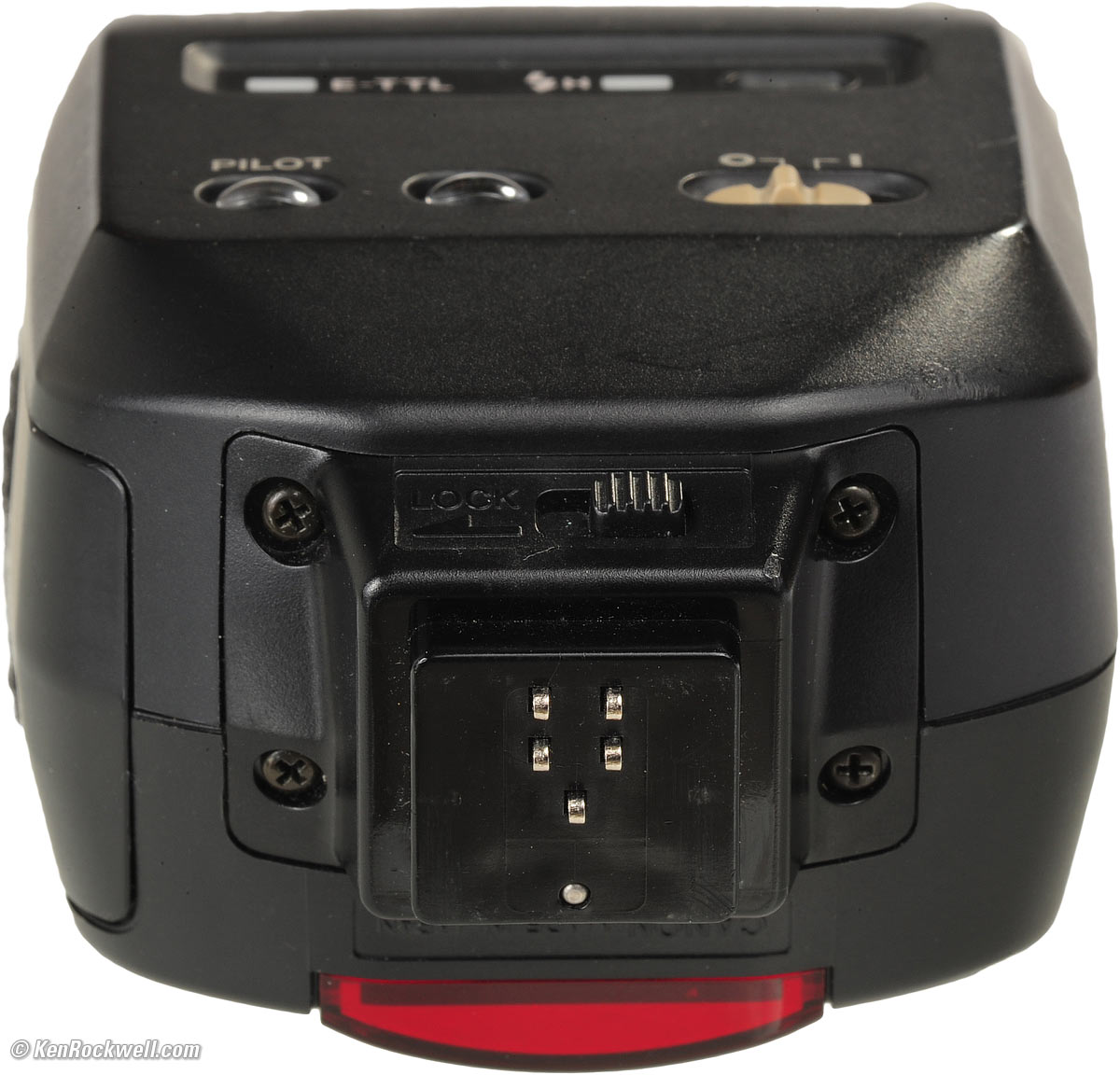
Bottom, Canon 220EX. enlarge.
The Canon 220EX is all plastic, with a metal lock pin. I'd be careful; it ought to be easy to break off the shoe. The 270EX is much tougher.
Shoe
Plastic, with steel lock pin.
Battery Door
All plastic, with plastic latches.
The battery door is the weakest part; be careful when closing it or you may break the weak plastic catches.
Noises When Shaken
Some clicking.
Made in
Japan.
Battery Life performance top
I took this 220EX to Maui for a week-long assignment in May 2010 with family, and came back with about 2,500 shots, many with flash, many not.
My set of 2,000 mAh Sanyo Eneloop HR-3UTG Ni-MH cells still had 50% of their charge left when I returned.
In other words, the 220EX really pounds out the flashes, and even shooting as hard as we do in digital, runs a long time on a charge.
Lens Coverage performance top
Regardless of how it's rated, in real-world use, it works great even with my Canon EF 20mm f/2.8 USM.
This is because I'm not photographing flat walls, but indoors where things at the sides of my image are closer to the camera, and thus the 220EX' light falloff is ideally matched to what I shoot with my 20mm lens on full-frame.
Wake-up Time performance top
When the 220EX flash goes to sleep, the charge drains from its capacitor much more slowly than the 270EX, so after several minutes, you still have full power available in less than a second after waking up your camera from its idle mode.
It took only 0.75 seconds after a 10 minute rest. The 270EX took a full two seconds, enough to make me miss photos. The 220EX is always ready to go.
Recommendations top
Intro Specs Performance Compared Recommendations
I prefer this 220EX over its newer replacement, the Canon 270EX and Canon 270EX II.
The 220EX just shoots, while the 270EX too often asks you to wait, or embarrasses itself with its use of the flash itself in place of its missing AF illuminator.
The Canon 320EX has more power and recycles just as fast, but it's bigger and has no IR AF illuminator. The 320EX is a great replacement for the 220EX depending on your priorities for power or size.
The larger Canon flashes like the 430EX II are great if I'm shooting an event all day, but if I'm carrying my flash just in case, the 220EX or 320EX are the way to go.
I use flash all the time for fill-flash.
If I need flash indoors as a primary source of light, I use plug-in-the-wall studio strobes, not battery powered devices.
More Information:
Peter Kun Frary's review from Hawai'i
© Ken Rockwell. All rights reserved. Tous droits réservés. Alle Rechte vorbehalten.
Help Me Help You
I support my growing family through this website, as crazy as it might seem.
The biggest help is when you use any of these links when you get anything. It costs you nothing, and is this site's, and thus my family's, biggest source of support. These places always have the best prices and service, which is why I've used them since before this website existed. I recommend them all personally.
If you find this page as helpful as a book you might have had to buy or a workshop you may have had to take, feel free to help me continue helping everyone.
If you've gotten your gear through one of my links or helped otherwise, you're family. It's great people like you who allow me to keep adding to this site full-time. Thanks!
If you haven't helped yet, please do, and consider helping me with a gift of $5.00.
As this page is copyrighted and formally registered, it is unlawful to make copies, especially in the form of printouts for personal use. If you wish to make a printout for personal use, you are granted one-time permission only if you PayPal me $5.00 per printout or part thereof. Thank you!
Thanks for reading!
Mr. & Mrs. Ken Rockwell, Ryan and Katie.