Home Donate New Search Gallery Reviews How-To Books Links Workshops About Contact
Nikon 20mm f/4
NIKKOR (1974-1978)
© 2013 KenRockwell.com. All rights reserved.
Intro Specifications Performance Compared Recommendations

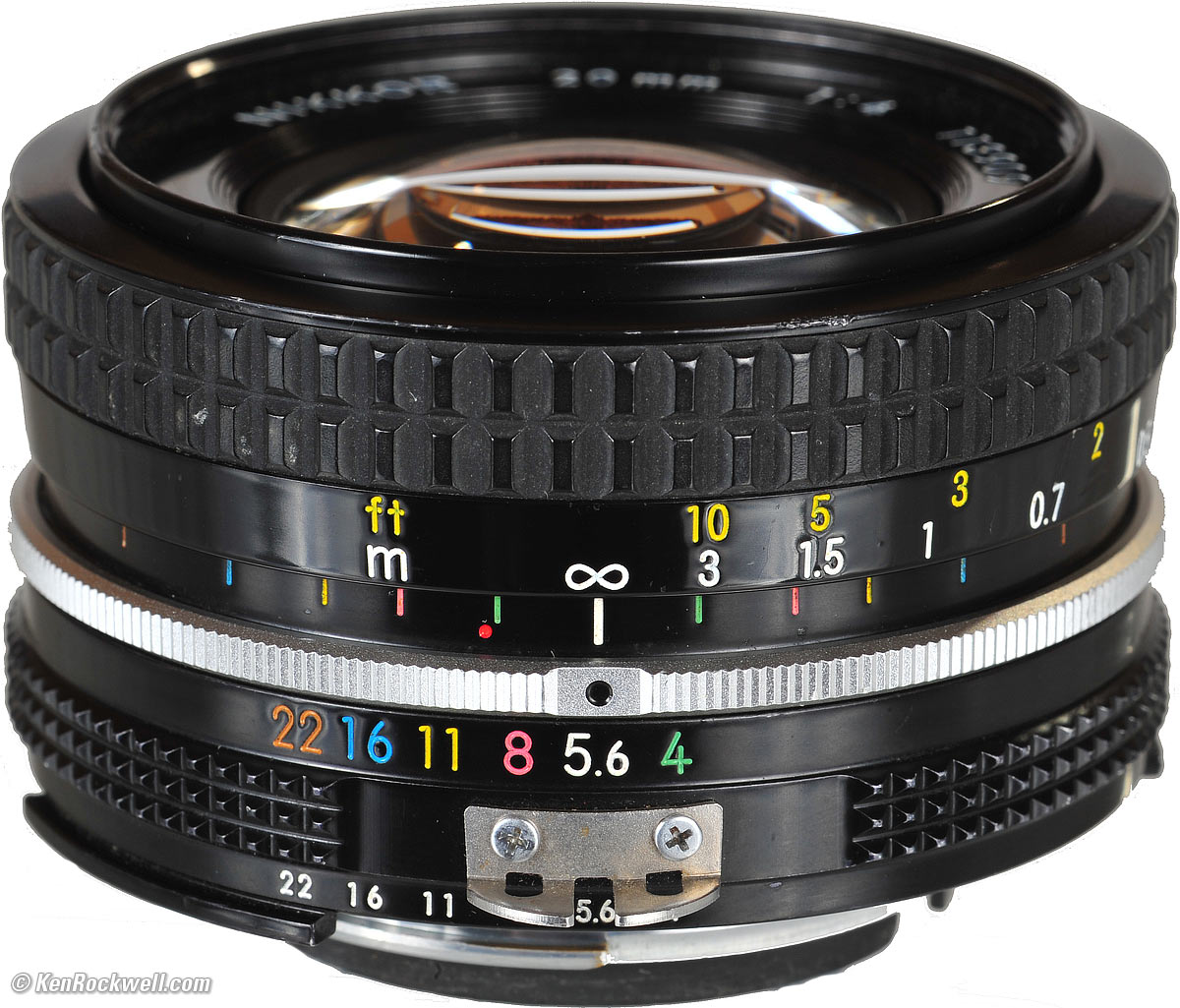
Nikon 20mm f/4 AI (52mm filters, 7.4 oz./209g, about $200 used). enlarge. This free website's biggest source of support is when you use any of these links, especially this direct link to this lens at eBay (see How to Win at eBay) when you get anything. Thanks! Ken.
October 2013 Nikon Reviews Nikon Lenses All Reviews
Why fixed lenses take beter pictures
Sharpness Comparison to other 20mm lenses
Ideal Uses
Superb FX ultrawide, and ultracompact, too. This 20mm f/4 is Nikon's smallest and lightest ultrawide ever; it's smaller than any 50mm lens!
Not for
I wouldn't bother with this on a DX camera. I'd use any DX lens, like the 18-55mm kit lens, instead. As a manual focus lens, I wouldn't use it for sports, kids or action since it's too hard to track focus by hand.
| Optics: |  |
| Ergonomics: | (manual focus) |
| Usefulness: |  |
| Availability: |  |
| Overall: | |
Introduction top
Intro Specifications Performance Compared Recommendations

Adorama pays top dollar for your used gear.
|

The Nikon 20mm f/4 AI is one of my very favorite Nikon lenses of all time. This is because it's super-compact, takes standard 52mm filters, and is optically the same as all of Nikon's bigger 20mm lenses and ultrawide zooms. The only Nikon lenses which can outdo it optically are the 16-35mm VR and the 14-24mm, but they are to big to use in the field.
Galen Rowell loved it, too: he raved about it in the September 1999 issue of "Outdoor Photographer" magazine. Why? Simple: Galen found it optically superior to the 20-35mm f/2.8 AF-D zoom many professionals lugged around, and it's one of the tiniest lenses Nikon has ever made. Size is very important to those of us who actually shoot.
This lens is a little hard to find; Nikon only made it for a few years before it was replaced with the equally excellent 20mm f/3.5.
Here is an article about its development. Its tiny size was quite revolutionary and resulted in patents for its innovative design.
The manual-focus Nikon 20mm f/4 works great with most Nikon cameras, 35mm and digital — if it's either the newer AI version, or has been updated to AI. If it's a non-AI version and hasn't been updated, it's called an F-mount or pre-AI lens, and while it works perfectly on every Nikon SLR made up through 1976, will have more limited utility with more recent Nikons.
Presuming yours is AI or AI-updated, the 20mm f/4 works flawlessly with every manual focus Nikon ever made, from the F of 1959 through the FM3a and today's FM-10.
With an AI or AI-updated lens, on the D4, D800, D800E, D600, D610, D3X, D3s, D3, D7100, D7000, D700, D300, D200, D2 and F6, use the "Non-CPU Lens Data" menu option to set 20mm and f/4 to get full color matrix metering, EXIF data and finder read-out of set aperture. It works great in aperture-preferred as well as manual modes on these cameras.
With an AI or AI-updated lens, it works perfectly on every professional 35mm camera (F, F2, F3, F4, F5, F6), and adds Matrix metering on the F6.
If it is a true AI lens, it also adds matrix metering on the F4 and FA. If it has been updated to AI, it doesn't offer matrix with the F4 or FA, which uniquely require real AI lenses for matrix metering — they have an extra lug on the back not added in the later AI update process.
The meters of cheaper digital (D90, D5000 and below) and cheaper 35mm cameras (N80 and below) will not couple (or work at all) with this lens, so you'll be on your own guessing exposure using the rear LCD or an external meter, or get a tiny Gossen Digisix meter and hotshoe adapter to meter manually.
See Nikon Lens Compatibility for details on your camera. If your 20mm f/4 is not AI or updated, read down the "Pre-AI" column, if it's been AI-updated, read down the "AI Converted" column, and if it shipped originally as an AI lens, read down the "AI, AI-s" column.
1959-1967
Nikon repackaged their 2.1cm (21mm) f/4 rangefinder lens, originally designed for the Nikon SP, for the F-mount SLRs.
It required the use of mirror lockup and a separate finder slid over the funky rewind crank of the NIkon F, as it poked all the way into the camera.
Nikon made about 5,000 of the 2.1cm f/4 lenses.
1967-1974
The 20mm f/3.5 UD was Nikon's first 20mm lens. It was the ultrawide for the late 1960s and early 1970s. There was no wider non-fisheye lens made by Nikon until the insane 15mm f/5.6 of 1973 and the 18mm f/4 of 1974.
Nikon made about 40,000 of the 20mm f/3.5 UD lenses.
1974-1978
This tiny 20mm f/4 (52mm filters), the smallest ultrawide ever made by Nikon or Canon, replacing the big 20/3.5 UD, with similar optical performance.
In 1975 Nikon introduced the world's widest non-fisheye lens, the Nikkor 13mm f/5.6, which remains today a the world's widest professional SLR lens ever made.
Nikon made F-mount (non-AI) 20mm f/4s from 1974-1977. The mount was redesigned as an AI lens in 1977, and sold until 1978.
Nikon made about 35,000 of these 20mm f/4 lenses, about half AI and half not. Most non-AI lenses have long since been updated to AI.
1978-1984
Nikon replaced the tiny 20mm f/4 with an almost-as-tiny 20mm f/3.5, which also takes 52mm filters.
Nikon made about 55,000 of the 20mm f/3.5 AI and AI-s lenses.
1984-today
Nikon replaced the tiny 20mm f/3.5 with today's 20mm f/2.8, which takes 62mm filters and is sold today in both manual-focus AI-s and autofocus versions.
Nikon has made about 70,000 of the 20mm f/2.8 AI-s lenses as of 2010, and still makes them today.
Nikon has made about 115,000 of the 20mm f/2.8 AF and AF-D lenses as of 2010, and still makes them today.
Price, new* |
Price in that era's dollars |
|
1977 |
$975 |
$270 |
2010 |
n/a |
|
2013 |
n/a |
* Corrected for inflation, 2010, and at full NYC discount. Very few people bought their lenses this inexpensively back then.

Nikon 20mm f/4 AI. enlarge.
Specifications top
Intro Specifications Performance Compared Recommendations
Name
Nikon calls this the Nikon NIKKOR 20mm f/4, and adds "AI" to the newer models.
Optics top
This tiny jewel has 10 elements in 8 groups.
It doesn't use floating elements, called "CRC," in other lenses.
It's multicoated, which Nikon calls Nikon Integrated Coating.
Angle of View top
94° on FX and 35mm.
71° on small-format DX.
Diaphragm top
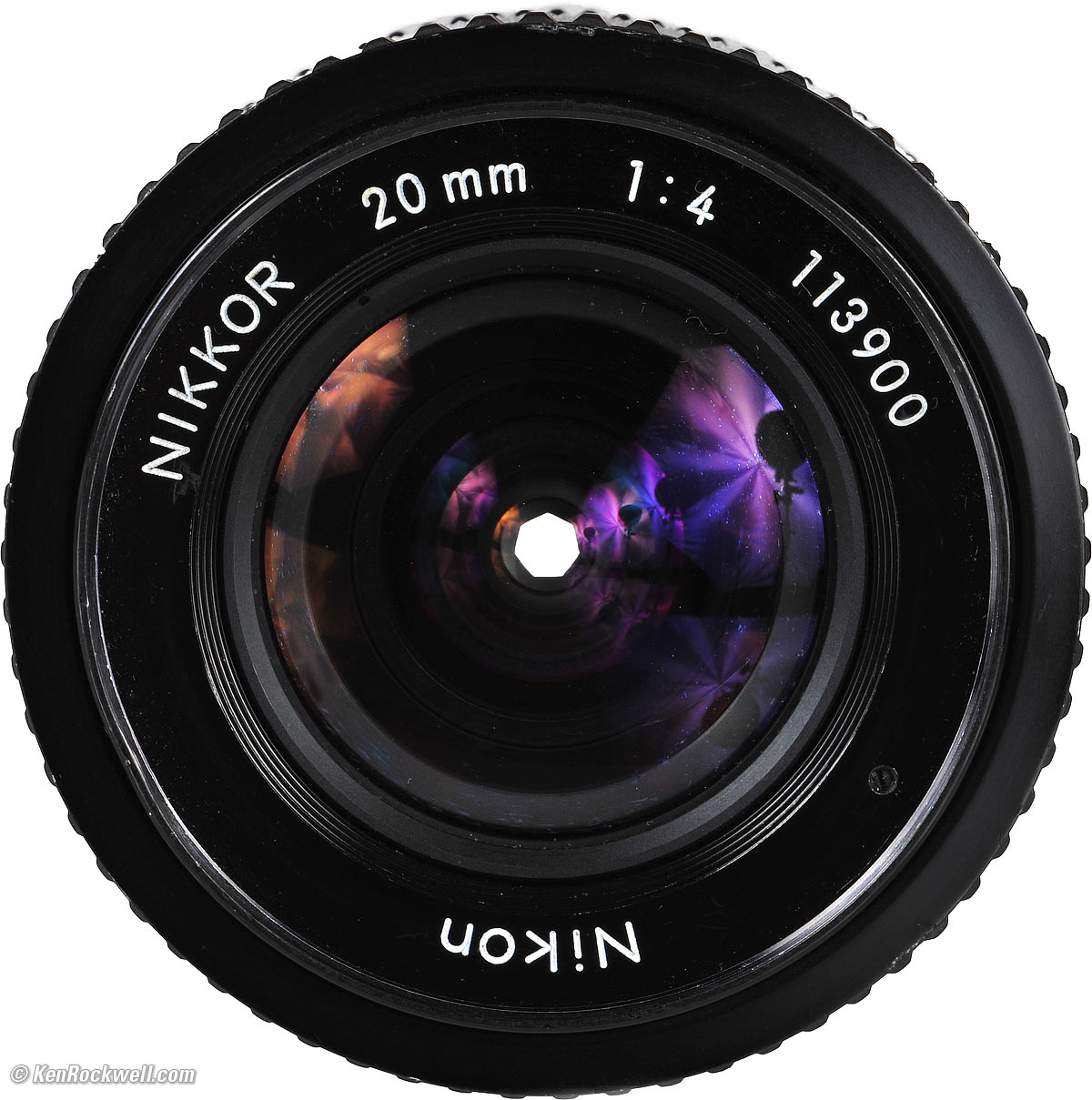
Nikon 20mm f/4 AI at f/5.6. enlarge.
7 straight blades.
Stops down to f/22.
Aperture Ring top
Yes.
Metal.
Full-stop clicks.
Close Focus top
1 foot.
0.3 meters.
Maximum Reproduction Ratio top
1:11.
Angle of View top
94° on FX and 35mm.
71° on small-format DX.
Focal Length top
20mm.
On a small-format DX camera, this lens sees an angle-of-view similar to what a 30mm lens would see on a full-frame camera.
Hard Infinity Focus Stop? top
Yes.
This is great for astronomy; just turn to the stop and you have fixed laboratory-perfect focus all night.
Focus Scale top
Yes, very precise.
Depth-of-Field Scale top
Yes, very precise.
Infra-Red Focus Index top
Yes: red dot in depth-of-field scale next to the f/4 mark.
Filter Thread top
52mm, metal.
Does not rotate.
Size top
Nikon specifies 1.4" (35.5mm) extension from flange (1.9" (47.5mm) overall) by 2.5" (63.5mm) diameter.
Weight top
7.357 oz. (208.6g), measured, AI version.
Nikon specifies 7.4 oz. (210g).
Hood top
HN-14 screw-in metal hood, optional.
Bizarre HK-3 slip-over metal hood. The HK-3 slips over the focus ring and holds on with a compression fitting!
You can ignore the hood. The filter threads provide about the same degree of stray light protection as the hood. Either tiny hood doesn't improve anything; unlike the 15mm f/3.5 AI-s, this 20/4 thankfully has few ghosts or flare problems, so you luckily just don't need a hood.
Case top
CL- 31, pouch No. 54, or CP-1 plastic bubble.
All are optional.
Made in top
Japan.
Teleconverters top
TC-200/201 and TC-14A, but why on Earth would you want to carry a separate teleconverter to turn this into a 28mm f/5.6 or a 40mm f/8 lens?
Performance top
Intro Specifications Performance Compared Recommendations
Overall Focus Color Distortion Ergonomics
Falloff Filters Ghosts Color Fringes
Overall performance top
The performance of this 20mm f/4 AI is indistinguishable from today's newest 20mm f/2.8 AI-s and 20mm f/2.8 AF-D lenses. This 20/4 is simply one stop slower, and a whole lot smaller.
This 20mm f/4 is the smallest ultrawide lens or zoom ever made by Nikon.
The maximum aperture is really closer to about f/4.5. Don't worry, the metering system compensates for all this. By cheating a little like this Nikon was able to get stellar performance in this tiny lens.
Focus performance top
Manual focus is excellent.
It is very precise, not fast. The focus ring turns 140.º The 20/3.5 AI-s is geared for faster focus (the ring only turns 70º) if you prefer it that way.
The D3, D3X, D3s, D700, F4, F5, F6 and most professional AF cameras have three very precise electronic manual focus indicators, with which this lens works perfectly.
Lesser digital cameras, like the D300s and down, usually have just one "OK" focus dot, which is not as precise as two arrows and a dot.
Color Rendition performance top
The color rendition of this Nikon 20mm f/4 matches my other multicoated Nikkors.
Distortion performance top
The Nikon 20mm f/4 has little distortion. It bloats-out a little in the center, and gets straight again towards the sides.
Vertical lines on either side, about 1/2 to all the way out, stay relatively straight.
Here's an uncorrected FX image of the sea, with the horizon along the top:

La Jolla Cliffs on FX, uncorrected. enlarge.
If correcting it with simple tools like Photoshop's lens distortion filter, some slight waviness will be left after these corrections. These aren't facts or specifications, they are the results of my research that requires hours of photography and calculations on the resulting data.
If shot on DX, which is silly, you see more distortion because you're only using the center of the image, where distortion is strongest, but much easier to correct.
FX and Film |
||
∞ |
+0.0* |
+2.2 |
10' (3m) |
+0.0* |
© 2010 KenRockwell.com. All rights reserved.
* Some waviness remains.
Ergonomics performance top
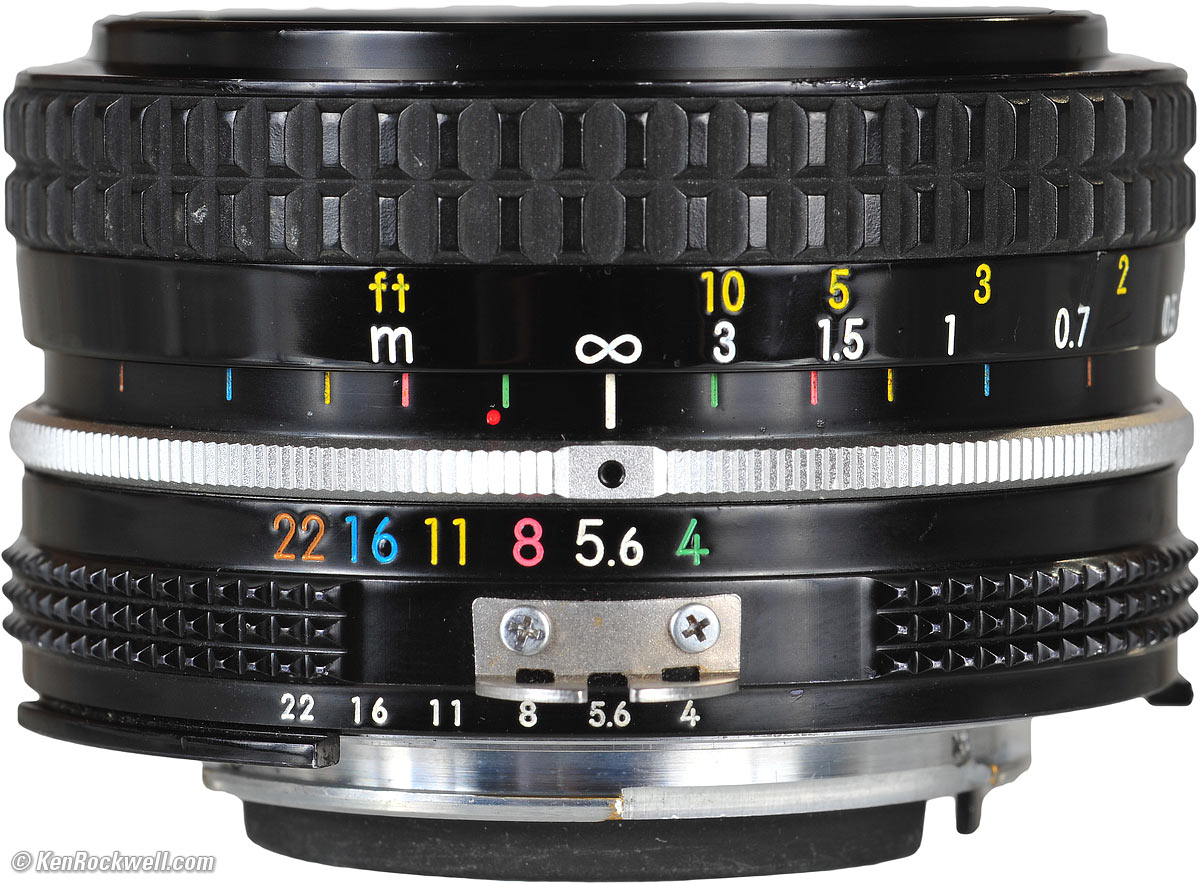
Nikon 20mm f/4 AI. enlarge.
The Nikon 20mm f/4's ergonomics are perfect.
All it is is a focus ring, a mounting and unmounting grab ring, and an aperture ring.
Newer lenses often lack an aperture ring or a decent focus ring.
The grab ring is especially easy to grab well.
Falloff (darkened corners) performance top
Falloff is visible wide-open and at f/4, mostly goes away at f/5.6, and is gone at f/8.
Falloff on FX is exactly the same as Nikon's other 20mm lenses and wide zooms.
See my 20mm lens falloff comparison.
It won't be an issue at all on DX (see crop factor).
I've exaggerated this by shooting a gray field and placing these on a gray background.
Nikon 20mm f/4 AI falloff on FX and film at infinity, no correction.
© 2010 KenRockwell.com. All rights reserved.
|



Filters, Use with performance top
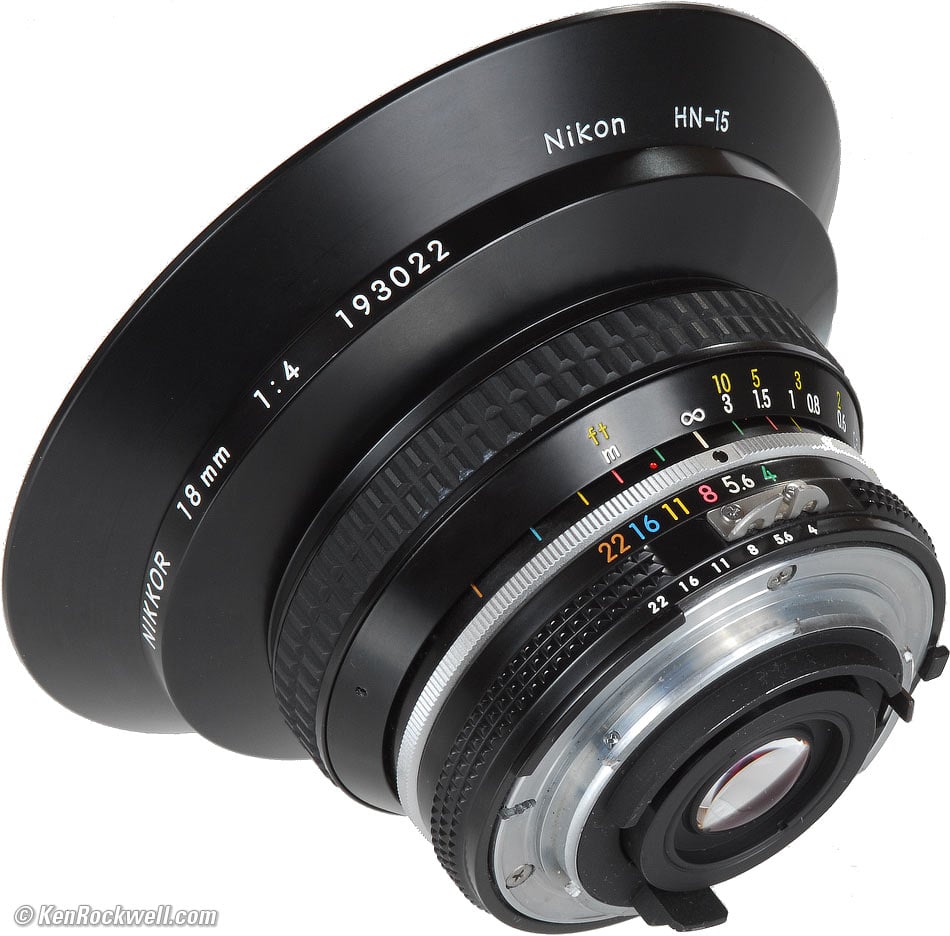
Filters are tight; you have to use a genuine Nikon-brand filter or risk vignetting, since the Nikon filters are thinner.
Don't use a polarizer; they don't work with well with any 20mm lens because the polarization of nature itself varies over such a broad angle.
To use more than one filter at a time, use a 52mm -> 77mm step-up ring, and use 77mm filters.
Flare and Ghosts performance top
It has very few magenta ghosts, if you get the disc of the sun in your image.
Lateral Color Fringes performance top
There can be some minor blue/yellow lateral color fringes when shot on the D3.
On 35mm, which offers no automatic correction, there are also some small yellow/blue lateral color fringes visible under the microscope.
Mechanics performance top
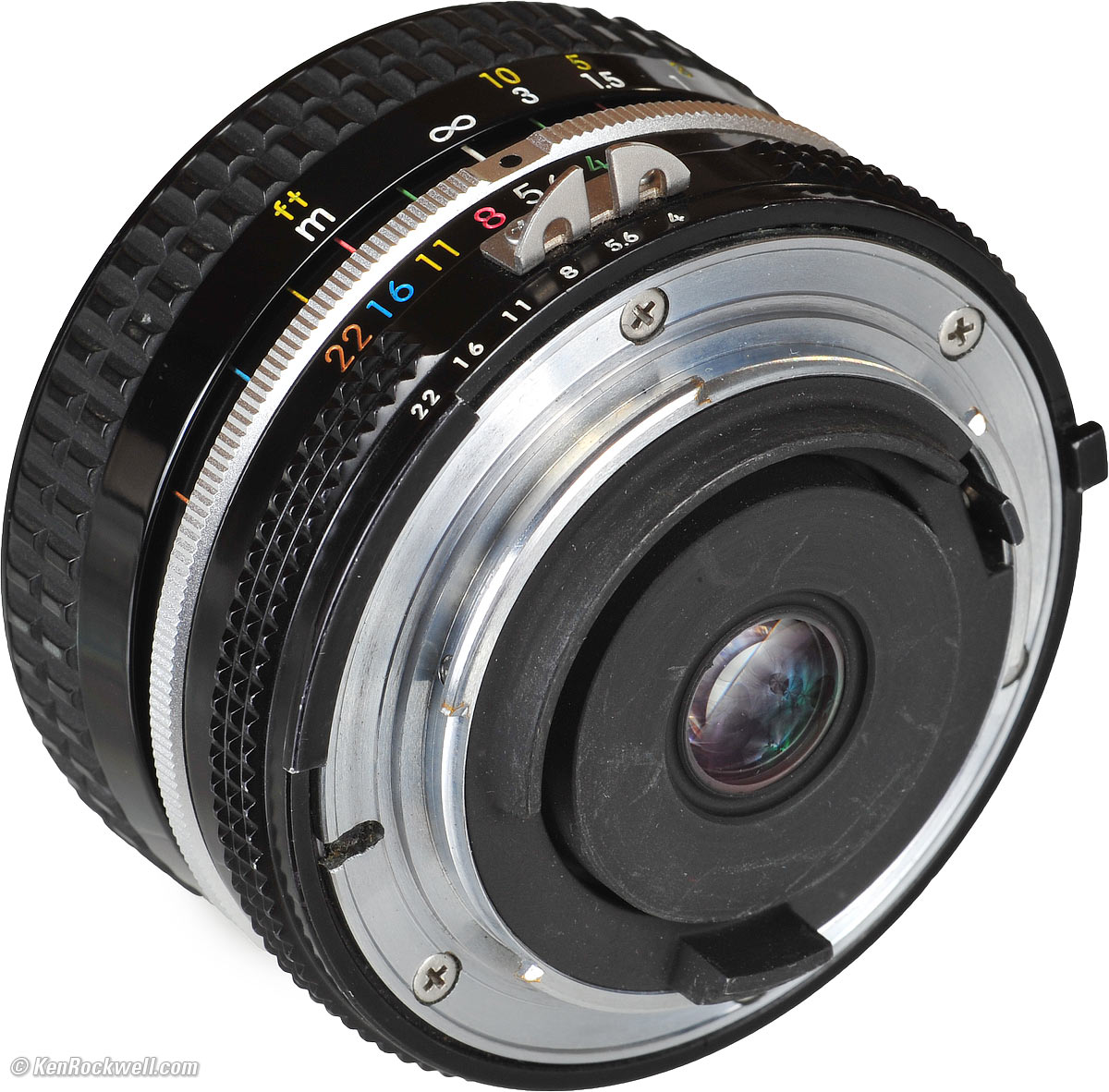
Nikon 20mm f/4 AI. enlarge.
Like all Nikkor manual focus lenses, the Nikon NIKKOR 20mm f/4 is built to the highest mechanical standards. This isn't some made-in-Red-China plastic dog plop.
Barrel Exterior
Anodized and enameled aluminum.
Filter Threads
Anodized aluminum.
Focus Ring
Metal, rubber covered.
Focus Helicoids
Feels like brass: smooth and silky with no play or need for damping grease.
Depth-of-Field Scale
Engraved into barrel and filled with different colors of paint.
Internals
All metal.
Aperture Ring
Cast aluminum, anodized and enameled.
Engraved markings filled with different colors of paint coded to the depth-of-field scale.
Mount
Dull-chromed brass.
Markings
Engraved into the metal and filled with paint.
Identity and Serial Number
On the front of the lens, inside the filter ring, engraved into the metal and filled with paint.
Ass-Gasket (dust seal at mount)
No.
Noises When Shaken
Delicate clicking from the diaphragm blades.
Made in
Japan.
Sharpness performance top
Warning 1: Image sharpness depends more on you than your lens.
Warning 2: Lens sharpness doesn't mean much to good photographers.
With those caveats, the 20mm f/4 AI is as sharp as all the rest of Nikon's 20mm lenses. I'm amazed at how similar they are when I did a run-off of about seven Nikon 20mm lenses and zooms.
All are as sharp in the center; the only difference is that the 16-35mm VR and 14-24mm are a bit sharper in the corners of FX wide-open. At actual shooting apertures like f/8, they are the same.
On 12MP FX (D700, D3)
At f/4
Sharp and contrasty center, perfect.
Softer sides and softer, darker corners.
At f/5.6
Sides and corners a bit better than at f/4, and lighter, too.
At f/8
Sides and corners better than at f/5.6, and all falloff is gone, too.
At f/11
The sides and corners are just about at their best. This and f/8 are the optimum apertures.
At f/16
Diffraction limits performance more than the optics themselves in the center, while the sides and corners get slightly sharper.
At f/22
Diffraction limits performance.
On Fuji Velvia with a 22x Loupe
I get very good performance even at f/4. I use it at any aperture, I see very little sharpness variation with aperture.
f/4: great in center, mild coma in edges but mostly lateral color. Some light falloff.
f/5.6: pretty good out to edges, a little light falloff.
f/8 and up: great performance all over
Sunstars performance top
The 20/4's straight 7-bladed diaphragm, makes great 14-pointed sunstars on bright points of light.
Compared top
Intro Specifications Performance Compared Recommendations
Oddly, I carefully compared this to eight other Nikon fixed 20mm and ultrawide zooms, and except for the superior 16-35mm and 14-24mm, they are all pretty much the same sharpness overall!
I compared the 20/3.5 UD, 20/4 AI, 20/3.5 AI, 20/2.8 AI-s, 20/2.8 AF, 20-35mm, 17-35mm, 18-35mm and 14-24mm. Wow! Yes, they were all different, but different in different ways in different places, thus in all, they were each as sharp as the next. (The 16-35mm and 14-24mm were superior, but everything else was the same.)
Sharpness Comparison to other 20mm lenses
| Anni | 2010- |
2009- |
1984- |
1977-1984 |
1974-1978 |
1967-1974 |
| Filter | 77mm |
52mm |
62mm |
52mm |
52mm |
52mm |
| Threads | Plastic |
Metal |
Metal |
Metal |
Metal |
Metal |
| Barrel | Plastic |
Metal |
Metal |
Metal |
Metal |
Metal |
| Weight | 678g |
199.5g |
259g |
232g |
209g |
388g |
| Weight | 23.9 oz. |
7.040 oz. |
9.1 oz. |
8.2 oz. |
7.4 oz. |
13.7 oz. |
| Price, USA, September 2010 |
Recommendations top
Intro Specifications Performance Compared Recommendations
The Nikon 20mm f/4 AI is a manual-focus only lens. For compact travel, it's the best Nikon ultrawide ever made, with the 20/3.5 AI as an almost identical second place in size.
This lens also showed me the complete lack of correlation between appearance (what camera dealers call "condition") and performance. I have had two of these lenses. The first one I bought used for $300 from a prominent Palo Alto, CA dealer in 1993. It looked completely unused. Its performance was worse than the beat-up one I use today as pictured above. The lens I use today looks much more beat up and cost me only $150 from a stranger, also in 1993. It performs much better. These differences are due to manufacturing variations. The only way to see how well a lens works is to photograph with it. Luckily the dealer who sold me the nice looking but poor performing 20mm took it back.
On 35mm, I can handhold it with sharp results 70% of the time at 1/8 on a Nikon FA. It's always sharp for me at 1/15 on an FA.
Deployment top
I'd pitch the flat Nikon cap that came with this lens new, and get a new "pinch" type cap. I'm not kidding: the new fatter caps are much easier to use in the field.
I'd leave either a 52mm Nikon Clear (NC - UV) filter, or a 52mm Hoya Super HMC UV on the lens at all times. I would leave the hood at home.
For color slides like Velvia 50, I use an old Nikon A2 or new 52mm Hoya HMC 81A outdoors.
For B&W film outdoors, I'd use an old Nikon Y48 or O56, or a new 52mm Hoya HMC K2 Yellow or 52mm Hoya HMC Orange.
Help me help you top
I support my growing family through this website, as crazy as it might seem.
The biggest help is when you use any of these links when you get anything, regardless of the country in which you live. It costs you nothing, and is this site's, and thus my family's, biggest source of support. These places have the best prices and service, which is why I've used them since before this website existed. I recommend them all personally.
If you find this page as helpful as a book you might have had to buy or a workshop you may have had to take, feel free to help me continue helping everyone.
If you've gotten your gear through one of my links or helped otherwise, you're family. It's great people like you who allow me to keep adding to this site full-time. Thanks!
If you haven't helped yet, please do, and consider helping me with a gift of $5.00.
As this page is copyrighted and formally registered, it is unlawful to make copies, especially in the form of printouts for personal use. If you wish to make a printout for personal use, you are granted one-time permission only if you PayPal me $5.00 per printout or part thereof. Thank you!
Thanks for reading!
Mr. & Mrs. Ken Rockwell, Ryan and Katie.
Home Donate New Search Gallery Reviews How-To Books Links Workshops About Contact