Home Donate New Search Gallery How-To Books Links Workshops About Contact
Nikon
20mm f/3.5
NIKKOR AI and AI-s (1977-1984)
© 2010 KenRockwell.com
Intro Specifications Performance Compared Recommendations

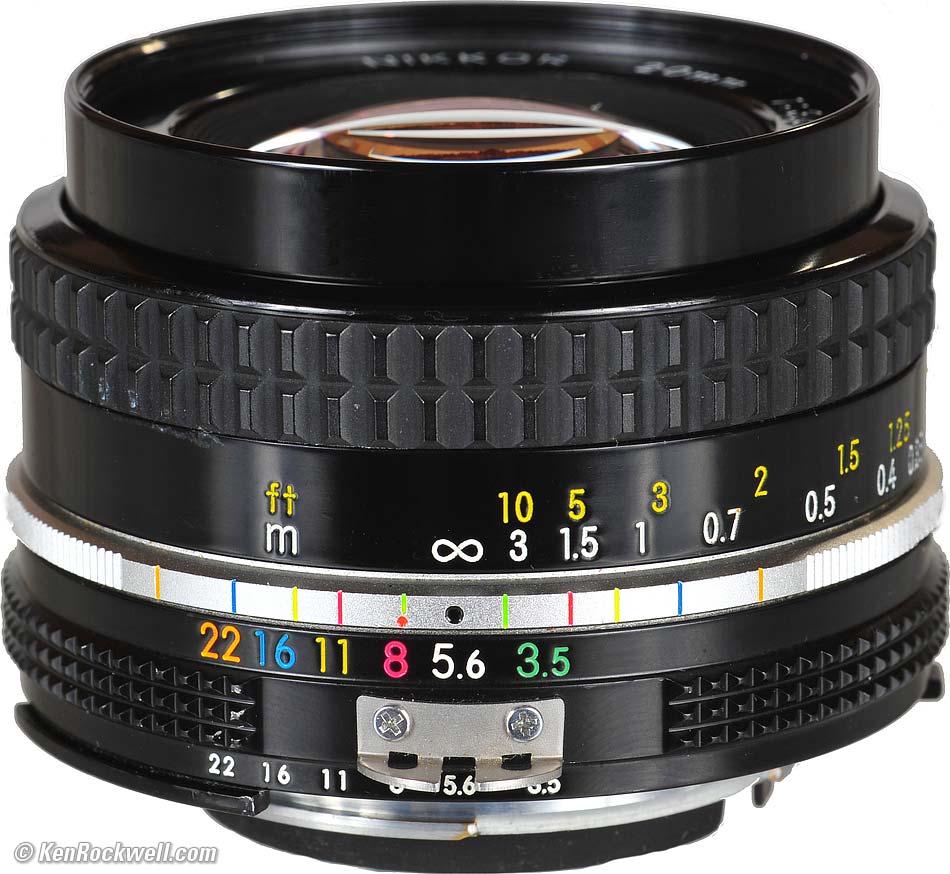
Nikon Nikkor 20mm f/3.5 AI (52mm filters, 8.2 oz./232g, about $225 used). enlarge. This free website's biggest source of support is when you use any of these links, especially this direct link to this lens at eBay (see How to Win at eBay) when you get anything. Thanks! Ken.
September 2010 More Nikon Reviews Nikon Lens Reviews
Sharpness Comparison to other 20mm lenses
Ideal Uses
Superb FX ultrawide, and ultracompact, too. This 20mm f/3.5 is Nikon's smallest and lightest ultrawide except for the slightly smaller 20mm f/4. This is the same size as a 50mm lens.
Not for
I wouldn't bother with this on a DX camera. I'd use any DX lens, like the 18-55mm kit lens, instead. As a manual focus lens, I wouldn't use it for sports, kids or action since it's too hard to track focus by hand.
| Optics: |  |
| Ergonomics: | (manual focus) |
| Usefulness: |  |
| Availability: |  |
| Overall: | |
Introduction top
Intro Specifications Performance Compared Recommendations
I personally buy from Adorama, Amazon, Ritz, B&H, Calumet and J&R. I can't vouch for ads below.
|



This Nikon 20mm f/3.5 is a great unknown lens made only for a few years around 1980. Besides being super small and taking standard small 52mm filters, it has excellent optics and superb mechanics.
It works wonderfully on all Nikon FX cameras, as well as 35mm.
This was the "cheap" 20mm lens compared to the larger 20mm f/2.8 AI-s back in the 1980s. The sharpness of this f/3.5 is at least as good, and the tiny size and common 52mm filter size makes it preferable. It has the same sharpness, distortion and falloff as all the other Nikon fixed 20mm lenses I've evaluated.
The manual-focus Nikon 20mm f/2.8 works great with most Nikon cameras, 35mm and digital.
It works flawlessly with every manual focus Nikon ever made, from the F of 1959 through the FM3a and today's FM-10.
On the D3X, D3s, D3, D700, D300, D200, D2 and F6, use the "Non-CPU Lens Data" menu option to set 20mm and f/3.5 to get full color matrix metering, EXIF data and finder read-out of set aperture. It works great in aperture-preferred as well as manual modes on these cameras.
It works perfectly on every professional 35mm camera (F, F2, F3, F4, F5, F6), and adds Matrix metering on the FA, F4 and F6.
The meters of cheaper digital (D90, D5000 and below) and cheaper film cameras (N80 and below) will not couple (or work at all) with this lens, so you'll be on your own guessing exposure using the rear LCD or an external meter, or get a tiny Gossen Digisix meter and hotshoe adapter to meter manually.
See Nikon Lens Compatibility for details on your camera. Read down the "AI, AI-s" column for this lens.
1959-1967
Nikon repackaged their 2.1cm (21mm) f/4 rangefinder lens, originally designed for the Nikon SP, for the F-mount SLRs.
It required the use of mirror lockup and a separate finder slid over the funky rewind crank of the NIkon F, as it poked all the way into the camera.
Nikon made about 5,000 of the 2.1cm f/4 lenses.
1967-1974
The 20mm f/3.5 UD was Nikon's first 20mm lens. It was the ultrawide for the late 1960s and early 1970s. There was no wider non-fisheye lens made by Nikon until the insane 15mm f/5.6 of 1973 and the 18mm f/4 of 1974.
Nikon made about 40,000 of the 20mm f/3.5 UD lenses.
1974-1978
The tiny 20mm f/4 (52mm filters), the smallest ultrawide ever made by Nikon or Canon, replacing the big 20/3.5 UD, with similar optical performance.
In 1975 Nikon introduced the world's widest non-fisheye lens, the Nikkor 13mm f/5.6, which remains today a the world's widest professional SLR lens ever made.
Nikon made F-mount (non-AI) 20mm f/4s from 1974-1977. The mount was redesigned as an AI lens in 1977, and sold until 1978.
Nikon made about 35,000 of these 20mm f/4 lenses, about half AI and half not. Most non-AI lenses have long since been updated to AI.
1977-1984
The 20mm f/3.5 AI lens was introduced in the fall of 1977 as one of the first AI lenses.
The optically identical AI-s version replaced it in the fall of 1981. The AI-s version was made until about 1984, since most people preferred the f/2.8 and bought it instead.
Nikon made about 30,000 of each version, or 60,000 total.
1984-today
Nikon replaced this tiny 20mm f/3.5 with today's 20mm f/2.8, which takes 62mm filters and is sold today in both manual-focus AI-s and autofocus versions.
Nikon has made about 70,000 of the 20mm f/2.8 AI-s lenses as of 2010, and still makes them today.
Nikon has made about 115,000 of the 20mm f/2.8 AF and AF-D lenses as of 2010, and still makes them today.
Price, new* |
Price in that era's dollars |
|
1982 |
$645 |
$285 |
1983 |
$415 |
$190 |
2010 |
n/a |
* Corrected for inflation, 2010, and at full NYC discount. Very few people bought their lenses this inexpensively back then.
** USA/gray.
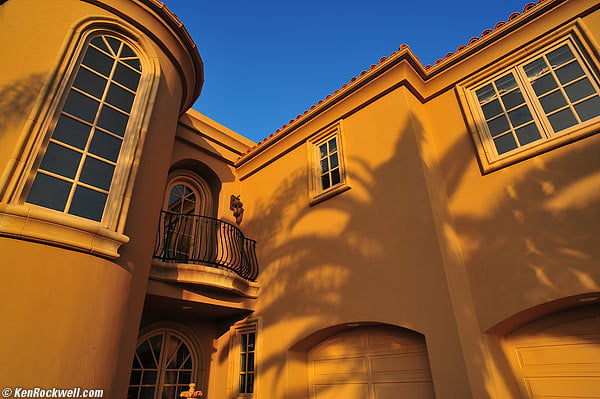
Sample Photo: Hotel. 20mm f/3.5 AI, f/11 at 1/125, Nikon D3, ISO 200.
Specifications top
Intro Specifications Performance Recommendations
Name
Nikon calls this the Nikon NIKKOR 20mm f/3.5 AI or AI-s.
Optics
11 elements in 8 groups.
That's a lot of tiny, precision glass.
Multicoated.
Traditional spherical design.
Focal Length
20mm.
Used on a DX camera it gives angles of view similar to what a 30mm lens would give on an FX or 35mm film camera. See also Crop Factor.
Angle of View top
94° on FX and 35mm.
71° on small-format DX.
Diaphragm
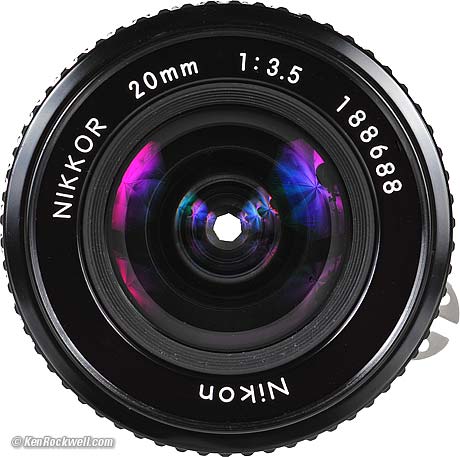
Nikon 20mm f/3.5 AI at f/5.6.
7 blades.
Stops down to f/22.
Close Focus
1 foot (0.3m).
Maximum Reproduction Ratio
1:10.8.
Depth-of Field Scale
YES.
Infra-Red Focus Index
YES, just below the f/3.5 depth-of-field index.
Filter Thread
52mm.
Metal.
Does not rotate.
Size
1.624" extension from flange (focused at infinity) x 2.459 " diameter (41.26 x 62.46mm), measured.
The widest thing is the aperture ring.
Nikon specifies 50.5 x 63.5mm
Weight
8.195 oz. (232.3g), measured.
Nikon specifies 235g.
Hood
HK-6, which isn't needed, and is a pain to attach with a friction gismo.
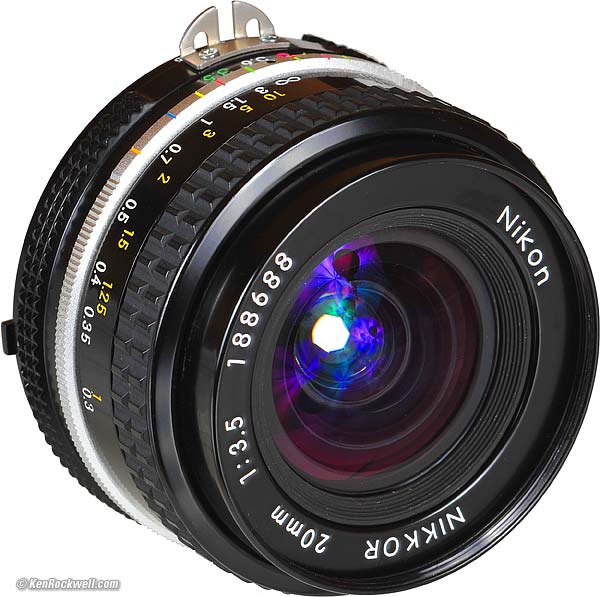
Nikon 20mm f/3.5 AI at f/5.6.
Performance top
Intro Specifications Performance Compared Recommendations
Overall
Performance is great: it's sharp, tiny and just works.
Falloff (dark corners)
Falloff is visible wide-open and at f/4, mostly goes away at f/5.6, and is gone at f/8.
Falloff on FX is exactly the same as Nikon's other 20mm lenses and wide zooms.
It won't be an issue at all on DX (see crop factor).
I've exaggerated this by shooting a gray field and placing these on a gray background.
Nikon 20mm f/3.5 falloff on FX and film at infinity, no correction.
© 2010 KenRockwell.com. All rights reserved.
|




Focus
Manual focus has the exquisite classic Nikon feel, which is duplicated nowhere else.
One light fingertip is all that's required to focus.
The AI-s version focuses with a smaller turn of the ring, while the AI version here spreads the focus range over a larger area to allow more precise focus, depth-of-field calculation and more precise distance markings.
AI version focus scale markings, 100º rotation
Feet: 10, 5, 3, 2, 1.5, 1.25 and 1 foot.
Meters: ∞, 3, 1.5, 1, 0.7, 0.5, 0.4, 0.35 and 0.3 meters.
AI-s version focus scale markings, 70º rotation
Feet: 5, 3, 2, 1.5, 1.25 and 1 foot.
Meters: ∞, 2, 1, 0.7, 0.5, 0.4, 0.35 and 0.3 meters.
The AI-s version doesn't have the 10 foot or 0.35 meters markings, and replaces the 1.5 and 3 meter markings with a single 2 meter mark.
Ghosts
It has very few ghosts when pointed into the sun; a hair less than the 20/4 AI.
Distortion
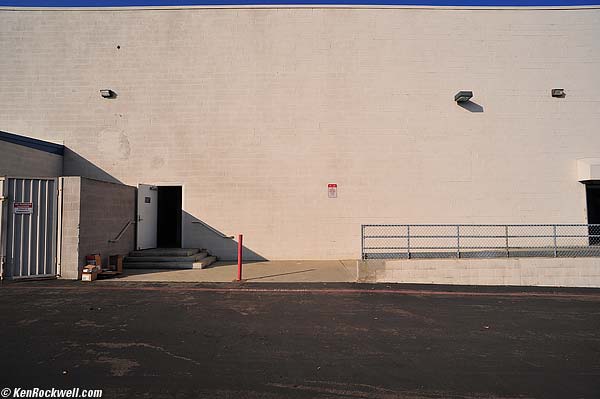
Wall of Shame, shot on FX, uncorrected. Note slight wiggling along top.
Distortion is complex on film and FX. It's simple barrel distortion on DX, with no wiggling.
You may as well leave it along on film and FX, since the correction below doesn't do much to eliminate the complex curve.
On DX, it corrects perfectly, but why use this 20mm lens on DX when the 18-55mm AFS kit lens works so much better?
Plug these figures into Photoshop's lens distortion filter to correct the distortion. These aren't facts or specifications, they are the results of my research that requires hours of data collection and computation.
FX and Film |
||
50' (15m) |
-0.2* |
+2.2 |
© 2008 KenRockwell.com
*Wiggling, or waviness, remains.
Color Rendition
Like all Nikon multicoated lenses, I've never seen any variation between any of them in color rendition. They all look the same, the hallmark of a well-designed lens line.
Peripheral color balance is cooler than the center, which is typical for ultra-wide lenses of every brand and format. Look at the boring wall above: it's pinker in the middle, and greener in the corners.
Except for this shot of a wall, for which only an idiot photographer would use a 20mm lens instead of a 105mm Micro, I've never seen this effect affect any real photos, like the one at the top of this page. While I also see it on my 75mm Super-Angulon when shooting tests of walls, it never effects real photos.
This effect is an artifact of lens coatings. Coatings work based on interference patterns between various wavelengths (colors) of light and the thickness of the coatings. When light comes at an angle other than 90 degrees normal to the glass surface, the light has to travel through more coating, which moves the effects of the coating to longer (redder) wavelengths.
Think I'm kidding? Look at the reflections in the glass from the front of the 20mm f/3.5, then move the lens to change the angle. I see many green reflections straight-on, which turn to magenta at an angle. This means less green light gets in at the center (since it's reflected more), and more green gets in at the sides. These reflections are less than 1% of the light, but that means that transmission might vary from 100% down to 99%.
I can't see this in real photos. If it bothers you, get the 14-24mm f/2.8 AFS, which has this effect under better, but not complete, control.
Filters, Use with
There is no problem with vignetting with 52mm filters, so long as you use Nikon brand filters which have very thin mounts.
The very thick mounts of Tiffen, Heliopan and B&W filters may cause some vignetting on film and FX digital.
If you, as I, want to use colors of filters that Nikon does not make, then I suggest getting a huge filter like a 77mm and using a step-up ring. I use this trick with my 20mm f/2.8 AF and it works fine, even with stacked filters.
Don't use a polarizer; they don't work with well with any 20mm lens because the polarization of nature itself varies over such a broad angle.
Lateral Color Fringes on the D3
None.
Manufacturing Variation
My first sample in the 1990s was softer on one side than the other.
The sample I bought in 2007 is fine.
Mechanics and Construction
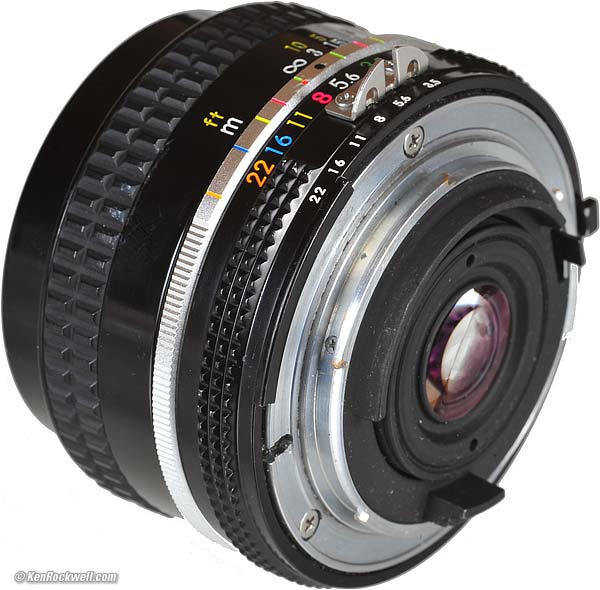
Nikon 20mm f/3.5 AI.
The Nikon 20mm f/3.5 is made like they used to. It is built to the highest mechanical standards.
Filter Threads
Metal.
Barrel
Metal.
Focus Ring
Metal, rubber covered.
Aperture Ring
Metal.
Finish
Black enamel over black anodize.
Mount
Dull chromed brass.
Internals
Metal.
Markings
Engraved and filled with paint.
Noises when shaken
Clicking from the diaphragm blades.
Sharpness
Like most lenses, the sharpness of images made with the Nikon 20mm f/3.5 is more a function of the photographer's skill than any limitation of the lens.
On full-frame digital and film, it's soft in the corners wide open, so don't do that if you're shooting test charts. If you are shooting charts, get the 14-24mm f/2.8 AFS, which is superior. I'd never notice any difference between this and any other 20mm lens in real shooting.
Sharpness on a 12 MP FX camera (D3 or D700)
Viewed at 100%, in the center, out to an radius of about 12mm, it's perfectly sharp at every aperture. Diffraction limits sharpness at f/11 and smaller.
In the far sides of the full FX frame (18mm radius), its softer wide open at f/3.5, and becomes s sharpest at f/11.
In the farthest corners (a radius of 21.6mm), It's soft wide-open, and sharpest at f/22.
I'd shot it at f/11 for best results, or simply not worry about it. it works well at every aperture in the conditions you're likely to use it.
Compared top
Intro Specifications Performance Compared Recommendations
Oddly, I carefully compared this to eight other Nikon fixed 20mm and ultrawide zooms, and except for the superior 16-35mm and 14-24mm, they are all pretty much the same sharpness overall!
I compared the 20/3.5 UD, 20/4 AI, 20/3.5 AI, 20/2.8 AI-s, 20/2.8 AF, 20-35mm, 17-35mm, 18-35mm and 14-24mm. Wow! Yes, they were all different, but different in different ways in different places, thus in all, they were each as sharp as the next. (The 16-35mm and 14-24mm were superior, but everything else was the same.)
Sharpness Comparison to other 20mm lenses
| Anni | 2010- |
2009- |
1984- |
1977-1984 |
1974-1978 |
1967-1974 |
| Filter | 77mm |
52mm |
62mm |
52mm |
52mm |
52mm |
| Threads | Plastic |
Metal |
Metal |
Metal |
Metal |
Metal |
| Barrel | Plastic |
Metal |
Metal |
Metal |
Metal |
Metal |
| Weight | 678g |
199.5g |
259g |
232g |
209g |
388g |
| Weight | 23.9 oz. |
7.040 oz. |
9.1 oz. |
8.2 oz. |
7.4 oz. |
13.7 oz. |
| Price, USA, September 2010 |
Recommendations top
Intro Specifications Performance Compared Recommendations
Definitely get one of these if you want a tiny 20mm lens for film or FX digital. Skip it for DX digital since there are more convenient lenses, cheaper, for DX.
The older 20mm f/4 AI is as good, too.
Deployment top
I'd pitch the flat Nikon cap that came with this lens new, and get a new "pinch" type cap. I'm not kidding: the new fatter caps are much easier to use in the field.
I'd leave either a 52mm Nikon Clear (NC - UV) filter, or a 52mm Hoya Super HMC UV on the lens at all times. I would leave the hood at home.
For color slides like Velvia 50, I use an old Nikon A2 or new 52mm Hoya HMC 81A outdoors.
For B&W film outdoors, I'd use an old Nikon Y48 or O56, or a new 52mm Hoya HMC K2 Yellow or 52mm Hoya HMC Orange.
Help me help you top
I support my growing family through this website, as crazy as it might seem.
The biggest help is when you use any of these links to Adorama, Amazon, B&H, eBay, Ritz, Calumet and J&R and when you get anything. It costs you nothing, and is this site's, and thus my family's, biggest source of support. eBay is always a gamble, but all the other places always have the best prices and service, which is why I've used them since before this website existed. I recommend them all personally.
If you find this page as helpful as a book you might have had to buy or a workshop you may have had to take, feel free to help me continue helping everyone.
If you've gotten your gear through one of my links or helped otherwise, you're family. It's great people like you who allow me to keep adding to this site full-time. Thanks!
If you haven't helped yet, please do, and consider helping me with a gift of $5.00.
As this page is copyrighted and formally registered, it is unlawful to make copies, especially in the form of printouts for personal use. If you wish to make a printout for personal use, you are granted one-time permission only if you PayPal me $5.00 per printout or part thereof. Thank you!
Thanks for reading!
Mr. & Mrs. Ken Rockwell, Ryan and Katie.
Home Donate New Search Gallery How-To Books Links Workshops About Contact