Home Donate New Search Gallery Reviews How-To Books Links Workshops About Contact
Nikon
58mm f/1.2
Noct-NIKKOR AI and AI-s (1977-1997)
Intro Specs Performance Compared Anecdote Recommendations
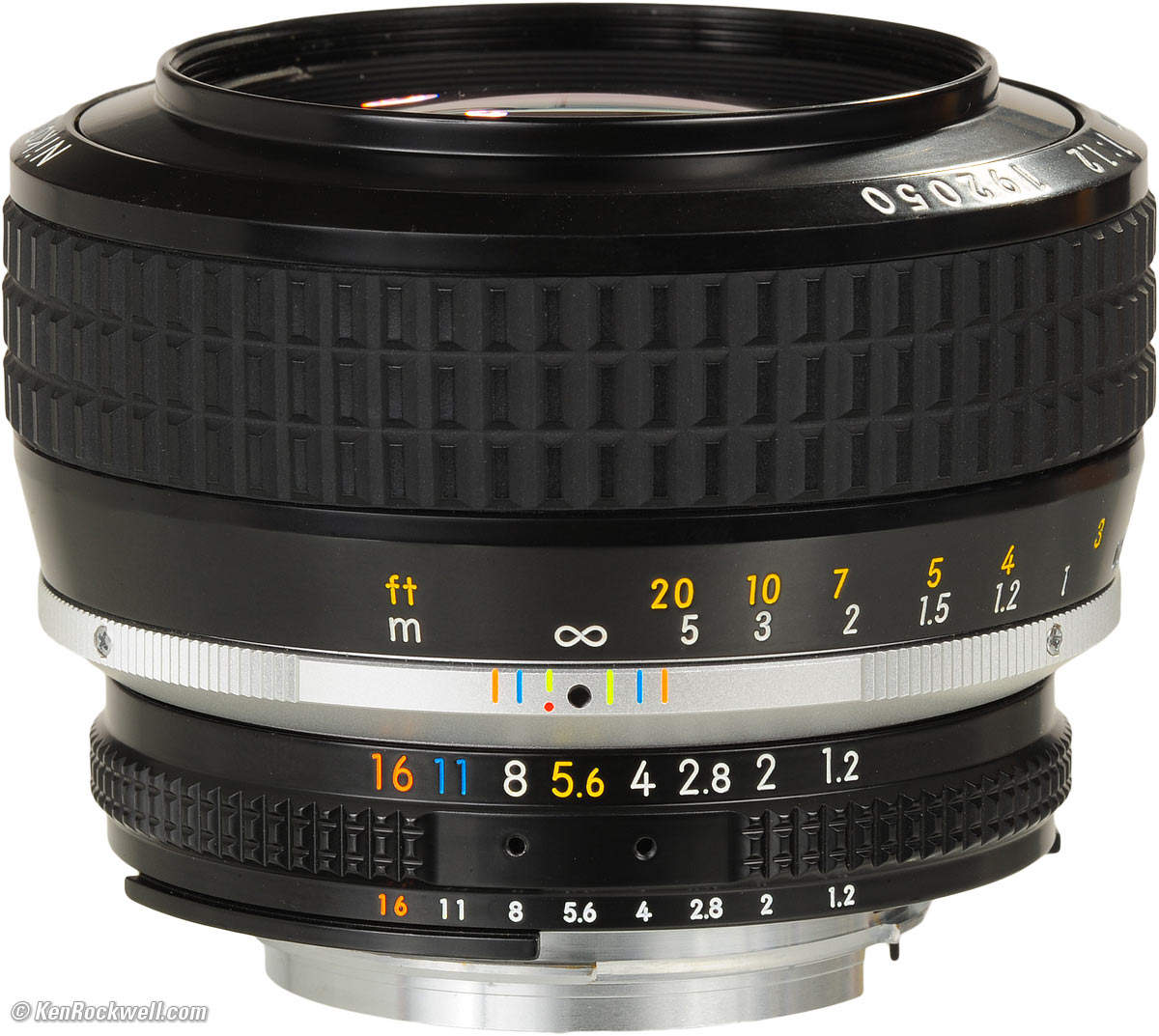
Nikon AI Noct-NIKKOR 58mm f/1.2s (meter-coupling prong removed for this photo, FX, DX and 35mm coverage, 52mm filters, 16.6 oz./470g, 1.7'/0.5m close focus, about $3,800 used if you know How to Win at eBay). enlarge. This free website's biggest source of support is when you use that or any of these links when you get anything, regardless of the country in which you live. Thanks! Ken.
2:22 PM, 22 February 2022 Nikon Reviews Nikon Lenses Nikon Flash All Reviews
Premium 50mm Lenses Compared 04 September 2014
Nikon 58mm f/1.4 G. December 2013.
Nikon 50mm and 58mm Bokeh Comparisons. December 2013.
Nikon 58mm f/1.4 F (350g, 1959-1962)
Nikon High-Speed 50mm Lens Sharpness Comparison 09 Sep 2010
Why Fixed Lenses Take Better Pictures
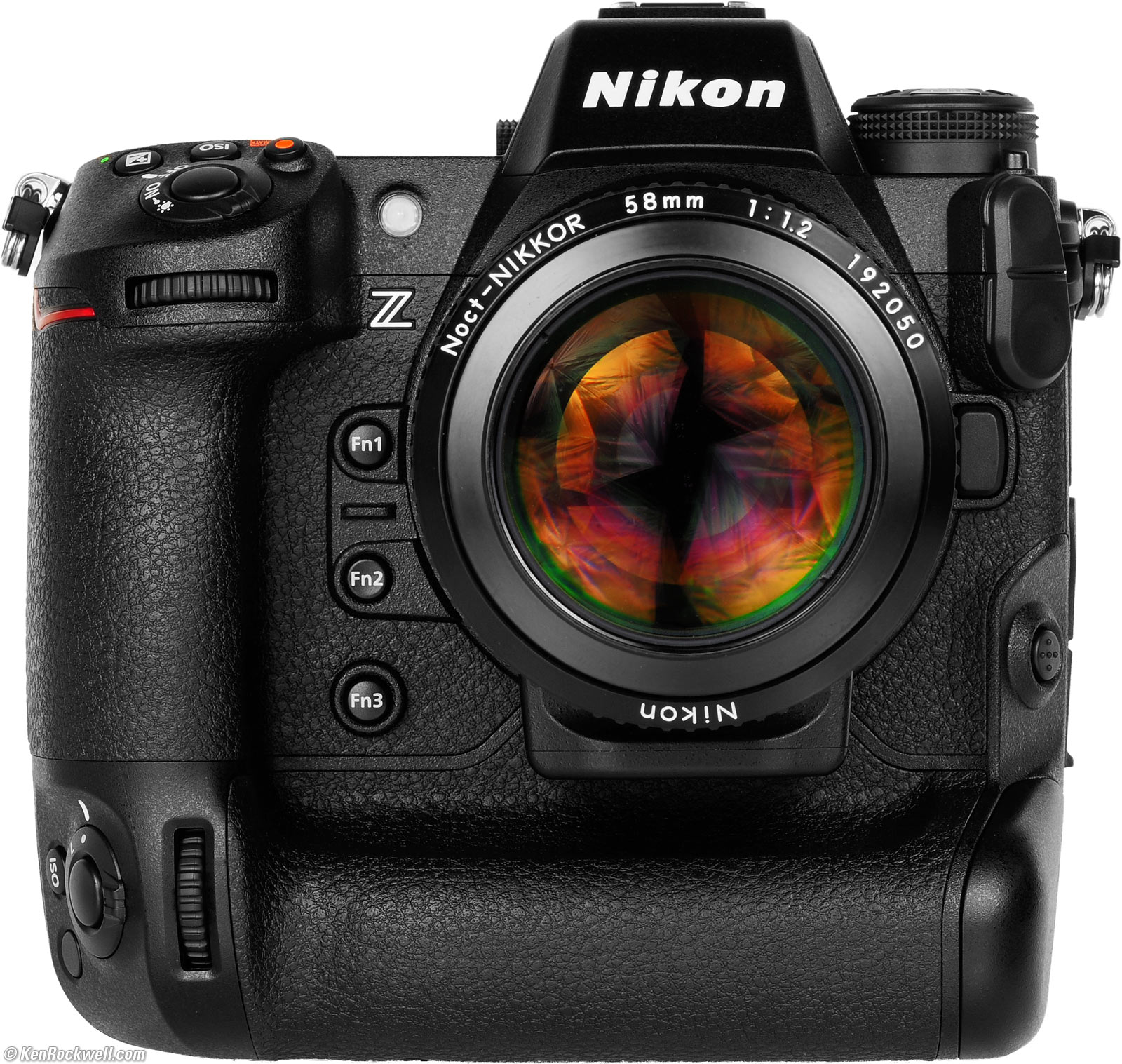
Nikon Z9 and Nikon AI Noct-NIKKOR 58mm f/1.2s on FTZ. bigger.
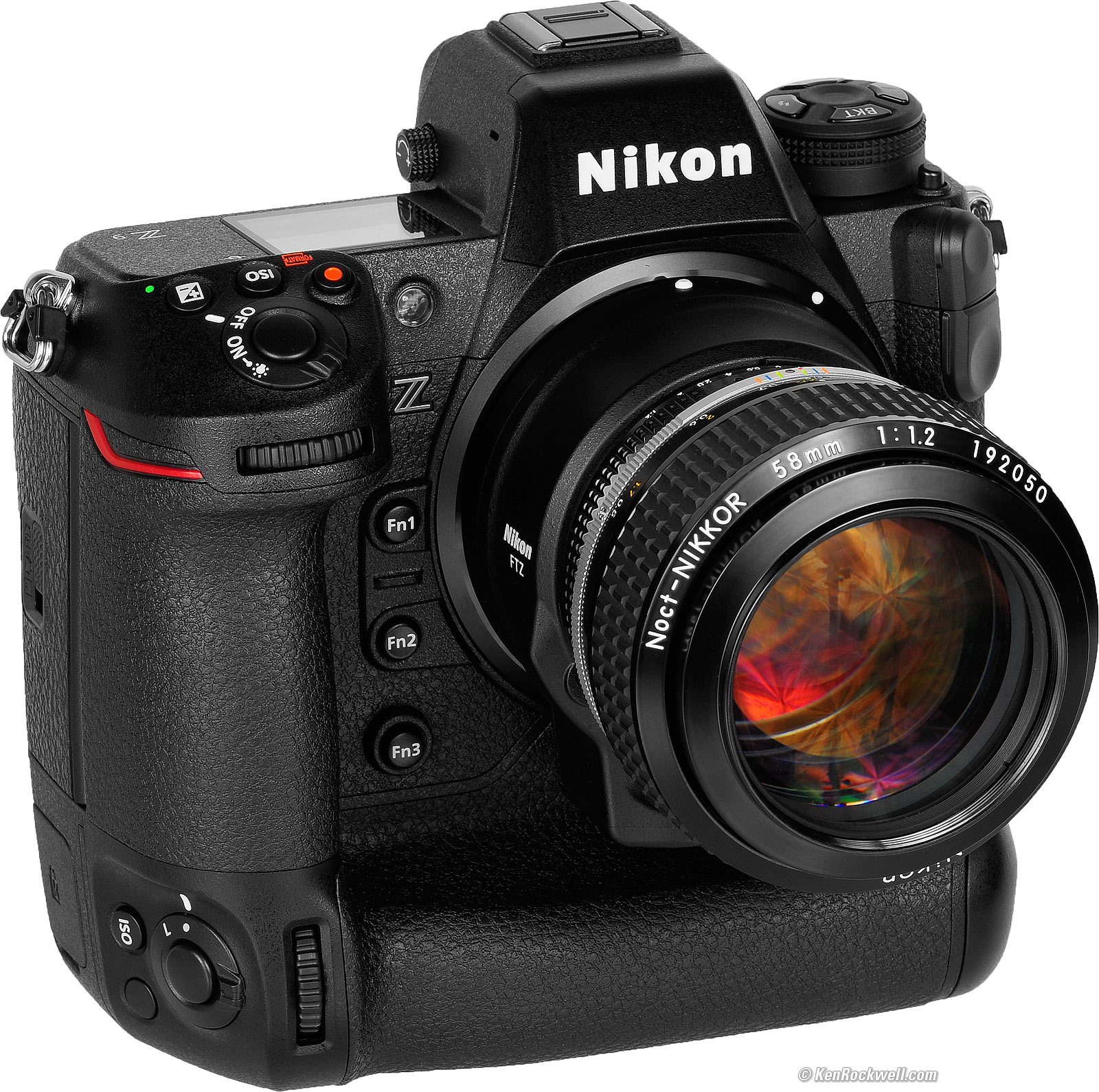
Nikon Z9 and Nikon AI Noct-NIKKOR 58mm f/1.2s on FTZ. bigger.
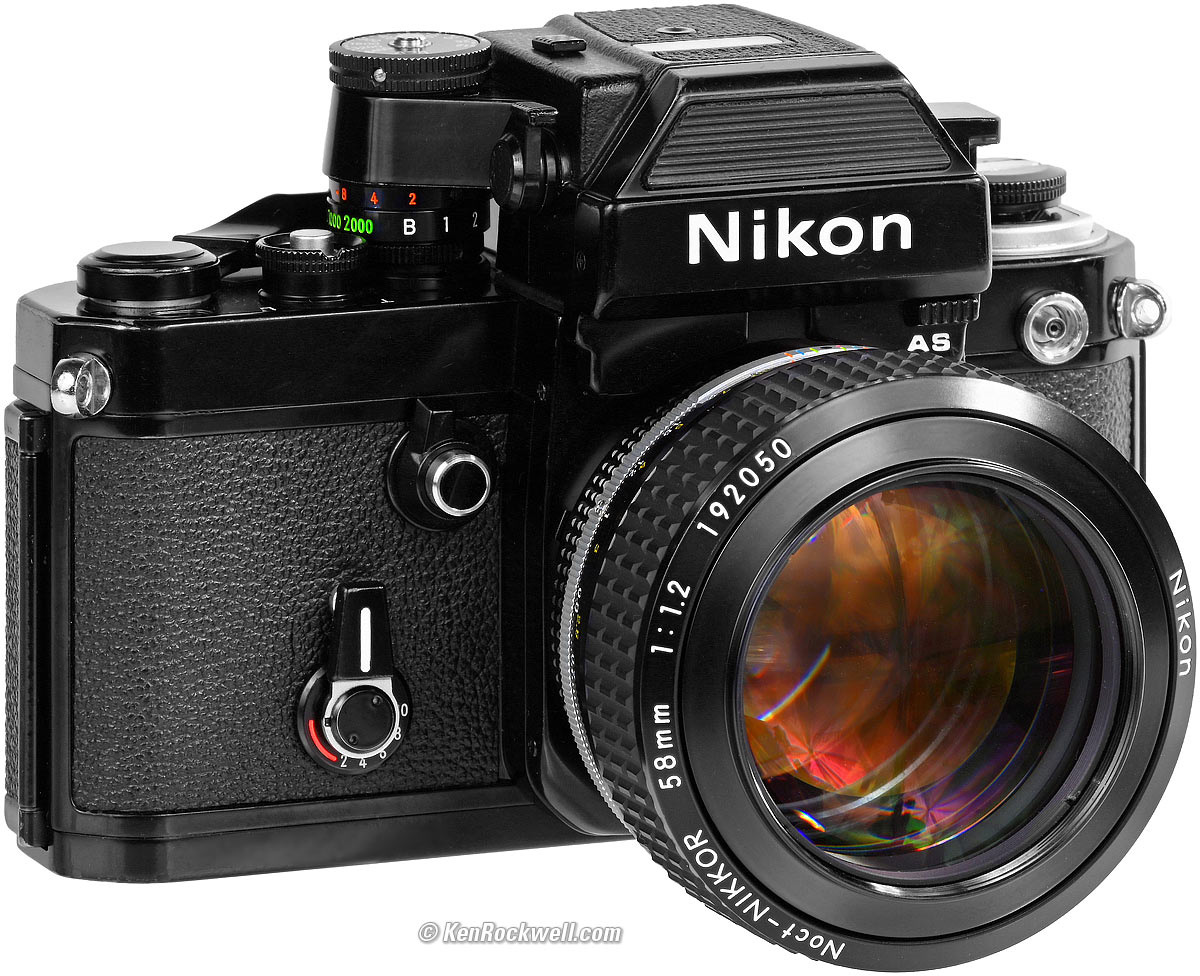
Nikon F2AS and Noct-NIKKOR 58mm f/1.2 AI-s. bigger.
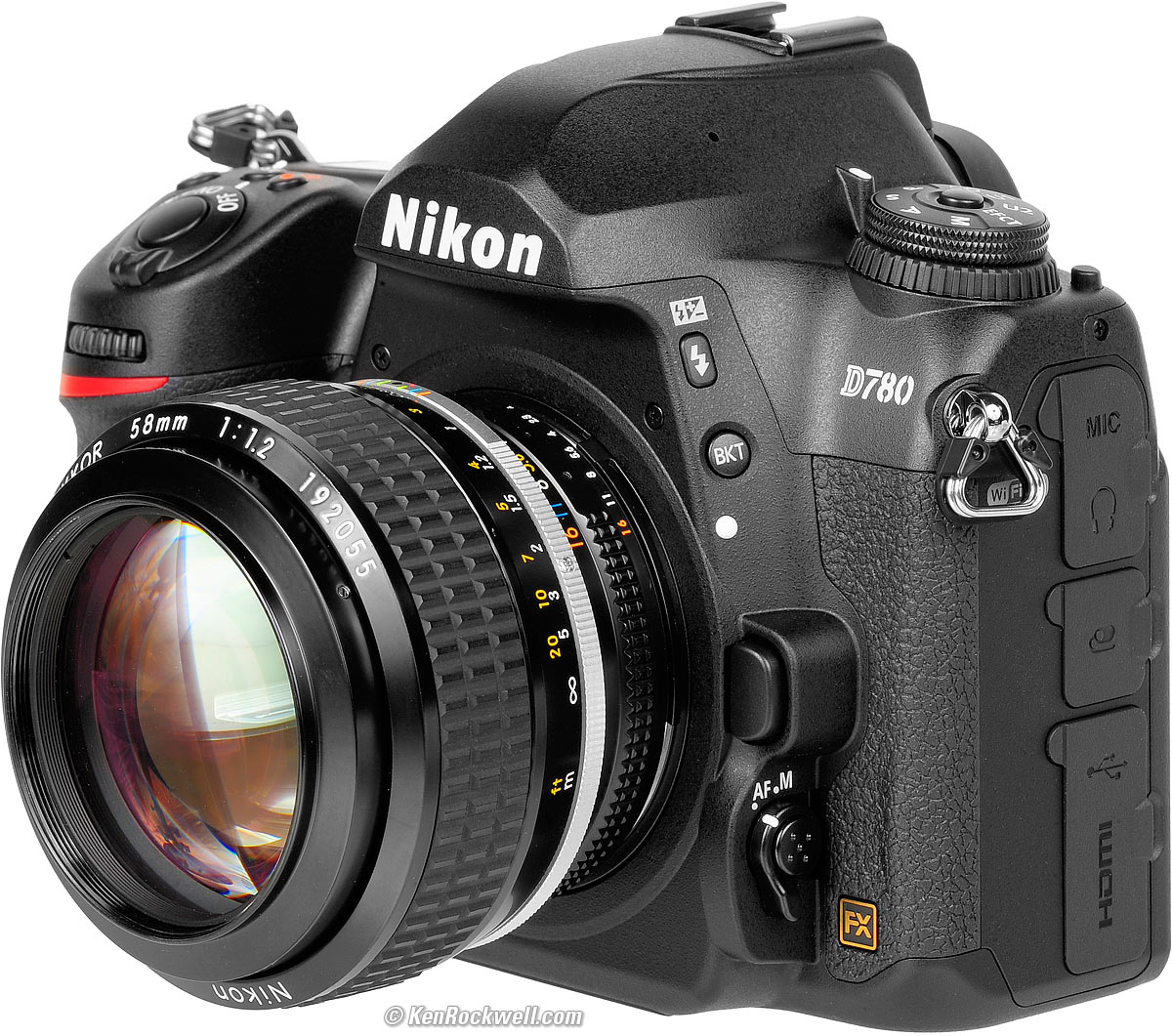
Nikon D780 with 58mm Noct-NIKKOR f/1.2 AI-s. bigger.
Good
This Nikon 58mm f/1.2 Noct-NIKKOR is the fastest, sharpest and most contrasty lens ever made by Nikon when compared to any other lens at f/1.2 or f//1.4. Used wide-open, its performance is unbeaten, and if you shoot at these apertures, you'll love the Noct.
Unlike conventional lenses, the Noct-NIKKOR is just as sharp and contrasty at f/1.2 as it is stopped-down. It doesn't get less contrasty, softer or more hazy or veiled when shot at f/1.2 as do other lenses.
Today's 50mm f/1.4 AF-S is very close, but still not quite as good in the center at large apertures.
The Noct-NIKKOR is especially well suited to photographing points of light against dark backgrounds, be they streetlights at night, stars, or tracking space-based weapons platforms over large visual fields as seen from Earth.
Bad
Collectors have jacked the price up to $3,000, used.
For conventional photography, other 50mm lenses are sharper in the corners.
Accurate and precise focus is critical at f/1.2. AF and digital Nikons that only have one focus "OK" dot rarely will give good focus at f/1.2; you need a camera which has a three-segment ( > o < ) electronic focus indicator, or a manual-focus camera.
| Optics: |  |
| Ergonomics: |  (manual focus) (manual focus) |
| Usefulness: | |
| Availability: |  |
| Overall: | |
Introduction top
Intro Specifications Performance Compared Recommendations
Compatibility History Production Pricing

|



The 58mm f/1.2 Noct-NIKKOR is very special aspherical lens that was designed expressly for photography that involves brilliant points of light against dark backgrounds at large apertures.
This is a special purpose, hand-ground aspherical lens intended to be used at f/1.2 for hand-held night or astronomical photography.
Most fast 50mm lenses have an optical aberration called coma, which adds weird blobs of light around brilliant points of light at large apertures in the corners.
The aspherical design of this Noct (Nocturnal) lens really works: points of light do render as points, and not big blobs. It is also impeccably sharp at f/1.2 in the center of the image, as spherical aberration has been eliminated.
The manual-focus Nikon 58mm f/1.2 Noct-NIKKOR works great with most Nikon cameras, film and digital.
This classic manual focus lens, one of Nikon's greatest of all time. It has no data communication when used on the FTZ so it has no autofocus and very limited usability; use it on an FX DSLR for the best experience (Nikon FX DSLRs have technology lacking in the FTZ for full communication with manual-focus lenses).
It works flawlessly with every manual focus Nikon ever made, from the F of 1959 through the FM3a and today's FM-10.
On the D3X, D3s, D3, D700, D300, D200, D2 and F6, use the "Non-CPU Lens Data" menu option to set 58mm and f/1.2 to get full color matrix metering, EXIF data and finder read-out of set aperture. It works great in aperture-preferred as well as manual modes on these cameras.
It works perfectly on every professional film camera (F, F2, F3, F4, F5, F6), and adds Matrix metering on the FA, F4 and F6.
The meters of cheaper digital (D90, D5000 and below) and cheaper film cameras (N80 and below) will not couple (or work at all) with this lens, so you'll be on your own guessing exposure using the rear LCD or an external meter, or get a tiny Gossen Digisix meter and hot shoe adapter to meter manually.
See Nikon Lens Compatibility for details on your camera. Read down the "AI, AI-s" column for this lens.
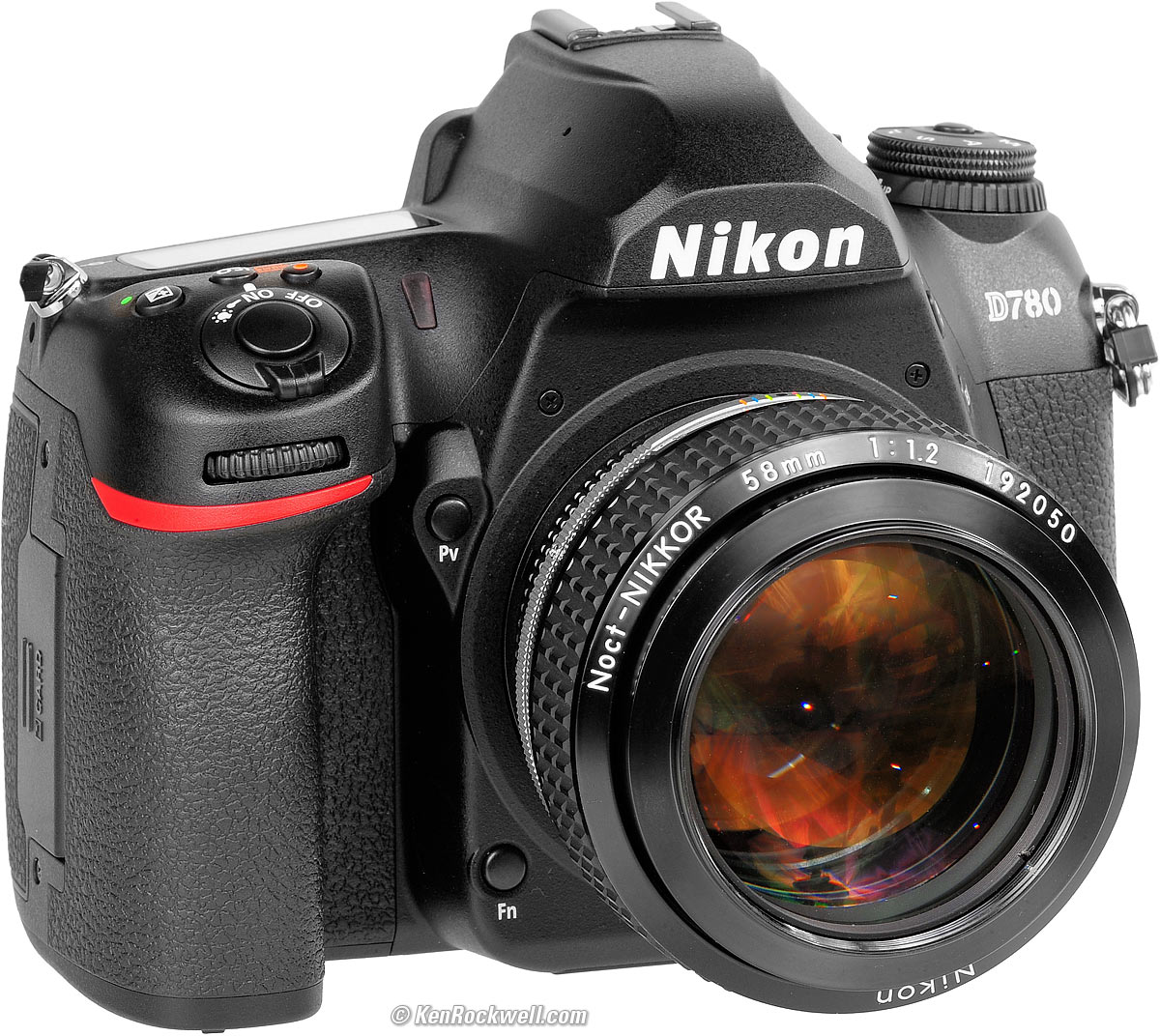
Nikon D780 with Noct-NIKKOR 58mm f/1.2 AI-s (1977-1997). bigger.
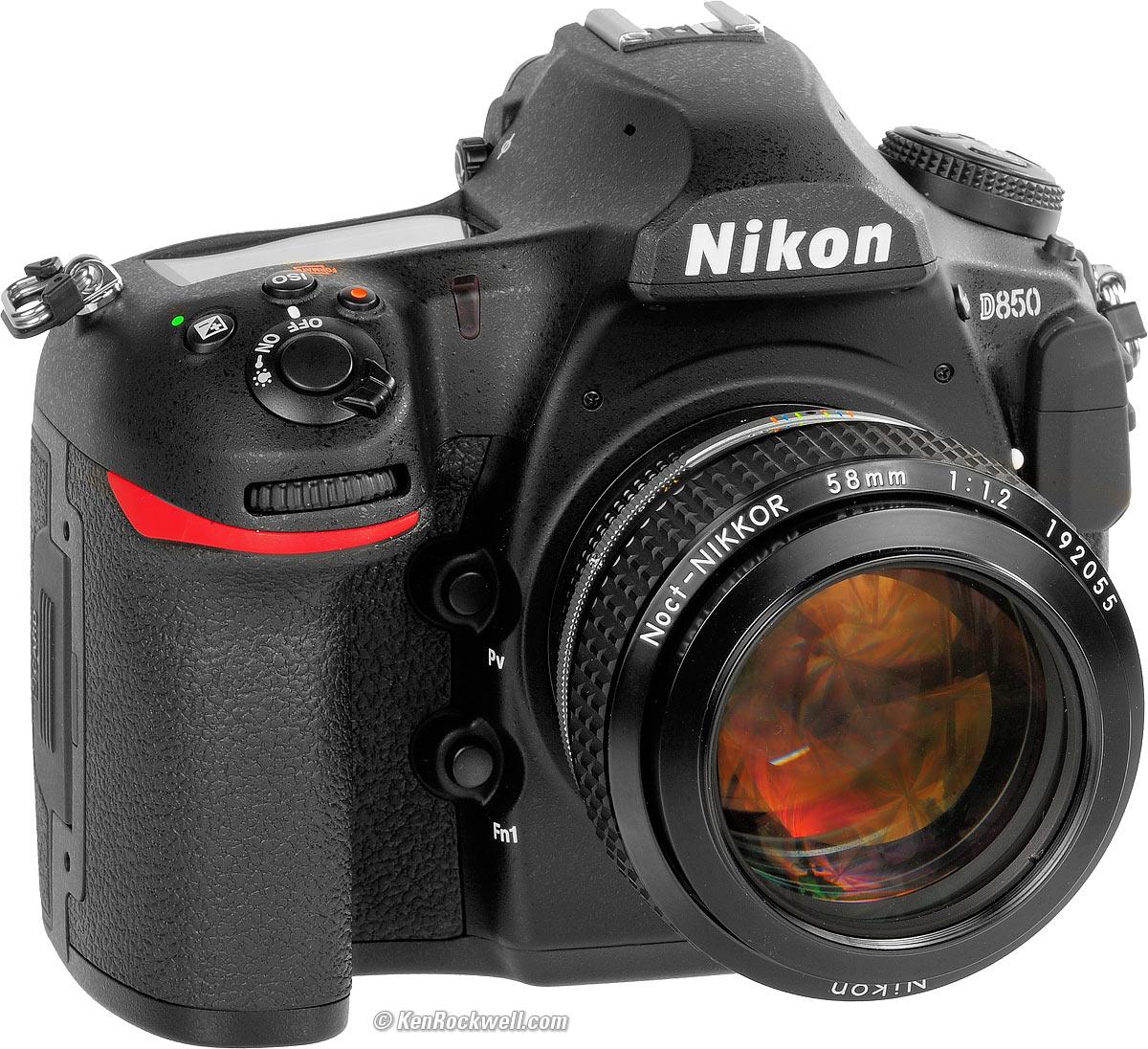
Nikon's best camera with one of Nikon's best lenses: the D850 and 58mm f/1.2 Noct-NIKKOR. bigger.
1977-1981
The Noct-NIKKOR was introduced in 1977 as an AI lens.
It has a 7-bladed diaphragm.
1982-1997
Nikon updated the 58/1.2 to AI-s in November 1981.
It has a 9-bladed diaphragm.
It was discontinued in 1997.
Nikon made about 2,500 of the AI version, and about 9,000 of the AI-s.
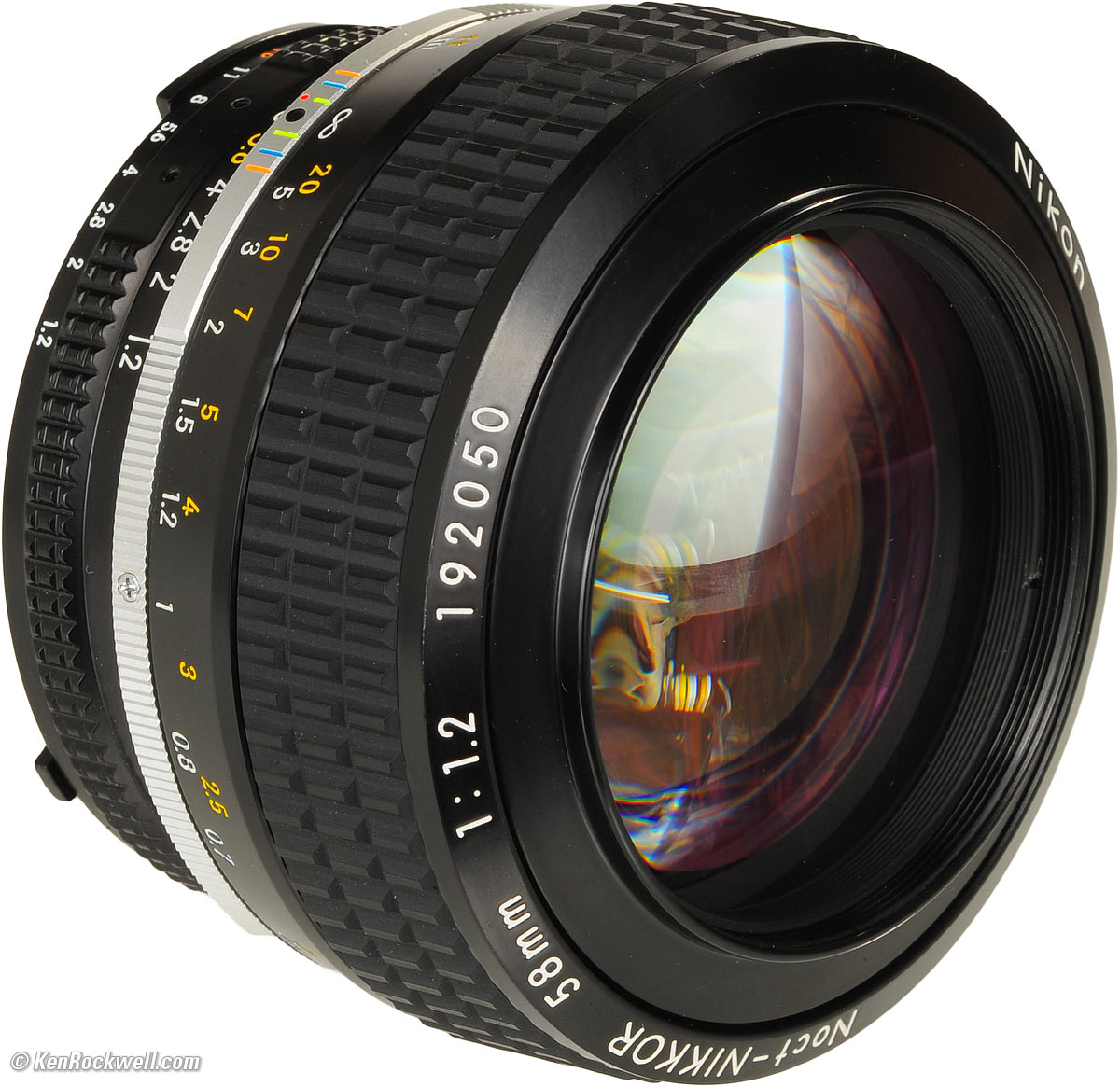
Nikon 58mm f/1.2 Noct-NIKKOR. enlarge.
Specifications top
Intro Specs Performance Compared Anecdote Recommendations
Name
Nikon calls this the Nikon Noct-NIKKOR 58mm f/1.2 AI (or AI-s).
Noct means that this lens is optimized for nocturnal use.
NIKKOR is Nikon's brand name for their lenses.
AI and AI-s are technical descriptions of how the apertures couple to the meter.
Optics top
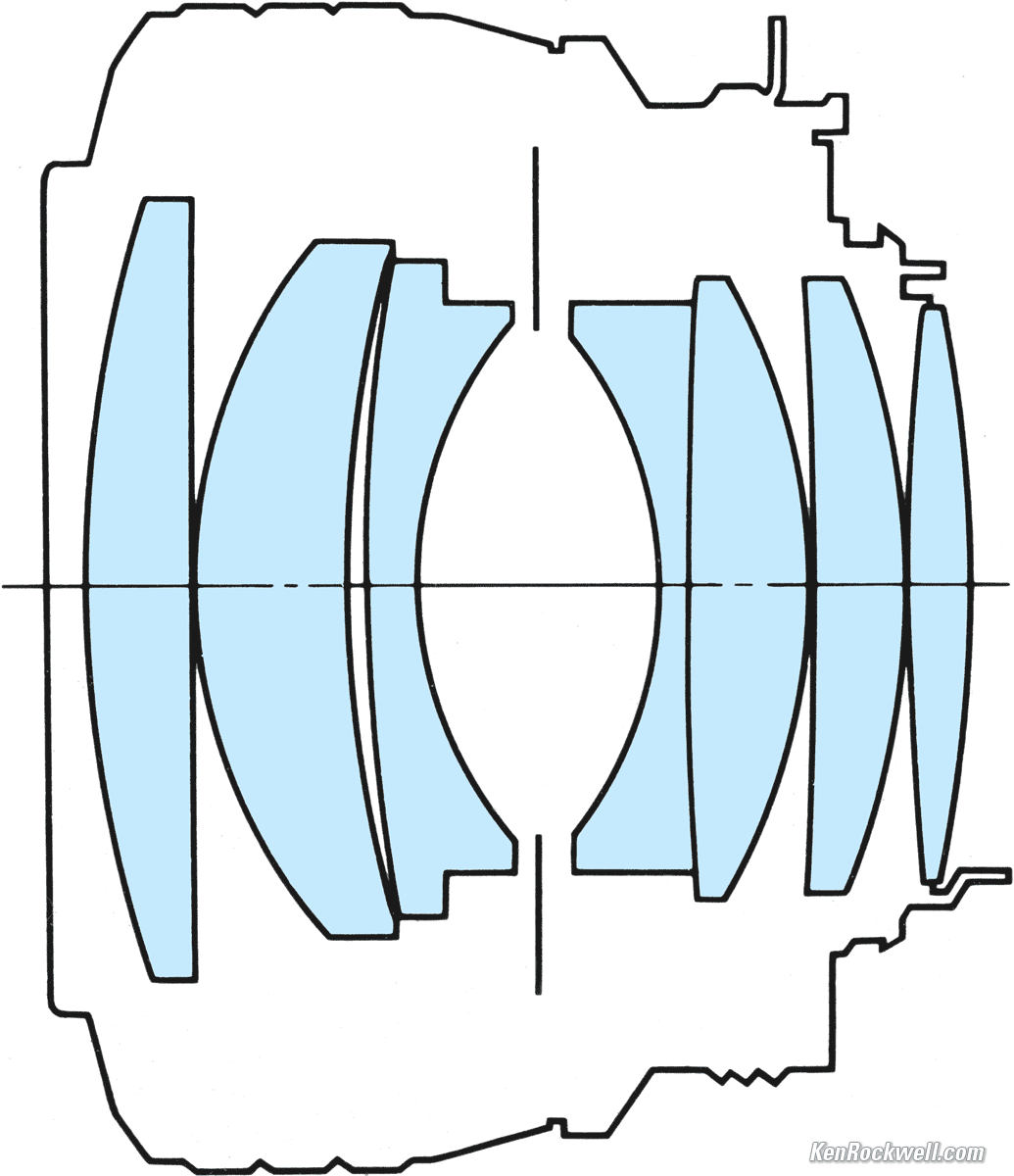
Diagram, Nikon 58mm f/1.2 Noct-NIKKOR. enlarge.
7 elements in 6 groups.
The front surface of the the front element has a hand-ground aspherical surface, the key to its incredible performance at f/1.2.
It's all multicoated on all air-to-glass surfaces, which Nikon calls Nikon Integrated Coating (AI-s version).
Angle of View top
Focal Length top
58mm.
On a small-format DX camera, this lens sees an angle-of-view similar to what an 88mm lens would see on a full-frame camera.
Diaphragm top

Nikon 58mm f/1.2 Noct-NIKKOR AI-s at f/5.6. enlarge.
AI-s version (1982-1997): 9 straight blades (shown above).
AI version (1977-1981): 7 somewhat rounded blades.
Stops down to f/16.
Aperture Ring top
Yes.
Metal.
Full-stop clicks.
Close Focus top
1.7 feet, marked.
0.5 meters, marked.
Maximum Reproduction Ratio top
1:6.7.
Hard Infinity Focus Stop? top
Yes.
This is great for astronomy; just turn to the stop and you have fixed laboratory-perfect focus all night.
Focus Scale top
Yes.
Depth-of-Field Scale top
Yes.
It seems as if it's calculated for a smaller circle of confusion than other lenses, while in fact the depth of field of a 58mm lens is shallower than 50mm lenses. Focal length has a huge influence on depth of field, far larger than aperture.
Infra-Red Focus Index top
Yes: red dot near the f/5.6 depth-of-field index.
Filter Thread top
52mm, metal.
Does not rotate.
Also optional AF-1 gelatine filter holder.
Size top
Nikon specifies 2.0" (51.5mm) extension from flange (2.5" or 63mm overall) by 2.9" (74mm) diameter, AI-s version.
Weight top
AI-s version (1982-1997)
16.575 oz. (469.9g), measured.
Nikon specifies 16.4 oz. (465g).
AI version (1977-1981)
Nikon specifies 16.9 oz. (480g).
Hood top
HR-2 folding rubber hood with metal center, $19. (not included.)
HS-7 snap-in metal, not included.
Case top
None is included. Optional are:
CL-31S case.
Pouch #61.
CP-8 plastic bubble.
Made in top
Japan.
Teleconverters top
TC-200/201 and TC-14A, but why? The TCs only use a maximum of f/1.8 of the lens, meaning you'll make your lens an 81mm f/2.5 or an 116mm f/3.5. So?
Nikon warns of potential uneven exposure at smaller than f/11, not that I've ever figured out what they mean by that.
Nikon Product Number top
1439.
Price, U. S. A. specifications top
Historical New Prices
Price, New* |
Price, New** |
dollars at the time* |
|
1983 |
$1,590 |
$1,300 |
$600 |
1986 |
$1,680 |
$1,400 |
$700 |
1987 |
$1,950 |
$1,600 |
$840 |
1988 |
$2,175 |
$1,790 |
$970 |
1991 |
$1,936 |
$1,600 |
$1,000 |
1992 |
$1,860 |
$1,540 |
$990 |
1994 |
$2,455 |
$2,000 |
$1,380 |
1995 |
$2,751 |
$2,275 |
$1,590 |
1996 |
$2,675 |
$2,200 |
$1,590 |
1997 |
$2,550 / $2,710*** |
$2,100 / $2,250*** |
$1,550/1,650*** |
1998 |
$2,510 / $2,670*** |
$2,050 / $2,200*** |
$1,530/1,650*** |
* Corrected for inflation in 2021. Also listed at full NYC discount; very few people bought their lenses this inexpensively back then.
** Corrected for inflation in 2010. Also listed at full NYC discount; very few people bought their lenses this inexpensively back then.
*** Gray / USA.
Used Prices, if you know How to Win at eBay
Price |
Range |
|
2010 |
$2,100 ~ $3,200 |
|
5/2018 |
$2,100 ~ $3,200 |
|
6/2021 |
$3,100 ~ $4,500 |
|
2/2022 |
$3,500 ~ $4,200 |
* In 2010, expect to pay about $2,100 for a well-worn sample to about $3,200 for a very clean one as seen here. Dealers will ask $4,500 for them like-new-in-the-box with papers, but they won't sell at that price. In 2018 it's still the same price.
** In 2021 expect to pay about $3,500 for a nice lens as seen here, or about $4,200 for one in a box. Range runs rom $3,100 to $4,500, if you know How to Win at eBay.
Performance top
Intro Specs Performance Compared Anecdote Recommendations
Overall Focus Bokeh Color Coma Distortion
Ergonomics Falloff Filters Color Fringes Mechanics
Sharpness Stabilzation Spherochromatism Sunstars
Overall performance top
The 58mm f/1.2 Noct-NIKKOR is a very special lens. The people who own it love it, because the people who own it use it wide open.
The 58mm f/1.2 Noct is not a general purpose lens. For most uses, a 50mm f/1.8 will work as well or better, with better corner sharpness and less distortion.
The Noct's specialty is general shooting at f/1.2, and especially keeping bright points of light as bright points of light, not weird coma blobs.
Focus performance top
Manual focus is lovely.
Focus is as smooth as silk, perfectly damped with no play.
The D3, D3X, D3s, D700, F4, F5, F6 and most professional AF cameras have three very precise electronic manual focus indicators, with which this lens works perfectly.
I find that my D3 and the sample of lens I borrowed tended to focus the most accurately if I pulled-in the focus just a nit so that the left and center electronic focus dots were blinking alternately.
Lesser digital cameras, like the D300s and down, usually have just one "OK" focus dot, which is not precise enough to focus this lens accurately and repeatably at f/1.2.
Focus Screens
What do viewfinder focus screens have to do with the Nikon 58mm f/1.2 Noct?
Simple: modern bright screens do not show the limited depth of field at f/1.2. Huh?
In the beginning, focus screens really were made of something similar to ground glass on the Nikon F, F2, F3 and FE cameras up until the 1970s. Back in these days, most people shot with f/2 or faster normal lenses, and f/2.8 wide and tele lenses. The slowest bargain lenses were f/3.5.
Zooms became popular in the 1970s, which started at f/3.5 and got slower from there. Only in the 1990s did f/2.8 zooms become common, and they are still too expensive for most people's budgets today. Today in 2007 most people shoot with f/3.5-5.6 zooms, and pros shoot with f/2.8 zooms. f/2.8 is the fastest lens usually used in 2007.
Therefore SLR cameras have been using very special focus screens, cut by computer-controlled lasers with zillions of precise prismatic surfaces instead of just random grain, ever since the 1970s. These special screens optimize brightness with the zoom lenses used by most people, including pro zooms at f/2.8.
Here's the catch: modern extra-bright focus screens only see through a section of lens up to about f/2.8. They simply don't see any of the light from the outer sections of the lens from faster apertures, so they don't show you the defocus you'll get at f/1.2!
Use the depth of field preview. You won't see any darkening until you get to about f/2.8. In other words, the finder looks as bright at f/2.8 as it does at f/1.2. You're not seeing what you'll get at f/1.2 or f/2!
Still think I'm kidding? Look through the front of the 50mm f/1.2 back into your camera. On a 1980 and newer camera you'll only see light from the screen in the middle of the lens, while on a 1960s camera you'll see the ground glass lit up from the finder's eyepiece throughout the entire open front of the lens.
Do you care? Be forewarned that modern focus screens, meaning all digital cameras and film cameras from the F4 and newer, aren't showing you the full extent of background defocus, nor are they helping you get snap focus on the ground glass.
I don't know of any Nikon focus screens for modern cameras optimized for lenses faster than f/2.8. Canon does. If you care, you may want to shoot an older camera if you use the ground glass to focus or to see depth of field.
The microprisms and split rangefinders of all screens work the same.
Bokeh performance top
Bokeh, the character of out of focus areas, not simply how far out of focus they are, is uniquely weird.
Have a look for yourself above. Backgrounds are very far out of focus and undistracting, but not completely soft.

Ryan Flossing. (Nikon D3, STANDARD Picture Control with +2 saturation, Auto white balance with A3 trim, Noct-NIKKOR 58mm f/1.s AI-s, no filters, 1/60 at f/1.2, Auto ISO 900.) enlarge. enlarge and dodged properly.
Background highlight blurs may also be tinged with a bit of green; that's spherochromatism.
Color Rendition performance top
The color rendition of this Noct-NIKKOR matches my other modern NIKKOR lenses.
Coma performance top
Coma is weird smeared blobs that appear around bright points of light in the corners of ordinary fast normal lenses, and is the specific problem that this Noct lens was created to rectify. Coma is also called saggital coma flare.
Most conventional fast lenses are awful. Have a look at the coma of the 50mm f/1.2 for comparison.
This Noct really is special: it's not as sharp as conventional lenses in the corners wide-open, but it is much contrastier and free from coma.
Here is a full-frame image, first at f/4 and then at f/1.2:
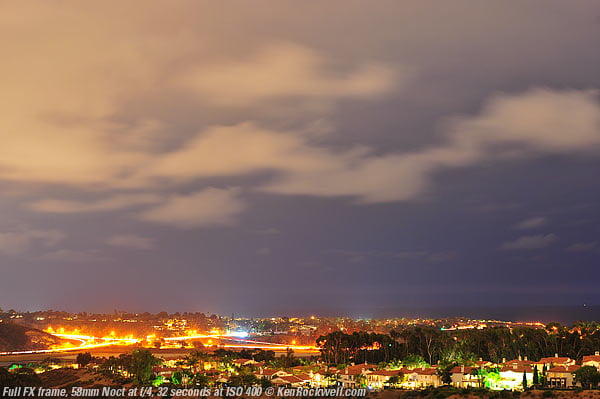
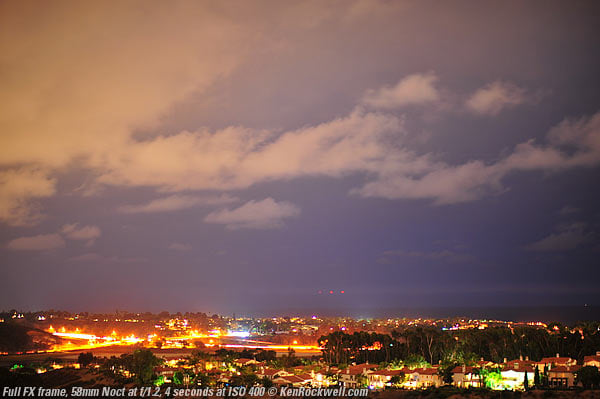
The red dots were a passing airplane.
Here are crops from 12MP FX D3 images at the lower left of the indices above. If you are looking at a standard computer monitor at 100 DPI, printing the full image at the same magnification as below is the same as making 42 x 28" (100 x 75cm) prints:
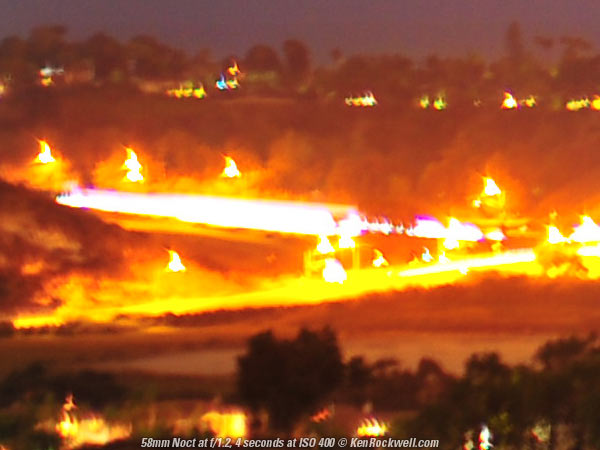
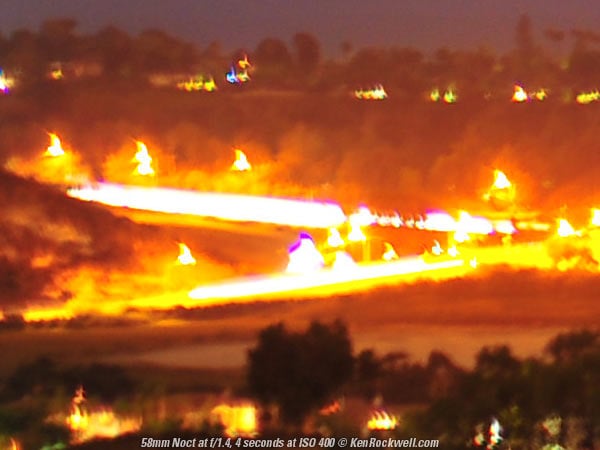
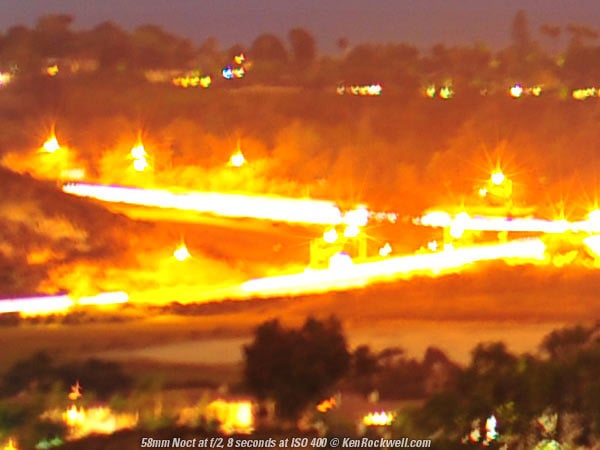
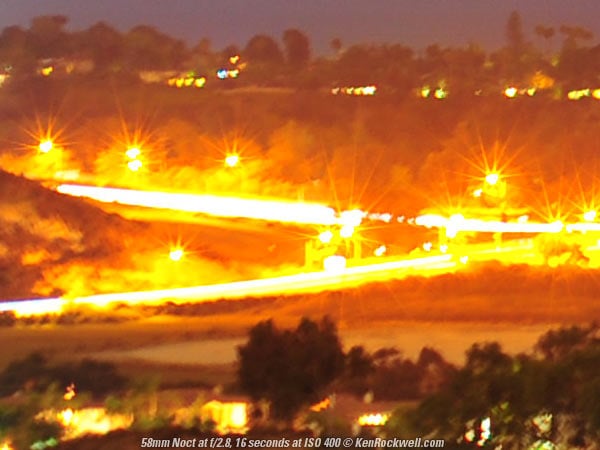
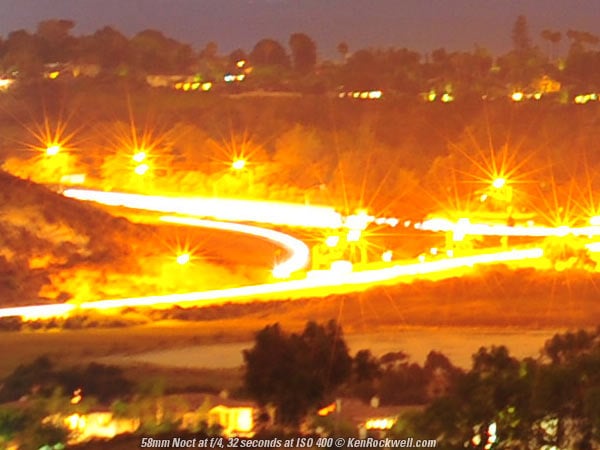
In case you didn't appreciate the freedom from coma of the f/1.2 images, here's the same thing as shot by the conventional 50mm f/1.2 AI-s:
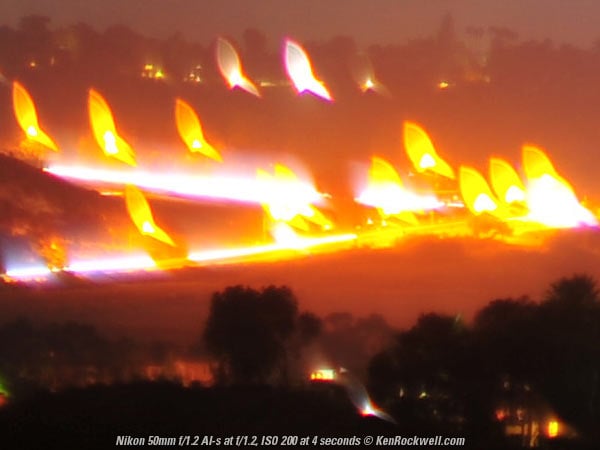
See those nasty blobs? That's what the Noct was created to prevent, and the conventional 50mm f/1.2 has this much coma even with half the effective exposure (ISO 200 versus ISO 400)!
Distortion performance top
The Nikon 58mm f/1.2 has moderate barrel distortion, the same as the 50mm f/1.4 AF-S.
It's easy to corrected completely by plugging these figures into Photoshop CS2's lens distortion filter. These aren't facts or specifications, they are the results of my research that requires hours of photography and calculations on the resulting data.
FX and Film |
|
∞ |
+2.0 |
10' (3m) |
+2.0 |
3' (1m) |
+3.0 |
1.7' (0.5m) |
+3.2 |
© 2010 KenRockwell.com. All rights reserved.
Ergonomics performance top
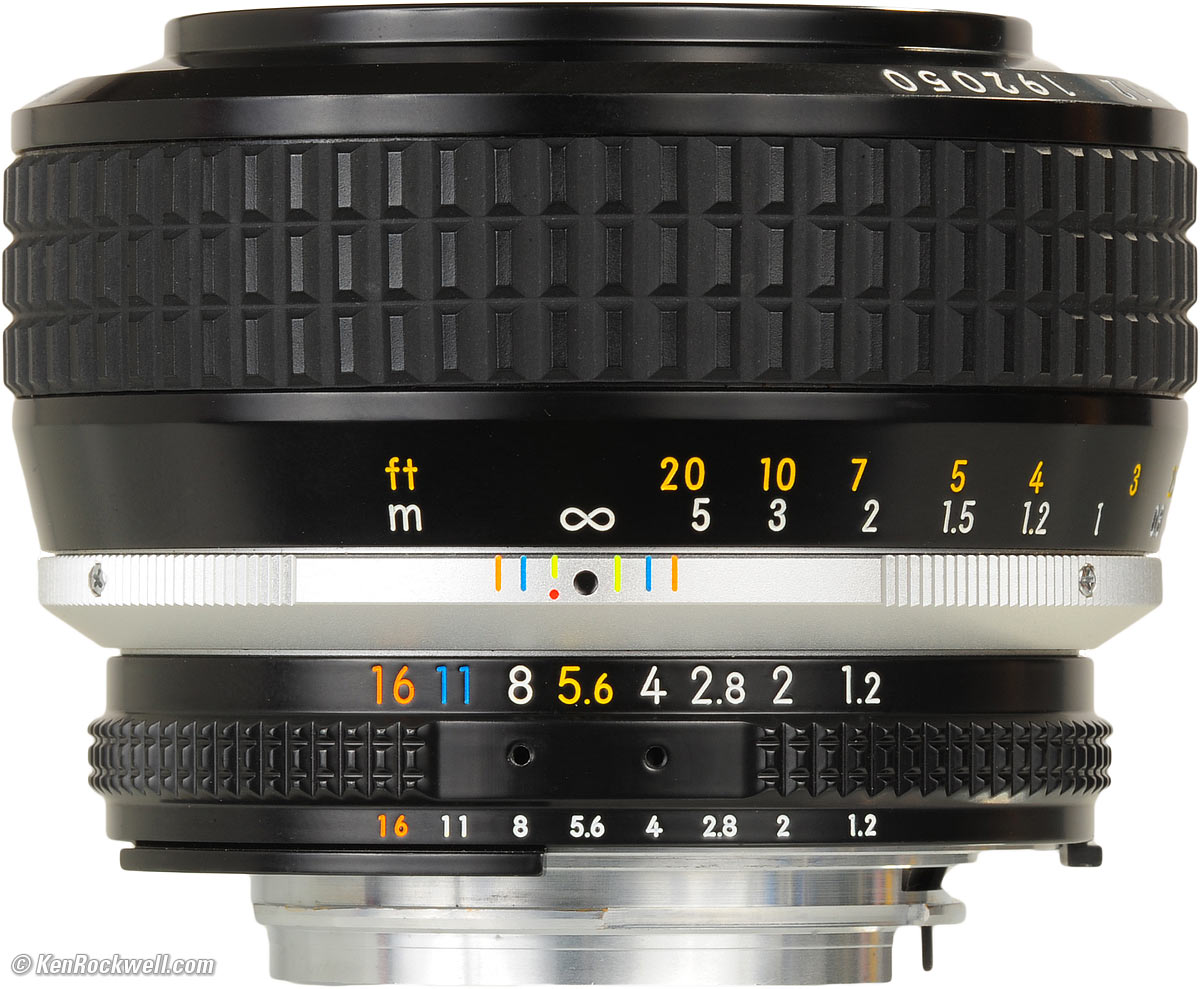
Nikon 58mm f/1.2 Noct-NIKKOR. enlarge.
The Nikon 58mm f/1.2's ergonomics are as expected from every Nikon manual-focus lens.
The only difference is the unusually wide focus ring, which provides smooth, precise focus.
The manual focus is stiffer (silky-smooth, but more damped) than most other NIKKOR normal lenses. It's better for fixing focus for scientific use, while less speedy for journalism. It hangs a little when turned with just one finger; using two fingers is much better. If you want 1-finger focus, the current 50mm f/1.2 AI-s is much better since this 58mm NOCT's friction increases if it's turned from just one side.
The sample seen here had its meter-coupling prong unscrewed to increase the visibility of the second ADR (aperture direct readout) scale in viewfinders of cameras that read this scale, like the FE, FA, F4 and F5.
Falloff (darkened corners) performance top
Falloff on FX is much less than expected.
It's visible at f/1.2 and f/1.4, and gone by f/2.
With vignetting correction, it's not a problem even at f/1.2.
It won't be an issue at all on DX (see crop factor).
I've exaggerated this by shooting a gray field and placing these on a gray background.
Nikon 58mm f/1.2 Noct-NIKKOR falloff on FX and film at infinity, no correction.
© 2010 KenRockwell.com. All rights reserved.
|






Filters, Use with performance top
I see no problem with vignetting with any sort of filter.
Lateral Color Fringes performance top
I can't see any lateral color fringes on the D3, which would correct them if the lens had any.
Mechanics performance top
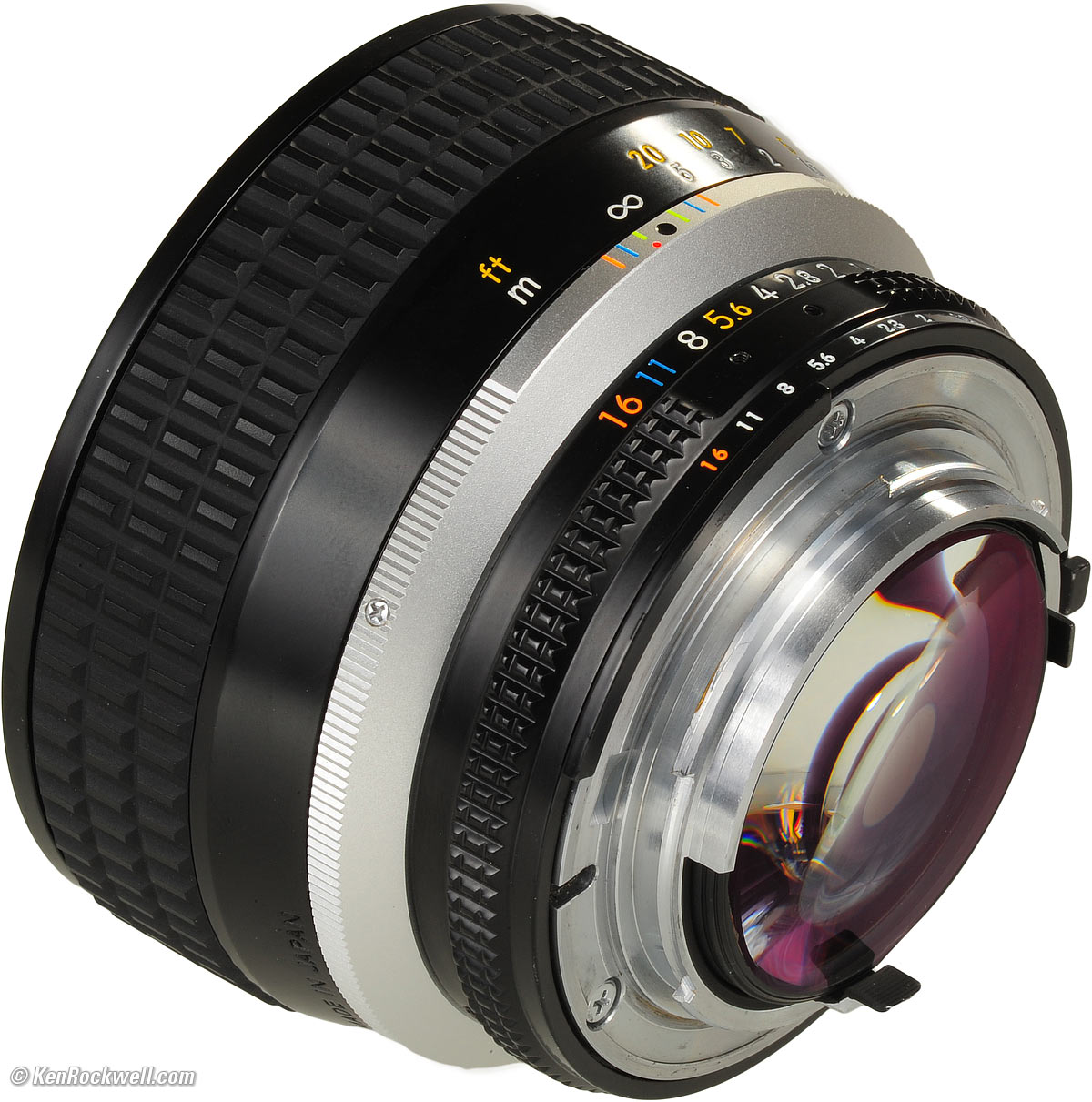
Rear, Nikon 58mm f/1.2 Noct-NIKKOR. enlarge.
Be careful of the little zigzag rear element protector pin seen here at the bottom. If you set the Noct down on a table without its rear cap, avoid bending this pin. It goes through the contortions it does to avoid the huge rear element.
Like all Nikkor manual focus Noct-NIKKOR lenses, the Nikon NIKKOR 58mm f/1.2 Noct-NIKKOR is built to the highest mechanical standards of any lens ever made.
I am concerned that the 50mm f/1.2 AI-s and 55mm f/1.2 have dainty focus helicoids. Depending on how I squeeze their focus rings, the focus gets easier or tighter.
Luckily, this much bigger and heavier 58mm f/1.2 Noct-NIKKOR seems to have a fully-solid focus helicoid as we expect. The focus ring just works, and does't look at you funny depending on how you look at it.
Barrel Exterior
Anodized and enameled aluminum.
Filter Threads
Anodized aluminum.
Focus Ring
Metal, rubber covered.
Focus Helicoids
Feels like brass: smooth and silky with no play or need for damping grease.
Depth-of-Field Scale
Engraved into barrel and filled with different colors of paint.
Internals
All metal.
Aperture Ring
Cast aluminum, anodized and enameled.
Engraved markings filled with different colors of paint coded to the depth-of-field scale.
Mount
Dull-chromed brass; slides in smoothly to any Nikon.
Markings
Engraved into the metal and filled with paint.
Identity and Serial Number
On the front of the lens, riding on the focus ring, engraved into the metal and filled with paint.
Ass-Gasket (dust seal at mount)
No.
Noises When Shaken
Mild clicking from the diaphragm blades and actuation system.
Made in
Japan.
Sharpness performance top
Warning 1: Image sharpness depends more on you than your lens.
Warning 2: Lens sharpness doesn't mean much to good photographers.
The 58mm f/1.2 Noct-NIKKOR is extremely sharp in the center where it matters, at every aperture, especially f/1.2. At f/1.2, it's the sharpest normal lens I've ever used.
The Noct is specifically designed for high contrast in the corners, not high resolution as are ordinary lenses. Because the Noct is designed for no coma, it appears softer than other lenses in the corners at large apertures for conventional subjects, and shines when the subject becomes brilliantly contrasty.
See my Nikon High-Speed 50mm Lens Sharpness Comparison for specific examples.
As seen on a 12MP FX Nikon D3:
At f/1.2 through f/2.8
The 58mm f/1.2 Noct-NIKKOR is scaldingly sharp in the center, especially at f/1.2, presuming you actually got it in perfect focus.
The corners are very contrasty, but low-resolution.
This doesn't change much from f/1.2 through f/2.8.
At f/4
The corners get much better than at f/2.8 and larger.
At f/5.6
The corners get much better than at f/4.
They are just about perfect.
At f/8
Everything is perfect, as is the case with pretty much every lens at f/8.
At f/11
Same as f/8.
At f/16
Diffraction slightly limits performance.
Image Stabilization (VR) performance top
This lens has no internal optical stabilization, however it works with internal sensor-shift Image Stabilization (IS or VR (Vibration Reduction)) in some of Nikon's mirrorless Z cameras with the FTZ adapter.
"Percent Perfectly Sharp Shots" are the percentage of frames with 100% perfect tripod-equivalent sharpness I get when I'm shooting hand-held while free-standing with no support or bracing. This is a very strict test; in actual shooting at typical print sizes I get acceptable sharpness at much slower speeds, but for the purposes of seeing how much improvement an IS system gives, this is the most precise method.
Hand tremor is a random occurrence, so at marginal speeds some frames will be perfectly sharp while others will be in various stages of blur — all at the same shutter speed. This rates what percentage of shots are perfectly sharp, not how sharp are all the frames:
| % Perfectly Sharp Shots | 1/2 |
1/4 |
1/8 |
1/15 |
1/30 |
1/60 |
1/125 |
1/250 |
1/500 |
| Stabilization ON | 0 |
17 |
100 |
100 |
100 |
100 |
100 |
100 |
100 |
| Stabilization OFF | 0 |
0 |
0 |
0 |
17 |
17 |
67 |
100 |
100 |
I see about a four stop real-world improvement, which is superb.
Spherochromatism performance top
The Nikon 58mm f/1.2 has some spherochromatism, meaning that out-of-focus background highlights can sometimes take on a little bit of green color fringing.
I don't see any complementary color fringes on out-of-focus foregrounds.
Sunstars performance top
With its straight 9-bladed diaphragm, the 58mm f/1.2 Noct makes magnificent 18-pointed sunstars on bright points of light.
Compared top
Intro Specs Performance Compared Anecdote Recommendations
NEW: Premium 50mm Lenses Compared 04 September 2014
Optically, the Noct is the sharpest and contrastiest lens ever made by Nikon at f/1.2 and f/1.4 in the center, and the contrastiest Nikon lens ever made in the corners at those apertures.
The Noct also has the least coma in the corners, which also render it the softest for ordinary subjects in the corners.
See also my Nikon High-Speed 50mm Lens Sharpness Comparison.
The distortion of this Noct is on the high side of normal, the same as the 50/1.4 AFS and 55mm f/1.2. The other f/1.4 lenses have only about 3/4 as much distortion, and the f/1.8 50mm lenses have no distortion.
Versus Modern Lenses
58 Noct |
||||||
| Anni | 1977-1997 |
2013- |
2008- |
1986- |
1981- |
1976- |
| Filter | 52mm |
72mm |
58mm |
52mm |
52mm |
52mm |
| Optics | 7/6 ASPH |
9/6, 2 ASPH |
8/7 |
7/6 |
7/6 |
7/6 |
| Blades | 9 AI-s 7 AI |
9 rounded | 9 | 7 | 9 | 7 |
| Repro | 1:6.7 |
1:7.7 |
1:6.8 |
1:6.8 |
1:7.9 |
1:6.8 |
| Weight | 470g |
382g |
278g |
229g |
354g |
250g |
Versus Classic Lenses
58 Noct |
55/1.2 |
50/1.4 |
58/1.4 |
||||
| Anni | 1977-1997 |
1981- |
1965-1978 |
1976- |
1962-1976 |
1959-1962 |
1976-2008 |
| Filter | 52mm |
52mm |
52mm |
52mm |
52mm |
52mm |
60mm |
| Optics | 7/6 ASPH |
7/6 |
7/5 |
7/6 |
7/5 |
7/6 |
7/6 |
| Blades | 9 AI-s 7 AI |
9 | 7 | 7 | 6 or 7 | 6 | 10 |
| Repro | 1:6.7 |
1:7.9 |
1:7.3 |
1:6.8 |
1:9.8 |
1:8.4 |
|
| Weight | 470g |
354g |
410g |
250g |
310g |
350g |
584g |
Compared to the LEICA 50mm f/1 NOCTILUX, this Nikon 58mm Noct has less light falloff, the same distortion, much closer focus, much better focus accuracy (most samples of LEICA cameras will need their rangefinders trimmed to match any given sample of lens perfectly). In the corners, the Nikon has less coma but less sharpness at large apertures.
The Canon FD 50mm f/1.2 L is about the same optically as the Nikon 58mm f/1.2 Noct-NIKKOR, and sells for one-tenth the price. The Canon adds floating elements for an even more advanced design in a smaller package, and both take standard 52mm filters. THe Canon sells for so much less because Canon dumped its entire FD line back in 1986, so the FD lenses are orphans that only work with Canon's FD manual-focus 35mm cameras, not any of their "digital" cameras of later years.
Anecdote top
Intro Specs Performance Compared Anecdote Recommendations
This story was told to me by Ernie Mastroianni, then photo editor of Birder's World magazine, in September 2006:
"About 10 years ago, a photographer at the Milwaukee Journal Sentinel (I was a photo editor there for 19 years) offered to sell me his Noct-Nikkor 58mm f/1.2 lens. He knew I was into astrophotography and thought that I might be interested in a high speed lens. He was right. I came up with the $175 that he needed and proceeded to enjoy taking pictures of the Milky Way with 20-second exposures, with no tracking and no star trails. It was an excellent portrait lens too, showing fantastic Bokeh and producing some excellent results for group and family pictures, being sharp from edge-to-edge.
But as I migrated to digital, I found that the lens was a bit too long and it could not be converted to a D-lens. It sat on my shelf until I noticed that someone sold one on eBay for about $1,200, although I was not sure if it was a scam.
So I put my own lens up for sale, hoping I might get a legitimate offer of about $1,000. The bidding immediately passed $1,000, but it was all from folks with new identities or very low bidding histories. One bidder, with a big 0 for a history, kept bidding it up beyond anyone else, until it climbed over $2,000. Too good to be true, I thought, and this looks like a scam.
So I wrote the bidder, and said I was wise to the usual tricks, that he better pay with a money order from a real bank and it has to be for the exact amount. I won't ship to Indonesia and I'll hold the lens till the check clears, blah blah blah.
The bidder wrote back. He was a buyer for the Princeton Particle Physics Laboratory, and he needed the lens for some exotic physics experiment. His scientists said that only the 58mm f/1.2 Noct-Nikkor would work. Not the 55mm, not the 50mm. Just the 58. His story checked out, the lab was real. He needed my 58mm lens and the US government was willing to pay whatever it took. In fact, he needed SIX of the lenses. He was happy to hear from me, because he was getting hounded by scam artists who were trying to sell lenses that they did not have. He had no eBay identity because of government regulations.
So he bought the lens for about $2,100, which financed my Nikon D80 and a high-end pair of astronomy binoculars. I later saw that he shelled out about $2,600 for some other Noct-Nikkors that did not appear to be as pristine as the lens I sold him.
A fun story, and I got some cool stuff out of it, but to tell you the truth, I do miss that lens. There was something about it that always produced sharp, saturated images."
Recommendations top
Intro Specifications Performance Compared Recommendations
If you need this you already know it. It is a very special purpose lens. If you don't know why you need this, don't buy it.
The Noct is designed for astronomy, and thus priced astronomically.
There is zero depth of field at f/1.2. Your camera, eyeball and focusing screen need to be very carefully aligned in order to get sharp results at f/1.2.
The Noct is for hand-held low-light and astronomical shooting. If you have a tripod, stop down your f/1.8 lens, and it will be sharper than this Noct.
For moving subjects, the 50/1.4 AFS is a much smarter idea, as this Noct is manual-focus, only.
If you're not going to shoot any wider than f/1.8, then the 50mm f/1.8 AF-D has optics as sharp, especially in the corners, with less distortion.
For things with straight lines, the lack of distortion of the 50mm f/1.8 AF-D makes it the best.
For most things, especially involving action, the 50/1.4 AFS is the best lens. The newer 50/1.4 AF-S is almost as sharp in the center wide open, and sharper in the corners. The AF-S has some coma, but most people will prefer the corner sharpness of conventional lenses over the lack of coma of the Noct.
And there we have it. Nikon has been making 50mm lenses for photography for over 75 years, and they still have yet to make a 50mm lens which is optically perfect in every way. (Ditto for Canon.) The 50mm lenses closest to perfect are the LEICA SUMMICRON-M 50mm f/2 and LEICA SUMMILUX 50mm f/1.4 ASPH, which cost about the same new as a used Noct-NIKKOR. Such a deal!
More Information
Here's an article about the specifics of the design. (index)
Deployment top
I'd leave a 52mm Nikon Clear (NC - UV) filter on the Noct at all times.
I would buy and use the HR-2 folding rubber hood.
I'd pitch the flat Nikon cap that came with this lens new, and get a new "pinch" type cap in 52mm. I'm not kidding: the new fatter caps are much easier to use in the field.
If I was working in nasty, dirty areas, I'd forget the cap, and use an uncoated 52mm Tiffen UV filter instead. Uncoated filters are much easier to clean, but more prone to ghosting.
© Ken Rockwell. All rights reserved. Tous droits réservés. Alle Rechte vorbehalten.
Help Me Help You
I support my growing family through this website, as crazy as it might seem.
The biggest help is when you use any of these links when you get anything. It costs you nothing, and is this site's, and thus my family's, biggest source of support. These places always have the best prices and service, which is why I've used them since before this website existed. I recommend them all personally.
If you find this page as helpful as a book you might have had to buy or a workshop you may have had to take, feel free to help me continue helping everyone.
If you've gotten your gear through one of my links or helped otherwise, you're family. It's great people like you who allow me to keep adding to this site full-time. Thanks!
If you haven't helped yet, please do, and consider helping me with a gift of $5.00.
As this page is copyrighted and formally registered, it is unlawful to make copies, especially in the form of printouts for personal use. If you wish to make a printout for personal use, you are granted one-time permission only if you PayPal me $5.00 per printout or part thereof. Thank you!
Thanks for reading!
Ken Rockwell.