Home Donate New Search Gallery Reviews How-To Books Links Workshops About Contact
Nikon
28-70mm f/2.8
AF-S ZOOM-NIKKOR (1999-2007)
©
2011 KenRockwell.com
Intro Specifications Performance Recommendations

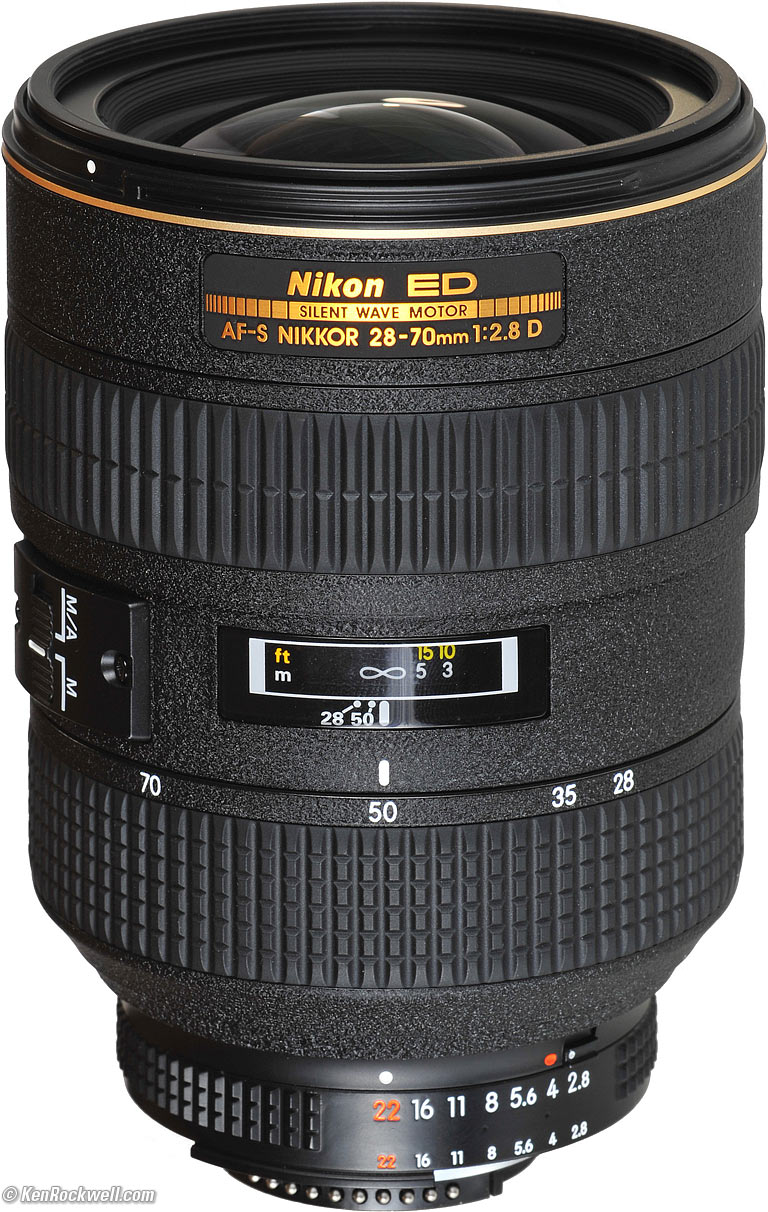
Nikon 28-70mm f/2.8 AF-S (77mm filters, 32 oz./900g, about $1,000 used). enlarge. This free website's biggest source of support is when you use these links, especially this link directly to this lens at eBay (see How to Win at eBay) or to it at Amazon when you get anything, regardless of the country in which you live. Thanks! Ken.
July 2011, December 2007 Nikon Lens Reviews Nikon Reviews All Reviews
See my Nikon Professional Normal Zoom Comparison for exhaustive side-by-side image examples.
Introduction top
Intro Specifications Performance Recommendations
I use Adorama, Amazon, Ritz, B&H, Calumet, J&R and ScanCafe. I can't vouch for ads below.
|



The Nikon 28-70mm f/2.8 AF-S D is a spectacular lens. It's just as sharp as the newest 24-70mm f/2.8 AF-S, and this 28-70 costs much less used today.
This 28-70/2.8 offers spectacular performance, and the price you pay is huge size and weight. If you're shooting all day, by all means get this lens, but if your camera spends more time dangling around your neck than in you shooting hands, you might prefer something lighter like the tiny 28-70mm f/3.5-4.5 AF-D instead.
I'm afraid of this 28-70mm lens because it is so big and heavy. It is Nikon's heaviest midrange zoom ever. I'd never want to walk around with this thing hanging off the front of my camera. If you spend more time shooting than carrying it, it's a great lens. The Nikon 28-70mm AF-S is not a lens for taking on vacation or for the timid. It's a lens to use all day long shooting.
Compatibility
As an AF-S lens, it works perfectly on every Nikon digital SLR, and on almost every 35mm SLR, manual or autofocus.
It won't autofocus on some of the oldest and cheapest AF film cameras, like the N2020 or N55. It works perfectly on the N75 and F4.
Since it has an aperture ring, this 28-70mm works great on all manual focus 35mm cameras, like the FA, F2, F3, and everything else all the way back to the F. You may need to use stop-down metering with the F, or have a coupling prong fitted to the aperture ring for cameras older than 1977.
The newest 24-70mm f/2.8 AF-S won't work at all on manual-focus cameras because it's been gelded (had its aperture ring removed to save cost: G-series). This 28-70mm AF-S is the last Nikon professional normal zoom which works on manual focus cameras.
See Nikon Lens Compatibility for details with your camera. Read down the "AF-S, AF-I" column for this lens.
Production History
Introduced in 1999 and sold until replaced by the improved, lighter and even more expensive 24-70mm f/2.8 AF-S in late 2007. It was sold through early 2008.
Nikon made about 130,000 of these 28-70/2.8 lenses.
Details at Roland Vink's site.
This was the best professional lens Nikon could make for a decade, and priced accordingly.
Corrected for inflation, 2011* |
Dollars at the time* |
|
2002 |
$1,750 |
$1,400 |
2007 |
$1,575 |
$1,450 |
2011 |
* At full NYC discount. Very few people bought their lenses this inexpensively before 2005.
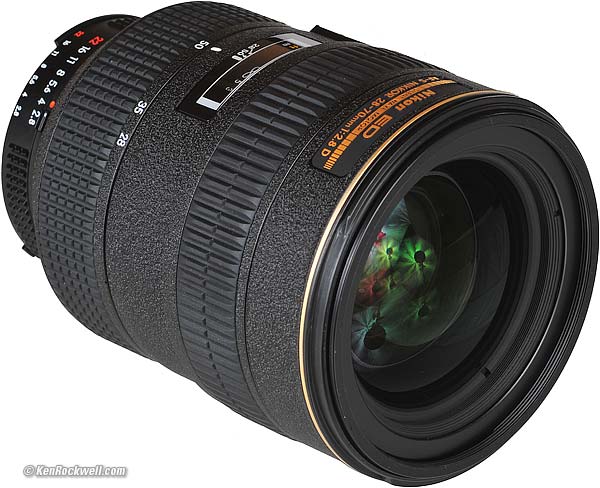
Nikon 28-70mm AF-S.
Specifications top
Intro Specifications Performance Recommendations
Name
Nikon calls this the Nikon ED AF-S NIKKOR 28-70mm f/2.8 D.
ED: Magic Extra-low Dispersion Glass.
AF-S and SWM: Silent Wave Autofocus Motor.
NIKKOR: Nikon's brand name for their lenses.
D: Couples distance information to the Matrix Meter.
IF: Internal focusing; nothing moves externally as focused.
Aspherical: Specially curved glass to give even sharper pictures.
∅77: 77mm filter thread.
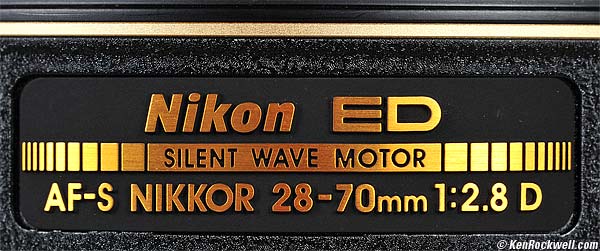
Identity Plate, Nikon 28-70mm AF-S.
Optics
15 elements in 11 groups.
Two of these are of magic ED glass and one is a molded glass aspherical.
It has Nikon's "SIC" Super Integrated multi-coating and internal focusing.
Filter Size
77mm.
Diaphragm
9 blades, rounded.
Stops down to f/22.
Close Focus
1.5 feet (0.5 meters).
Maximum Reproduction Ratio
1:5.6.
(The 24-70mm AF-S gets to 1:3.7.)
Infra-Red Focus Indices
Yes, at 28 and 50mm.
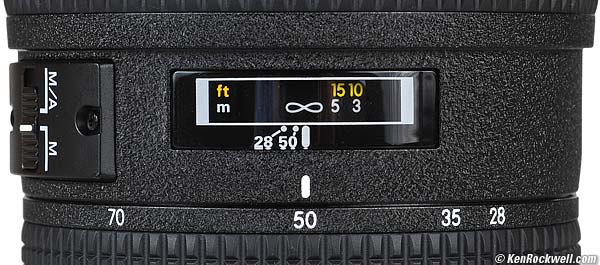
Focus Window, Nikon 28-70mm AF-S.
Size
4.779" extension from flange by 3.493" diameter 121.39 x 88.72mm), measured.
Nikon specifies 3.5" (89mm) around by 4.9" (124mm) long: big!
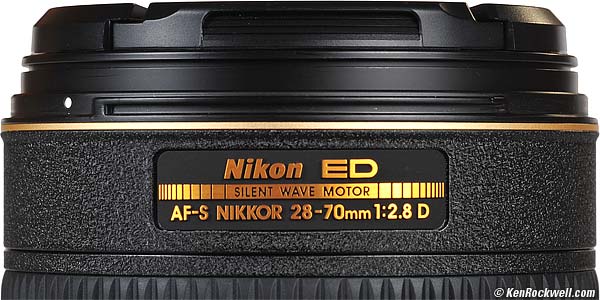
How fat? See the 77mm lens cap on top? The lens gets fatter from there!
Weight
1999-2005 version (serial numbers 200000 - 399999): 32.190 oz (912.5g), measured.
2005-2006 version (serial numbers 400000 and above): 31.265 oz (886.3g), measured.
Nikon specifies 31.3 oz. (890g) or 33.0 oz. (935g) in various places. That's TWO POUNDS!!!!
Hood
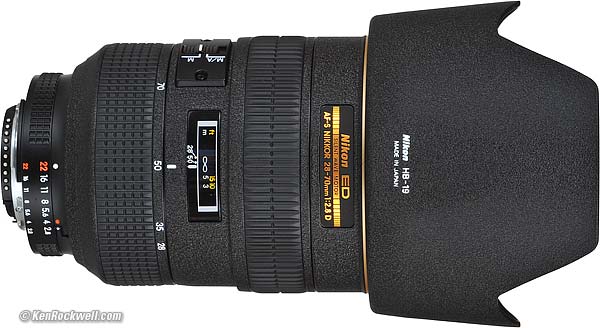
A big, fat lens with an even bigger, fatter hood.
HB-19 plastic bayonet hood, included.
Case
CL-74, included.
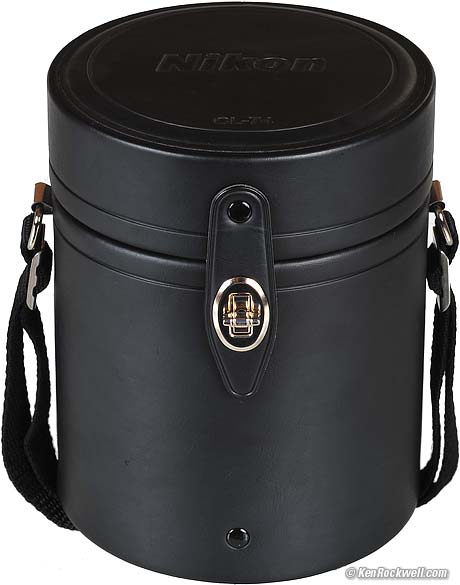
CL-74 hard case, included (made in China).
Nikon Product Number
1961.
Performance top
Intro Specifications Performance Recommendations
See my Nikon Professional Normal Zoom Comparison for exhaustive side-by-side image examples.
If you aren't scared of the size, weight and price, this is of course a spectacular lens. It was Nikon's best professional no-compromise normal zoom from 1999-2007.
Focus
It's easy to use; there are no annoying range limiters or macro lock-out switches. Oddly Nikon, Japan says the macro range is only available at 70mm, but the sample I tried got to the closest focus distance at all focal lengths.
AF Speed
AF is fast on a D3. AF is fast on a D40.
AF action is pretty fast on an F100.
AF Accuracy
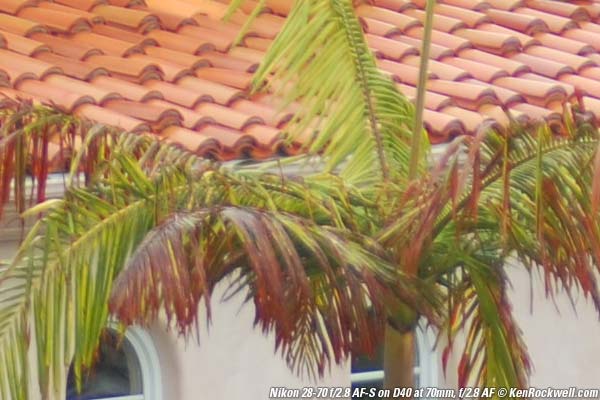
AF offset at 70mm and f/2.8. Roll mouse over to see effect of a small manual adjustment. (crops from 100% images on a D40)
Every individual sample of lens and every individual sample of camera vary somewhat. This lens on my D3 had strong autofocus errors at 70mm leading to very soft results wide open. Results were fine at 28mm. In other words, this sample sucked at 50mm and 70mm on my D3.
I used my D3's "AF Fine Tune" feature, second from the bottom in the wrench menu, to fix this. This particular lens and my particular D3 needed a setting of about -15.
I wouldn't penalize this model of lens; this varies from sample-to-sample. It does underscore the importance of checking every lens you buy, as I do, on your camera, and returning it if it isn't compatible. This is why I only buy from places that allow 100% cash refunds if I'm unhappy.
That said, this lens, which I borrowed from a friend for this review, works great on my D3 once I fine-tune the AF in the appropriate menu. This is why Nikon provides this adjustment. Other cameras, like all earlier Nikons like the D40, have no such adjustment.
Manual Focus
Easy: just grab the ring at any time.
The manual focus ring is geared perfectly for use on manual focus cameras; put this on your F3 and have at it!
Sharpness, presuming you have your autofocus system properly calibrated as described above, is excellent. Duh, what would you expect from any Nikkor lens with a four-digit price tag?
I'm looking very closely at the equivalent or 43" (1m) wide prints for this, and then shooting on top of a mountain so that I have unlimited detail throughout the entire frame all in focus at infinity. This lens is very sharp for any real picture taking; these comments below are for the few people who like to split hairs.
Center Sharpness on the Nikon D3
28mm and 35mm: Sharp, even wide open.
50mm and 70mm: A tiny little bit softer at f/2.8, perfect by f/4. This could still be focus issues. In any case, it is excellent in the center on a D3.
Corner Sharpness on a D3
28mm: A little smeary at f/2.8, much better at f/4, perfect by f/8.
35mm: A little soft at f/2.8, much better at f/4, perfect by f/8.
50mm: A little soft at f/2.8, much better at f/4, perfect by f/5.6.
70mm: A little soft at f/2.8, much better at f/4, perfect by f/5.6.
Distortion top
Distortion is as expected: moderate barrel at wide, and very minor pincushion at tele.
Plug these figures into Photoshop's lens distortion filter to correct the distortion. These aren't facts or specifications, they are the results of my research that requires me to climb a bluff on a very clear day, shoot the ocean's horizon, and run calculations on the resulting data.
For scanned film, use the FX full-frame figures.
at infinity: |
FX and film |
|
28mm |
+3.1 |
+1.5 |
35mm |
+1.2 |
+0.5 |
50mm |
-1.3 |
0.0 |
70mm |
-1.2 |
-0.1 |
© 2011 KenRockwell.com
Use with Filters top
On film and FX digital, I get no vignetting even with a relatively fat filter with a 6.5mm thick ring. This is about the limit; thicker filters will start to vignette at 28mm.
On DX, don't worry. You won't get any vignetting even with a stack of filters.
Mechanics and Construction top
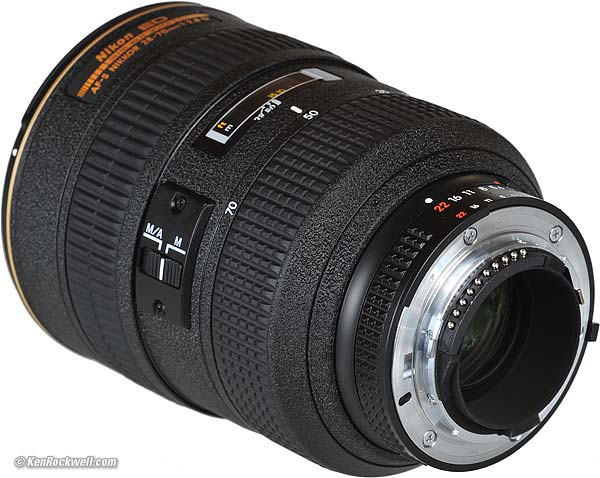
Nikon 28-70mm AF-S.
The Nikon 28-70/2.8 AF-S is a very tough professional lens.
Filter Threads
Plastic, surrounded by metal.
This is good: filters often unscrew themselves from metal lens threads.
Forebarrels
Metal.
Hood Bayonet
Metal.
Focus Ring
Metal with slip-on rubber grip band.
Focus Scale Window
Plastic.
Barrel around Focus Window
Seems like plastic.
Zoom Ring
Metal with slip-on rubber grip band.
Painted focal-length markings.
Aperture Ring
Plastic.
Aperture markings are indented and filled with paint.
Lens Mount
Metal.
Internals
Look like metal.
Noises when Shaken
Moderate dull klunking.
Serial Number
Laser engraved into bottom of aperture ring.
USA versions prefixed by "US," with a space between the US and the rest of the serial number.
Quality
Lens Made in Japan.
Hood made in Japan.
Caps usually Thailand (front) and Japan (rear)
Case made in China.
Zooming top
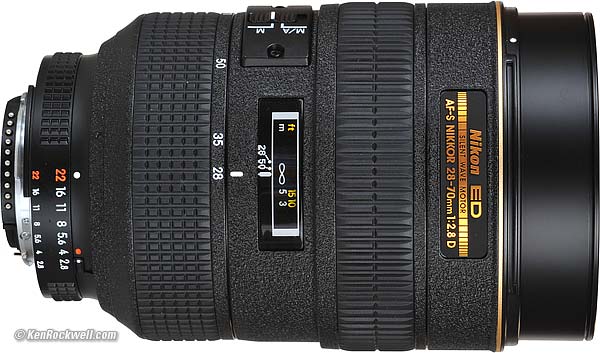
It gets even bigger when set to 28mm!
The front group extends at 28mm. It is shortest at 50mm, which is how I and others photograph the lens for most of its representative product shots. It doesn't grow much from 50mm to 70mm.
Zooming is precise. This is great for landscapes, but the huge zoom ring might be a little slow for news and sports. The 24-70mm f/2.8 AF-S zoom ring is much lighter and faster, and the 35-70mm f/2.8 zoom can be pushed or pulled faster, too.
I can flick the zoom ring of this 28-70mm AF-S with moderate pressure from my middle finger while holding a camera with the same hand.
Zooming is best with the lens horizontal, which is how I usually shoot. When pointed directly at the zenith or nadir, you are working to move the front group up and down with or against gravity. I see no creep, but it is often more difficult to zoom pointed up or down.
The zoom ring of the 28-70mm is huge! It's calibrated at a lazy 5 cm/octave.
Recommendations top
Intro Specifications Performance Recommendations
This is a lens for full-time professional use 24/7, where you are spending more time shooting than carrying it. It's too big and too heavy to serve as a rich man's vacation lens, but rich people still bought these by the case when they were new.
The newest and even more expensive 24-70mm f/2.8 AF-S weighs a little less and is narrower, but longer.
This 28-70mm AF-S sold well at about $1,600 for its entire life. It's a great lens, and the used price of $1,000 shows us how respected it is, even today.
It's tougher than the more expensive 24-70mm f/2.8 AF-S. Readers have written that the insides of the 24-70mm f/2.8 AF-S are plastic, and that these newer lenses have broken into two pieces at times!
This 28-70mm f/2.8 is as sharp as the 24-70mm f/2.8 AF-S and ought to last you for a lifetime of professional use. If you think you want one, you'll love it.
If you've found this review helpful, this free website's biggest source of support is when you use these links, especially this link directly to this lens at eBay (see How to Win at eBay) or to it at Amazon when you get anything, regardless of the country in which you live. Thanks! Ken.
Help me help you top
I support my growing family through this website, as crazy as it might seem.
The biggest help is when you use any of these links to Adorama, Amazon, eBay, B&H, Ritz, Calumet, J&R and ScanCafe when you get anything, regardless of the country in which you live. It costs you nothing, and is this site's, and thus my family's, biggest source of support. These places have the best prices and service, which is why I've used them since before this website existed. I recommend them all personally.
If you find this page as helpful as a book you might have had to buy or a workshop you may have had to take, feel free to help me continue helping everyone.
If you've gotten your gear through one of my links or helped otherwise, you're family. It's great people like you who allow me to keep adding to this site full-time. Thanks!
If you haven't helped yet, please do, and consider helping me with a gift of $5.00.
As this page is copyrighted and formally registered, it is unlawful to make copies, especially in the form of printouts for personal use. If you wish to make a printout for personal use, you are granted one-time permission only if you PayPal me $5.00 per printout or part thereof. Thank you!
Thanks for reading!
Mr. & Mrs. Ken Rockwell, Ryan and Katie.
Home Donate New Search Gallery Reviews How-To Books Links Workshops About Contact