Nikon 28mm f/1.4
AF-D (1994-2006)
Intro Specs Performance Usage Recommendations

Nikon 28mm f/1.4 D (FX, DX and 35mm coverage, metal 72mm filter thread, 18 oz./520g, 1.15'/0.35m close focus, about $1,250 used). bigger. You always can get these at eBay (see How to Win at eBay), and at Amazon.
This junk-free website's biggest source of support is when you use those or any of these links to approved sources when you get anything, regardless of the country in which you live. Buy only from the approved sources I use myself for the best prices, service, return policies and selection. Thanks for helping me help you! Ken.
When you click on links to various merchants on this site and make a purchase, this can result in this site earning a commission. Affiliate programs and affiliations include, but are not limited to, the eBay Partner Network.
May 2017 Nikon Reviews Nikon Lenses Nikon Flash All Reviews
NEW: Nikon AF-S 28mm f/1.4 E FX.
Why Fixed Lenses Take Better Pictures
Nikon 24mm f/1.4 G AF-S 09 February 2010
Sharpness Comparison to all other 24mm lenses August 2010

Introduction top
Intro Specs Performance Usage Recommendations

I buy only from these approved sources. I can't vouch for ads below. |



The Nikon 28mm f/1.4 is an absolutely extraordinary lens. It is as sharp at f/1.4 as it is at other apertures. This baby loves to be shot at f/1.4 without having to make any excuses for quality. You pay an awful lot for this lens, and it delivers the optical and mechanical quality for which you pay. This is not your dad's old 35mm f/1.4 AI-s, and the manual focus 28mm f/2 doesn't come close either.
The 28mm f/1.4 has a precision-ground aspheric element that gives it performance far beyond the obsolete 35mm f/1.4 AI-s. I hate to have to define "obsolete," however obsolete merely means that there are better, newer replacements. The 35/1.4 is still being sold new.
The 28mm f/1.4 is is a sturdy, solid professional lens.
While in production, the 28mm f/1.4 was Nikon's most expensive lens, short of the f/2.8 300mm and longer super-telephotos.
It was even more expensive than the AF-S 17-35mm f/2.8D, 70-200 f/2.8 VR or 300mm f/4 AFS.
28mm is normal on DX digital cameras. A 28mm lens on a DX camera gives the same angle of view as a 45mm lens gives on a 35mm film camera.
Back in film days some wished Nikon made a 35mm f/1.4 AF. Well, it turns out that the effective focal length of the 28mm f/1.4 AF is actually 30mm, so no big deal. Also the 35mm f/2.0 AF is better than the manual focus 35mm f/1.4 anyway, so again this isn't that big an issue.
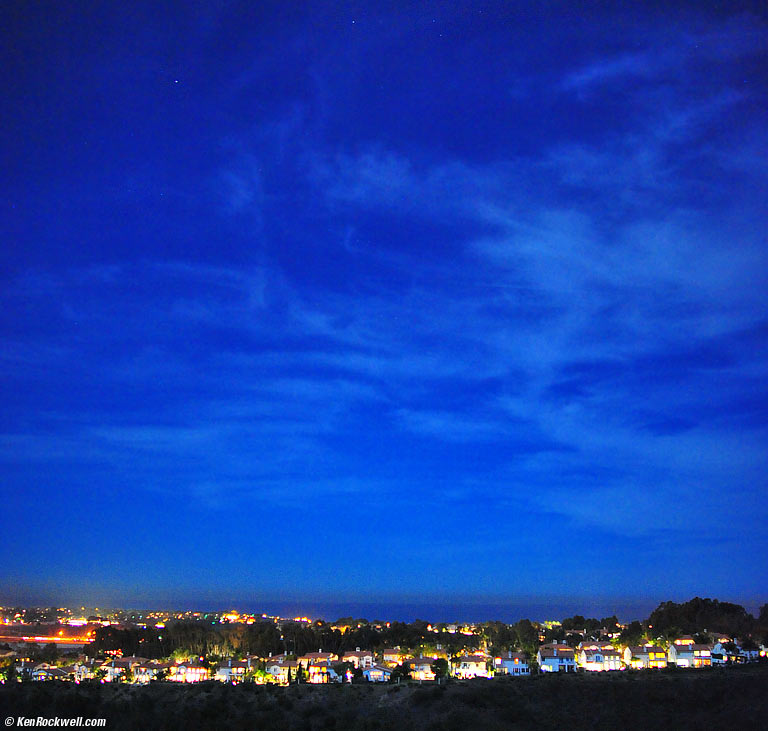
Aviara under moonlight, handheld! larger. Nikon D3, 1/4 at f/1.4 at ISO 6,400.
Specifications top
Intro Specs Performance Usage Recommendations
Name
Nikon calls this the Nikon AF Nikkor 28mm f/1.4D Aspherical.
Optics
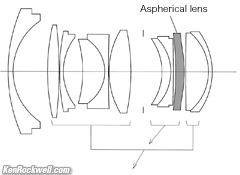
11 elements in 8 groups.
One of these elements is a precision ground aspheric.
Focusing is in three groups.
Diaphragm
9 conventional straight blades.
Stops down to f/16.
Close Focus
1.15' or 0.35m.
Size
3" (75.1mm) around by 3.1" (77.4mm) long.
Weight
18 oz. (520g), measured.
The caps add 25g, and my filter adds another 35g. Yes, that's 1 pound, 5 ounces as it sits in my bag. It is solid and all metal, except for the clear plastic window covering the footage scale.
Filter Size
It takes a generous 72mm filter, which gives it plenty of extra glass to prevent vignetting.
Case
CL-44 hard case, optional.
Hood (optional)
It takes the HK-7 hood that I ignore.
Serial Number
The serial number is laser engraved on the bottom of the plastic aperture ring.
Nikon Product Number
1921.
Pricing, USA top
September 2022
About $1,250 used if you know How to Win at eBay.
May 2017
About $2,100 used.
2009
About $3,500 used.
2008
The used price skyrocketed to over $4,000 with the late 2007 introduction of Nikon's first full-frame digital, the D3.
This also made the 28mm f/1.4 more expensive than most 300mm f/2.8 lenses!
2006
Rose to over $2,000 used once it was no longer available new, with no replacement.
1994 ~ September 2006
When available new (1994- September 2006), it sold for $1,700 at full NYC discount discount.
Because it was so expensive, no one bought them. Because no one bought them, Nikon stopped making them. Because Nikon stopped making them, photographers and collectors now want it, so the price skyrocketed.
Performance top
Intro Specs Performance Usage Recommendations
Autofocus
AF Speed
One full turn of the AF screw brings focus from infinity to 2m (6 feet). It has pretty ordinary AF speed on my F100. It focuses by moving the rear group.
A - M ring function
The focus ring always is free to spin when the ring is set to the A mode. I can keep turning it as far as I want and the focus ring does nothing. I wasn't able to get the focus ring to drive the focus if turned more than a full turn in A mode on the lens.
In M mode it focuses the lens, and only turns that 1/2 or so turn corresponding to the focus range.
Nothing moves externally as the lens focuses.
AF Accuracy
There is some auto focus shift on an early 1999 F100. At f/1.4 my 1999 F100 and F5 tended to auto focus a hair in front of the subject. Of course at f/1.4 "a hair in front of" means your subject is out of focus and you miss much of this incredible lens' potential sharpness. In many cases I revert to manual focusing. It is fine with my 2001 F100.
It's dead-on on my D80 and D200.
My sample is dead-on when you use the infinity focus stop. This makes for easy use for astronomical photography, as well as for accurate setting of manual focus by scale for night shots.
Shooting an f/1.4 lens at full f/1.4 aperture demands a very precisely calibrated camera and AF system to give you the sharpness for which you are paying.
I have had to hand-select or adjust manual and AF cameras and lenses to get the performance I do.
Otherwise any tiny focus inaccuracy will soften your results since even the slightest error at f/1.4 robs much sharpness due to the tiny depth of field and tiny depth of focus at the image plane.
If you're not getting the results you should, then you must check your systems by focusing on an object and carefully examining your results to ensure that your intended subject is in focus, and that the focus has not instead been slightly behind or in front of your intended subject.
You must do this on the final image, not through the finder, since the finder is a separate adjustment from the camera's film or sensor plane which is different adjustment from the AF system which is a different adjustment from the lens' infinity stop.
Likewise, simply depending on the infinity stop in manual focusing mode to focus at infinity with your lens or camera cannot be guaranteed till you try it.
This has always been the case with f/1.4 lenses: even systems that have been giving tack-sharp results with f/2.8 lenses for decades may or may not be well enough adjusted for shooting at f/1.4. I've been chasing these issues since the 1970s.
Bokeh
Bokeh is funny due to the aspheric element. The far bokeh is a big blob with a bright dot in the center.
Distortion
It only has half the barrel distortion common in other Nikkor wide angles and fast normals.
Ghosts and Flare
It has almost no ghosts or flare.
Point it right into your light source and there are no added flare blobs or ghost images.
I do see one slight ghost through my F100 when pointed straight at the sun (makes you wonder how bright I am), however I don't see this dim blob on film.
If you use a filter, there can be an inverted full-size, in-focus ghost image in the central 12mm of the image. This can happen if you are:
1.) shooting brightly lit signs or other light sources at night,
2.) have them off to one side of the central 12mm of the image, and
3.) have dark space on the other side of the central 12mm of the image in which to see the dim ghost.
It took me a couple of years to discover this, and it goes away if you take off your filter.
Sharpness
The 28mm f/1.4 is sharp at every aperture, even at f/1.4 in the corners.
This is unique among Nikkor wide angle lenses. The aspheric element gives it freedom from the coma (lateral spherical aberration) that plagues all other Nikon wide and fast normal lenses. In other words, shot at f/1.4, points of light in the corners still stay as reasonably small points of light, not the big batwing blobs that one gets at full aperture with other wide and normal Nikkors. You can see how well controlled this if by looking at this worst case photo made at f/1.4, hand held at 1/8 of a second. Yes, you can see a little coma in the lower right, but it's far better than any other Nikkor at f/1.4.
The only lack of perfection in sharpness is that in the very far corners of film, only in the last two millimeters of the image, it is soft at most larger apertures. Thus the circle of good definition is 40mm and the circle of good illumination is at least 43mm. This is fine; you really have to go out of your way to find a subject that requires sharpness at f/1.4 in the last mm of the corner. The sharpness just inside this 40mm circle is very, very sharp even at f/1.4 which is better than any other lens I've used at the larger apertures.
On digital it's sharp all over.
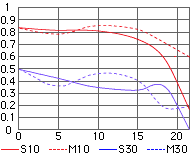
Nikon 28mm f/1.4 AF-D MTF.
There is some, but not much, light falloff at f/1.4.
Falloff is gone at f/2.
This is extraordinary performance, better than any other Nikkor lens.
I've exaggerated this by shooting a gray field and placing these on a gray background.
Nikon 28mm f/1.4 AF-D falloff on FX and 35mm at infinity. Vignetting correction OFF.
© 2017 KenRockwell.com. All rights reserved. |




Color Rendition
This baby lives for low light. Because of that I can't fault what sometimes seems like a slight cyan color cast, which makes it cooler for daylight shooting unless you filter it. This cyan cast optimizes it for grabbing every last photon while shooting under dim artificial light.
I find that with a Nikon A2 filter it's color balance matches most other unfiltered Nikkors, but I don't think is that cool.
Macro
No big deal here; the inexpensive 35mm f/2.0D AF focuses a lot closer.
You don't buy this lens for macro shooting, however it does have close-range correction (CRC) and rear focusing and is very sharp, even in the corners, at close distances. This 28mm is much sharper at close distances than the closer-focusing 35mm AF.
Usage top
Intro Specs Performance Usage Recommendations
Filters
The 72mm filter size is generous, so nothing vignettes.
One may hold a 67mm Hoya filter in front of the lens and not get vignetting.
I get slight vignetting with a 62mm Nikon A2 held to the lens, which serves me right.
Personally I run it with a 72mm -> 77mm step up ring that I don't remove so that it takes the same filters as the rest of my big glass. I prefer the B+W brand step-up ring.
For film I run it with a Tiffen 812 filter in daylight, with which its color matches my other Nikkors with the A2 filters I use for film. With the 812 it looks great for daylight shooting, although for daylight shooting you aren't using any of what you pay for with this special lens.
For digital today I run it with a 77mm Hoya HMC skylight filter I got here and a 72mm -> 77mm step-up ring you can get here. If you want to go super luxury try the super multicoated filter here. You don't need a special wide filter, there is no vignetting with this lens. The slight magenta/pink cast of the skylight filter corrects the cyan cast of the lens.
Environment
The instruction manual cautions you to avoid leaving it in your car on a hot day because the internal plastic may melt, which strikes me as odd since this is among the sturdiest AF lenses Nikon has made.
Weird Custom Aperture Scale
What's with the odd depth-of-field scale seen in the top image?
Depth-of-field scales are calculated by Nikon at the maximum limits of fuzziness people are likely to tolerate. They are intended for when you are in a tight place without a tripod and have to make the best judgment of how to make the best of things. They are not calculated to give you the sharpest possible result if you have a tripod.
You might think that stopping all the way down gives the sharpest result, however it doesn't due to an effect called "diffraction." This effect is the same as squinting your eyes too much: it just gets fuzzier.
To spare you a very long and mathematical story, just stick a little scale like this to your 28mm f/1.4 lens if you intend to use it on a tripod for landscapes, which I'll admit is not the reason to buy this $1,500 lens. Find the nearest and farthest points of your subject, and place them each an equal distance from the main focus index so that they each fall on an equal f/stop. Read that f/stop off the scale, and set that as your aperture for the sharpest possible result considering both depth-of-field and the effects of diffraction.
F/16 on this scale goes over where Nikon suggests f/11, f/11 on my scale goes halfway in between that point and the center index mark, and f/8 on my scale goes halfway between my f/11 mark and the center.
For instance, if you want everything from 15 feet to infinity in focus, set the lens to about 30 feet and use f/11 as indicated on my scale. See more about this foolishness here.
Recommendations top
Intro Specs Performance Usage Recommendations
If you need to shoot at f/1.4, this lens is unequalled. If you want to use it in daylight, any other 28mm AF Nikkor performs the same.
Today, the new Nikon 24mm f/1.4 G AF-S might perform as well, for less money.
This extraordinary 28mm f/1.4 lens allows handheld photography in conditions twice as dim as a 50mm f/1.4. Why? Simple: it's half the focal length of a normal lens, so you can shoot at one stop slower shutter speed. I get great results at 1/8 second. I usually shoot a few frames , and at least one will be super sharp. Many of the night photos you see on this site were shot, hand held, with this 28mm at f/1.4 and 1/8 second exposure, on 50 speed Velvia on the street at night.
The 28mm has much more depth-of-field than a 50mm lens. Therefore scenes shot at f/1.4 will usually have plenty in focus so you really can shoot at f/1.4, unlike with a 50mm lens that has just about zero depth-of-field at f/1.4.
This lens effectively turns night into day.
Unfortunately was expensive new, and its value is going up used now that no more new ones are available.
When it was introduced in 1993, many people like me were crazy enough to be shooting slow film like Velvia or Kodachrome in available light.
In the 1999 when I bought mine, many photojournalists started to use negative film, and just grabbed 800 speed film when the light faded and used their f/2.8 zooms. The salad days of the f/1.4 lens are behind us, and only a few crazy artists like myself still shoot slow, saturated film like Velvia in the dark. Because of this there is not much demand for the 28/1.4, especially at its super high price, so it will be tough finding any used.
Today everyone is digital, and ISO 1,600 looks great and doesn't need f/1.4.
If you are on a budget, the 35mm f/2.0D AF lens gives pretty good performance at about one-seventh the price. The AF 35/2.0D is better than the more expensive and much older 35/1.4 manual focus.
Before you go off and buy one of these on my recommendation (and you should), remember that I think I got a great sample. Others have had worse results, for instance I had mail that one person's sample had it's infinity focus calibration a little off. I never know what sample-to-sample variations there are out there, I just know that my lens is extraordinary.
More Information
Popular Photography (USA) tested it on page 76 of their November, 1994 issue.
© Ken Rockwell. All rights reserved. Tous droits réservés. Alle Rechte vorbehalten. Alla rättigheter förbehållna. Toate drepturile rezervate. Ken Rockwell® is a registered trademark.
Help Me Help You top
I support my growing family through this website, as crazy as it might seem.
The biggest help is when you use any of these links when you get anything. It costs you nothing, and is this site's, and thus my family's, biggest source of support. These places always have the best prices and service, which is why I've used them since before this website existed. I recommend them all personally.
If you find this page as helpful as a book you might have had to buy or a workshop you may have had to take, feel free to help me continue helping everyone.
If you've gotten your gear through one of my links or helped otherwise, you're family. It's great people like you who allow me to keep adding to this site full-time. Thanks!
If you haven't helped yet, please do, and consider helping me with a gift of $5.00.
As this page is copyrighted and formally registered, it is unlawful to make copies, especially in the form of printouts for personal use. If you wish to make a printout for personal use, you are granted one-time permission only if you PayPal me $5.00 per printout or part thereof. Thank you!
Thanks for reading!
Ken.