Home Donate New Search Gallery How-To Books Links Workshops About Contact
Zeiss
50mm f/1.4
© 2006, 2010
KenRockwell.com
Intro Specs Performance Recommendations

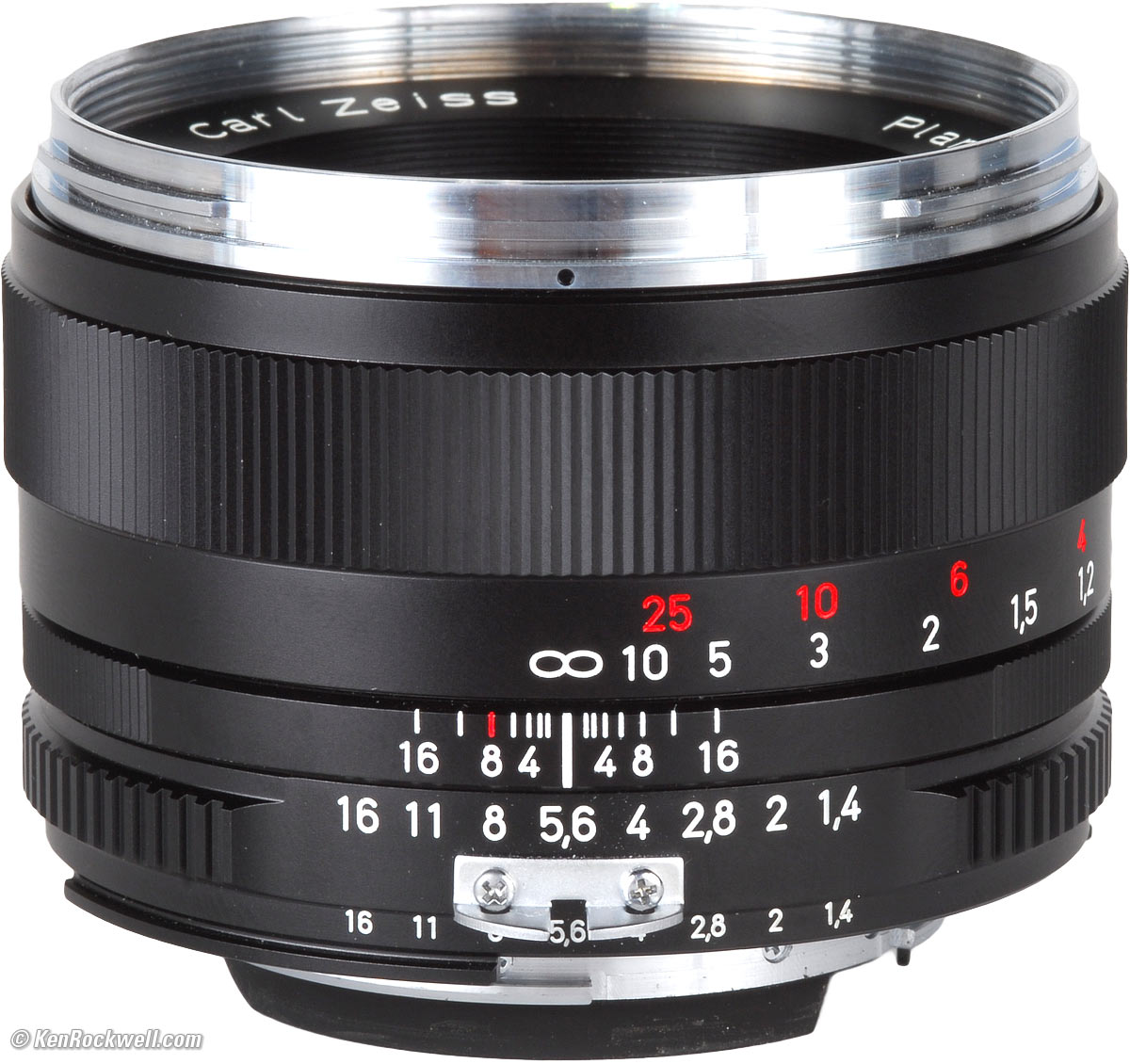
Zeiss 50mm f/1.4, für Nikon. (58mm filters,11.585 oz./328.5g). enlarge. I'd get it a Adorama, in mounts for Nikon, Canon EOS/EF, Pentax, or M42 screw mounts. It helps me keep adding this site when you get yours from these links, thanks! Ken.
April 2010 More Zeiss Reviews
Introduction top
Intro Specs Performance Recommendations
I personally suggest Adorama, Amazon, Ritz, B&H, Calumet and J&R. I can't vouch for ads below.
|



Some years ago Zeiss licensed Kyrocera of Japan to use the name Zeiss on some lenses made for the Contax brand of cameras. Life was good.
Contax went out of business in 2005, ending the need for these lenses. As soon as the agreement expired in 2006, Zeiss looked for something to do with the Japanese manufacturing capacity.
Zeiss decided to put these former Contax mount lenses in Nikon mounts instead, and that's how we get these ZF lenses. These are new lenses made in Nikon mount.
This lens is not made in Germany and it is not made in a Zeiss factory. It is made in Japan by Cosina, the same company that made the cheap FM-10 for Nikon and many other inexpensive lenses and cameras for third-party makers for many decades.
Manual focus lenses went obsolete 20 years ago. This is a lens for the gear hobbyist or collector, or someone shooting manual focus 35mm film cameras. This lens can't autofocus and makes no sense to use on for any digital or AF Nikon.
It feels exactly like a third-party manual focus lens from the 1970s, and for good reason. Cosina, who makes this lens, made many of the third-party lenses of the 1970s. This Zeiss branded lens even has the same focus ring finish as my very first ever third-party lens. I got a Vivitar 200mm f/3.5 T-mount lens for Christmas in 1973. It has the same anodized aluminum finish, engraved markings and straight-ribbed focus ring of this Zeiss lens. Ditto for the 25mm f/3.5 Lentar lens I bought for my Minolta at Fortunoff in 1974 before I could afford camera-brand lenses. I was only 12 years old back then.
Better lenses, if this Zeiss was better, don't improve image quality anywhere near as much as stepping up to a larger film format.
Specifications top
Intro Specs Performance Recommendations
Name
Zeiss calls this the Zeiss Planar T* f/1,4 50 mm ZF
Optics
7 elements, 6 groups. T* brand multicoating.
Diaphragm
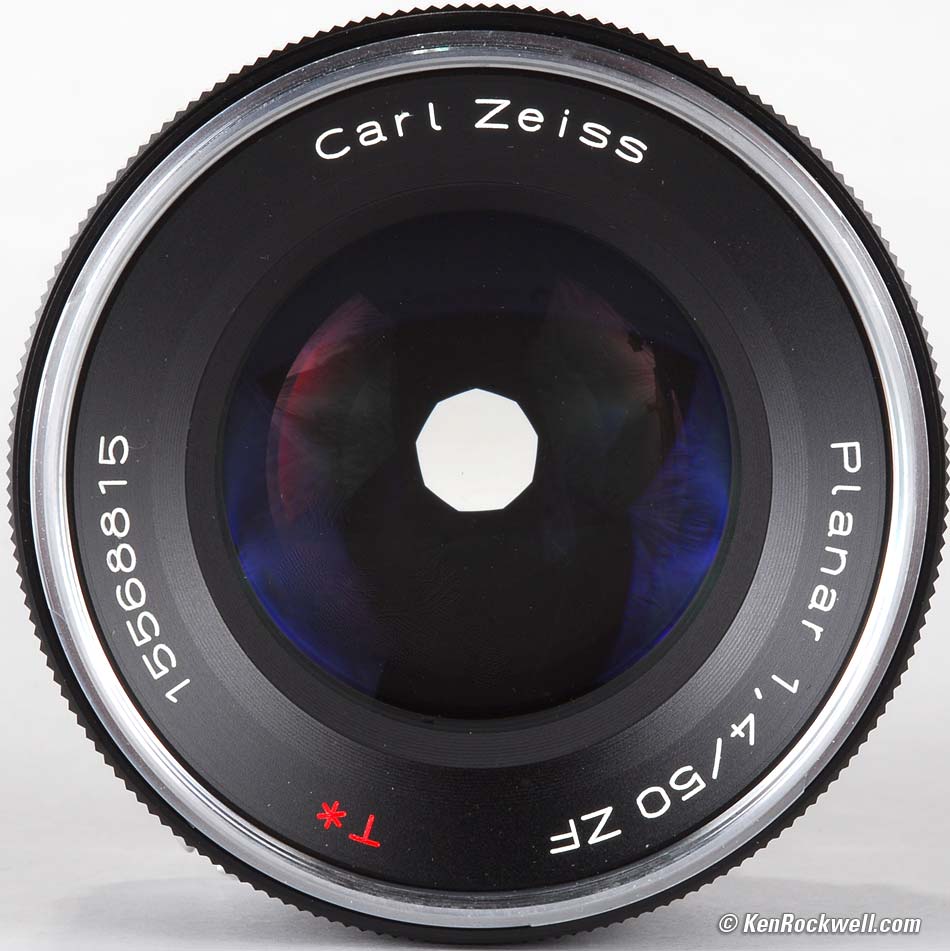
9 straight blades.
f/1.4 to f/16.
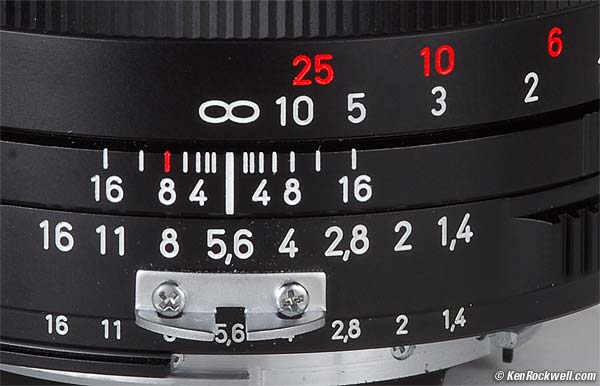
Annoying half-stops make it difficult to impossible to set aperture by feel, also makes it had to set third stops (as light meters read).
Traditional aperture ring coupling lug for use with 1959 - 1977 vintage cameras.
Close focus
1.5 feet or 0.45 m, normal for these lenses 50 years ago.
Filter Size
58 mm filter.
WRONG! Nikon's standard is 52 mm, so my stack of 52mm filters won't work.
Hood
Superb bayonet metal hood, included. I never use hoods.
Size
2.565" (65.92 mm) diameter x 1.760" (44.70 mm) extension from flange at infinity.
Weight
11.585 oz. (328.5g), measured.
The Zeiss rear lens cap weighs 10.1 g, compared with 8.8 g for Nikon's. Oddly the Zeiss cap feels a little weaker.
Performance top
Intro Specs Performance Recommendations
(on a D200 digital Nikon)
See my 50mm Lens Comparison for a knock-down, drag-out comparison among this and many other 50mm lenses. I have far more details in those pages about this lens, including exaple photos, than I have here.
Optically this Zeiss is fine and similar to the Nikkor 50mm f/1.4s. Mechanically I prefer the Nikkors.
Sharpness
f/1.4
Soft focus effect. Spherical aberration puts a soft, low contrast veil over a sharp underlying image. This is typical of f/1.4 50 mm lenses. It has high resolution, but low contrast, which results in a soft image.
f/2.8
Brilliantly sharp. Only the slightest traces of secondary lateral chromatic aberration (called purple fringing by hobbyists). Again, typical of 50 mm lenses.
f/4
Brilliantly sharp.
f/8
A little less sharp. This isn't cause by the optics; it's the limits of physics and diffraction.
f/16
Less sharp due to diffraction, as expected.
Distortion
Minor Barrel. Correct with -1.00 in PhotoShop CS2's Lens Distortion Correction Filter.
This is typical for a 50mm f/1.4 lens. This is too bad; the Nikon 50mm f/1.8 has less distortion.
Mechanics
It feels like a good off-brand like Spiratone or Tokina from the 1970s. Made in Japan, too, just like them. All markings are engraved and filled with paint, just like the off-brands of the 1970s.
No rubber, just metal, focus ring. Can't be focused easily with just one finger. The focus less smooth than a Nikkor manual focus lens. It's also worse than the Nikkors of the 1960s. The Zeiss focus ring is round, the early Nikkors had scalloped rings you could turn with one finger.
Half stop aperture clicks. This makes it tough to set third stops, and tougher to set full stops by feel.
Red, not yellow, footage markings.
Very clean inside, and ought to stay that way because it doesn't have air pumping in and out as a zoom does.
It has no chrome grab ring for mounting and unmounting.
Recommendations top
Intro Specs Performance Recommendations
I'd much rather have a Nikon manual focus lens than this one, and much rather have an AF compared to a manual focus lens.
A used Nikkor 50mm f/1.4 AI has the same optical performance and better mechanical performance for a lot less money.
Help me help you top
I support my growing family through this website, as crazy as it might seem.
If you find this as helpful as a book you might have had to buy or a workshop you may have had to take, feel free to help me continue helping everyone.
If you've gotten your gear through one of my links or helped otherwise, you're family. It's great people like you who allow me to keep adding to this site full-time. Thanks!
If you haven't helped yet, please do, and consider helping me with a gift of $5.00.
The biggest help is when you use any of these links when you get anything. It costs you nothing, and is this site's, and thus my family's, biggest source of support. These places always have the best prices and service, which is why I've used them since before this website existed. I recommend them all personally.
Thanks for reading!
Ken
Home Donate New Search Gallery How-To Books Links Workshops About Contact