Home Donate New Search Gallery Reviews How-To Books Links Workshops About Contact
Nikon
20mm f/2.8
NIKKOR AF and AF-D (1989-)
©
2004, 2011 KenRockwell.com
Intro Specs Performance Compared Recommendations

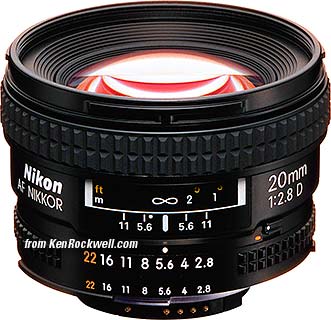
Nikon 20mm f/2.8 AF (62mm filters, 9.1 oz/255g, 10"/0.25m close focus, about $570 new or about $325 used). This free website's biggest source of support is when you use any of these links, especially this direct link to it at Adorama, at Amazon, at B&H, or this direct link to it used at eBay (see How to Win at eBay), when you get anything, regardless of the country in which you live. Thanks! Ken.
October 2011 Nikon Reviews Nikon Lenses All Reviews
NEW: Nikon 20mm f/1.8 G Review October 2014
Nikon Ultrawide Zooms Compared 08 March 2010
Sharpness Comparison to other 20mm lenses
Nikon 20mm lens falloff comparison February 2008
Introduction top
Intro Specs Performance Compared Recommendations

I use Adorama, Amazon, eBay, Ritz, B&H, Calumet, J&R and ScanCafe. I can't vouch for ads below.
|


The Nikon 20mm f/2.8 AF was introduced in the spring of 1989, and today is still Nikon's smallest and lightest ultrawide lens.
It is a wonderful lens, and often my preference over any of Nikon's bigger and heavier ultrawide zooms.
History
1984 - today
Nikon's manual-focus 20mm f/2.8 AI-s lens is also made today, and has more precise mechanics than this autofocus lens.
1989-1994
Nikon's first autofocus ultrawide lens is the 20mm f/2.8 AF.
It has exactly the same optics as the manual-focus lens.
The internal, engraved metal focus distance indicator appears to be the same part as from the 20mm AI-s manual focus lens.
1994-today
Today's AF-D version adds distance coupling to the camera for slightly better exposure control with flash, otherwise, today's lens is the same as the first AF version, which has the same optics as the manual focus version of 1984.
Specifications top
Intro Specs Performance Compared Recommendations
Optics
12 elements in 9 groups.
Angle of View top
94° on FX and 35mm.
71° on small-format DX.
Diaphragm
7 blades.
Stops down to f/22.
Close Focus
It focuses as close as 0.25m or 10 inches.
It has CRC, close range correction (floating elements).
Hood
An HB-4 hood is attached by bayonet. I don't bother with one.
Size
2.7" (69mm) around by 2.1" (54mm) long, specified.
Weight
9.060 oz. (256.8g), measured, AF version.
9 ounces (260 g), specified.
Nikon Product Number
1913.
Price, USA
2014 October: $570 new or about $325 used.
2011 October: $570 new or about $375 used.
Performance top
Intro Specs Performance Compared Recommendations
AF Speed
The AF speed is almost instantaneous on an F100. One full turn of the AF screw focuses the lens from infinity to 2.5 feet.
Falloff of Illumination
It has the usual illumination falloff at f/2.8 and it's gone by f/5.6 or f/8. The 17-35mm zoom is much better if this is important to you.
See also Nikon 20mm lens falloff comparison for much more.
Filter Vignetting on Film
There is no vignetting when used with a Nikon brand filter. They are thinner than most other brands. I get slight vignetting with Tiffen, Hoya, B+W, Heliopan and most other filters. I have heard that the 62mm B+W slim mount polarizer works OK, too. I have not tried it.
Ghosts
It has very few few ghosts. You are pretty safe with the sun in your image. It has the best ghost performance of any 20mm I've tested, and second only to the 17-35mm AF-S You can forget the lens hood, you don't need it.
Sharpness
It has coma (fuzziness) wide open in the corners typical to Nikon wide angle lenses.
Stopped down a couple of stops it is very, very sharp.
Mine is a bit softer in the lower left than in the lower right corner. I also find that with a Tiffen 62mm filter that the upper right vignettes more than the other corners. This is most likely due to mechanical slop.
Distortion
It has a mildly complex distortion signature on FX and film. It has some barrel distortion in the central area of the image, and tends to straighten out at the very edges.
It has the same distortion at all distances.
Photoshop's lens distortion tool can't do much, since it's complex distortion. I'd leave it alone unless DxO has a profile.
The Panorama Tools coefficients for use on FX are:
R 0.0063, -0.021,
0, 1.0153
G 0.0063, -0.021, 0, 1.0147
B 0.0063, -0.021, 0, 1.0143
Mechanics
As typical for an AF lens, there is enough play in the mechanics so even if the focus ring is held tight that one can jiggle the front of the lens around enough to move the image around a bit.
Close Focus
Close focusing is closer than I need it. The smallest horizontal field is about 11-1/4."
Compared top
Intro Specs Performance Compared Recommendations
See Nikon Ultrawide Zooms Compared.
Recommendations top
Intro Specs Performance Compared Recommendations
The new 20mm f/1.8G is far better optically.
I used to use this AF 20mm all the time because it's small and easy to use. I'd rather tote it around instead of the fat $1,500 17-35mm AF-S.
This lens is not quite as sharp as my old 20mm f/4 AI manual focus. It's not quite as good as the 17-35mm F/2.8 AF-S zoom, which may be a first zoom to be a tad sharper than a fixed lens. The zoom also has less light falloff at f/2.8. How about that!
Here's a trick: Get all your filters in 77mm size. Get a step-up ring here to allow 77mm filters to fit on this 62mm threaded lens. Now not only can you use any filter without vignetting, you can even use two 77mm filters at the same time without vignetting. Even if one of those filters is an ordinary thick-mount polarizer I still get away with just a little darkening of the corners.
I get sharp results handheld at 1/10 second.
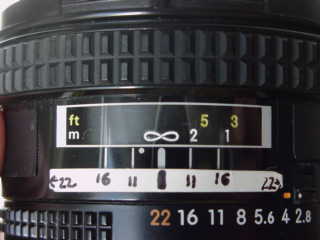
What's this odd depth-of-field scale all about?
Depth-of-field scales are calculated by Nikon at the maximum limits of fuzziness people are likely to tolerate. They are not calculated to give you the sharpest possible result if you have a tripod.
You might think that stopping all the way down gives the sharpest result, however it may not due to an effect called "diffraction." This effect is the same as squinting your eyes too much: it just gets fuzzier.
To spare you a very long and mathematical story, just stick a little scale like this to your 20mm lens. Find the nearest and farthest points of your subject, and place them each an equal distance from the main focus index so that they each fall on an equal f/stop just as you would for the conventional DOF scale. Read the f/stop from this new scale, and set that as your aperture for the sharpest possible result considering both depth-of-field and the effects of diffraction.
F/22 is indicated at the ends of the scale, somewhat beyond what the window displays.
For instance, if you want everything from 3 feet to infinity in focus, set the lens to 6 feet and use f/11-1/3 or f/13. You don't need to worry about the fractions; either f/11 or f/16 will be fine.
Help me help you top
I support my growing family through this website, as crazy as it might seem.
The biggest help is when you use any of these links when you get anything, regardless of the country in which you live. It costs you nothing, and is this site's, and thus my family's, biggest source of support. These places have the best prices and service, which is why I've used them since before this website existed. I recommend them all personally.
If you find this page as helpful as a book you might have had to buy or a workshop you may have had to take, feel free to help me continue helping everyone.
If you've gotten your gear through one of my links or helped otherwise, you're family. It's great people like you who allow me to keep adding to this site full-time. Thanks!
If you haven't helped yet, please do, and consider helping me with a gift of $5.00.
As this page is copyrighted and formally registered, it is unlawful to make copies, especially in the form of printouts for personal use. If you wish to make a printout for personal use, you are granted one-time permission only if you PayPal me $5.00 per printout or part thereof. Thank you!
Thanks for reading!
Mr. & Mrs. Ken Rockwell, Ryan and Katie.
Home Donate New Search Gallery Reviews How-To Books Links Workshops About Contact