Home Search Gallery How-To Books Links Workshops About Contact
Recommended Cameras: Holiday 2007
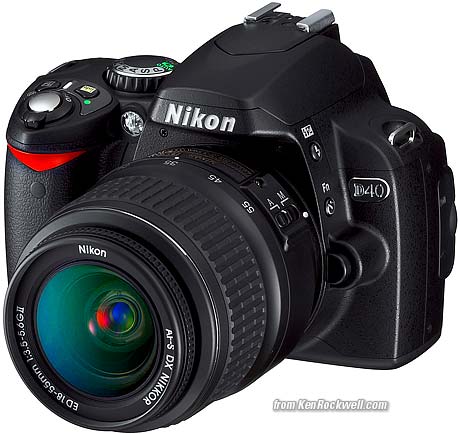
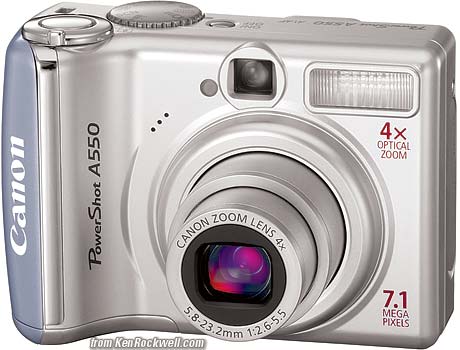
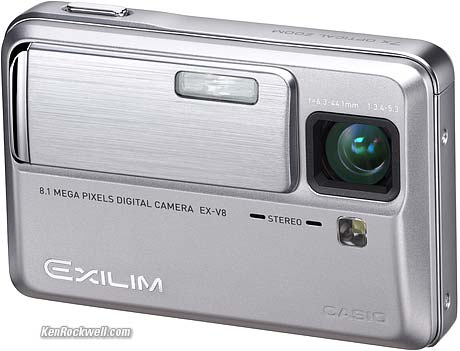
The Nikon D40, the answer to most people's camera questions. November 2007 Fast Answer: If you don't have the time to read the rest of this page: For the best possible camera for just about anything, fun or serious, I use my Nikon D40. I own more expensive cameras, but whenever I grab a camera for my own personal vacations or family photos, it's almost always my remarkable Nikon D40. There isn't anything reasonable I can't do with Nikon's least expensive D40. For $480, complete with an exceptionally good lens today, it's a no-brainer. (I paid $600 for my D40 a year ago.) I wouldn't bother with the more expensive Nikons unless you really want to spend money, or will be using it all day, every day. I only use my more expensive cameras when I'm shooting all day. If I'm spending more time carrying it than using it, I always grab my Nikon D40. For a compact pocket camera, I won't go anywhere without a Casio EX-V8 (about $250) in my pocket. I consider it the best compact digital camera. It's inexpensive and makes stereo movies and too much more to list. it has a very sharp 7 power zoom lens that never needs to extend; it works simply by sliding open the cover. Introduction Friends and family always ask me what camera to buy. Here are my recommendations, starting with the least expensive possible camera that can make great pictures, including big enlargements, and moving up from there depending on how much money you'd like to spend and what you'd like to photograph. This holiday guide covers cameras for normal people as well as dedicated photographers. Click any of the names or photos of the cameras to get to my detailed reviews, and if I don't have a detailed review, at least to another page with details. If you find this page helpful, you can support me to keep adding to this site by using the links I've provided to Adorama, Ritz, Amazon and B&H when you get anything. I've been using these great stores myself for years (or decades), using these links costs you nothing, probably saves you money, and gets you the same great service I've enjoyed myself. Caveats: Cameras What makes for a good or bad photo is the skill of the photographer. Regardless of the expense and advancement of your camera or car, you still have to drive your camera. just as you have to drive you own car. A camera can't take a picture any more than a typewriter can write a novel, but camera makers would like you to think so. The ultimate quality of any photo does not depend on the camera. A $150 camera can make the same quality photo as a $5,000 camera. Good photographers get great great photos even with the cheapest cameras. Most people will get the same crappy photos even if they spend $10,000 on a new camera. If you're not happy with your photos, a new camera rarely solves the problem. Learning how to recognize a good photo before you take it and how to adjust your camera are far more important than buying a new camera. The reason to spend more is to get a camera which makes it easier to get great photos over a wider range of conditions and can handle a wider range of subjects. For instance, it's easy to get great shots of posing family and friends with any camera, but sports, moving kids, and indoor cultural events without flash require more flexible cameras. Caveats: Stores I can't vouch for any other stores or ads you see since I haven't used them. Personally I always use Adorama, Ritz, Amazon and B&H. See How to Buy on how to avoid scams. Hint: if anyone's offering prices lower than Adorama, Amazon or B&H, it's almost always either an outright scam or a place that will try to upsell you on worthless accessories to charge you more than you would have paid from a good store. Often the bad stores, especially those that advertise heavily on the Internet and look perfectly legitimate but lower priced, pad their prices by trying to sell you accessories, like the battery charger, that already come with the camera! I'm as cheap as they come, having started my photo hobby before I was 11 years old and working off my allowance, so I've researched the cheapest places many times over. Recommendations back to top The Cheapest Good Digital Camera: $130. Don't want to spend much money on a good camera, but want great photos of family and friends? The $140 Canon A550 was the best buy in photography in 2007, until it was replaced by the even better A560 for only about $130.
Canon A550 or A560 The Canon A550 can make great photos. Today's A550 is far better than the Canon A70 for which I paid $400 in 2003 and with which I made these photos. The A560 looks like the same thing as the A550 I used, with a larger 2.5" instead of 2" screen and adds face detection. I'd get the A560 for $130, no problem! Hint: I get the wilder colors I prefer by setting all my Canon compact cameras to their "Vivid" modes. To do this, hit FUNC/SET, go down a couple of clicks to OFF, and click one to the right to VIVID. The limitations of these two Canons are that 1.) you have to supply your own AA batteries (they come with one set of disposables), 2.) they can't photograph moving things well, 3.) their flashes take a long time to recharge for each shot, and 4.) they are too big to fit in a pocket. Their photos are great, they just aren't as small or convenient as more expensive cameras. Cheapest High-Performance Pocket Camera: $210.
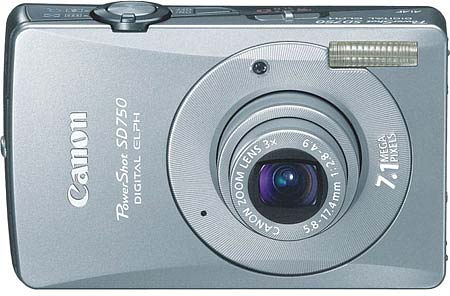
The Canon SD750 is built like a tank, has a huge 3" screen that fills almost the entire back of this tiny camera, it fits in a small pocket and comes included with its own tiny battery and charger. I've never used one, but if my budget was $210, this is what I'd get and I'd take it everywhere. As I mentioned above, I prefer setting all my Canon compacts to the "Vivid" color mode. Press FUNC/SET, go down a couple of clicks to OFF, and click one to the right to VIVID. My Favorite Compact Cameras: about $300 If you have about $300, you can have your choice of compact cameras. My favorites are:
The Casio EX-V8, selling for only about $229 today here and Amazon, is about the size of a business card and under an inch thick. I always have one concealed in my pocket. (Bargain hint: last year's almost identical EX-V7 sells for only $199.95 at Adorama and Amazon.) Unlike most compacts, its lens doesn't extend. Simply slide open the cover and you're ready to shoot. I suspect this will let this Casio last much longer than other compacts, since the first thing to break on all of my other compacts is the lens retracting system or the lens cover blades. The EX-V8 has a 7-power zoom lens, about double the magnification of most other compact cameras. It has a stabilizer to ensure sharp hand-held shots, even at the maximum telephoto setting. The maximum telephoto setting is equivalent to about a 260mm lens on a 35mm film camera. Also, unlike other compacts, you can select any exact zoom setting. Most compacts only zoom in a few fixed steps, making precise composition difficult. The Casio EX-V8 zooms with two speeds as you move the zoom lever! Want more? The EX-V8 makes high-quality movies with stereo sound, and you can zoom optically while you shot unlike other pocket cameras! Hint: Just like my Canons, which I set to their Vivid modes, I prefer wilder colors and get them by using different menu settings in the EX-V8. I set +2 for saturation and +2 for contrast. I also set the sharpening lower, to -1, for better results. The EX-V8 by default tends to oversharpen. The EX-V8 is also the sharpest compact camera I've ever used, its lens is sharp even at tele and even in the corners for making great 12x18" prints at Costco. It comes with a rechargeable battery and a very handy stand in which the camera recharges and from which you can download your photos. Like everything from Casio, it does more than I can fit here. My other Casios run for 24 hours or more for recording audio-only; I've never wanted to wait that long to time this one. Canon Compacts Everything Canon makes is good. If you find a Canon you like, get it. Canon introduces new models every week, so I can't possibly keep up. My favorites are the tiny, pocketable ELPH series with image stabilization (IS). IS allows me to get sharp shots, even at the telephoto settings, hand-held.
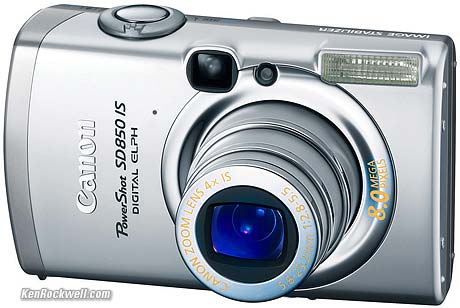
I own an SD700 IS, which was last year's model. In 2007, I'd get any of the SD850 (about $260), SD870 (about $310) or SD950 (about $370). Even the SD850 is greatly improved over my beloved SD700 for which I paid over $400 in 2006. Each model offers a little more resolution and features. Most people get the SD950, but personally I'd get the SD870 because is has a wider lens and a larger 3" screen than the others. The SD950 appears to be made of titanium while the SD870 feels like plastic, but I'd go for the bigger screen of the SD870 for less money. As above, I get wilder colors using Canon's "Vivid" mode. I hit FUNC/SET, go down a couple of clicks to OFF, and click one to the right to VIVID. Unless you're shooting movies, the limitations of all of these compact cameras, regardless of price, is that they can't photograph sports or moving things well. For sports and moving kids, you need a Single-Lens Reflex (SLR). SLR Cameras SLR cameras are needed to photograph things that move, like kids, sports and just about anything that won't pose for you. My favorite SLR camera just happens to be the cheapest SLR camera: the incomparable Nikon D40.
The Nikon D40. The Nikon D40, for only about $480, comes included with an excellent 18-55mm lens, built-in flash, battery and charger. My D40 is so light that I forget I'm carrying it, and it lets me easily make extraordinary images. Even with 6 megapixels I can make stunning 12 x 18" prints. If you can't make a sharp shot with the D40, a more expensive camera isn't likely to help you. Contrary to what salespeople try to get you to believe, megapixels have nothing to do with sharpness. Call me a renegade, but honestly the Nikon D40 is superior to the more expensive D40x and D80 for two reasons very important to full-time professional photographers. First, the D40 is twice as sensitive to light as the D40x and D80. (The D40's ISO defaults to ISO 200 instead of the less sensitive ISO 100, making for sharper photos in any light.) Second, the D40 is far more flexible with flash in daylight. The maximum unimpeded shutter speed of every Nikon other than the D40 when used with flash is only 1/250 second, while the D40 easily shoots at 1/500 with flash with no loss of performance. I have a complete, free, plain-English users guide to the Nikon D40 where I explain everything I know about how to get great photos and great colors with it. So why do people pay more for other cameras? Because most of the people buying the D40x don't exactly earn 100% of their income from photography. Full-time pros know intimately the importance of exotica like sync speed, but snapshooters are more easily separated from their money because they worry about unimportant things like megapixels. Megapixels don't matter. If you want a fancier camera, the next real step up is the Nikon D200 or D300 as I explain below.
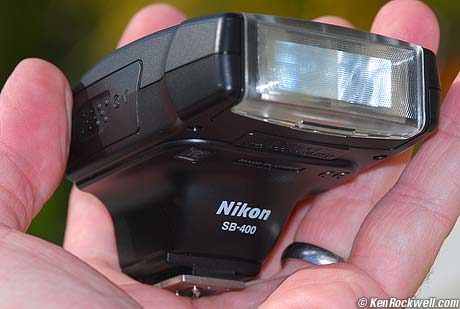
Nikon SB-400, about $110. The built-in flash of the D40 is excellent, but can't be used to bounce off the ceiling to improve your indoor photos. Since I just saved you at least $200 with the D40 instead of the D40x, let me suggest an excellent accessory flash, the SB-400. I own more expensive flashes, but I almost always have my SB-400 on my D40 when I run out the door. Even if you don't bounce it, the SB-400 lets you shoot fast with flash since it recharges much faster than the D40's built-in. I use my SB-400 even on my more expensive Nikons. It's that good. You Can Stop Here This is all you really need. I go on vacations for a week at a time with my super-lightweight D40, 18-55mm and SB-400 flash, and never miss anything. In fact, I love not having to carry more gear! The D40 battery lasts so long, about 500 - 1,000 shots, that you might be able to leave the charger at home if you're feeling lucky. I shoot so heavily that I always take it. Did I say heavily? I've made about 15,000 shots on my D40 and it looks and runs exactly as it did when brand new. Photos of Far Away Things
The included lens is great for everything, so long as you can get close enough. If you can't, get the Nikon 55-200mm VR lens for about $230. The D40 and this lens will cost about the same as the more expensive D40x, and I still prefer the less expensive D40.
If you want to get serious shooting sports, get the bigger, longer more serious Nikon 70-300mm VR lens. I have a neighbor who uses a D40 and the 70-300mm VR to photograph his high school football star, and everyone (even he) is amazed at the quality of the images. This system easily tracks and focuses on the players as they run around.
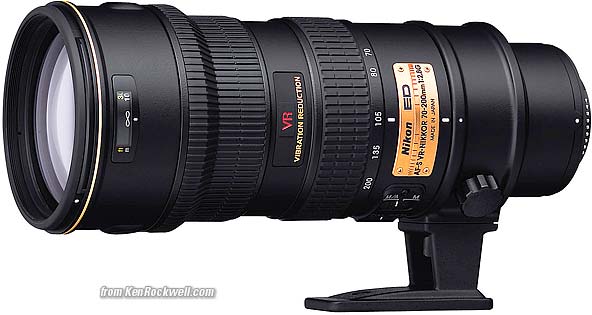
If you really want to get serious for indoor sports and theater, the fully professional (and therefore about $1,600) Nikon 70-200mm f/2.8 VR works in much lower light, and works perfectly with the D40. Wide Angles
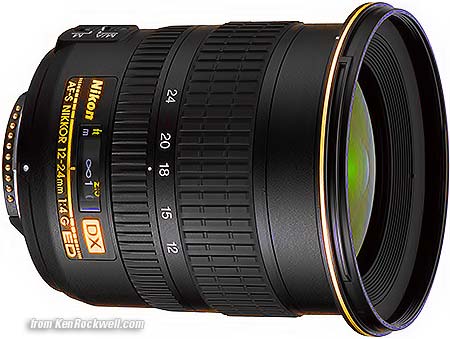
I'm a sucker for ultra-wide lenses. If the included lens isn't wide enough, my favorite is Nikon's 12-24mm DX (about $925). For about half the cost, the Tokina 12-24mm is just about as good, but won't autofocus on a D40. The even wider and less expensive Sigma 10-20mm will autofocus on the D40, but I don't trust the durability of the Sigma lens. Long term, it's always better to spend money on lenses instead of digital cameras. Any of these lenses will work great on any fancier camera. Cameras drop in price and go obsolete every year, while lenses can stay current for a decade. Cameras for the Man Who Has Everything No one, not even me who uses his cameras all day long, needs anything better than a D40. Guys who own fancy cameras may not have the confidence to admit it and poke fun at the D40, but I love it. I own fancier cameras because they make it even easier to do fringe-element things, like make 6-foot-wide prints that are still sharp close up (prints from a D40 look great at any size when seen from a reasonable distance), or shoot with bizarre wide angle lenses, or burn away at 10 frames per second for sports. No one needs this, but if you have the cash or use cameras so much that even little improvements are appreciated, go for it. See also Is It Worth It.
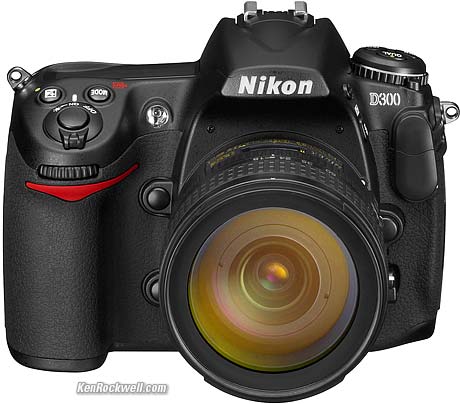
The best camera for serious amateur photographers is the new and backordered Nikon D300 ($1,800). It does the same thing as the D40, just more of it with more weight and far more expense. Honestly, though, the D300 offers much faster firing rates for sports. I'd get the Nikon 18-200mm VR lens with it (about $700). I love the 18-200mm VR because it does everything well in one lens; every other Nikon lens works well on the D300, too. If you need it soon, you may be better off with last-year's Nikon D200 which costs less and ought to be in stock.
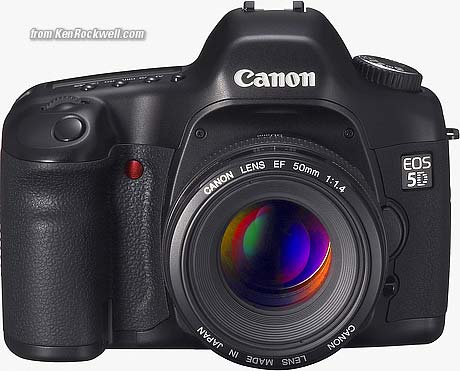
For painstaking landscapes and portraits, I prefer my Canon 5D (about $2,200 before rebates). I most often use a Canon 16-35mm f/2.8 L II (about $1,300) or 17-40mm f/4 L (about $650) lens, or a Canon 70-200mm f/4 L (about $1,000) with it. Most or all these lenses are on rebate in the USA until some time in January 2008.
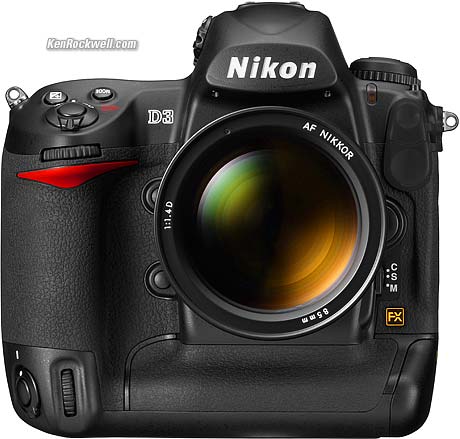
For professional news and sports, every man wants the Nikon D3 ($5,000). The Nikon D3 is also great for landscapes, but bigger, heavier and more than twice as expensive as the flimsier Canon 5D. Like the Nikon D300, the Nikon D3 is heavily back-ordered, but unlike the D300, has no equivalent. All Nikon lenses work on the D3. For the man who wants a D3, he'll want the Nikon 70-200mm f/2.8 VR I mentioned above, as well as the $1,700 24-70mm normal lens and the $1,800 14-24mm wide lens. Less expensive Nikon lenses work great on it, too.
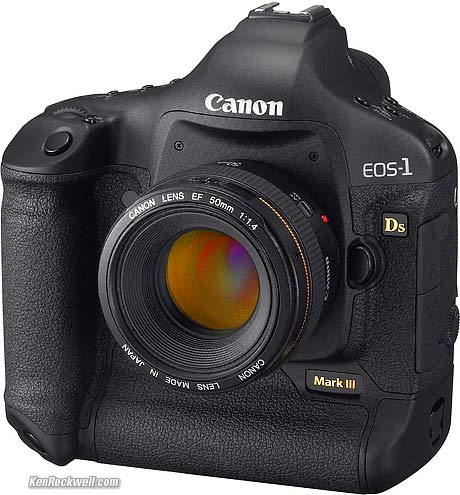
The craziest (good) camera for portraits and landscapes is Canon's $8,000 1Ds Mk III. It's the world's best. Go for it. Get the same lenses as I suggested for the Canon 5D, or the sorts of folks who get the 1Ds Mk III tend to want the far heavier 70-200mm f/2.8 IS over the much lighter but just as good f/4 I prefer. PLUG If you find this as helpful as a book you might have had to buy or a workshop you may have had to take, feel free to help me continue helping everyone. The biggest help you can give is simply to use the links I provide for getting them. Thanks for reading! Ken |





Home Search Gallery How-To Books Links Workshops About Contact