Home Donate New Search Gallery Reviews How-To Books Links Workshops About Contact
Nikon
60mm f/2.8
Micro-NIKKOR AF-D (1989-)
© 2008~2013 KenRockwell.com. All rights reserved.
How to Shoot Macro Best Macro Lenses Compared
Intro Specifications Performance Recommendations

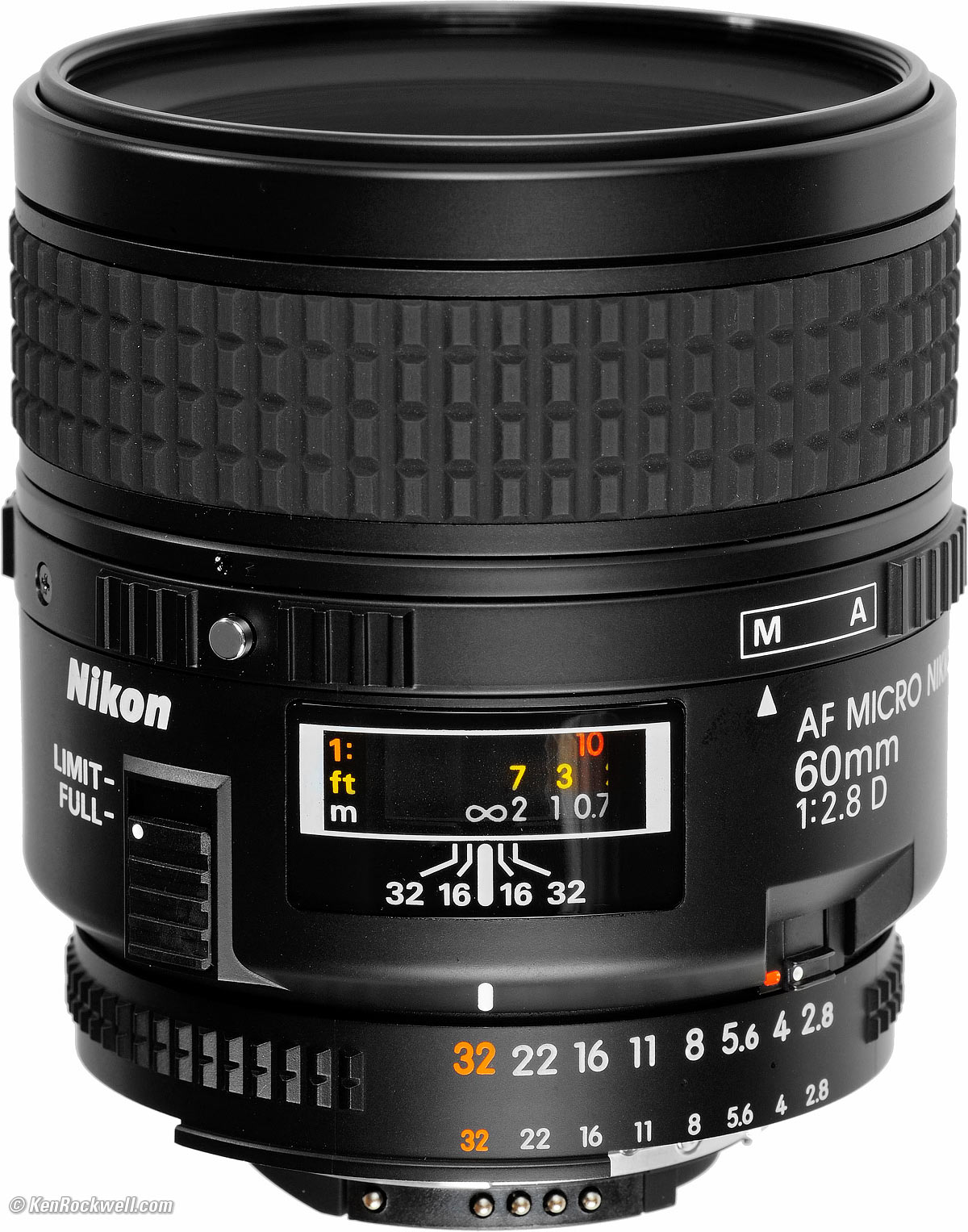
Nikon AF Micro Nikkor 60mm f/2.8D (FX, DX and 35mm coverage, 1:1 macro, 62mm filters, 15.3 oz./434g, about $430 new or $225 used). enlarge. I'd get mine new at Adorama, new at Amazon or used at eBay (see How to Win at eBay).
My biggest source of support for this free website is when you use those or any of these links when you get anything, regardless of the country in which you live. It helps me keep adding to this free website when you get your things through these links — but I receive nothing for my efforts if you buy elsewhere. Please always use those or these links for the best prices and service. Thanks for helping me help you! Ken.
June 2013 Nikon Reviews Nikon Lenses All Reviews
Explicit 60mm AF-S vs. 60mm AF-D comparison.
Why fixed lenses take better pictures.
Introduction top
Intro Specifications Performance Recommendations

|

The Nikon 60mm f/2.8 Micro has been around for decades. It is an excellent normal and short telephoto lens, as well as a superb close-up lens.
Micro is Nikon's word for macro. It's the same thing. This lens focuses to life-size, which means an object as small as an inch across can fill the frame.
As of 2008 this 60mm f/2.8 AF-D has been replaced by a newer AF-S version, which does the same thing but costs much more. The only advantage of the AF-S version is easier access to manual focus and that is can autofocus on Nikon's cheapest D40, D40x, and D60.
Compatibility
As a traditional AF lens, the Nikon AF-D 60mm Micro works on a broader range of Nikon cameras than any other. Except that it won't autofocus on the D40, D40x, or D60 and that you'll have to have an AI coupling prong to the aperture ring for coupled metering with antediluvian Nikons made from 1959 - 1976, this lens works perfectly with every Nikon ever made over the past 30 years.
See Nikon Lens Compatibility for details on your camera. Read down the "AF, AF-D (screw)" column for this lens.
Production History
1956-1961
Nikon made a 55mm f/3.5 Micro for rangefinder cameras like the Nikon SP.
God only knows how you focused or composed.
1961-1979
Nikon made various versions of a 55mm f/3.5 manual-focus Micro.
Nikon made about a half-million of these.
1979 -
Introduced the manual focus 55mm f/2.8 AI-s Micro-NIKKOR in 1979, and as one of the best lenses in photography, it's still sold today as of 2010.
Nikon has made about 600,000 of these — so far as of 2010.
1986-1989
55mm f/2.8 AF, Nikon's first AF micro.
Nikon only made about 50,000 of these.
1989-1993
60mm f/2.8 AF, which is the same as this lens shown here, withouth the ability to couple the focus distance to your camera's metering system. This only is an advantage if you're shootign with flash on-camera; otherwise, it's the same lens.
Nikon made about 150,000 of these non-D AF versions.
1993-2008
This 60mm f/2.8 AF-D, which is the same as the previous 60mm f/2.8 AF but adds the minor D feature.
Nikon has made about 295,000 of the AF-D versions, or about 445,000 total, as of 2010.
2008 -
The 60mm AF-S Micro is introduced, adding internal focusing and an internal AF-S focus drive motor.
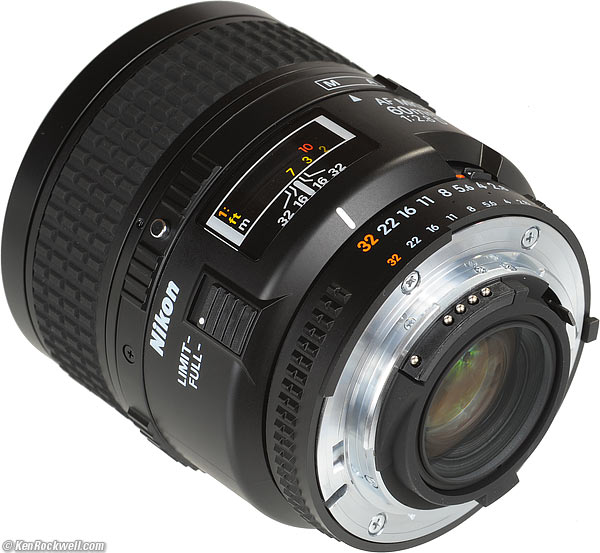
Nikon 60mm f/2.8 AF-D.
Specifications top
Intro Specifications Performance Recommendations
Name
Nikon calls this the Nikon AF Micro Nikkor 60mm f/2.8D.
Focal Length
60mm.
Used on a DX camera it gives an angle of view similar to what a 90mm lens would give on an FX or 35mm film camera. See also Crop Factor.
Optics
8 elements in 7 groups.
Close-range-correction (CRC).
Multicoated.
Diaphragm
7 conventional straight blades.
Stops down to f/32 at infinity.
Stops down to f/57 at 1:1.
Hard Infinity-Focus Stop?
Yes.
Close Focus
8.62" (0.219m), marked.
This is the distance to the image plane (the back of the camera).
Working Distance
I measure only 2-7/8" (73mm) from the subject to the front of the lens at the closest focus distance.
Nikon specifies 3.56" (90.4mm).
This is how close the front of the lens is to the subject at the closest focusing distance, and why I don't suggest 60mm micro lenses. A 105mm gives you enough room to work and not block your light.
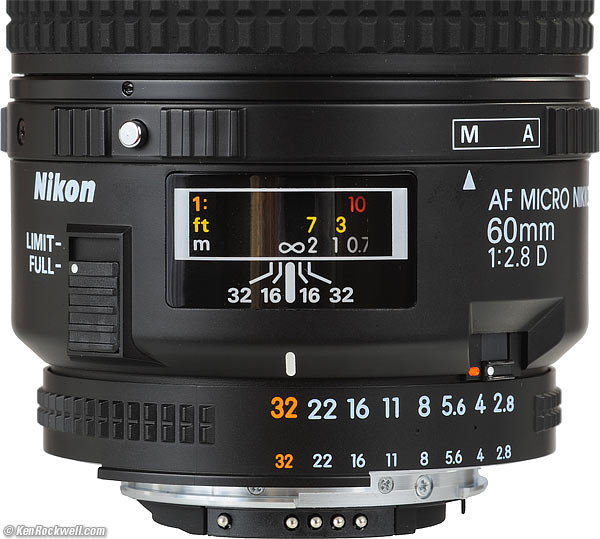
Control Surfaces, Nikon 60mm AF-D.
Focus Range Limiter?
Yes.
Limits close focus to 1 foot (0.3m), or limits far focus to 10" (0.26m).
Maximum Reproduction Ratio
1:1.
Focus Distance Scale?
Yes, basic.
Depth-of Field Scale?
Only for f/16 and f/32 .
Infra-Red Focus Index?
No.
Filter Thread
62mm, doesn't rotate with focusing.
Size
2.943" extension from flange by 2.851" diameter (74.76 x 72.41mm) when focused at infinity.
It extends to a total of 3.908" (99.26mm) extension from flange when focused at 1:1.
Nikon specifies 2.9" extension from flange (focused at infinity) x 2.8" diameter (74.5 x 70mm).
Weight
2008: 15.780 oz. (447.35g) measured (serie 5064).
2010: 15.307 oz. (433.95g), measured (serie 5076).
Nikon specifies 15.5 oz. (440g).
Case
CL-32S or CL-0815 pouch, both optional.
Hood
HN-22 metal screw-in hood, optional.
It's completely unnecessary: the optics recess deeply into the barrel at normal distances, and at close distances a hood would get in the way of the subject.
Nikon Product Number
1987.
Introduced
1989 as a non-D lens; today's D lens has been sold since 1993.
Price, USA
2013 May: $430.
2010 October: $460.
2008 May: $399.
Box, Nikon 60mm f/2.8 AF-D. (box wall thickness: 0.0225" (0.57mm).)
Performance top
Intro Specifications Performance Recommendations
Overall AF Bokeh Color Color Fringes Distortion
Falloff Filters Flash Maximum Aperture Mechanics
Sharpness Spherochromatism Working Distance
Overall back to Performance back to top
This 60mm f/2.8 AF-D has been one of the lenses by which rest of the industry judges itself since 1989. The only thing it doesn't do compared to the newer 60mm f/2.8 AF-S is autofocus on Nikon's cheapest digital cameras, the D40, D40x and D60. Otherwise, I prefer it to the newer more expensive 60mm AF-S lens.
Focus back to Performance back to top
The lens racks in and out as you focus, There are three nested cups which, if you mouse over the image below, can see in action.
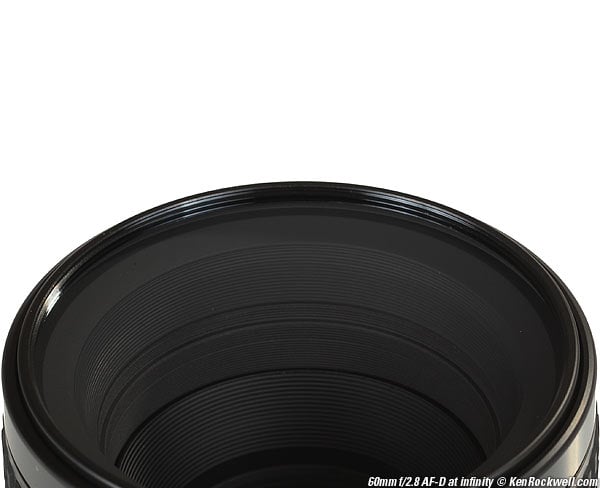
Front of 60mm f/2.8D. Roll mouse over to see it focus at 1:1.
Autofocus
Autofocus is fast and sure. Autofocus can hunt and grind a bit if you're running through the full range.
Since the focus range from near to far is so great, it's not unusual for AF to get a little confused if you're at the wrong end of the focus scale. It's better than the newest 60mm AF-S on the D300 and D3 at this.
When I shoot macro, I focus manually, so no big deal.
Manual Focus
Manual focus requires you press the chrome unlock button and rotate the M - A ring to M.
Manual focus is swell once you get there.
Bokeh back to Performance back to top
Bokeh, the character of out-of-focus backgrounds, not simply how far out of focus they are, is poor.
Backgrounds are often busy at f/2.8; blur circles look more like rolled condoms than discs.
Color Rendition back to Performance back to top
Color seems neutral and matches my other AF Nikkors.
Lateral Color Fringes back to Performance back to top
There are no color fringes on the D300 or D3, which would correct them if the 60mm f/2.8 AF-D had any.
There are also no color fringes on the D200, which tells me that the 60mm f/2.8 AF-D simply has no color fringes.
Distortion back to performance back to top
On FX; the 60mm f/2.8 AF-D has no visible distortion (curving) of straight lines. The only way I'm able to measure this is to enlarge test images to 200% on my screen. The RMS distortion over for all my measured distances is only 0.196.
This 60mm AF-D is better than the newer 60mm f/2.8 AF-S, which has 0.376 RMS distortion under the same conditions. The distortion of the 60mm AF-S can be visible if you're looking for it.
On DX, it's not a problem.
Plug these figures into Photoshop CS2's lens distortion filter if you need perfection. These aren't facts or specifications, they are the results of my research that requires hours of photography and calculations on the resulting data.
FX and Film |
||
infinity |
-0.1 |
0.0 |
30' (10m) |
-0.2 |
0.0 |
10' (3m) |
-0.3 |
tbd |
3' (1m) |
-0.2 |
tbd |
1' (0.3m) |
-0.1 |
tbd |
1:1 life size |
-0.2 |
tbd |
© 2008 KenRockwell.com
Falloff (darkened corners) back to performance back to top
Falloff isn't a problem, even on FX digital. This AF-D lens has far less falloff than the newer 60mm AF-S lens.
I've exaggerated this by shooting a gray field and then placing these on the same gray background.
Nikon 60mm f/2.8 AF-D falloff on film and FX at infinity.
FX at 1:10.
FX at 1:3.
FX at 1:1.
* at 1:1, maximum aperture is only f/5.
|















Filters, Use with back to Performance back to top
There's no problem, even on FX, using two stacked filters. There's no need for expensive thin filters.
Flash, Use with back to Performance back to top
Since you have to get so close to your subject, the lens often will cast a shadow from the built-in flash, if you use it.
You're OK with a D300, and usually OK with a D200.
Forget it with a D40, D40x, D60 or D70. Their slightly smaller flashes don't reach high enough to clear the lens at 1:1.
You're fine with a shoe-mount flash.
It's silly to spend this much money on a specialized micro lens and not use the serious lighting it deserves, so don't worry about this.
Maximum Aperture back to performance back to top
The 60mm f/2.8 AF-D alters its optics as it focuses. It becomes slower as it's focused more closely.
Infinity |
f/2.8 |
10' (3m) |
f/2.8 |
3' (1m) |
f/3.2 |
1' (0.3m) |
f/3.5 |
10" (0.25m) |
f/4 |
1:1 life size |
f/5 |
© 2008 KenRockwell.com
Mechanics back to Performance back to top
The Nikon 60mm AF-D is mostly made of metal, including the filter threads.
Inner Barrel and Filter Threads
Metal.
Barrel Exterior
Plastic.
Focus Ring
Rubber-covered metal.
Internals
Probably metal.
Mount
Dull-chromed brass.
Markings
White paint.
Serial Number
Laser-engraved on bottom of aperture ring.
USA Versions
Serial numbers prefixed with "US."
Ass-Gasket (dust seal at mount)
No.
Noises When Shaken
Lots of klunking and clicking from all the glass and mechanics which have to move around inside to focus.
Made in
Japan.
Sharpness back to Performance back to top
This is an unquestionably excellent lens. If you can't get sharp images with it, you're doing something stupid like shooting at too small an aperture.
It's only slight limitation is if you're looking in the far corners of the FX frame with a microscope at f/2.8; if you are, the newer 60mm f/2.8 AF-S is slightly better there. Stopped down, you're only limited by diffraction and that's about it.
Nikon's specified MTF doesn't look that exciting, but that's because it's shown at f/2.8. Stop down a stop or two and you should get diffraction limited performance.
If you want a prettier looking MTF specification, pay an extra $200 for the newest AF-S version, but be forewarned: the AF-S' horrendous falloff at f/2.8 looks far worse than the sharp images from this AF-D lens at f/2.8 in the corners.
Spherochromatism performance top
Out-of-focus highlights may have green or magenta fringes. This is spherochromatism, also called "color bokeh" by laypeople.
Working Distance back to Performance back to top
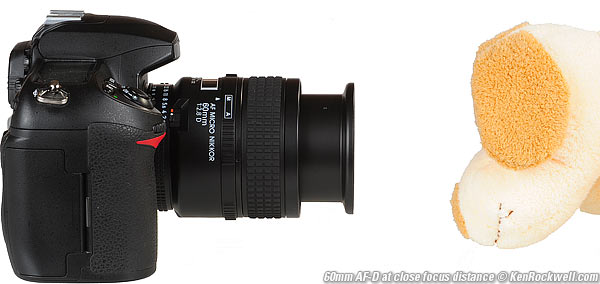
Nikon 60mm AF-D at closest focus distance. Good luck lighting your subject!
I measure only 2-7/8" (73mm) between the front of the lens and the subject at the closest focus distance (1:1).
This is why I don't suggest 60mm micro lenses: you will get in the way of your lighting, making this lens mostly useless at 1:1 except for copying slides.
A 105mm gives you enough room to work and not block your light.
Think this is tight? The newest 60mm f/2.8 AF-S gives an inch (25mm) less working room!
Recommendations top
Intro Specifications Performance Recommendations
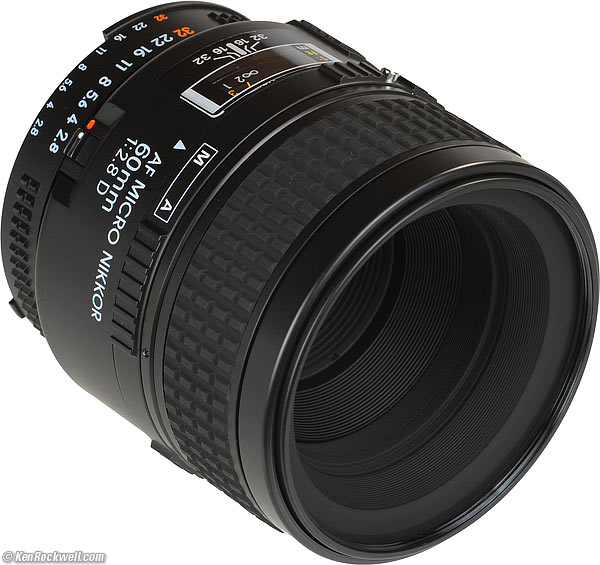
Nikon 60mm f/2.8 AF-D.
I'd use this lens as a general-purpose lens, but not if my main interest is macro. Actually, for less money, the lens I really do use as a general purpose lens is my 50mm f/1.4 AF-D.
If you really want to shoot close-ups, you'll find that you probably have to get so close that it's difficult to stay out of your own lighting, and if your subjects are critters, that you'll bug them.
Most people shooting macro prefer longer focal lengths because it lets us get further away. For macro, being two feet (0.6m) away is much handier than being 2 inches (5cm) away.
For macro, the 105mm is the favorite. The 200mm macro lenses are great, but very expensive and usually only used by people shooting insects and venomous snakes.
More Information
Help me help you top
I support my growing family through this website, as crazy as it might seem.
The biggest help is when you use any of these links when you get anything, regardless of the country in which you live. It costs you nothing, and is this site's, and thus my family's, biggest source of support. These places have the best prices and service, which is why I've used them since before this website existed. I recommend them all personally.
If you find this page as helpful as a book you might have had to buy or a workshop you may have had to take, feel free to help me continue helping everyone.
If you've gotten your gear through one of my links or helped otherwise, you're family. It's great people like you who allow me to keep adding to this site full-time. Thanks!
If you haven't helped yet, please do, and consider helping me with a gift of $5.00.
As this page is copyrighted and formally registered, it is unlawful to make copies, especially in the form of printouts for personal use. If you wish to make a printout for personal use, you are granted one-time permission only if you PayPal me $5.00 per printout or part thereof. Thank you!
Thanks for reading!
Mr. & Mrs. Ken Rockwell, Ryan and Katie.
Home Donate New Search Gallery Reviews How-To Books Links Workshops About Contact