Home Donate Search Gallery Reviews How-To Books Links Workshops About Contact
Nikon 55mm f/3.5
Micro-NIKKOR (1969-1979)
© KenRockwell.com. All rights reserved.
How to Shoot Macro Best Macro Lenses Compared
Intro Specifications Performance Usage Recommendations

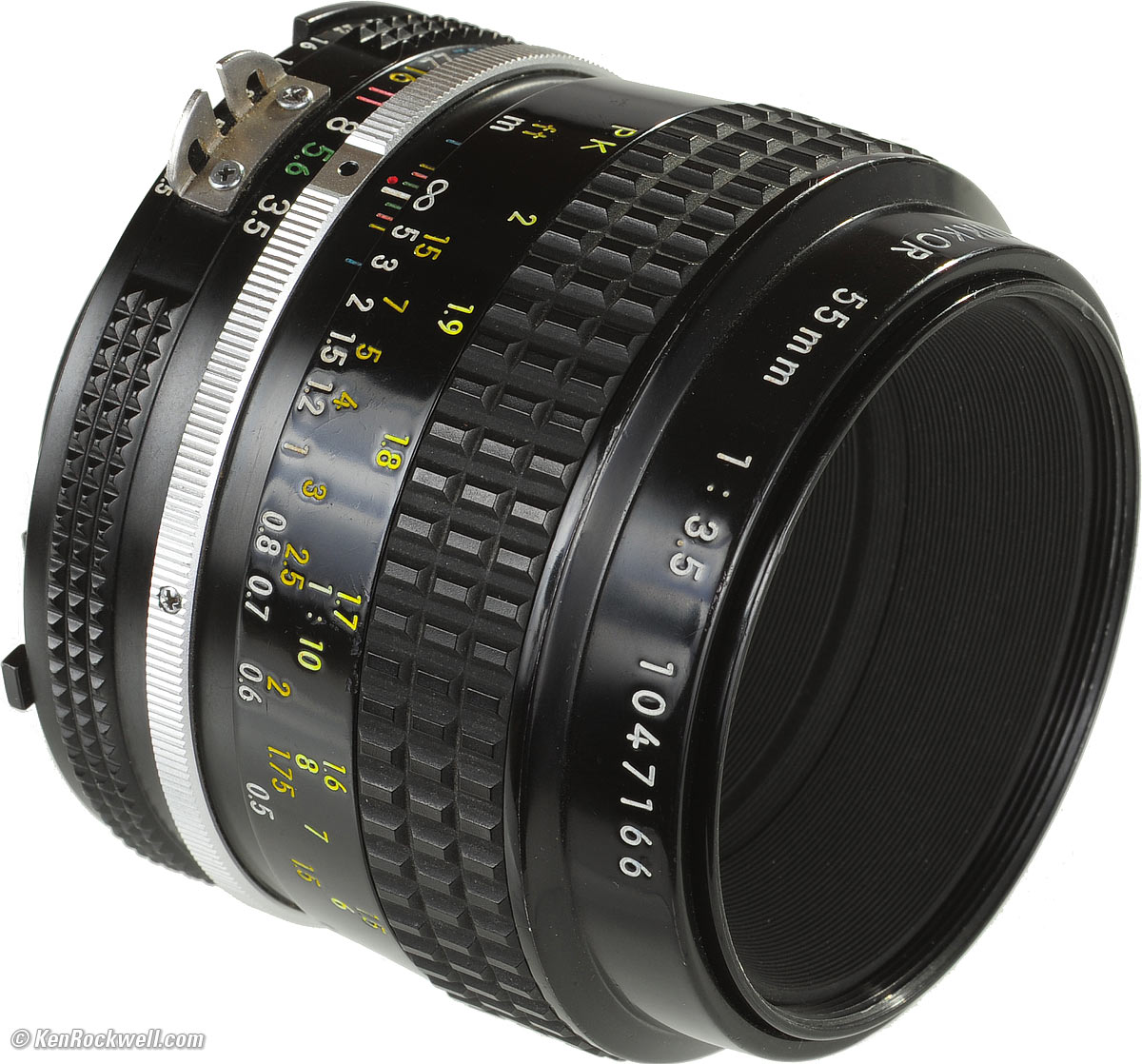
Nikon 55mm f/3.5 AI (FX, DX and 35mm coverage, 52mm flters, 8.5 oz./241g, about $50 used). enlarge. I got this one at this direct link to it at eBay (see How to Win at eBay). The current models you can get new are the 55mm f/2.8 AI-s, 60mm AF-D and 60mm AF-S. It helps me keep adding this site when you get anything from those or these links, regardless of the country in which you live. Thanks! Ken.
June 2015 Nikon Reviews Nikon Lenses All Reviews
Why fixed lenses take better pictures.
Ideal Uses: Super-sharp normal lens for manual-focus and FX cameras in good light. Photography of fish in tanks. Nikon's least expensive used macro lens; and it will work on even the cheapest cameras like the D40 but you will have to guess at exposure.
Not for: For serious macro use, 105mm or 200mm lenses are much better ideas because they give you enough room between you and your subject. As a manual focus lens, I wouldn't use this for sports, kids or action since it's too hard to track focus by hand.
| Optics: |  |
| Ergonomics: |  (manual focus) (manual focus) |
| Usefulness: | |
| Availability: | |
| Overall: | |
Sample Images top
Sample Images Intro Specifications
Performance Usage Recommendations

Quaint Home in Barstow in First Light, 7:01 AM.Nikon D810, Nikon Micro-NIKKOR 55mm f/3.5 AI, f/5.6 at 1/125 hand-held at ISO 100. bigger or Camera-original © JPG file. Not too shabby!

Last Light on Peeling Paint, Dunes Motel, West Barstow, 5:07 PM, 06 February 2015. Nikon D810, Nikon Micro-NIKKOR 55mm f/3.5 AI, f/8 at 1/60 at Auto ISO 450. bigger.

Close-up of Colorful Old Gas Pump, 9:31 PM, 06 February 2015.Nikon D810, Nikon Micro-NIKKOR 55mm f/3.5 AI, f/16 at 30 seconds at ISO 100. bigger.

Burning Fires of Hell 666 Heater, 9:35 PM, 06 February 2015.Nikon D810, Nikon Micro-NIKKOR 55mm f/3.5 AI, f/8 at 30 seconds at ISO 100. bigger.
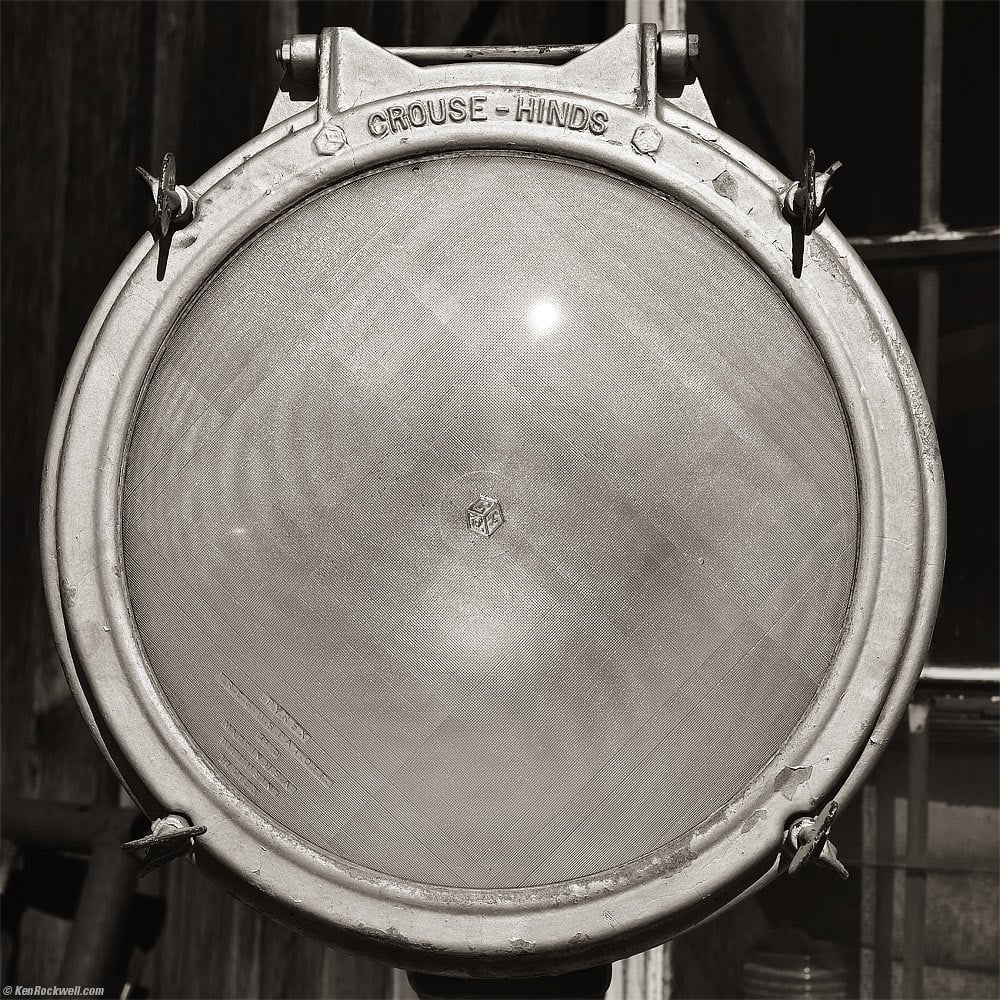
Crouse-Hinds Light, Daggett, 10:18 AM.Nikon D810, Nikon Micro-NIKKOR 55mm f/3.5 AI, f/8 at 1/1,000 at Auto ISO 100, split-toned print. bigger.

Colorful Graffiti on Cinder-Block Wall with Hole, 3:31 PM.Nikon D810, Nikon Micro-NIKKOR 55mm f/3.5 AI, f/8 at 1/250 at Auto ISO 100. bigger or Full Resolution.

Retired Orange Santa Fe Railroad Car in Last Light, 4:45 PM. Nikon D810, Nikon Micro-NIKKOR 55mm f/3.5 AI, f/8 at 1/250 at Auto ISO 100. bigger or Camera-original © 36MP JPG file.

Chloride River in B&W, 4:52 PM. Nikon D810, Nikon Micro-NIKKOR 55mm f/3.5 AI, f/8 at 1/60 at Auto ISO 100. bigger.
Introduction top
Sample Images Intro Specifications
Performance Usage Recommendations
Compatibility History Production Pricing
Nikon uses the word "Micro" to mean the same thing as "macro." I'll use these words interchangeably.
The Nikon Micro-NIKKOR 55mm f/3.5 is an excellent manual-focus lens. It works perfectly on every manual-focus Nikon camera, and also works great on all better digital Nikons, especially the D3X, D700 and other FX cameras. It won't meter with the cheaper DX digital or AF cameras like the D90; for these cameras, guess and use the LCD, or use the Gossen Digisix meter and hot-shoe adapter.
For manual focus cameras, the newer f/2.8 AI-s version is still made today, and used f/2.8 versions cost very little more. This f/3.5 is a great lens, but if I had my choice, I'd get the f/2.8. I only bought this one to archive here; I already have two f/2.8 AI-s 55mm lenses I bought new over the years.
For AF and digital cameras, I'd suggest getting the newest 60mm AFD instead. For the D40, you'll want the 60mm AF-S to have autofocus.
Even for manual focus cameras today, I'd suggest getting the 60mm AFD since it also will work perfectly on your AF cameras.
The optics of all of these lenses are superlative; it's the mechanics and ease of use with AF and digital cameras which varies.
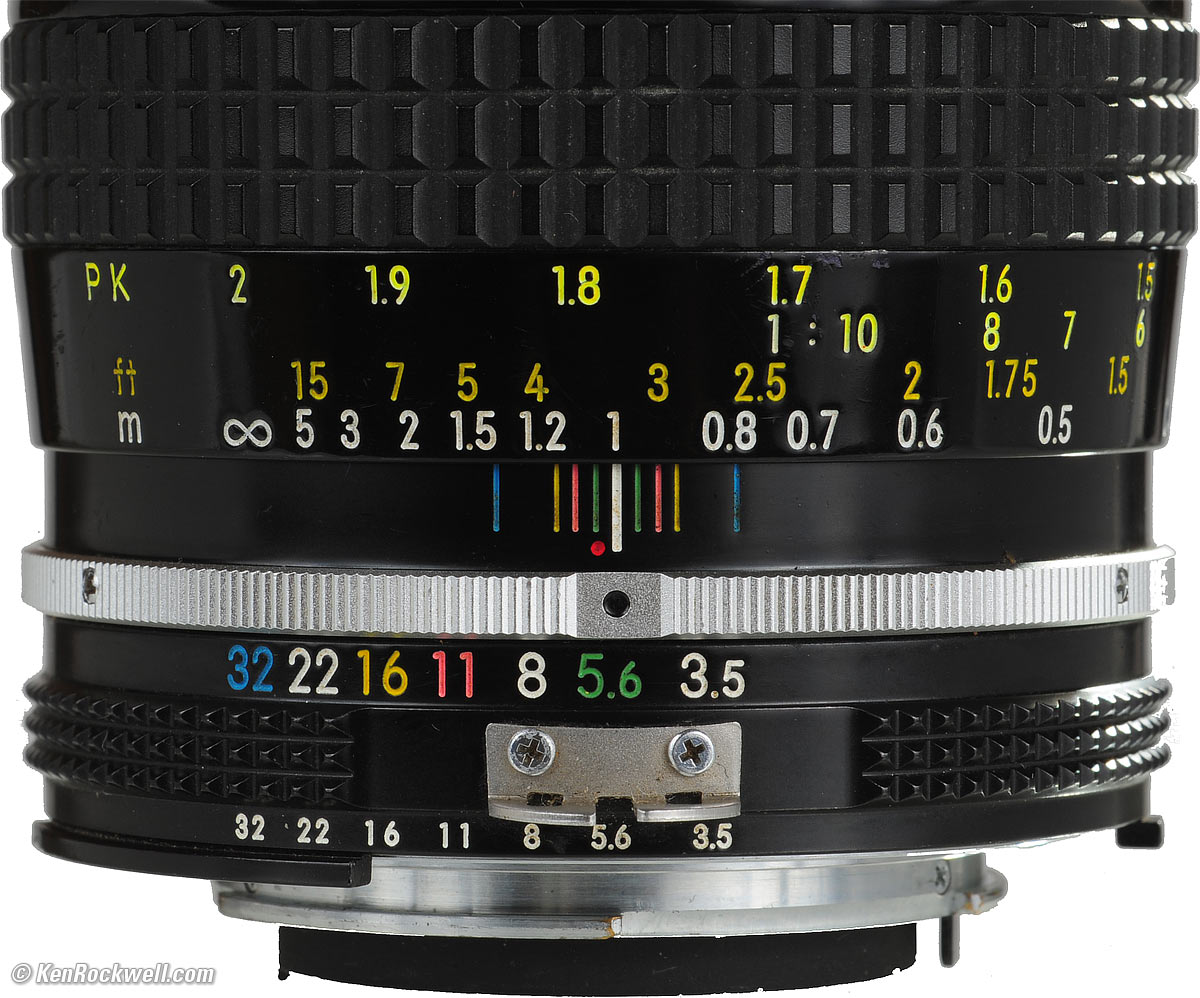
Focus Scale, Nikon 55/3.5. enlarge.
Compatibility back to intro back to top
The manual-focus 55mm f/3.5 AI works great with most Nikon cameras, film and digital.
It works flawlessly with every manual focus Nikon ever made, from the F of 1959 through the FM3a and today's FM-10.
On the D3X, D3, D700, D300, D200, D2 and F6, use the "Non-CPU Lens Data" menu option to set 55mm and f/3.5 to get full matrix metering, EXIF data and finder read-out of set aperture. It works great in aperture-preferred as well as manual modes on these cameras.
It works perfectly on every professional film camera (F, F2, F3, F4, F5, F6), and adds Matrix metering on the FA, F4 and F6.
The meters of cheaper digital (D80 and below) and cheaper film cameras (N80 and below) will not couple (or work at all) with this lens, so you'll be on your own guessing exposure using the rear LCD or an external meter, or get a tiny Gossen Digisix meter and hot shoe adapter to meter manually.
See Nikon Lens Compatibility for details on your camera. Read down the "AI, AI-s" column for this lens.
The earliest non-AI versions should be upgraded to AI, otherwise, they are compatible with much fewer cameras. If you have a non-AI lens, see Nikon Lens Compatibility and read down the "pre-AI" column.
History back to intro back to top
Nikon made this same optical design starting in 1961, and changed the cosmetics, mechanics and coatings as time progressed.
The version shown above is the newest AI version made from about 1975 - 1979.
1956-1961
Nikon first made the 55mm f/3.5 Micro for its rangefinder cameras.
God only knows how you focused or composed without through-the-lens viewing.
Nikon didn't make a lot of these; LEICA was the market leader in those days.
1961-1969
Nikon put the same optics from the rangefinder lens in an F (SLR) mount mount for its new Nikon F 35mm SLR.
THey made at least two different cosmetic versions of this SLR lens.
Nikon made about 100,000 of these early verisons.
1969-1979
Nikon changed the optics slighty to the version reviewed here. Nikon made several different cosmetic versions, both AI and non-AI with the same optics, both single and multi-coated.
THese versions are best iditfied by serial number, or more casually, by a rubber (not fluted aluminum) focus grip.
Nikon made about 500,000 of these later verisons; about 275,000 AI and 165,000 non-AI.
1979 - today
Nikon introduced the improved 55mm f/2.8 AI-s Micro-Nikkor which replaced this f/3.5 version.
This current f/2.8 version adds CRC, close-range-correction, for optimum performance at every distance.
Nikon has made about 600,000 of these — so far.
1986-1989
55mm f/2.8 AF, Nikon's first AF micro, used the same optics as the AI-s verison.
Nikon only made about 50,000 of these.
1989-1993
A completely new design, the 60mm f/2.8 AF comes out to replace the 55mm f/2.8 AF.
Nikon made about 150,000 of these non-D AF versions.
1993-today
60mm f/2.8 AF-D, which is the same as the previous 60mm f/2.8 AF but adds the minor D feature.
Nikon made about 300,000 of the AF-D versions, or about 450,000 total 60mm f/2.8 AF — so far.
2008-today
The newest version is the 60mm AF-S Micro, which replaces the 60mm AF-D Micro. The AF-S micro will not work on cameras older than about 1993, while all these other lenses are perfectly compatible with them.
See also Roland Vink's authoritative tables for details and serial numbers.
Pricing back to intro back to top
Price, new* |
Corrected for inflation, 2008 |
|
1966 |
$129.50 |
$865 |
1977 |
$186.95 |
$670 |
2008 |
— |
$65 used |
2011 |
— |
|
2015 |
— |
* At full NYC discount. Very few people bought their lenses this inexpensively back then.
Specifications top
Sample Images Intro Specifications
Performance Usage Recommendations
Name
Nikon calls this the Nikon Micro-NIKKOR AI 55mm f/3.5.
Optics
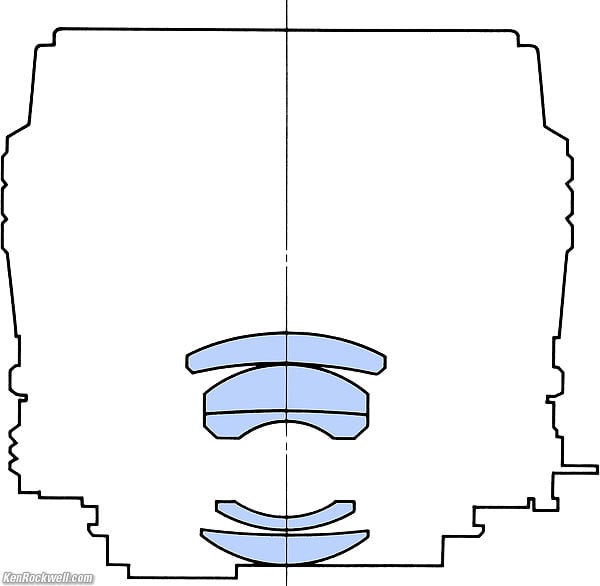
55mm f/3.5 schematic diagram.
5 elements in 4 groups.
Conventional spherical design, no floating elements.
Newer ones are multicoated.
Optimum Reproduction Ratio
1:10, which is at 2.4 feet or 0.7 meters.
Close Focus
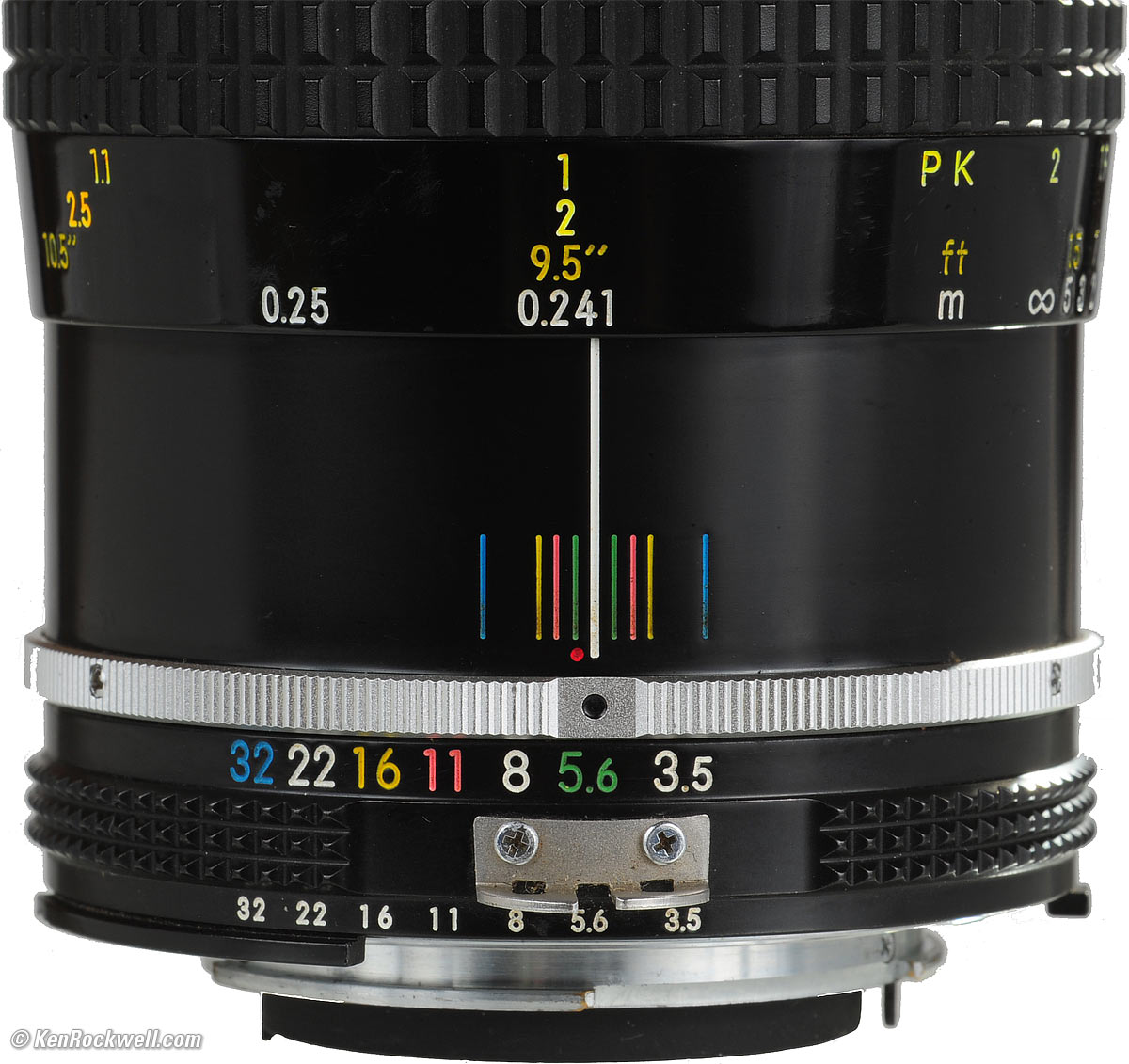
Focus Scale, Nikon 55/3.5. enlarge.
From the image plane (front of lens wil be much closer):
0.79 feet.
9.5 inches.
0.241 meters.
Maximum Reproduction Ratio
1:2. You get between 1:2 and 1:1 with either the PK-3 or PK-13 ring.
Diaphragm
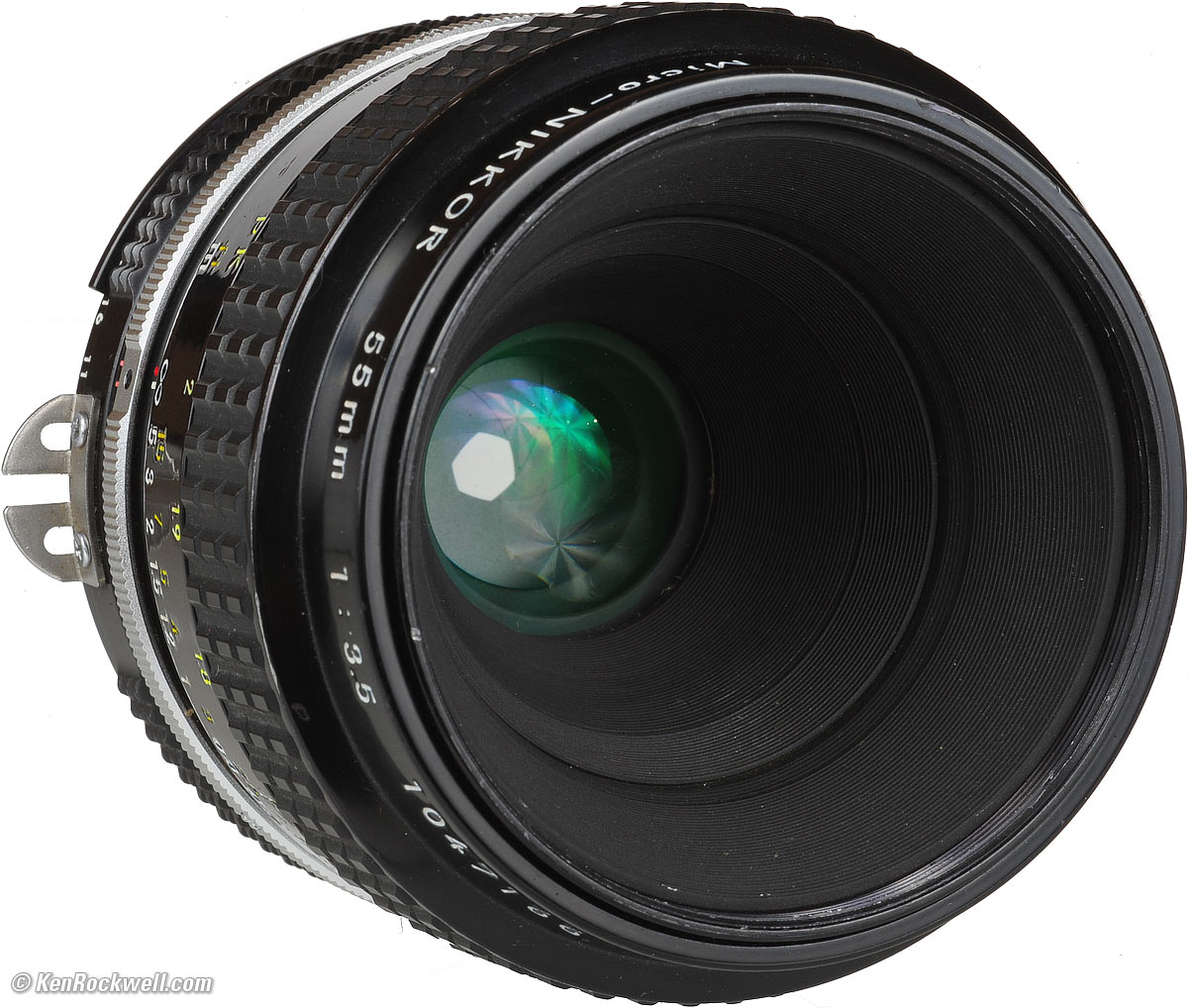
Front view, Nikon 55mm f/3.5 AI. enlarge.
6 straight blades.
Stops down to f/32.
Aperture Ring
Yes, full-stop clicks.
Hard Infinity Focus Stop?
Yes.
This is great for astronomy; just turn to the stop and you have fixed laboratory-perfect focus all night.
Focus Scale
Yes.
Depth-of-Field Scale
Yes.
Infra-Red Focus Index
Yes: red dot near depth-of-field scale.
Filter Thread
52mm, metal.
Does not rotate.
Size
Nikon specifies 2.1" (53.5mm) extension from flange (2.54" or 64.5mm overall) by 2.6" (66mm) diameter.
Weight
8.495 oz. (240.8g), measured (AI version).
Nikon specifies 8.64 oz. (245g).
Hood
None needed; the front elements are already deeply recessed.
If you insist, Nikon specifies the common HN-3 hood.
Case
Optional CL-31 case.
With the PK-3 or PK-13 ring, use the CL-33A case.
Use the #54 pouch, or #55 with a PK ring.
You also can use the CP-1 plastic bubble, or CP-2 with a PK ring.
Made in
Japan.
Teleconverters
TC-200/201 and TC-14A.
Performance top
Sample Images Intro Specifications
Performance Usage Recommendations
Overall Focus Distortion Falloff Color Fringes Mechanics Sharpness
Overall back to Performance back to top
The 55mm f/3.5 is a great lens. It just works, and always delivers sharp images.
Focus back to Performance back to top
Manual focus is easy.
Focus is as smooth as silk, perfectly damped with no play.
The D3, D700, F4, F6 and most professional AF cameras have three very precise electronic manual focus indicators.
Lesser digital cameras, like the D300 and down, usually have just one "OK" focus dot, which is not as precise as two arrows and a dot.
Distortion back to performance back to top
The Nikon 55mm f/3.5 has no visible distortion.
For scientific use, plug 0.20 into Photoshop CS2's lens distortion filter for shots made at infinity on film or FX.
Falloff (darkened corners) back to performance back to top
Falloff on FX is negligible.
It won't be an issue at all on DX (see crop factor).
I've exaggerated this by shooting a gray field and placing these on a gray background.
Nikon 55mm f/3.5 AI-s falloff on FX and film. At infinity:
At 1:10:
At 1:2:
© 2008 KenRockwell.com. All rights reserved.
|















Lateral Color Fringes back to Performance back to top
There are no visible lateral color fringes on the D3, which would correct them if the lens had any.
Mechanics back to Performance back to top

Rear, Nikon 55 3.5 AI. enlarge.
Like all Nikkor manual focus AI lenses, the Nikon 55/3.5 is built to the highest mechanical standards of any lens ever made.
Barrel Exterior
Anodized and enameled aluminum.
Filter Threads
Anodized aluminum.
Focus Ring
Metal, rubber covered.
Focus Helicoids
Feels like brass: smooth and silky with no play or need for damping grease.
Depth-of-Field Scale
Engraved into barrel and filled with different colors of paint.
Internals
Metal.
Aperture Ring
Cast aluminum, anodized and enameled.
Engraved markings filled with different colors of paint coded to the depth-of-field scale.
Mount
Dull-chromed brass.
Markings
Engraved and filled with paint.
Identity and Serial Number
On the outside of the focus ring, engraved into the metal and filled with paint.
Rain seal at mount
No.
Noises When Shaken
Mild clicking from the diaphragm blades and actuation system.
Made in
Japan.
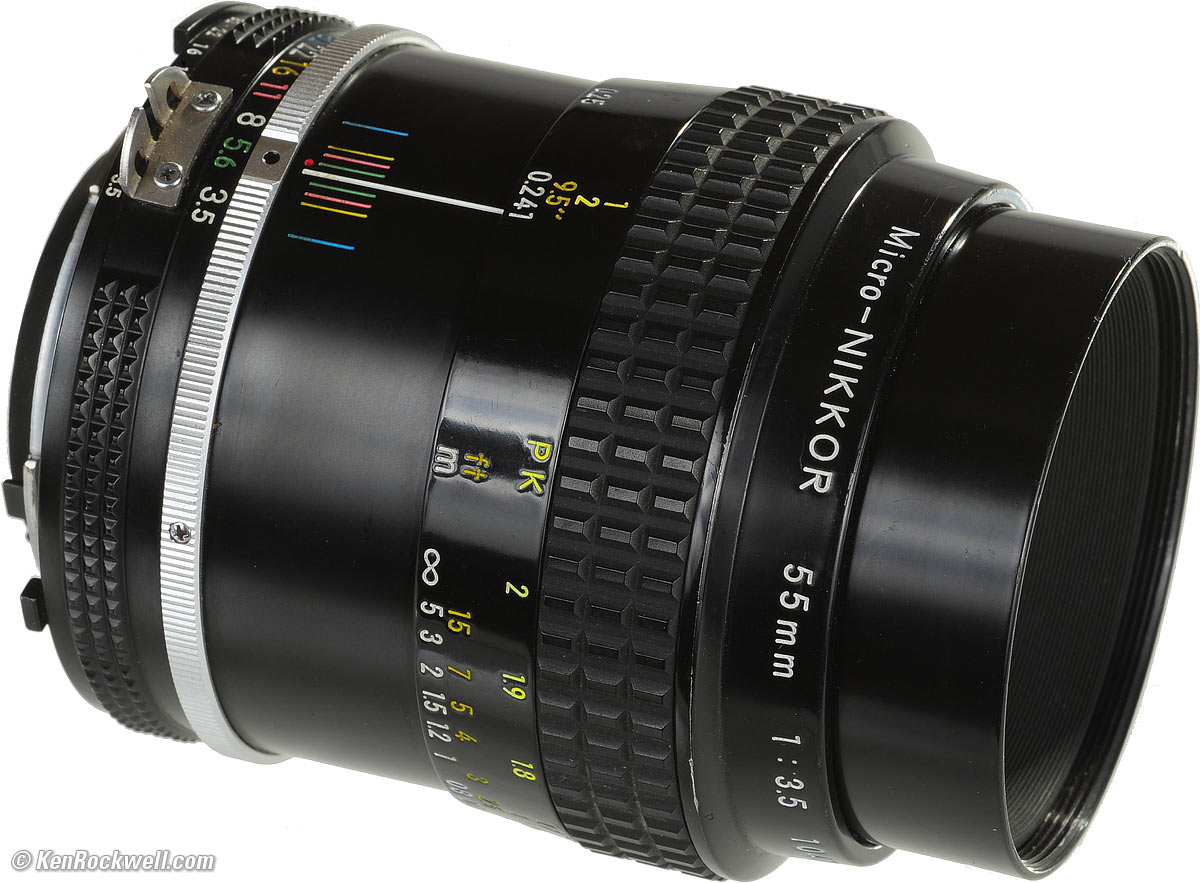
Nikon 55mm f/3.5 at close focus (1:2). enlarge.
Sharpness back to Performance back to top
Warning 1: Image sharpness depends more on you than your lens.
Warning 2: Lens sharpness doesn't mean much to good photographers.
With those caveats, the 55mm f/3.5 Micro-NIKKOR is super-sharp. It makes newer zooms like the awful 24-120mm VR look as bad as they are.
At infinity on a D3:
At f/3.5 and f/4
The center is super-sharp. The corners are sharp, but with a little less contrast.
At f/5.6
Everything is super-sharp side to side.
At f/8
Everything is super-sharp, and even the farthest corners are perfect. f/8 is optimum.
At f/11
As good as f/8.
At f/16
Diffraction limits performance.
At f/22
Diffraction limits performance.
At f/32
Diffraction limits performance.
Usage back to top
Sample Images Intro Specifications
Performance Usage Recommendations
It's easy, just focus and shoot.
If you need to get closer than 9-1/2," use the PK-13 extension tube to get to 1:1 (life-size at the sensor or film).
Exposure Compensation for external light meters
Focus scale at close focus, Nikon 55/3.5. enlarge.
When focused closer, the lens extends away from the film or sensor. Since the mechanical diaphragm doesn't open to compensate, less light makes it to the film or sensor.
All modern Nikon cameras have their light meters built-in, so they automatically correct and use a slightly longer exposure time.
If you're using a hand-held meter (or non-TTL flash), here is the additional exposure needed as you get closer.
If you do this often, it's much handier to write these factors on a piece of removable white label attached to the focus ring. This way you can read the factor right off the lens as you focus. I simply put dots to mark how many third-stops are needed at the right spots on the front of the focus ring.
Repro Ratio |
Exposure Factor |
Stops |
∞ |
1 |
0 |
1:10 |
1.2 |
0.3 |
1:8 |
1.3 |
0.3 |
1:6 |
1.4 |
0.4 |
1:4 |
1.6 |
0.6 |
1:2 |
2.3 |
1.2 |
1:1.8 |
2.4 |
1.3 |
1:1.6 |
2.6 |
1.4 |
1:1.4 |
2.9 |
1.6 |
1:1.2 |
3.4 |
1.7 |
1:1 |
4.0 |
2 |
R = Reproduction Ratio.
Exposure Factor = (1 + R)2
Stops Compensation: Log2 (Exposure Factor)
Recommendations back to top
Sample Images Intro Specifications
Performance Usage Recommendations
The f/2.8 manual-focus 55mm lens is a tiny bit sharper in the corners wide-open at infinity, as are the other f/2.8 55mm and 60mm lenses. Then again, for $65 used, you can't do much better at any price for a lens better than this f/3.5. Stopped down to f/5.6 or f/8, nothing is sharper. Even at f/3.5, the resolving power in the center far exceeds the D3X; just peer through a Lens Scope Converter and you'll see far more detail than you will in a D3X file.
I prefer a 105mm lens or longer for my macro work to allow enough distance for my lighting, or to put little bugs at ease. Friends use this focal length for photographing fish in aquarium tanks. The short focal length allows one to get close to the glass and still be able to see a complete fish, unlike a 105mm.
If you want a macro for duplicating documents then this is a good choice. If you want to photograph little animals, then go instead for a 105mm macro.
The 55mm Micro works great in place of a faster normal lens. When I was younger and stupider I thought that it would not be very good when used at ordinary distances. Whoops, it's spectacular at all distances. Unless you need the extra stop or two offered by the other 50mm normal lenses, you can forget about needing a separate normal 50mm lens if you have this.
Help me help you top
I support my growing family through this website, as crazy as it might seem.
The biggest help is when you use any of these links when you get anything, regardless of the country in which you live. It costs you nothing, and is this site's, and thus my family's, biggest source of support. These places have the best prices and service, which is why I've used them since before this website existed. I recommend them all personally.
If you find this page as helpful as a book you might have had to buy or a workshop you may have had to take, feel free to help me continue helping everyone.
If you've gotten your gear through one of my links or helped otherwise, you're family. It's great people like you who allow me to keep adding to this site full-time. Thanks!
If you haven't helped yet, please do, and consider helping me with a gift of $5.00.
As this page is copyrighted and formally registered, it is unlawful to make copies, especially in the form of printouts for personal use. If you wish to make a printout for personal use, you are granted one-time permission only if you PayPal me $5.00 per printout or part thereof. Thank you!
Thanks for reading!
Mr. & Mrs. Ken Rockwell, Ryan and Katie.
Home Donate New Search Gallery Reviews How-To Books Links Workshops About Contact