Home Donate New Search Gallery Reviews How-To Books Links Workshops About Contact
Nikon
50mm f/1.8
AF (1986-2001)
©
2011-2013 KenRockwell.com. All rights reserved.

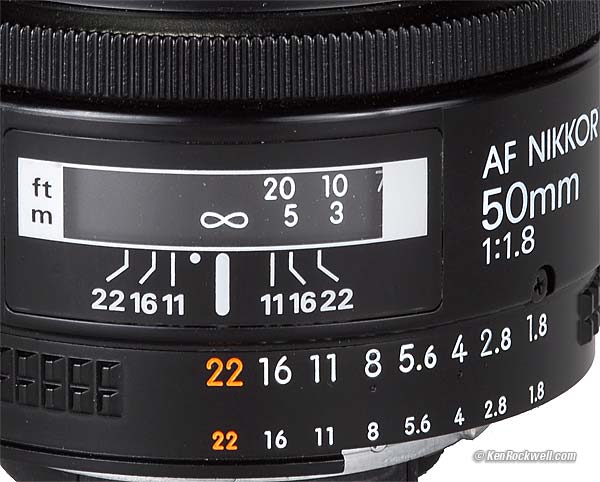
Nikon Nikkor 50mm f/1.8 AF, first version from 1986 (52mm filters, 5 oz. /155g, about $75 used). The biggest source of support for this free website is when you use these links, especially this direct link to this lens at eBay (see How to Win at eBay), when you get anything, regardless of the country in which you live. Thank you! Ken.
May 2013 Nikon Reviews Nikon Lens Reviews Other Reviews
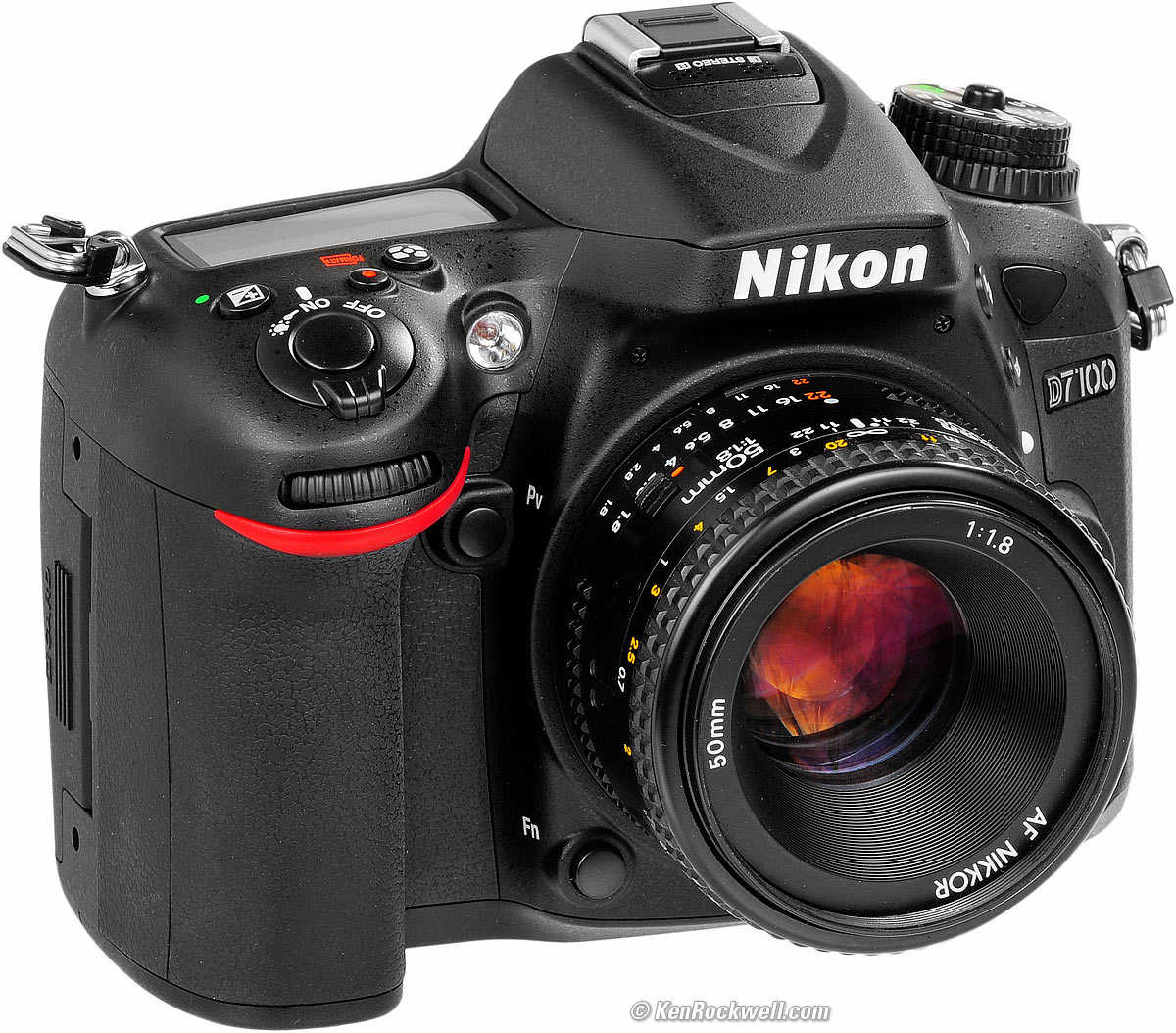
Nikon D7100 with 50mm f/1.8 AF, later type. enlarge.
See also
Nikon 50mm f/1.8 G AF-S (newest version, 2011-)
Nikon 50mm f/1.8 AF-D (newer version, 2002-)
Nikon 50mm f/1.4 G AF-S (newest f/1.4 version, 2008-)
Nikon 50mm f/1.4 AF-D (f/1.4 version, 1986-)
Introduction

Adorama pays top dollar for your used gear.
I use these stores. I can't vouch for ads below.
|

This Nikkor 50mm f/1.8 was among Nikon first AF lenses of 1986. It was replaced by the very similar AF 50mm f/1.8D in 2002, which is almost identical.
This was Nikon's least expensive lens selling new at about $90, and was also probably one of the best. It was made in China when it was discontinued in 2002. Its optics are unsurpassed; today's Nikon 50mm f/1.8 G AF-S might be a tiny bit sharper, but has far more distortion and costs three times as much.
It is unchanged since 1990. It is not a "D" lens, which is an almost meaningless feature anyway. In fact, the lack of this pointless feature means a great low price for you if you find a used one.
The very first version introduced in 1986 had the nasty hard focus ring seen in these pictures, and a plastic window through which the focusing scale was displayed.
Filter threads are just plastic, which is fine for an inexpensive lens like this.
This lens has the same build quality as the farmore Nikon 50mm f/1.4 AF-D, and this f/1.8 has much less distortion!
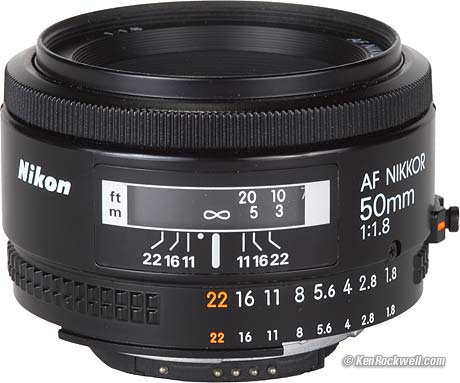
Nikon 50mm f/1.8 AF.
This is an FX lens, and works especially well with on FX, 35mm and DX Nikons like the D7000, D700, D3X, D300s and F6. It works fantastically on manual-focus cameras like the F2AS, F3, FE and FA, since it has real manual-focus and aperture rings that work exactly as they should.
The 50/1.8 AF works great with almost every film and digital Nikon camera made since 1977. If you have a coupling prong added to the diaphragm ring, it's perfect with every Nikon back to the original Nikon F of 1959.
The only incompatibility is that it will not autofocus with the cheapest D40, D40x, D60, D3000, D3100, D5000 or D5100, but if you focus manually, everything else works great. These cameras have in-finder focus confirmation dots to help you.
See Nikon Lens Compatibility for details on your camera. Read down the "AF, AF-D (screw)" column for this lens.
Specifications
This lens has six elements in five groups.
It focuses down to 0.45 meters or 1.5 feet.
It takes 52mm filters and the HR-2 hood.
It weighs only 5 oz. or 155g.
It's 2.6" (65mm) around by 1.7" (43mm) long.
It has a seven-bladed diaphragm and stops down to f/22.
Performance
AF action is really fast on an F100. One full turn of the AF screw focuses the lens from infinity to 6.'
Although it appears multicoated and has a very simple design it has more ghosting than most other Nikkor lenses. Watch it if you have the sun in your image.
The autofocus seems completely accurate on an F100, so shoot away at f/1.8 all you want.
Here's the performance by aperture:
f/1.8: some light
falloff. Some coma in the corners and a little less contrast all around
seemingly due to spherical aberration
f/2.8: almost no falloff and the coma seems to be gone. Sharp all over
f/4: no falloff. Very sharp all over
f/5.6: great, same as at f/4
Bokeh is fairly nice. It's better than a $10,000 400mm f/2.8 AF-I.
Even without the stupid "D" feature fill flash and metering work flawlessly on an F100. The "D" feature only is for people who insist on making flash photos directly into mirrors. Otherwise the "D" means nothing.
Recommendations
Buy one if you find a deal on a used one for less than $75, otherwise, get a 50mm f/1.8 D brand-new for $140.
I keep a 52mm Nikon NC filter and Nikon HR-2 rubber hood on it for protection.
If you're a pro, splurge for the 50mm f/1.4 if you shoot in available light without flash.
In spite of its Chinese manufacture it's better made than any discount lenses you might be considering at this price. This lens is the best bargain there is on a great lens.
In case you are new to photography, let me emphasize that this $90 lens is as sharp and over twice as sensitive to dim light as the $1,800 24-70mm AF-S lens. The reason to spend sixteen times as much is for no other reason than to get a lens that can zoom instead of you having to move forward and back to compose your image.
If you need super sharpness and a fast aperture than choose this over a zoom at the same price. This lens makes almost no compromises in image quality; it is inexpensive because it is both a very simple lens to make and few people want them today. A $90 zoom lens has to cut many corners in image quality that this 50mm doesn't.
In spite of my bellyaching I have found that as the decades pass that gear is more and more cheaply made, and it continues to work better and better.
Help me help you top
I support my growing family through this website, as crazy as it might seem.
The biggest help is when you use any of these links when you get anything, regardless of the country in which you live. It costs you nothing, and is this site's, and thus my family's, biggest source of support. These places have the best prices and service, which is why I've used them since before this website existed. I recommend them all personally.
If you find this page as helpful as a book you might have had to buy or a workshop you may have had to take, feel free to help me continue helping everyone.
If you've gotten your gear through one of my links or helped otherwise, you're family. It's great people like you who allow me to keep adding to this site full-time. Thanks!
If you haven't helped yet, please do, and consider helping me with a gift of $5.00.
As this page is copyrighted and formally registered, it is unlawful to make copies, especially in the form of printouts for personal use. If you wish to make a printout for personal use, you are granted one-time permission only if you PayPal me $5.00 per printout or part thereof. Thank you!
Thanks for reading!
Mr. & Mrs. Ken Rockwell, Ryan and Katie.
Home Donate New Search Gallery Reviews How-To Books Links Workshops About Contact