Home Donate New Search Gallery Reviews How-To Books Links Workshops About Contact
Nikon
16mm f/2.8
Fisheye-NIKKOR AF-D (1993-)
© 2013 KenRockwell.com. All rights reserved.
Intro Specs Math Performance Recommendations

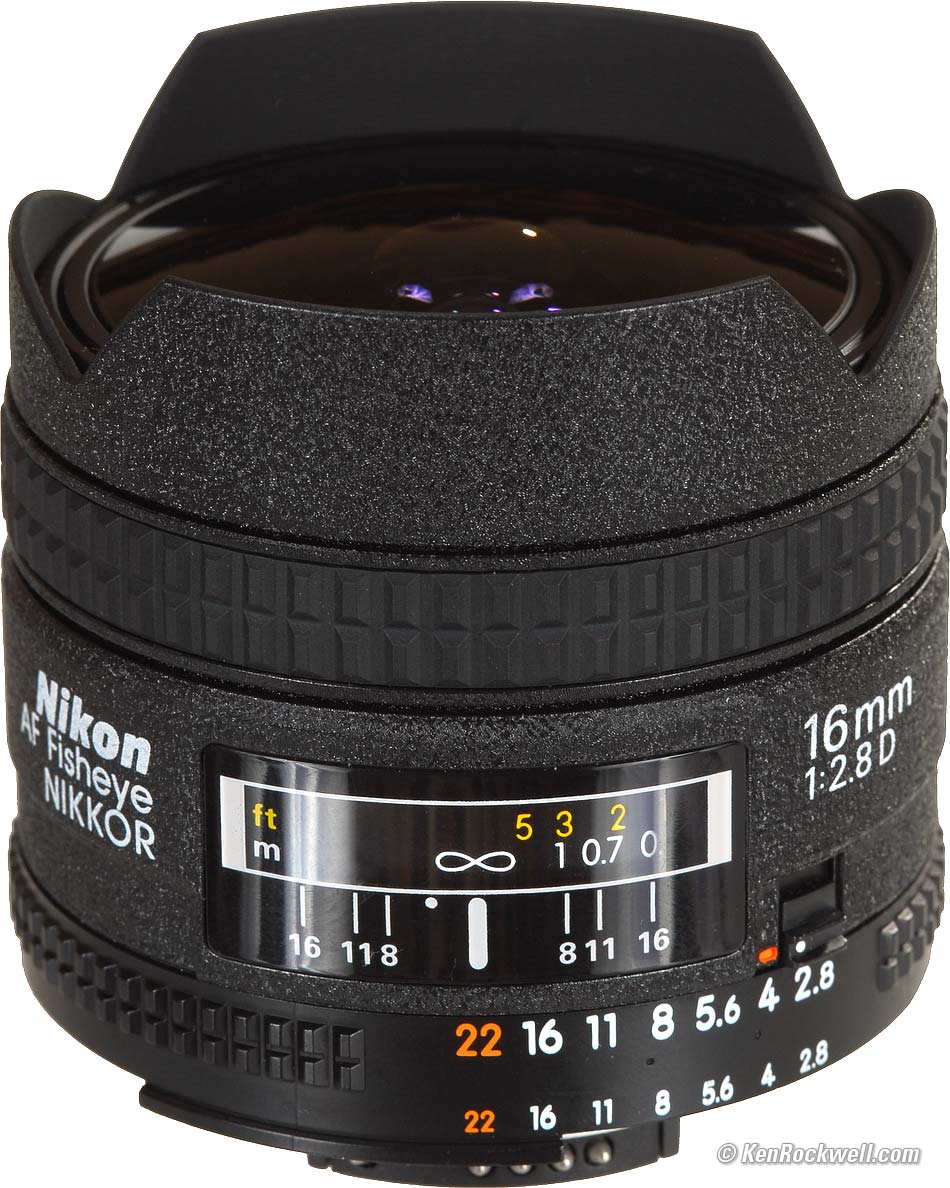
Nikon 16mm f/2.8 AF-D (FX and 35mm coverage (don't use on DX), rear bayonet filters, 10.3 oz./293g, 0.85'/0.25 m close focus, about $900 new or $600 used at eBay; see How to Win at eBay). enlarge. I got this one at Adorama. I'd also get it at Amazon. This free website's biggest source of support is when you use those or any of these links when you get anything, regardless of the country in which you live — but I receive nothing for my efforts if you buy elsewhere. I'm not NPR; I get no government hand-outs and run no pledge drives to support my research, so please always use any of these links for the best prices and service whenever you get anything. Thanks for helping me help you! Ken.
August 2013 Nikon Reviews Nikon Lenses All Reviews
Older Model: 16mm f/2.8 AI-s (1979-1998)
Oldest model: 16mm f/3.5 (1973-1979)
Introduction top
Intro Specs Math Performance Recommendations

Adorama pays top dollar for your used gear.
|

Thi sis Nikon's full-frame fisheye for use on FX and 35mm cameras. It is not a fisheye on DX, just a distorted wide lens. On DX, use onbly the 10.5mm DX fisheye.
This fisheye lens fills the entire frame with a useful image, unlike the foolish circular fisheyes of the 1960s.
It is ideal for use on the Nikon D3, as well as every film camera, auto and manual focus.
The Nikon 16mm fisheye offers all the convenience of through-the-lens viewing and metering, just like every other popular lens. It's as small as a regular lens, and smaller than zooms.
This is a fun lens for film and FX digital cameras. Used with software like DxO and Fisheye-Hemi it becomes much more useful because you can stretch the curved images back into something less silly. Fisheye Hemi also works with film scans. Be careful about DxO, since there is no module yet for the D3.
For DX cameras, get the 10.5mm DX instead.
Due to the Full Frame Advantage, this 16mm on a D3 should have better performance than the 10.5mm on a DX camera, or in the DX mode of the D3. I show examples in my 16mm Zenitar Fisheye Review of how the crappy Zenitar 16mm ($175 new) completely outperforms the Nikon 10.5mm DX on a DX camera as I stop them both down. This real Nikon 16mm ought to be much better; I'll let you know.
Specifications top
Intro Specs Math Performance Recommendations
Name
Nikon calls this the Nikon AF Fisheye Nikkor 16mm f/2.8 D.
Autofocus
Traditional screw type.
Focal Length
16mm.
It gives a highly distorted 180 degree angle of view from corner to corner on film or an FX camera.
On a DX camera it gives a less crazy 107 degree angle of view. See also Crop Factor.
Optics
8 elements in 5 groups.
It has close range correction, (CRC), unlike the manual focus lens. The front group moves out and rotates to focus more closely, while the rear group moves forward but does not rotate. The earlier 16mm f/2.8 AI-s had the same number of elements. but is a completely different design without CRC.
Diaphragm
7 conventional blades stopping down to f/22.
Filters
Dedicated rear bayonet.
Four filters included.
One must always be mounted.
Close Focus
0.85' or 0.25m.
Maximum Reproduction Ratio
1:10.
Infra-Red focus index
Yes!
That's the dot at f/4 on the depth-of-field scale.
Size
Mine measures 2.482" around by 2.262" extension from flange (63.05 x 57.45mm).
The front hood-like section of mine measures 2.402" (61.02mm) around; the lens body is slightly thicker than the front.
Nikon specifies 2.5" around (63.5mm) by 2.2" (56mm) long.
Weight
Mine measures 10.320 oz. (292.6g.), with no caps but with a mandatory rear filter.
Nikon species 10 oz. (285g) or 10.2 oz (290g), depending on where you read it.
Hood
None.
The built-in little petals are mostly for protecting the front element.
Case
CL-31s, optional and extra-cost.
Introduced
November 1993 as a D lens. There never was a non-D version. It's still made today.
Nikon Product Number: 1910.
Math top
Intro Specs Math Performance Recommendations
This uses the usual fisheye projection, which means that equal angles of displacement of the subject from the lens' axis results in equal displacement of that subject from the center of the image.
For you math professors, here's the formulae that represents how points on the subject map to your image:
d =
image displacement on film, mm, from the center of the image
f = focal length, mm
theta = radians displacement from the lens axis
d =
f * theta
theta = d/f
Performance top
Intro Specs Math Performance Recommendations
Sharpness
On the D3
On the Nikon D3 at infinity, it's sharp in the center at every aperture. If you're looking at 100% magnification on your computer, it gets slightly softer from diffraction at f/8 and smaller. It's soft in the corners at f/2.8 if you're looking at 100% magnification on your computer, and improves as it stops down until it becomes optimum at f/11.
For most use, stop down to at least f/5.6 for optimum results.
On Fuji Velvia 50 Film
On film, it's sharp and contrasty in the center at every aperture.
In the corners on film, it gets a little softer at f/2.8, but improves a lot at f/4, and by f/5.6 it's perfect again. No big deal; anytime you need f/2.8, use it since I doubt you'll see any of its softening in the low-light conditions where one would use f/2.8.
This is better than the average performance of the manual focus fisheye lenses I've owned. Many of them got very soft in the corners at f/2.8. Not so with the AF version; it looks great on Velvia 50 at every aperture.
On the D200
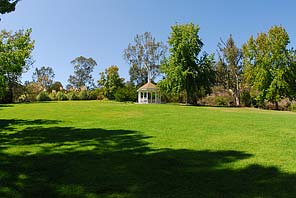
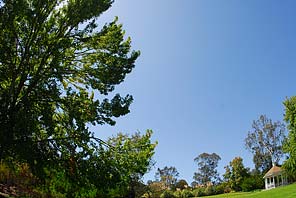
Here are complete images from which crops are taken below at 100% from my D200.
Full image from D200 (DX) |
Full image from D200 (DX) |
 |
 |
Used for center shots below |
Used for corner shots below. |
Here are crops from the center of my 100% D200 images. These complete images would print at 39" (1m) wide if you printed the whole image this wide.
Center crop, f/2.8 |
Center crop, f/4 |
 |
 |
 |
 |
Center crop, f/5.6 |
Center crop, f/8 |
As I said, the center always looks perfect regardless of aperture. Just avoid apertures smaller than f/8 due to diffraction.
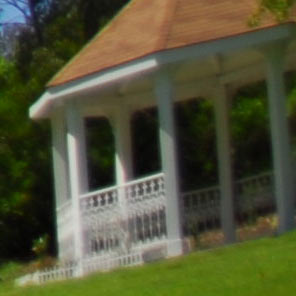
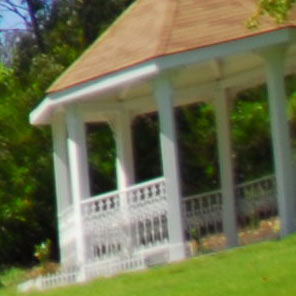
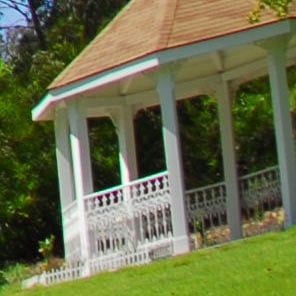
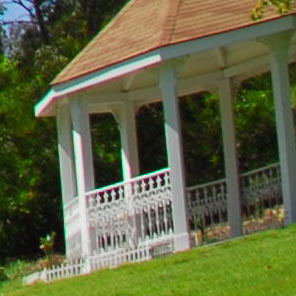
Here are crops from the 100% D200 (DX) images with the gazebo at the corner. These complete images again would print at 39 " (1m) wide if you printed the whole image.
Corner crop, f/2.8 |
Corner crop, f/4 |
 |
 |
 |
 |
Corner crop, f/5.6 |
Corner crop, f/8 |
Yes, the f/2.8 image looks awful this big. Don't shoot the 16mm fisheye at f/2.8 in broad daylight if you're going to make 39" wide prints and look at them as closely as you're looking at this screen. Shoot it at f/5.6 or f/8 and it's perfect. Avoid smaller apertures due to diffraction. You won't need them for depth of field unless you're doing something really crazy.
I don't yet have a D3 FX camera from which to show you examples. The FX camera sees farther to the corners since it's a larger sensor (see crop factor), but the D3 also has less linear resolution, so it ought to look similar.
This looks much better on film because you honestly need a microscope to see things this closely.
If you printed these images from the larger sensor of an FX or 35mm film camera at this same magnification, they would be 59" (1.5m) wide. I doubt anyone would be looking this closely at an image that big, and if they do, shoot at f/5.6 - 8 or buy a Hasselblad fisheye, a Hasselblad body and a Phase One P45 back which costs about 100 times as much as this lens.
Color Fringes
As you an see above, color fringes aren't a serious issue with the 16mm fisheye. It's much better than my 10.5mm fisheye.
There are none on my D3.
Falloff (darkened corners)
On the D3:
Falloff is only noticable at f/2.8; shoot at f/4 and no problem.
If you're looking for it deliberatly by shooitng a blank sky and toggling between images at different apertures, it is much better at f/4, almost gone at f/5.6, and completely gone at f/8.
For normal use, just stop down to f/4 and it's invisible.
On Film:
You're in luck: fisheyes rarely have problems, and likewise, even wide open the corners are as bright as the center.
It's the same as digital; just that with film, I can't flip back and forth among images to see even the slightest invisible falloff as I can on digital.
Ghosts and Flare
It has no ghosts or flare, so feel free to keep the sun in your images. This is a big deal for fisheyes, since half of the time the sun is in your photos.
AF Speed
AF Speed, like most wide lenses, is just about instantaneous. One full turn of the AF screw brings the focus from infinity down to 1.5.'
Construction
Exterior
Metal painted with tough-looking crinkle paint. This includes the front integral hood.Only the aperture ring and lens caps are plastic.
Filter Threads
None.
The rear bayonet is metal.
Focus Ring
Ribbed rubber over what seems to be metal.
Markings
Paint.
Switches
Plastic.
Only one switch, which is the minimum aperture lock used for most modern cameras which control the aperture from the camera body.
Mount
Metal.
Internals
If there's any plastic, I can't see it.
Noises when shaken
Only the most delicate clicking of the diaphragm blades and very slight clunking of the various optical groups which move when focused.
Made in
Japan.
Serial Number
Laser engraved on the bottom of the aperture ring. My Nikon USA lens has its serial number prefixed with "US."
Hand-Held Long Exposures
I easily get sharp results handheld at 1/15, and probably much, much slower, too.
Filters
With its 180 degree front field of view, there are no front or other protective filters available.
The Nikon 16mm comes with a clear bayonet filter on the rear, and three more filters in a small wallet.
Always use one of the filters. If you don't, you'll have focus and corner sharpness problems.
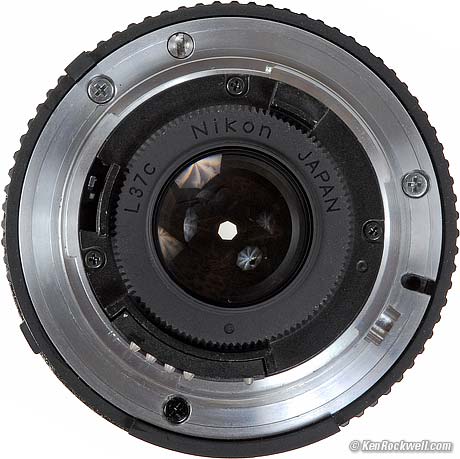
Nikon 16mm rear bayonet filter. (L37c means "clear.")
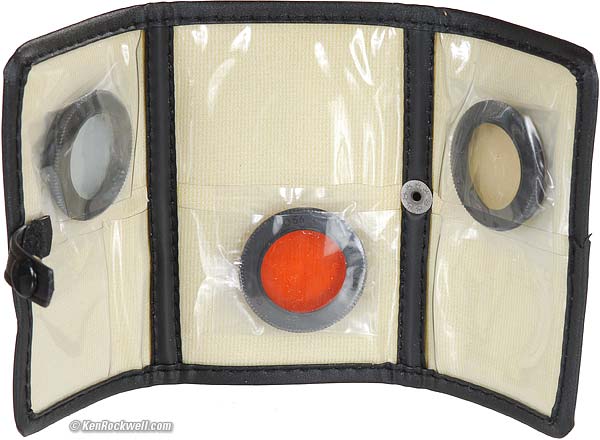
Nikon 16mm f/2.8 standard filter wallet with included B2, O56 and A2 filters.
No one ever uses the filters, so if you buy a used 16mm as I did, the filters are usually still wrapped in plastic inside each section of the wallet.
The L37c is Nikon's name for a UV filter. Use this. (L37 means a 370 nm cutoff for you scientists.)
The A2 is a mild warming (amber) filter. A2 is the European designation for 81A. I would take this along and use it with film. With digital I get the same effect by tricky setting of my white balance.
The B2 is a mild cooling (blueing) filter. I'm not into cooling; I go out of my way to find warm light.
The O56 is an orange filter for getting great clouds with black-and-white film. (O56 means a 560 nm cutoff for you scientists.)
Nikon will be happy to sell you other colors like Y48 (yellow) and R60 (red) at about $36 a pop. Other Nikon ultrawides, like the manual focus 13mm, 15mm and 16mm take these same bayonet filters. The 14mm and 10.5mm DX have a slot for gel filters instead.
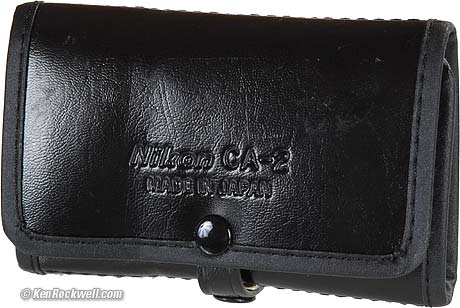
Filter Wallet, snapped closed.
Use with Fisheye Hemi
No problem. The Fisheye Hemi plugin works great, even with crappy film scans. This scan is from my Epson 4990 without even bothering to mount the slide properly.
Roll your mouse over to see before and after.
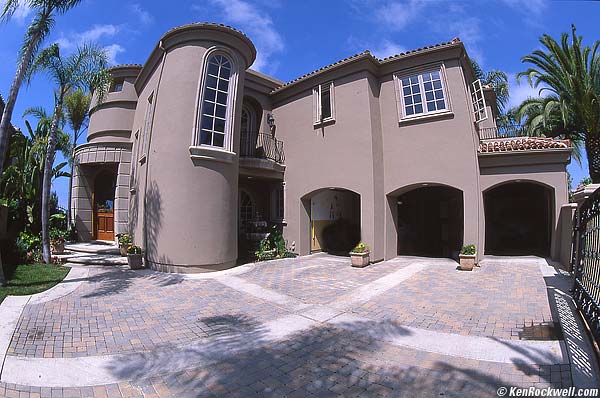
California Resort. Roll mouse over to see after Fisheye Hemi.
My apologies for not holding the camera perfectly steady since I wanted to get the shot before I got thrown out. That's why the verticals aren't perfect in the after photo.
Fisheye Hemi works even better on the D3.
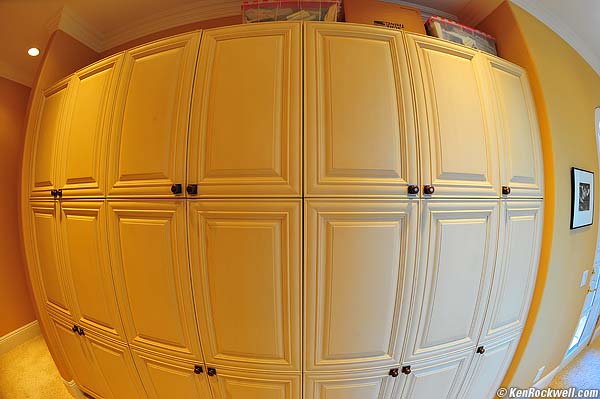
Cabinets at 1 meter (3 feet), before and after the Fisheye Hemi plugin. (roll mouse over.)
Use with Panorama Tools
Brian Caldwell calculated the R, G and B panorama tools coefficients as 0.0295, -0.13, 0, 1.1005 for DX digital SLRs.
For DX digital cameras get the 10.5mm DX fisheye instead, since on DX digital cameras this 16mm fisheye only gives a partial effect.
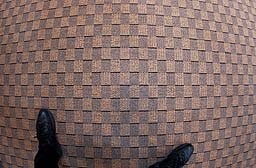
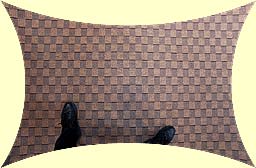
On a DX digital SLR you only get a half fisheye effect. To correct this to rectilinear use Photoshop CS2's lens distortion correction twice, each pass at +100 for distortion and +150 for size. This gives you:
 |
 |
on a DX camera, uncorrected |
corrected. |
The Fisheye Hemi plugin also has a setting optimized for this lens on a DX camera. It's the "Cropped" option.
Lens Caps
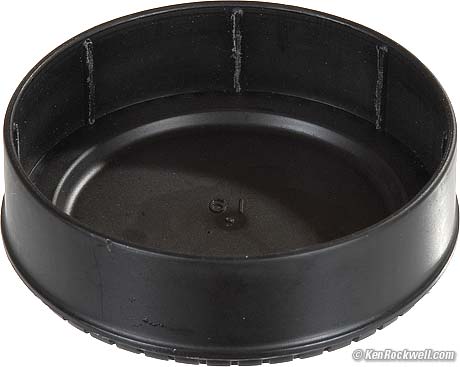
Front Lens Cap, Nikon 16mm Fisheye.
The front cap is a special 61mm inside diameter cap which seems to fit the 10.5mm DX and manual focus 16mm, too.
Don't loose the front lens cap. Nikon will hit you up for $50 last time I looked to replace one.
When I bought a new manual focus 16mm in 1984 it came with a nice, tight professional metal cap. Today Nikon has replaced that with a cheap piece of plastic that neither fits well nor keeps out dust, and they still want $50 for it.
Keep a keen eye: I found a plastic one in a junk box at Samy's in LA and it only cost me a dollar.
I sometimes use little pieces of self-stick felt on the inside of the cap to help them stay on the lens better.
The rear cap is the standard Nikon LF-1 rear cap.
Ease of Mounting
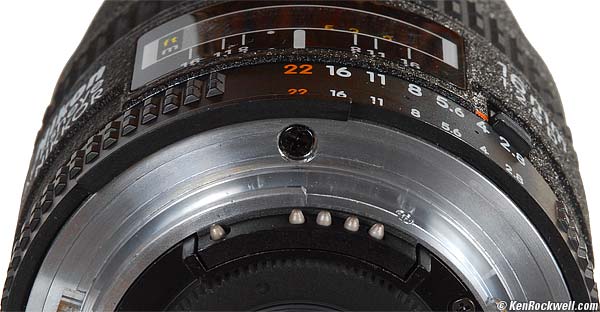
Lens mount and CPU contacts, Nikon 16mm f/2.8.
It's easy. Nikon even paints a screw on the lens black to help us find the mounting index in the dark.
Recommendations top
Intro Specs Math Performance Recommendations
Be sure if you buy a used one that it has the rear L37c (or L1Bc) bayonet filter attached. If not, the 16mm fisheye won't focus properly, and it will lack corner sharpness when you have to tweak the focus to get focus without the filter. Also get the filter wallet and the three other standard filters.
I find this AF version much better than the earlier manual focus versions, which have a similar but completely different non-CRC design. Since this AF version is also fully AI-s compatible and manually focuses very well, I'd use this AF version for manual focus cameras instead of the older manual version.
Forget this 16mm fisheye for DX DSLRs. For DX, get the 10.5mm DX instead. This 16mm is for big-boys with FX digital cameras and 35mm film.
If you use this lens on a Nikon to Canon adapter, be sure it's a good one and that infinity focuses when set to infinity. If not, the CRC system gets confused and really destroys the corner sharpness. On Canon, just get the excellent Canon 15mm fisheye which costs $200 less.
Don't worry about getting tired of it. I've sold every one of the three new fisheye lenses I've bought in my lifetime for more than paid for them when I got tired of them in the days before Photoshop plugins. You really can't go wrong if you buy well and tire of it.
If you find this review helpfull, know that my only major source of support is when you use these links and get yours at Adorama, at Amazon or used at eBay (see How to Win at eBay), but I receive nothing for my efforts if you buy elsewhere. I'm not NPR; I get no government hand-outs and run no pledge drives to support my research, so please always use any of these links for the best prices and service whenever you get anything. Thanks for helping me help you! Ken.
Help me help you top
I support my growing family through this website, as crazy as it might seem.
The biggest help is when you use any of these links when you get anything, regardless of the country in which you live. It costs you nothing, and is this site's, and thus my family's, biggest source of support. These places have the best prices and service, which is why I've used them since before this website existed. I recommend them all personally.
If you find this page as helpful as a book you might have had to buy or a workshop you may have had to take, feel free to help me continue helping everyone.
If you've gotten your gear through one of my links or helped otherwise, you're family. It's great people like you who allow me to keep adding to this site full-time. Thanks!
If you haven't helped yet, please do, and consider helping me with a gift of $5.00.
As this page is copyrighted and formally registered, it is unlawful to make copies, especially in the form of printouts for personal use. If you wish to make a printout for personal use, you are granted one-time permission only if you PayPal me $5.00 per printout or part thereof. Thank you!
Thanks for reading!
Mr. & Mrs. Ken Rockwell, Ryan and Katie.
Home Donate New Search Gallery Reviews How-To Books Links Workshops About Contact