Home Donate New Search Gallery Reviews How-To Books Links Workshops About Contact
Mamiya
7 N 43mm f/4.5 L
©
2003-2012 KenRockwell.com
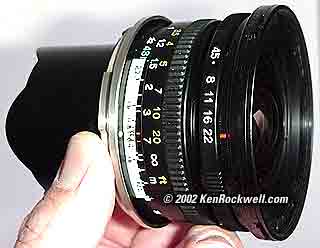
Mamiya 43mm f/4.5 without hood included. Note that half the lens comes out of the back of the mount. . This free website's biggest source of support is when you use these links, especially this link to it new at Adorama or used at eBay (see How to Win at eBay), when you get anything, regardless of the country in which you live. Thanks! Ken.
June 2012, March 2010, 2003 Mamiya Reviews Nikon Canon LEICA All Reviews
Sample Image:

Torino, Italy, October 2003. (10,000 x 8,000 pixels, shot on Mamiya 7 on Velvia.)
Here's a reduced-size version of the scan, from my cheap Minolta Multi-Pro scanner.
This reduced-size version is only 10,000 x 8,000 pixels (80 megapixels) and greatly JPG compressed so you can see it over the internet. My original scan is 150 MP and devoid of the artifacts in the file I share here, and includes even more image area that I cropped-off.

Introduction top
Intro Specs Performance Recommendations

Adorama pays top dollar for your used gear.
I use Adorama, Amazon, eBay, Ritz, B&H, Calumet, J&R and ScanCafe. I can't vouch for ads below.
|


This spectacular lens is the most perfect lens I have ever used.
It appears to be a direct copy of the Zeiss Biogon. The cross sectional diagrams are the same. It also has the same unusual freedom from internal mechanical vignetting unique to the Biogon, has the same speed (f/4.5) and angle of view.
Even better, the Mamiya 43mm is a copy of the better, original 10 element Biogon first used in the 75mm f/4.5 lens for view cameras, not the simpler 8 element version used in the far more expensive Hasselblad SWC.
This is a better design than the simplified 8 element design used in the Hasselblad SWC. The 43mm is multicoated, the earliest SWCs are not. The Mamiya 7 has a rangefinder for precise focusing, the SWC requires you focus by guessing or measuring the distance with a tape measure or separate rangefinder!
This works far better than the SWC I used to own, and is sharper, too. I have compared them directly and have the film to prove it
The need for an external viewfinder is a pain. You need to focus and meter looking through one hole, and compose looking through another. This is better than the SWC because the SWC does not have any meter or even anyway to focus other than by guessing the distance.
Specifications top
Intro Specs Performance Recommendations
67mm filter
10 elements, 6 groups.
1.7" (42mm) around by 2.8" (72mm) long.
14 oz. (390 g)
Focuses to 1 meter or 3'
Five-bladed diaphragm stopping down to f/22.
Performance top
Intro Specs Performance Recommendations
Sharpness
I already said that the 43mm is one of the world's most perfect lenses. The 43mm is intensely sharp at every aperture and, like most lenses, limited only by diffraction at f/22. Use it with gusto at f/4.5 or any aperture!
Distortion
None at any distance.
Falloff of Illumination
Like all other view-camera lenses, the 43mm has some minor light falloff.
People who only use SLR lenses may not be used to this. Falloff is the tiny price we pay for superior sharpness and complete freedom from distortion. Falloff easily can be corrected with a center filter. Unsharpness and distortion cannot.
The 43mm does not require any center filters, unless you are photographing blank walls AND want the whole wall to be the same shade.
The falloff of the 43mm is invisible for photographs of real subjects worth photographing.
In fact, the falloff can add drama and keep the viewers attention directed towards the center of the image. Ansel Adams took great pains to introduce this effect deliberately as "edge burning." See his book "The Print" for details.
I do have a center filter for a different lens I use on my view camera. It does improve scientific photos of walls, but to be honest has little visible effect on real photos other than to lose 2 stops of speed and make me have to screw with screwing the filter on and off to compose. Forget the center filter. Real architectural photographers don't use center filters either. If they are worried about this they just adjust their lighting accordingly.
I would use this 67mm Schneider center filter #3 you can get here if I worried about this. Schneider says add 1.5 stops; with this filter I add two full stops. Just set your exposure compensation to +2 with the filter and shoot away. Be sure that the filter does not cover the rangefinder window through which the in-camera meter reads if you use the filter. As I mentioned, I don't use this. Sell me yours if you buy one and get tired of it. No, you probably cannot use the hood at the same time as the center filter. The center filter is much bigger than 67mm.
Ghosts
None. Point this straight into the sun and there is no ghosting, even when I've deliberately tried to induce it.
The old, single coated Hasselblad SWC I had was worse.
Viewfinder
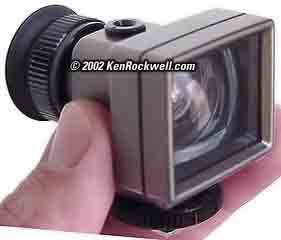
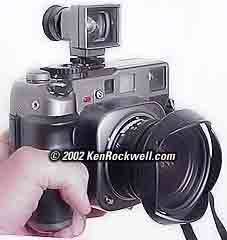
The level is very accurate, unlike most of the panoramic cameras I have used.
Having to use an external finder sucks. Not only is it a pain to have to look in two different holes, but you have to put it on and take it off when putting the camera away in most camera cases. You still focus and set exposure through the regular hole and then have to compose through the external finder. You also lose your hot shoe if you need it for fill flash. I never use fill flash with my 43mm lens. If you do, look here for a two shoe adaptor!
The finder has a focus adjustment to compensate for your eyesight. I have to readjust it every time I put it to my eye since it gets rotated just by carrying the camera around . Also my rubber eye hood fell off from normal wear.
What do the stupid letters N and L mean in the lens designation?
Nothing. Just marketing poof.
Recommendations top
Intro Specs Performance Recommendations
If you can afford it, buy one.
If you can't, then spend half as much for a 75mm lens for a 4x5 camera and get results twice as sharp, plus tilt and shifts at no extra charge!
Don't bother with the Hasselblad SWC unless you already are in the Hasselblad system and want the interchangeable backs, or prefer the 6x6 format.
Watch out when mounting this into the camera. You easily can damage the rangefinder roller follower if you hit it by accident as you insert the rear of the lens deep into the camera.
It takes a special rear cap unique to the 43mm. Make sure to buy a spare in case you loose it out in the field. OK, maybe the 50mm or 65mm lenses take this cap, too, I just don't own one of those. I do know the 80 and 150 take different caps.
See this page for information on the special depth-of-field scale I attached for optimum sharpness.
Help me help you top
I support my growing family through this website, as crazy as it might seem.
The biggest help is when you use any of these links to Adorama, Amazon, eBay, Ritz, Calumet, J&R and ScanCafe when you get anything, regardless of the country in which you live. It costs you nothing, and is this site's, and thus my family's, biggest source of support. These places have the best prices and service, which is why I've used them since before this website existed. I recommend them all personally.
If you find this page as helpful as a book you might have had to buy or a workshop you may have had to take, feel free to help me continue helping everyone.
If you've gotten your gear through one of my links or helped otherwise, you're family. It's great people like you who allow me to keep adding to this site full-time. Thanks!
If you haven't helped yet, please do, and consider helping me with a gift of $5.00.
As this page is copyrighted and formally registered, it is unlawful to make copies, especially in the form of printouts for personal use. If you wish to make a printout for personal use, you are granted one-time permission only if you PayPal me $5.00 per printout or part thereof. Thank you!
Thanks for reading!
Mr. & Mrs. Ken Rockwell, Ryan and Katie.
Home Donate New Search Gallery Reviews How-To Books Links Workshops About Contact